Page 1
SOULE SALUTE IRON AND STEEL PRODUCTS SS CO VOL. I, NO. 6 Published Regularly by and for Soule Steel War Workers OCTOBER, 1943
THERE GOES LIGHTER XXX!
LAUNCHING OF THE "SPIRIT OF SOULÉ STEEL" SEEN BY WORKERS AND THEIR FAMILIES
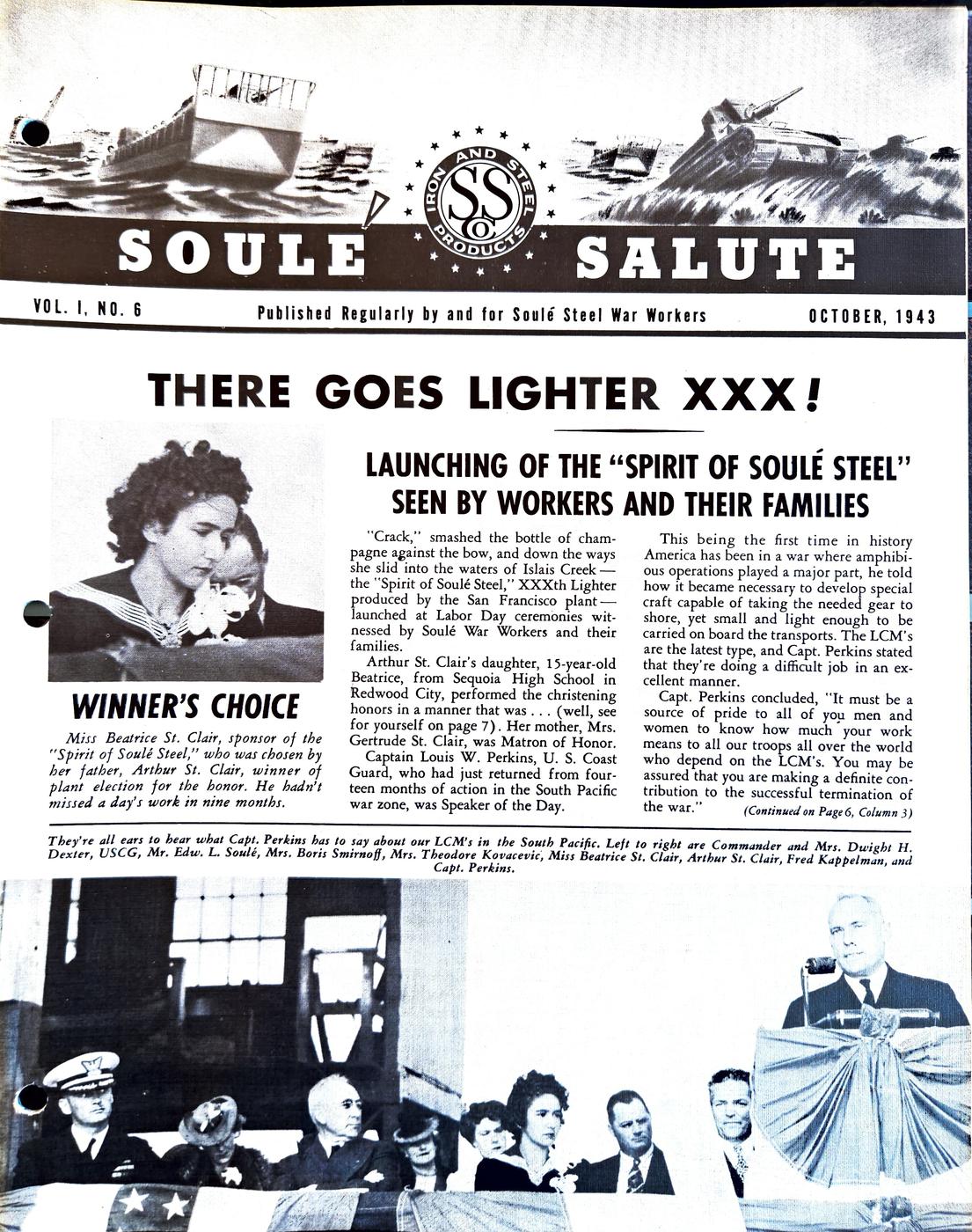
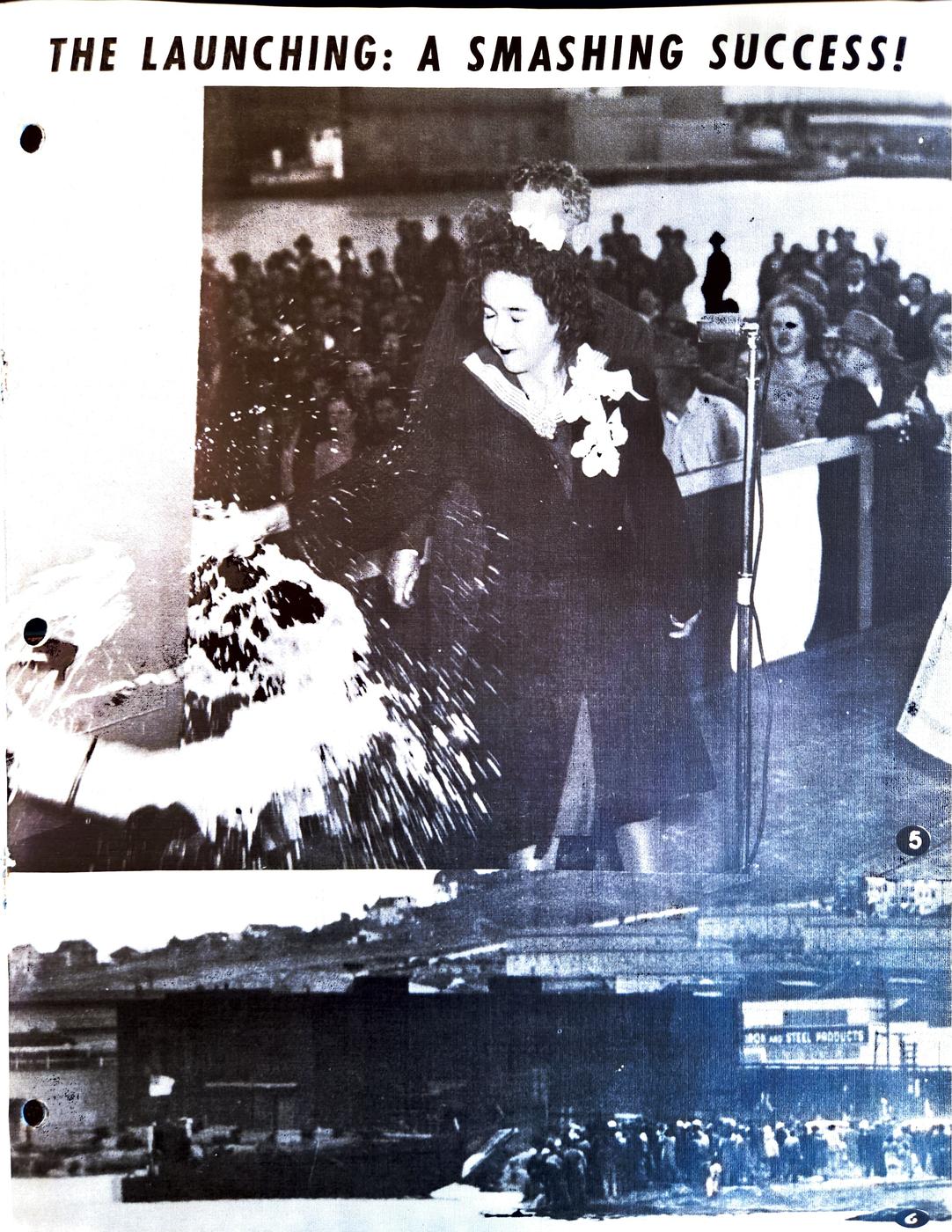
"Crack," smashed the bottle of champagne against the bow, and down the ways she slid into the waters of Islais Creek — the "Spirit of Soulé Steel," XXXth Lighter produced by the San Francisco plant — launched at Labor Day ceremonies witnessed by Soule War Workers and their families.
Arthur St. Clair's daughter, 15-year-old Beatrice, from Sequoia High School in Redwood City, performed the christening honors in a manner that was . . . (well, see for yourself on page 7). Her mother, Mrs. Gertrude St. Clair, was Matron of Honor.
Captain Louis W. Perkins, U. S. Coast Guard, who had just returned from fourteen months of action in the South Pacific war zone, was Speaker of the Day.
This being the first time in history America has been in a war where amphibious operations played a major part, he told how it became necessary to develop special craft capable of taking the needed gear to shore, yet small and light enough to be carried on board the transports. The LCM's are the latest type, and Capt. Perkins stated that they're doing a difficult job in an excellent manner.
Capt. Perkins concluded, "It must be a source of pride to all of you men and women to know how much your work means to all our troops all over the world who depend on the LCM's. You may be assured that you are making a definite contribution to the successful termination of the war." (Continued on Page 6, Column 3)
WINNER'S CHOICE
Miss Beatrice St. Clair, sponsor of the "Spirit of Soulé Steel," who was chosen by her father, Arthur St. Clair, winner of plant election for the honor. He hadn't missed a day's work in nine months.
*Photo: They're all ears to hear what Capt. Perkins has to say about our LCM's in the South Pacific. Left to right are Commander and Mrs. Dwight H. Dexter, USCG, Mr. Edw. L. Soule, Mrs. Boris Smirnoff, Mrs. Theodore Kovacevic, Miss Beatrice St. Clair, Arthur St. Clair, Fred Kappelman, and Capt. Perkins.*
Page 2
Soule' Salute
**SOULE SALUTE**
Vol. I No. 6 Published Regularly by and for Soule Steel War Workers
Staff: Managing Editor . . . George Cobb Los Angeles Editor . . . Bill Irwin Portland Editor . . . . . Les Poole San Francisco Editor, Fred Kappelman
Associate Editors: Los Angeles Art Carter Eddie Dugan Ted Jones Charles La Fevre Dorothy Olsen George Thomas
Portland James Moody La Voice (Buck) Portwood
San Francisco Art Eichorn Paul Graham Paul Hyner Gabe Kureon Lena Peters Joe Romero
Margie Victor (Cartoonist)
Torrance A. M. Dowell
MAN OF THE MIKE
It seems there is another reason for that big smile of Fred Kappelman's, 22 year man with Soule Steel, besides his success as Master of Ceremonies at the Lighter Launching.
After the bottle of champagne was broken on the bow of the XXXth Lighter, the M.C. was seen applying a handkerchief to his nose quite often. At first it was thought the reaction of his emotions was the cause, but the truth will out.
So that the wire holding the cork in the bottle of champagne would not hurt the hand of the Sponsor, Fred wrapped his handkerchief about the cork and neck of the bottle. When the bottle broke, the handkerchief became saturated with champagne. Fred tried wringing it out, but it evaporated at once.
However, the fragrance, like a memory, lingered on. Wonder if that's why the handkerchief was used so much at the launching?
What Are You Doing?
By Art Driver
Three men, all doing the same class of work on the same job, were asked, "What are you doing?" One man replied, "Wheeling cement." The second replied, "Earning $10 a day." The third answered, "Building a cathedral."
Each man was doing the same thing but each had a different attitude toward his work in relation to the whole job. Every shovelful of cement is essential to the successful completion of the building, but the thought in their minds denoted the kind of service they were rendering.
Every inch of welding we lay on . . . every nut we tighten . . . or every column of figures we add is essential to the successful prosecution of our war effort. That effort consists of removing all possibility of domination by the war lords of Japan and Germany . . . and the subsequent establishment of the Four Freedoms.
For the Boys Over There
It says and we quote: "The Sunset Post No. 400 of the American Legion wishes to express their sincere appreciation for the wonderful response the employees of the Soule Steel Company gave to the 'Cigarette Drive.' As advertised and explained, all proceeds are to be used for the purchase of cigarettes at 5 cents per pack to be distributed among our Soldiers and Sailors overseas."
So reads a letter from Charles Ubigau, Engineer in the San Francisco Reinforcing Department, just elected Commander of American Legion Sunset Post No. 400. It backs up the popular contention that the boys at Soule are always ready to "kick through" for the boys overseas.
MEN -MAN-OF-THE-MONTH
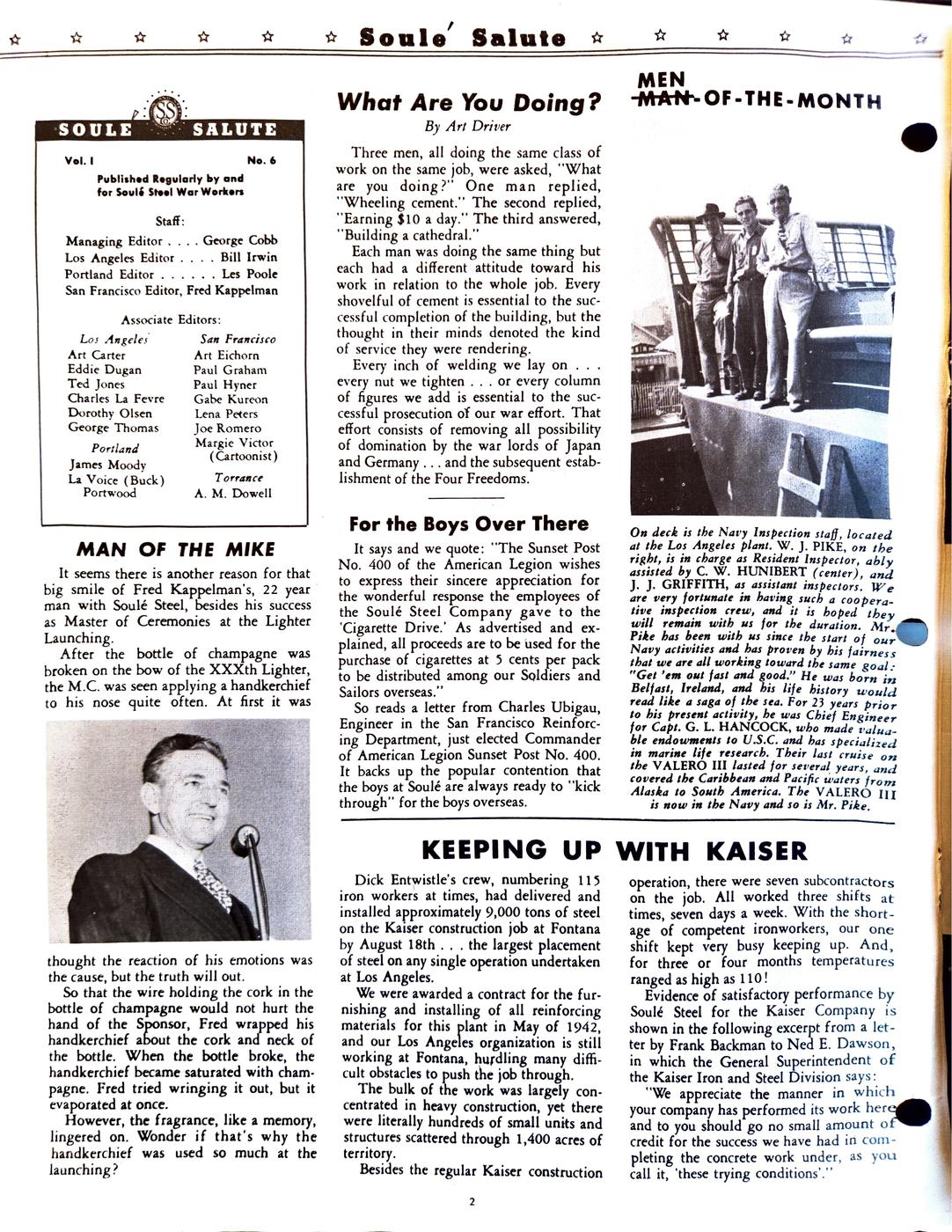
Photo: On deck is the Navy Inspection staff, located at the Los Angeles plant. W. J. PIKE, on the right, is in charge as Resident Inspector, ably assisted by C. W. HUNIBERT (center), and J. J. GRIFFITH, as assistant inspectors. We are very fortunate in having such a cooperative inspection crew, and it is hoped they will remain with us for the duration. Mr. Pike has been with us since the start of our Navy activities and has proven by his fairness that we are all working toward the same goal: "Get 'em out fast and good." He was born in Belfast, Ireland, and his life history would read like a saga of the sea. For 23 years prior to his present activity, he was Chief Engineer for Capt. G. L. HANCOCK, who made valuable endowments to U.S.C. and has specialized in marine life research. Their last cruise on the VALERO III lasted for several years, and covered the Caribbean and Pacific waters from Alaska to South America. The VALERO III is now in the Navy and so is Mr. Pike.
KEEPING UP WITH KAISER
Dick Entwistle's crew, numbering 115 iron workers at times, had delivered and installed approximately 9,000 tons of steel on the Kaiser construction job at Fontana by August 18th . . . the largest placement of steel on any single operation undertaken at Los Angeles.
We were awarded a contract for the furnishing and installing of all reinforcing materials for this plant in May of 1942, and our Los Angeles organization is still working at Fontana, hurdling many difficult obstacles to push the job through.
The bulk of the work was largely concentrated in heavy construction, yet there were literally hundreds of small units and structures scattered through 1,400 acres of territory.
Besides the regular Kaiser construction operation, there were seven subcontractors on the job. All worked three shifts at times, seven days a week. With the shortage of competent ironworkers, our one shift kept very busy keeping up. And, for three or four months temperatures ranged as high as 110!
Evidence of satisfactory performance by Soule Steel for the Kaiser Company is shown in the following excerpt from a letter by Frank Backman to Ned E. Dawson, in which the General Superintendent of the Kaiser Iron and Steel Division says:
"We appreciate the manner in which your company has performed its work here and to you should go no small amount of credit for the success we have had in completing the concrete work under, as you call it, 'these trying conditions'."
Page 3
Soule' Salute
BUILD 'EM, MISTER - QUICKLY! By Lt. Agis J. Mihalekis, U. S. Army Camp Roberts, California (On leave from Soule Steel Co.)
The soldier does his job in the foxholes, handling his tools with inestimable care, fondling them during a lull in the fire of the enemy as if they were life itself — because they are exactly that.
Life in the field of combat does not come in the form of pulse beats. Instead, life is in the form of a machine gun whose sights will not slip on the initial laying of the gun; life lies in the precision with which the soldier's weapons are built — and each error in its construction is a whisper of death; life lies in the number of these weapons the soldier has at his hand; a section of machine guns prolong that life, where a single machine gun would shorten it proportionately.
The War Worker is important to that boy in the fox-hole; the War Worker is the essential factor which delivers these "pulse-beats of life" to the boy who fights.
Build them, mister; build those barges! Build them as quickly as you can and more quickly than you are. Spur yourself to the job of providing pulse-beats for that man who is fighting with the tools you build. Work until your capacity for work can stand no more. He is doing no less, and never with a grimace, unless it be from pain and anguish dealt him by an enemy whose war workers have turned out more than you have!
PROVIDE HIM WITH THE PULSE-BEATS SO THAT HE CAN FIGHT, SO HE CAN WORK FOR YOU AS YOU ARE WORKING FOR HIM! IT WILL TAKE BOTH YOU AND THAT MAN IN THE FOXHOLE TO WIN THIS WAR. NEITHER OF YOU CAN DO IT ALONE! BUILD 'EM, MISTER, BUILD 'EM — QUICKLY!
STUPORMAN
MEET SOME WOMEN WELDERS, FOLKS By Lena Peters
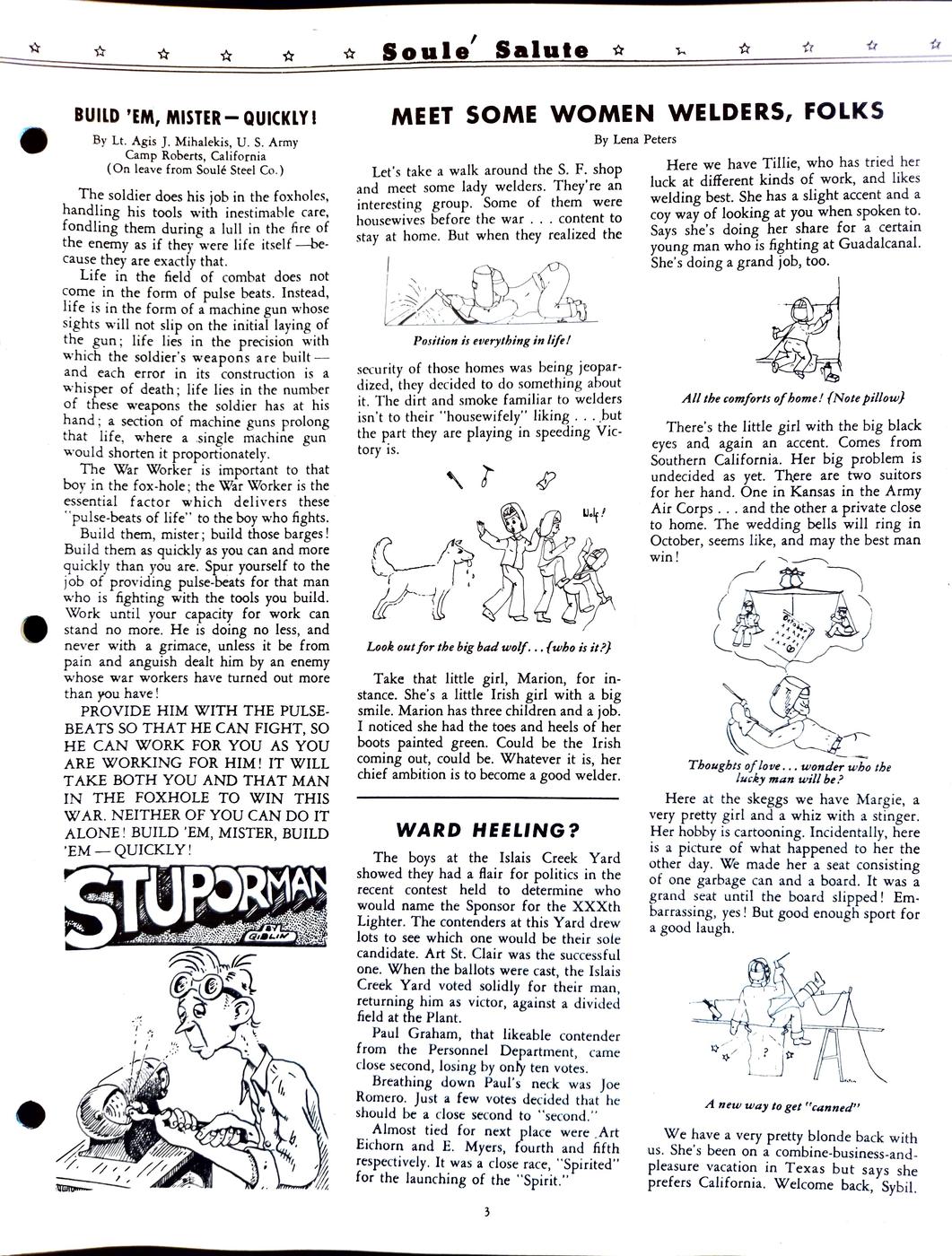
Let's take a walk around the S. F. shop and meet some lady welders. They're an interesting group. Some of them were housewives before the war . . . content to stay at home. But when they realized the
Photo: Position is everything in life!
security of those homes was being jeopardized, they decided to do something about it. The dirt and smoke familiar to welders isn't to their "housewifely" liking . . . but the part they are playing in speeding Victory is.
Photo: Look out for the big bad wolf . . . {who is it?}
Take that little girl, Marion, for instance. She's a little Irish girl with a big smile. Marion has three children and a job. I noticed she had the toes and heels of her boots painted green. Could be the Irish coming out, could be. Whatever it is, her chief ambition is to become a good welder.
WARD HEELING?
The boys at the Islais Creek Yard showed they had a flair for politics in the recent contest held to determine who would name the Sponsor for the XXXth Lighter. The contenders at this Yard drew lots to see which one would be their sole candidate. Art St. Clair was the successful one. When the ballots were cast, the Islais Creek Yard voted solidly for their man, returning him as victor, against a divided field at the Plant.
Paul Graham, that likeable contender from the Personnel Department, came close second, losing by only ten votes.
Breathing down Paul's neck was Joe Romero. Just a few votes decided that he should be a close second to "second."
Almost tied for next place were Art Eichorn and E. Myers, fourth and fifth respectively. It was a close race, "Spirited" for the launching of the "Spirit."
Here we have Tillie, who has tried her luck at different kinds of work, and likes welding best. She has a slight accent and a coy way of looking at you when spoken to. Says she's doing her share for a certain young man who is fighting at Guadalcanal. She's doing a grand job, too.
Photo: All the comforts of home! {Note pillow}
There's the little girl with the big black eyes and again an accent. Comes from Southern California. Her big problem is undecided as yet. There are two suitors for her hand. One in Kansas in the Army Air Corps . . . and the other a private close to home. The wedding bells will ring in October, seems like, and may the best man win!
Photo: Thoughts of love . . . wonder who the lucky man will be?
Here at the skeggs we have Margie, a very pretty girl and a whiz with a stinger. Her hobby is cartooning. Incidentally, here is a picture of what happened to her the other day. We made her a seat consisting of one garbage can and a board. It was a grand seat until the board slipped! Embarrassing, yes! But good enough sport for a good laugh.
Photo: A new way to get "canned"
We have a very pretty blonde back with us. She's been on a combine-business-and-pleasure vacation in Texas but says she prefers California. Welcome back, Sybil.
Page 4
☆ ☆ ☆ ☆ ☆ Soule' Salute ☆ ☆ ☆ ☆ ☆
MOVIES SALUTE SOULÉ!
Where Were You When the Brains Were Passed Out?
$$$ IDEAS PAY OFF $$$
How can we know you've got a lot of bright ideas if you don't let us know? Write those sparkling gems down and put them in the suggestion box. They pay off, you know.
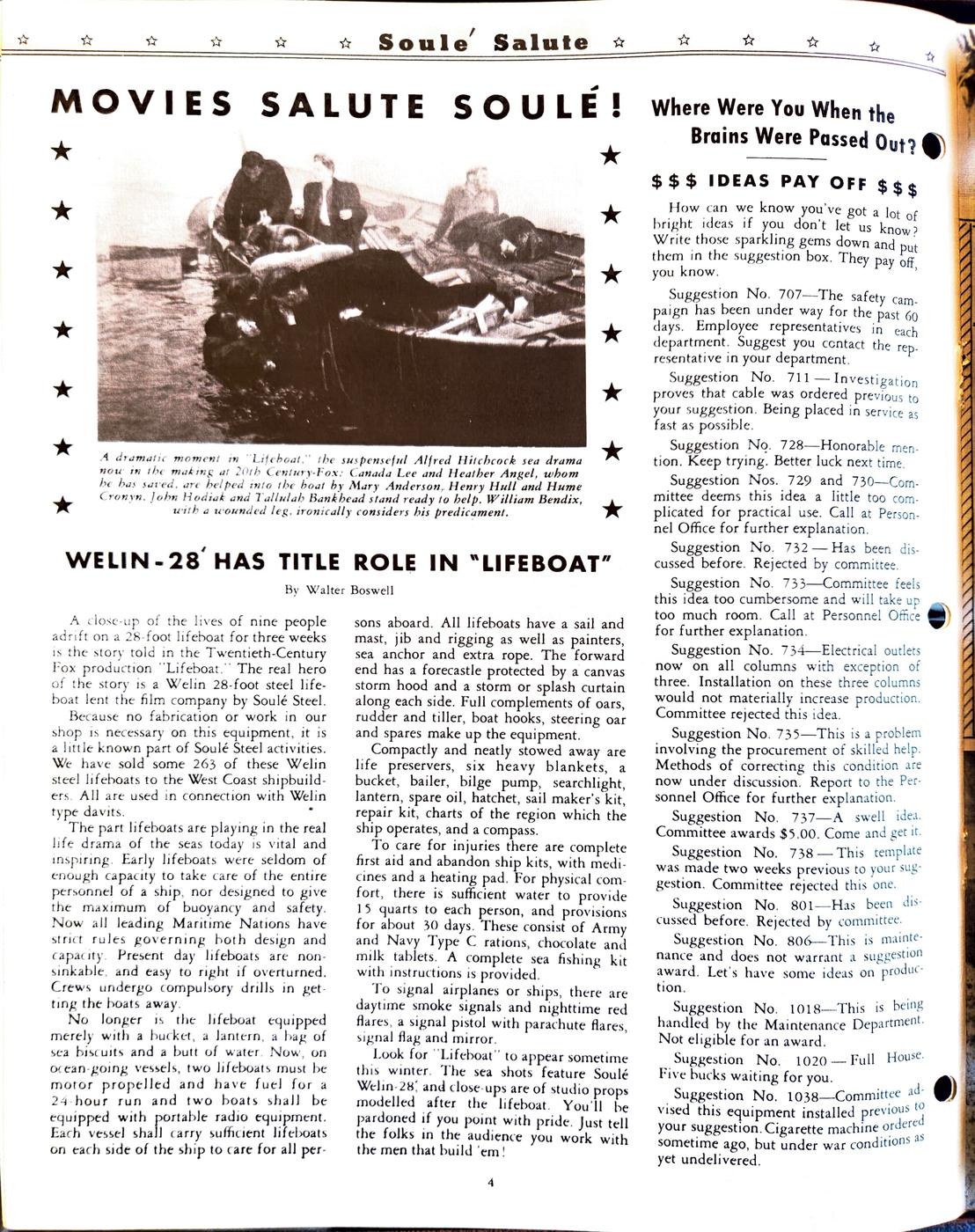
*A dramatic moment in "Lifeboat," the suspenseful Alfred Hitchcock sea drama now in the making at 20th Century-Fox: Canada Lee and Heather Angel, whom he has saved, are helped into the boat by Mary Anderson, Henry Hull and Hume Cronyn. John Hodiak and Tallulah Bankhead stand ready to help. William Bendix, with a wounded leg, ironically considers his predicament.*
WELIN-28' HAS TITLE ROLE IN "LIFEBOAT"
By Walter Boswell
A close-up of the lives of nine people adrift on a 28-foot lifeboat for three weeks is the story told in the Twentieth-Century Fox production "Lifeboat." The real hero of the story is a Welin 28-foot steel lifeboat lent the film company by Soule Steel.
Because no fabrication or work in our shop is necessary on this equipment, it is a little known part of Soule Steel activities. We have sold some 263 of these Welin steel lifeboats to the West Coast shipbuilders. All are used in connection with Welin type davits.
The part lifeboats are playing in the real life drama of the seas today is vital and inspiring. Early lifeboats were seldom of enough capacity to take care of the entire personnel of a ship, nor designed to give the maximum of buoyancy and safety. Now all leading Maritime Nations have strict rules governing both design and capacity. Present day lifeboats are non-sinkable, and easy to right if overturned. Crews undergo compulsory drills in getting the boats away.
No longer is the lifeboat equipped merely with a bucket, a lantern, a bag of sea biscuits and a butt of water. Now, on ocean-going vessels, two lifeboats must be motor propelled and have fuel for a 24-hour run and two boats shall be equipped with portable radio equipment. Each vessel shall carry sufficient lifeboats on each side of the ship to care for all persons aboard. All lifeboats have a sail and mast, jib and rigging as well as painters, sea anchor and extra rope. The forward end has a forecastle protected by a canvas storm hood and a storm or splash curtain along each side. Full complements of oars, rudder and tiller, boat hooks, steering oar and spares make up the equipment.
Compactly and neatly stowed away are life preservers, six heavy blankets, a bucket, bailer, bilge pump, searchlight, lantern, spare oil, hatchet, sail maker's kit, repair kit, charts of the region which the ship operates, and a compass.
To care for injuries there are complete first aid and abandon ship kits, with medicines and a heating pad. For physical comfort, there is sufficient water to provide 15 quarts to each person, and provisions for about 30 days. These consist of Army and Navy Type C rations, chocolate and milk tablets. A complete sea fishing kit with instructions is provided.
To signal airplanes or ships, there are daytime smoke signals and nighttime red flares, a signal pistol with parachute flares, signal flag and mirror.
Look for "Lifeboat" to appear sometime this winter. The sea shots feature Soule Welin-28', and close-ups are of studio props modelled after the lifeboat. You'll be pardoned if you point with pride. Just tell the folks in the audience you work with the men that build 'em!
Suggestion No. 707—The safety campaign has been under way for the past 60 days. Employee representatives in each department. Suggest you contact the representative in your department.
Suggestion No. 711 — Investigation proves that cable was ordered previous to your suggestion. Being placed in service as fast as possible.
Suggestion No. 728—Honorable mention. Keep trying. Better luck next time.
Suggestion Nos. 729 and 730—Committee deems this idea a little too complicated for practical use. Call at Personnel Office for further explanation.
Suggestion No. 732 — Has been discussed before. Rejected by committee.
Suggestion No. 733—Committee feels this idea too cumbersome and will take up too much room. Call at Personnel Office for further explanation.
Suggestion No. 734—Electrical outlets now on all columns with exception of three. Installation on these three columns would not materially increase production. Committee rejected this idea.
Suggestion No. 735—This is a problem involving the procurement of skilled help. Methods of correcting this condition are now under discussion. Report to the Personnel Office for further explanation.
Suggestion No. 737—A swell idea. Committee awards $5.00. Come and get it.
Suggestion No. 738 — This template was made two weeks previous to your suggestion. Committee rejected this one.
Suggestion No. 801—Has been discussed before. Rejected by committee.
Suggestion No. 806—This is maintenance and does not warrant a suggestion award. Let's have some ideas on production.
Suggestion No. 1018—This is being handled by the Maintenance Department. Not eligible for an award.
Suggestion No. 1020 — Full House. Five bucks waiting for you.
Suggestion No. 1038—Committee advised this equipment installed previous to your suggestion. Cigarette machine ordered sometime ago, but under war conditions as yet undelivered.
Page 5
Soule' Salute
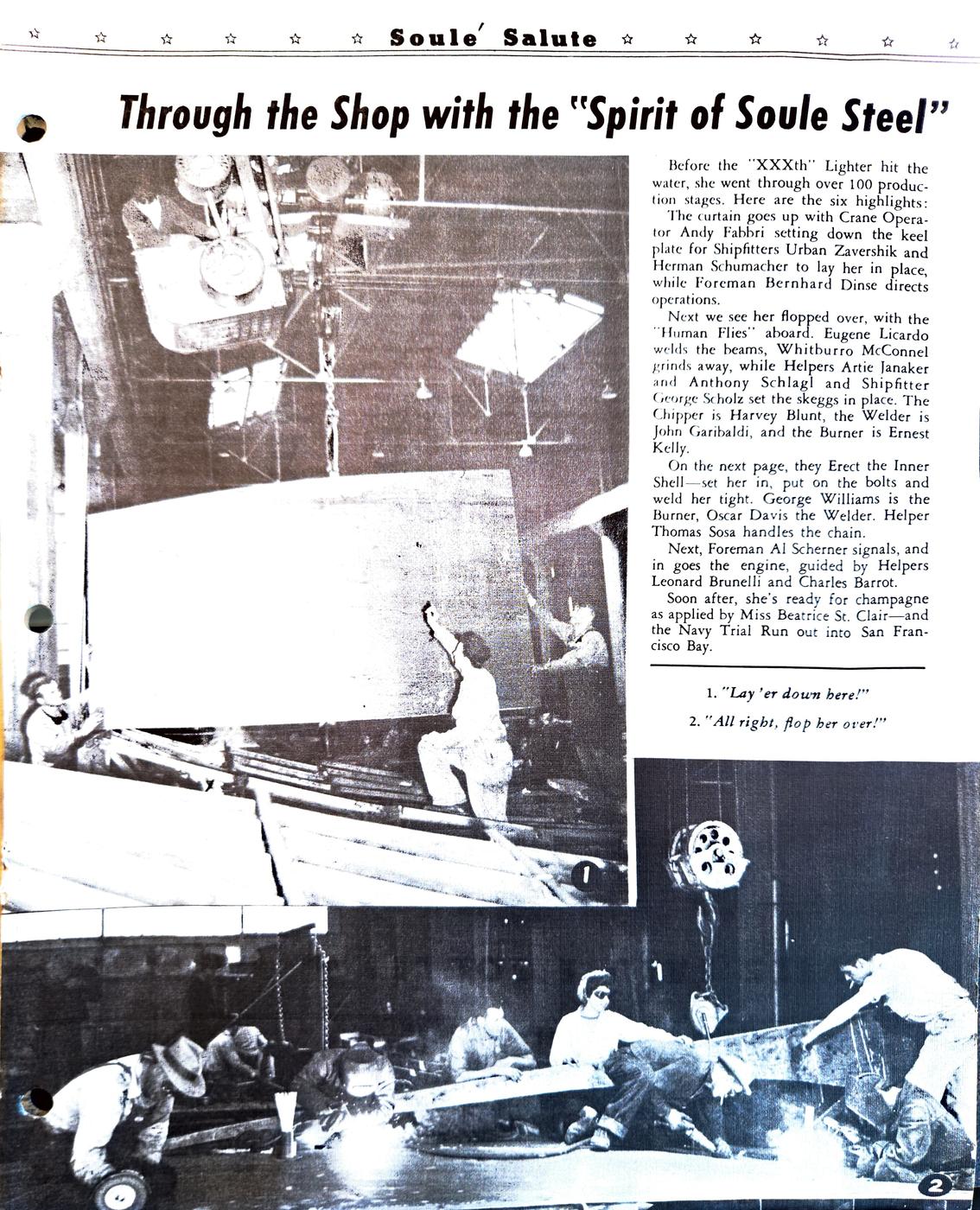
Through the Shop with the "Spirit of Soule Steel"
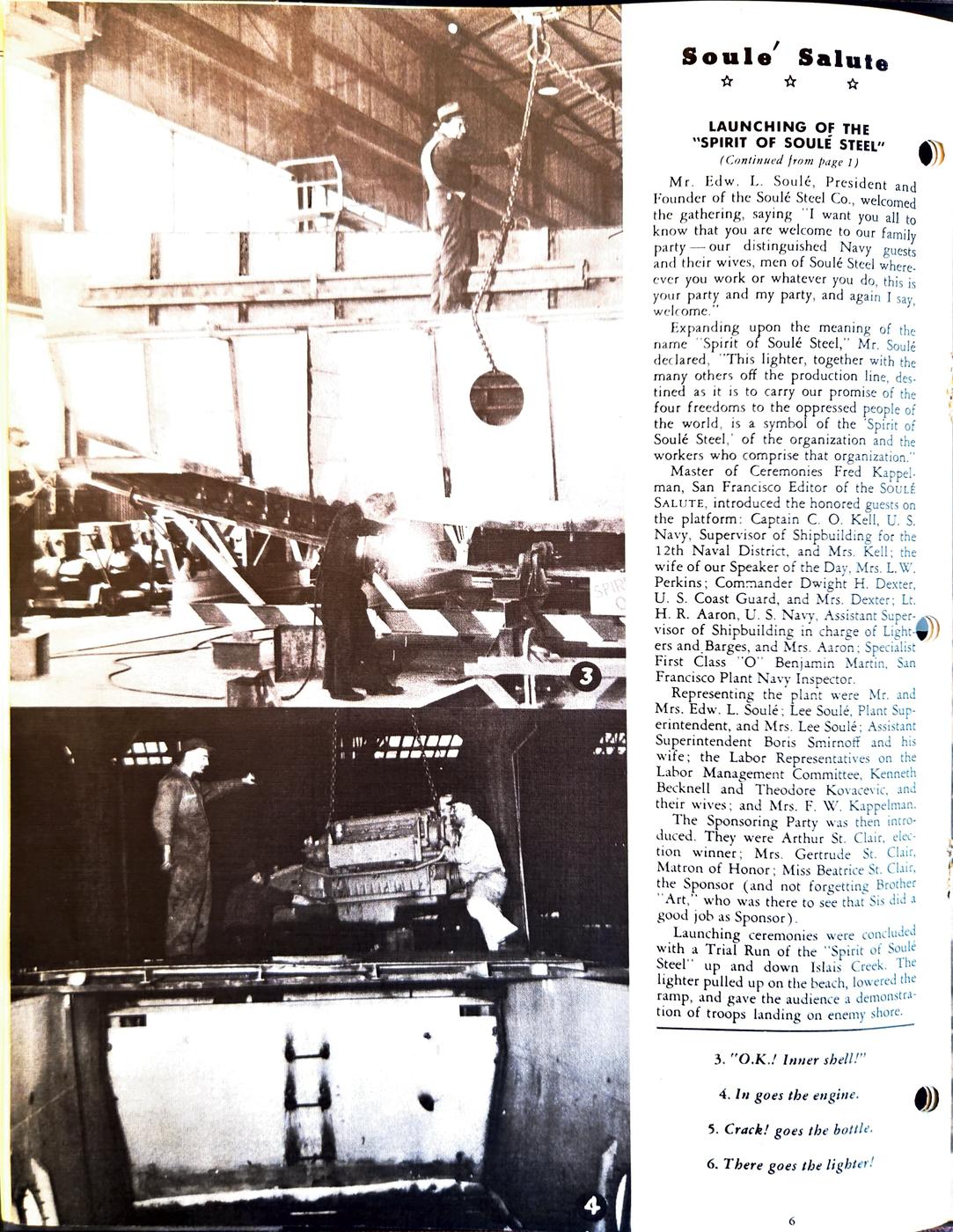
Before the "XXXth" Lighter hit the water, she went through over 100 production stages. Here are the six highlights: The curtain goes up with Crane Operator Andy Fabbri setting down the keel plate for Shipfitters Urban Zavershik and Herman Schumacher to lay her in place, while Foreman Bernhard Dinse directs operations. Next we see her flopped over, with the "Human Flies" aboard. Eugene Licardo welds the beams, Whitburro McConnel grinds away, while Helpers Artie Janaker and Anthony Schagtl and Shipfitter George Scholz set the skeggs in place. The Chipper is Harvey Blunt, the Welder is John Garibaldi, and the Burner is Ernest Kelly. On the next page, they Erect the Inner Shell—set her in, put on the bolts and weld her tight. George Williams is the Burner, Oscar Davis the Welder. Helper Thomas Sosa handles the chain. Next, Foreman Al Scherner signals, and in goes the engine, guided by Helpers Leonard Brunelli and Charles Barrot. Soon after, she's ready for champagne as applied by Miss Beatrice St. Clair—and the Navy Trial Run out into San Francisco Bay.
1. "Lay 'er down here!" 2. "All right, flop her over!"
Page 6
Soule' Salute ☆ ☆ ☆
LAUNCHING OF THE ## "SPIRIT OF SOULÉ STEEL" *(Continued from page 1)*
Mr. Edw. L. Soulé, President and Founder of the Soulé Steel Co., welcomed the gathering, saying "I want you all to know that you are welcome to our family party — our distinguished Navy guests and their wives, men of Soulé Steel wherever you work or whatever you do, this is your party and my party, and again I say, welcome."
Expanding upon the meaning of the name "Spirit of Soulé Steel," Mr. Soulé declared, "This lighter, together with the many others off the production line, destined as it is to carry our promise of the four freedoms to the oppressed people of the world, is a symbol of the 'Spirit of Soulé Steel,' of the organization and the workers who comprise that organization."
Master of Ceremonies Fred Kappelman, San Francisco Editor of the SOULÉ SALUTE, introduced the honored guests on the platform: Captain C. O. Kell, U. S. Navy, Supervisor of Shipbuilding for the 12th Naval District, and Mrs. Kell; the wife of our Speaker of the Day, Mrs. L. W. Perkins; Commander Dwight H. Dexter, U. S. Coast Guard, and Mrs. Dexter; Lt. H. R. Aaron, U. S. Navy, Assistant Supervisor of Shipbuilding in charge of Lighters and Barges, and Mrs. Aaron; Specialist First Class "O" Benjamin Martin, San Francisco Plant Navy Inspector.
Representing the plant were Mr. and Mrs. Edw. L. Soulé; Lee Soulé, Plant Superintendent, and Mrs. Lee Soulé; Assistant Superintendent Boris Smirnoff and his wife; the Labor Representatives on the Labor Management Committee, Kenneth Becknell and Theodore Kovacevic, and their wives; and Mrs. F. W. Kappelman.
The Sponsoring Party was then introduced. They were Arthur St. Clair, election winner; Mrs. Gertrude St. Clair, Matron of Honor; Miss Beatrice St. Clair, the Sponsor (and not forgetting Brother "Art," who was there to see that Sis did a good job as Sponsor).
Launching ceremonies were concluded with a Trial Run of the "Spirit of Soulé Steel" up and down Islais Creek. The lighter pulled up on the beach, lowered the ramp, and gave the audience a demonstration of troops landing on enemy shore.
3. "O.K.! Inner shell!"
4. In goes the engine.
5. Crack! goes the bottle.
6. There goes the lighter!
Page 7
THE LAUNCHING: A SMASHING SUCCESS!
5
IRON AND STEEL PRODUCTS
6
Page 8
THE TEAM By Paul Hyner
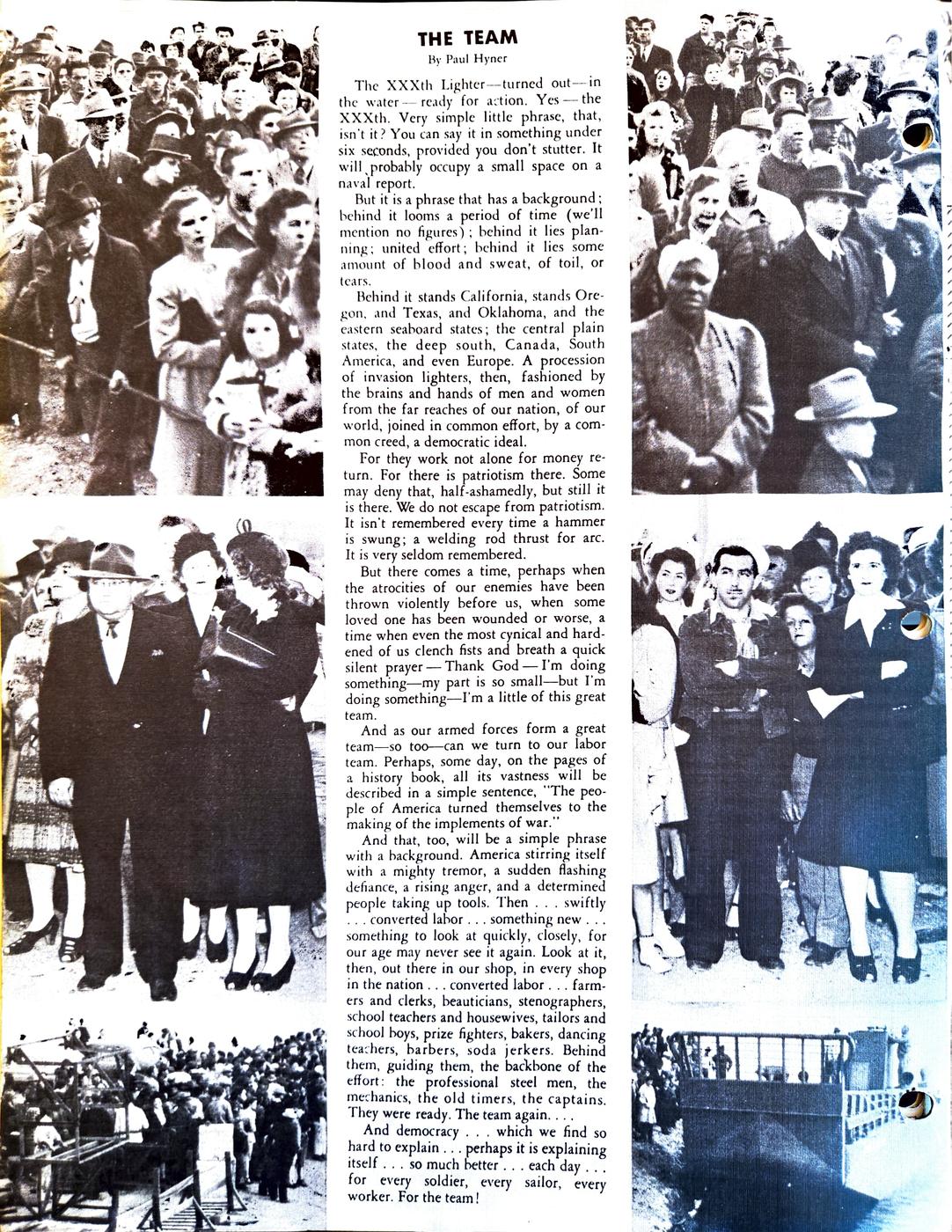
The XXXth Lighter—turned out—in the water—ready for action. Yes—the XXXth. Very simple little phrase, that, isn't it? You can say it in something under six seconds, provided you don't stutter. It will probably occupy a small space on a naval report.
But it is a phrase that has a background; behind it looms a period of time (we'll mention no figures); behind it lies planning; united effort; behind it lies some amount of blood and sweat, of toil, or tears.
Behind it stands California, stands Oregon, and Texas, and Oklahoma, and the eastern seaboard states; the central plain states, the deep south, Canada, South America, and even Europe. A procession of invasion lighters, then, fashioned by the brains and hands of men and women from the far reaches of our nation, of our world, joined in common effort, by a common creed, a democratic ideal.
For they work not alone for money return. For there is patriotism there. Some may deny that, half-ashamedly, but still it is there. We do not escape from patriotism. It isn't remembered every time a hammer is swung; a welding rod thrust for arc. It is very seldom remembered.
But there comes a time, perhaps when the atrocities of our enemies have been thrown violently before us, when some loved one has been wounded or worse, a time when even the most cynical and hardened of us clench fists and breath a quick silent prayer — Thank God — I'm doing something—my part is so small—but I'm doing something—I'm a little of this great team.
And as our armed forces form a great team—so too—can we turn to our labor team. Perhaps, some day, on the pages of a history book, all its vastness will be described in a simple sentence, "The people of America turned themselves to the making of the implements of war."
And that, too, will be a simple phrase with a background. America stirring itself with a mighty tremor, a sudden flashing defiance, a rising anger, and a determined people taking up tools. Then . . . swiftly . . . converted labor . . . something new . . . something to look at quickly, closely, for our age may never see it again. Look at it, then, out there in our shop, in every shop in the nation . . . converted labor . . . farmers and clerks, beauticians, stenographers, school teachers and housewives, tailors and school boys, prize fighters, bakers, dancing teachers, barbers, soda jerkers. Behind them, guiding them, the backbone of the effort: the professional steel men, the mechanics, the old timers, the captains. They were ready. The team again. . . .
And democracy . . . which we find so hard to explain . . . perhaps it is explaining itself . . . so much better . . . each day . . . for every soldier, every sailor, every worker. For the team!
Page 9
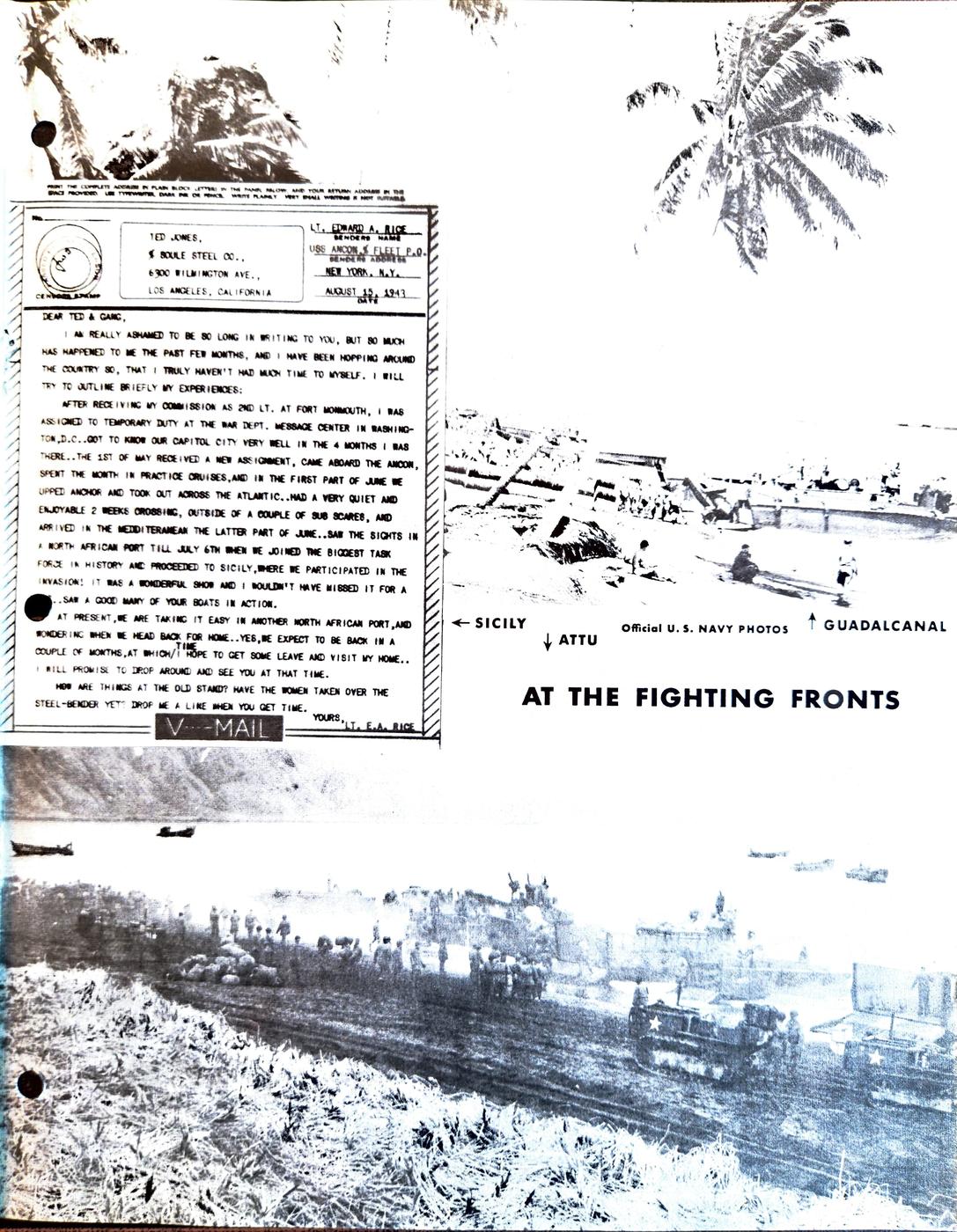
PRINT THE COMPLETE ADDRESS IN PLAIN BLOCK LETTERS IN THE PANEL BELOW, AND YOUR RETURN ADDRESS IN THE SPACE PROVIDED. USE TYPEWRITER, BALL PEN OR PENCIL. WRITE PLAINLY. VERY SMALL WRITING IS NOT SUITABLE.
LT. EDWARD A. RICE SENDER'S NAME USS ANCON, % FLEET P.O. SENDER'S ADDRESS NEW YORK, N.Y. AUGUST 15, 1943 DATE
TED JONES, SOULE STEEL CO., 6300 WILMINGTON AVE., LOS ANGELES, CALIFORNIA
DEAR TED & GANG,
I AM REALLY ASHAMED TO BE SO LONG IN WRITING TO YOU, BUT SO MUCH HAS HAPPENED TO ME THE PAST FEW MONTHS, AND I HAVE BEEN HOPPING AROUND THE COUNTRY SO, THAT I TRULY HAVEN'T HAD MUCH TIME TO MYSELF. I WILL TRY TO OUTLINE BRIEFLY MY EXPERIENCES:
AFTER RECEIVING MY COMMISSION AS 2ND LT. AT FORT MONMOUTH, I WAS ASSIGNED TO TEMPORARY DUTY AT THE WAR DEPT. MESSAGE CENTER IN WASHINGTON, D.C.. GOT TO KNOW OUR CAPITOL CITY VERY WELL IN THE 4 MONTHS I WAS THERE.. THE 1ST OF MAY RECEIVED A NEW ASSIGNMENT, CAME ABOARD THE ANCON, SPENT THE MONTH IN PRACTICE CRUISES, AND IN THE FIRST PART OF JUNE WE UPPED ANCHOR AND TOOK OUT ACROSS THE ATLANTIC.. HAD A VERY QUIET AND ENJOYABLE 2 WEEKS CROSSING, OUTSIDE OF A COUPLE OF SUB SCARES, AND ARRIVED IN THE MEDITERRANEAN THE LATTER PART OF JUNE.. SAW THE SIGHTS IN A NORTH AFRICAN PORT TILL JULY 6TH WHEN WE JOINED THE BIGGEST TASK FORCE IN HISTORY AND PROCEEDED TO SICILY, WHERE WE PARTICIPATED IN THE INVASION! IT WAS A WONDERFUL SHOW AND I WOULDN'T HAVE MISSED IT FOR A
..SAW A GOOD MANY OF YOUR BOATS IN ACTION.
AT PRESENT, WE ARE TAKING IT EASY IN ANOTHER NORTH AFRICAN PORT, AND WONDERING WHEN WE HEAD BACK FOR HOME.. YES, WE EXPECT TO BE BACK IN A COUPLE OF MONTHS, AT WHICH TIME I HOPE TO GET SOME LEAVE AND VISIT MY HOME..
I WILL PROMISE TO DROP AROUND AND SEE YOU AT THAT TIME.
HOW ARE THINGS AT THE OLD STAND? HAVE THE WOMEN TAKEN OVER THE STEEL-BENDER YET? DROP ME A LINE WHEN YOU GET TIME.
YOURS, LT. E.A. RICE
V---MAIL
← SICILY ↓ ATTU Official U. S. NAVY PHOTOS ↑ GUADALCANAL
AT THE FIGHTING FRONTS
Page 10
* * * Soule' Salute * * * * * * *
ABOUT OUR PEOPLE
**TORRANCE**
This one is continued from last month. Just get out your September edition, turn to the last page, and at the bottom of the first column, paste this in: "James W. is a pharmacist's mate, 2nd class. A third son will be in the service before the end of the year."
Oh, and while you have it there, would you mind cutting out the first and second articles on the top of the third column, and reversing them? So it will make sense? So solly, new copy boy he Chinee and he start at bottom and work up.
* * *
We were delighted to have a visit from J. J. Hornbach on August 10th. Joe looks swell and has gained about 15 pounds in weight. He is on Shore Patrol at Richmond, Virginia, but we don't think he likes it back there any too well. After all, there is no place like California, and we hope that he can be transferred to this coast again where he can be home with his wife once in awhile.
**LOS ANGELES**
Private Harry Williams, Jr., currently at camp in Wisconsin, and Private Willis T. Cain, from Florida, spent part of their furlough visiting with old friends in the shop.
* * *
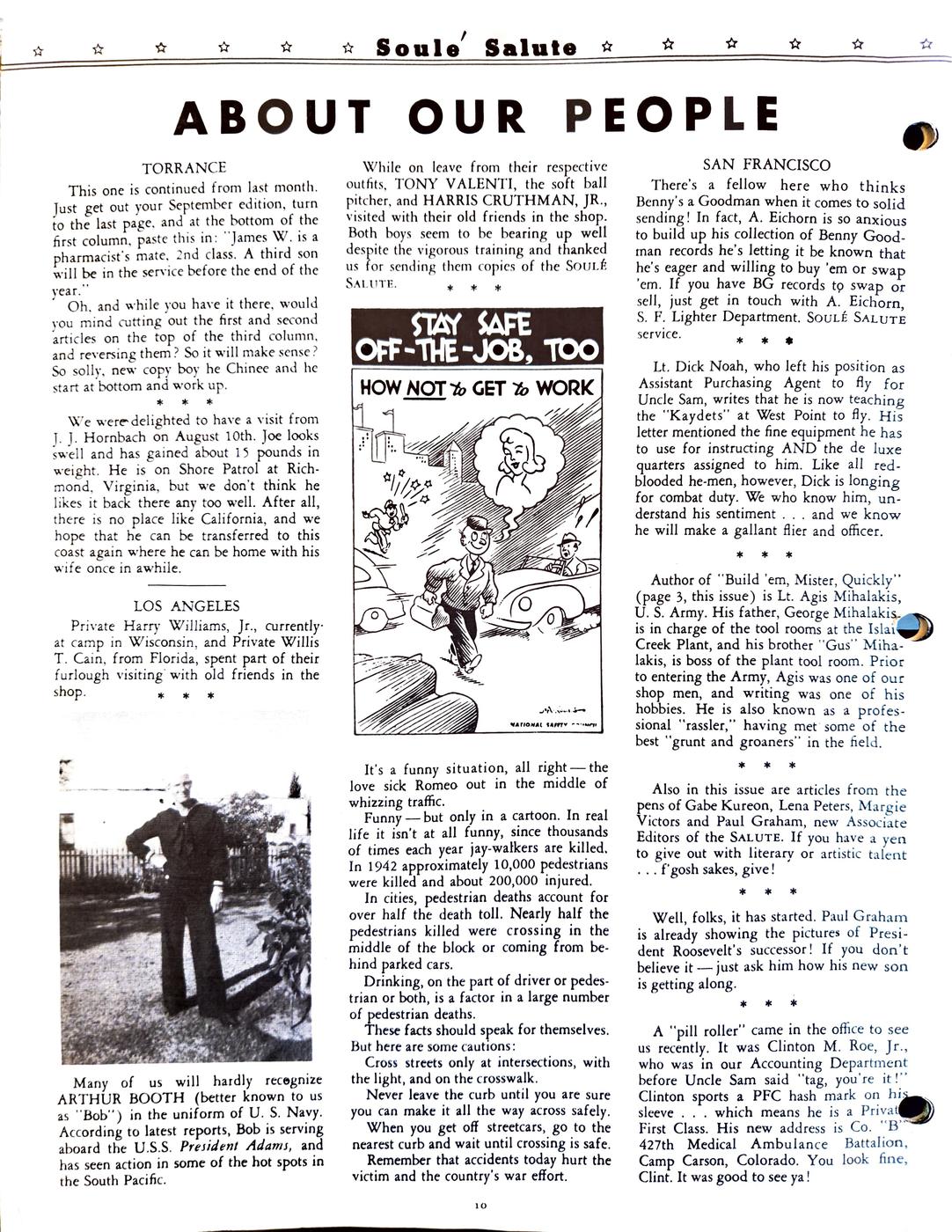
Photo: Many of us will hardly recognize ARTHUR BOOTH (better known to us as "Bob") in the uniform of U. S. Navy. According to latest reports, Bob is serving aboard the U.S.S. President Adams, and has seen action in some of the hot spots in the South Pacific.
While on leave from their respective outfits, TONY VALENTI, the soft ball pitcher, and HARRIS CRUTHMAN, JR., visited with their old friends in the shop. Both boys seem to be bearing up well despite the vigorous training and thanked us for sending them copies of the SOULÉ SALUTE.
* * *
STAY SAFE OFF-THE-JOB, TOO HOW NOT to GET to WORK
It's a funny situation, all right — the love sick Romeo out in the middle of whizzing traffic.
Funny — but only in a cartoon. In real life it isn't at all funny, since thousands of times each year jay-walkers are killed. In 1942 approximately 10,000 pedestrians were killed and about 200,000 injured.
In cities, pedestrian deaths account for over half the death toll. Nearly half the pedestrians killed were crossing in the middle of the block or coming from behind parked cars.
Drinking, on the part of driver or pedestrian or both, is a factor in a large number of pedestrian deaths.
These facts should speak for themselves. But here are some cautions:
Cross streets only at intersections, with the light, and on the crosswalk.
Never leave the curb until you are sure you can make it all the way across safely.
When you get off streetcars, go to the nearest curb and wait until crossing is safe.
Remember that accidents today hurt the victim and the country's war effort.
**SAN FRANCISCO**
There's a fellow here who thinks Benny's a Goodman when it comes to solid sending! In fact, A. Eichorn is so anxious to build up his collection of Benny Goodman records he's letting it be known that he's eager and willing to buy 'em or swap 'em. If you have BG records to swap or sell, just get in touch with A. Eichorn, S. F. Lighter Department. SOULÉ SALUTE service.
* * *
Lt. Dick Noah, who left his position as Assistant Purchasing Agent to fly for Uncle Sam, writes that he is now teaching the "Kaydets" at West Point to fly. His letter mentioned the fine equipment he has to use for instructing AND the de luxe quarters assigned to him. Like all red-blooded he-men, however, Dick is longing for combat duty. We who know him, understand his sentiment . . . and we know he will make a gallant flier and officer.
* * *
Author of "Build 'em, Mister, Quickly" (page 3, this issue) is Lt. Agis Mihalakis, U. S. Army. His father, George Mihalakis, is in charge of the tool rooms at the Islai Creek Plant, and his brother "Gus" Mihalakis, is boss of the plant tool room. Prior to entering the Army, Agis was one of our shop men, and writing was one of his hobbies. He is also known as a professional "rassler," having met some of the best "grunt and groaners" in the field.
* * *
Also in this issue are articles from the pens of Gabe Kureon, Lena Peters, Margie Victors and Paul Graham, new Associate Editors of the SALUTE. If you have a yen to give out with literary or artistic talent . . . f'gosh sakes, give!
* * *
Well, folks, it has started. Paul Graham is already showing the pictures of President Roosevelt's successor! If you don't believe it — just ask him how his new son is getting along.
* * *
A "pill roller" came in the office to see us recently. It was Clinton M. Roe, Jr., who was in our Accounting Department before Uncle Sam said "tag, you're it!"
Clinton sports a PFC hash mark on his sleeve . . . which means he is a Private First Class. His new address is Co. "B" 427th Medical Ambulance Battalion, Camp Carson, Colorado. You look fine, Clint. It was good to see ya!
10
Page 11
CONGRATULATIONS, WINNERS!
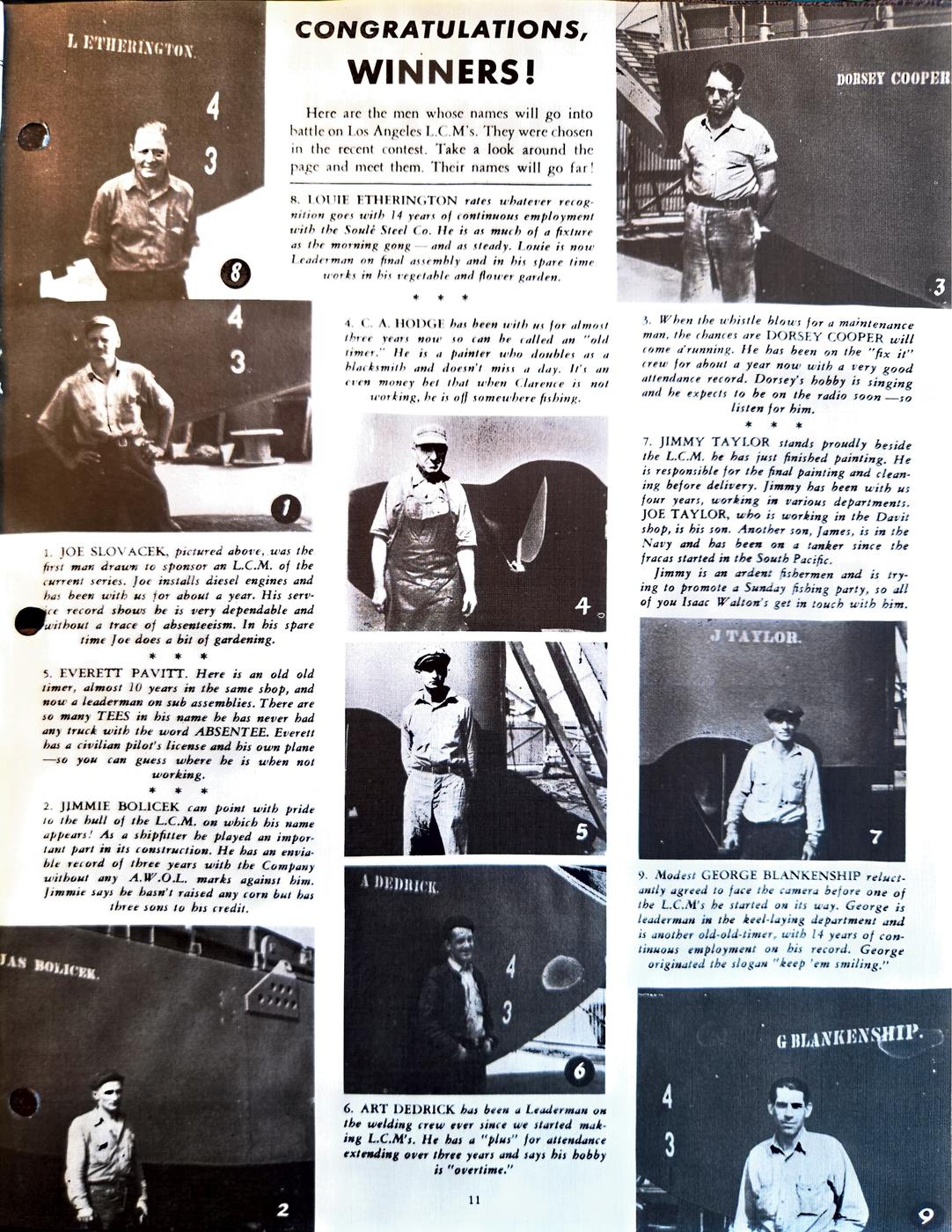
Here are the men whose names will go into battle on Los Angeles L.C.M's. They were chosen in the recent contest. Take a look around the page and meet them. Their names will go far!
Photo: *L. ETHERINGTON.*
8. **LOUIE ETHERINGTON** *rates whatever recognition goes with 14 years of continuous employment with the Soule Steel Co. He is as much of a fixture as the morning gong—and as steady. Louie is now Leaderman on final assembly and in his spare time works in his vegetable and flower garden.*
Photo: *DORSEY COOPER*
3. *When the whistle blows for a maintenance man, the chances are DORSEY COOPER will come a'running. He has been on the "fix it" crew for about a year now with a very good attendance record. Dorsey's hobby is singing and he expects to be on the radio soon—so listen for him.*
Photo: *J TAYLOR.*
7. **JIMMY TAYLOR** *stands proudly beside the L.C.M. he has just finished painting. He is responsible for the final painting and cleaning before delivery. Jimmy has been with us four years, working in various departments. JOE TAYLOR, who is working in the Davit shop, is his son. Another son, James, is in the Navy and has been on a tanker since the fracas started in the South Pacific.*
*Jimmy is an ardent fisherman and is trying to promote a Sunday fishing party, so all of you Isaac Walton's get in touch with him.*
Photo: *A DEDRICK.*
6. **ART DEDRICK** *has been a Leaderman on the welding crew ever since we started making L.C.M's. He has a "plus" for attendance extending over three years and says his hobby is "overtime."*
Photo: *G BLANKENSHIP.*
9. Modest **GEORGE BLANKENSHIP** *reluctantly agreed to face the camera before one of the L.C.M's be started on its way. George is leaderman in the keel-laying department and is another old-old-timer, with 14 years of continuous employment on his record. George originated the slogan "keep 'em smiling."*
4. **C. A. HODGE** *has been with us for almost three years now so can be called an "old timer." He is a painter who doubles as a blacksmith and doesn't miss a day. It's an even money bet that when Clarence is not working, he is off somewhere fishing.*
1. **JOE SLOVACEK**, *pictured above, was the first man drawn to sponsor an L.C.M. of the current series. Joe installs diesel engines and has been with us for about a year. His service record shows he is very dependable and without a trace of absenteeism. In his spare time Joe does a bit of gardening.*
5. **EVERETT PAVITT.** *Here is an old old timer, almost 10 years in the same shop, and now a leaderman on sub assemblies. There are so many TEES in his name be has never had any truck with the word ABSENTEE. Everett has a civilian pilot's license and his own plane—so you can guess where be is when not working.*
2. **JIMMIE BOLICEK** *can point with pride to the hull of the L.C.M. on which his name appears! As a shipfitter be played an important part in its construction. He has an enviable record of three years with the Company without any A.W.O.L. marks against him. Jimmie says be hasn't raised any corn but has three sons to his credit.*
Photo: *JAS BOLICEK.*
11
Page 12
☆ ☆ ☆ ☆ ☆ Soule' Salute ☆ ☆ ☆ ☆ ☆
WOMEN CAN WELD By Gabe Kureon
Because of the great need of manpower on our many fighting fronts, women are now taking the places of many of our men so they can be released to fight for our country. Welding is one of the many branches in which women are playing a big part, turning out tanks, airplanes, guns, ships, and barges.
Invasion barges for landing assaults against our enemy shores, supply barges and salvage barges are needed in ever increasing numbers. This is the reason women welders are now employed in our San Francisco plant for the first time in the many years of Mr. Soule's successful business. The women welders now employed are doing their job very well.
There are certain requirements a woman welder has to have before she is able to work on the production line. Our Personnel Department will ask them how much previous experience they have had and whether they are journeymen or first class trainees. They have to have their clearance papers, which is very important. Their application is then made out and they are finger printed.
All welders are subjected to a welding test. An application for this test by which our school instructor determines whether they are journeymen, first, second, or third class trainees. Beginners are not taken at the present time. After the application is made, they are shown how to make out their daily time cards. They are told of the different departments and our cafeteria's eating schedule on the way to the locker room. Next, to the welding school to be introduced to our welding instructor.
They are then given the welding test, which will determine in what classification they will be rated. If you are a journeyman and can pass this test, you are immediately put to work on the production line at $1.20 per hour. But if you cannot pass it, the instructor will keep you in school to practice until he determines you are ready to take it.
A first class trainee is given training to adapt himself to meet requirements demanded on the production line. The instructor will give every possible instruction necessary to help the trainee to become a journeyman. When there is a demand for tackers on the production line, a first class trainee down to a third class trainee is taken from school to do tacking for a while and is paid according to the first test which the instructor gave. When there is no more tacking, the trainee goes back to school until he is able to pass the test and become a journeyman.
When you are working on the production line, the job instructor will help you for the first week in any difficulties you may run into, instructing you in the proper setting of the welding machine and the right type of rod to use for the different jobs you may be working on. He will also show you the proper type of bead, method, and heat to use in relation to thickness of material. He will try to keep in touch with you from day to day to help you in becoming a better welder in yourself and in helping our Company turn out better built barges for our ever-increasing Army and Navy. The better you do your part in producing invasion barges for our Navy, the sooner we and our Allies will bring peace and happiness again to this war torn world.
GIVE and TAKE SAN FRANCISCO
Coca-Cola dispensing machines have been set up in the plant and Islais Creek Yard. These were obtained only by the fact that we are engaged in war work. It is going to be a lot easier to lose them than to get them ... so please be kind. Take care of the "coke" machine and it will "give" with the cool refreshing pause.
* * *
> Awards for suggestions have been made by Chairman Robert Reno to the following men in the Los Angeles shop: > > EVERETT PAVITT for his design of a welding jig now in use. > > FRED MASTIN proposed that tables and benches be provided for the men to use at lunch time. > > BILL O'HAVER suggested moving a small shack from in front of the lighter production line, where it interfered with efficient working conditions. > > If No. 286 will identify himself, there may be something interesting in his suggestion.
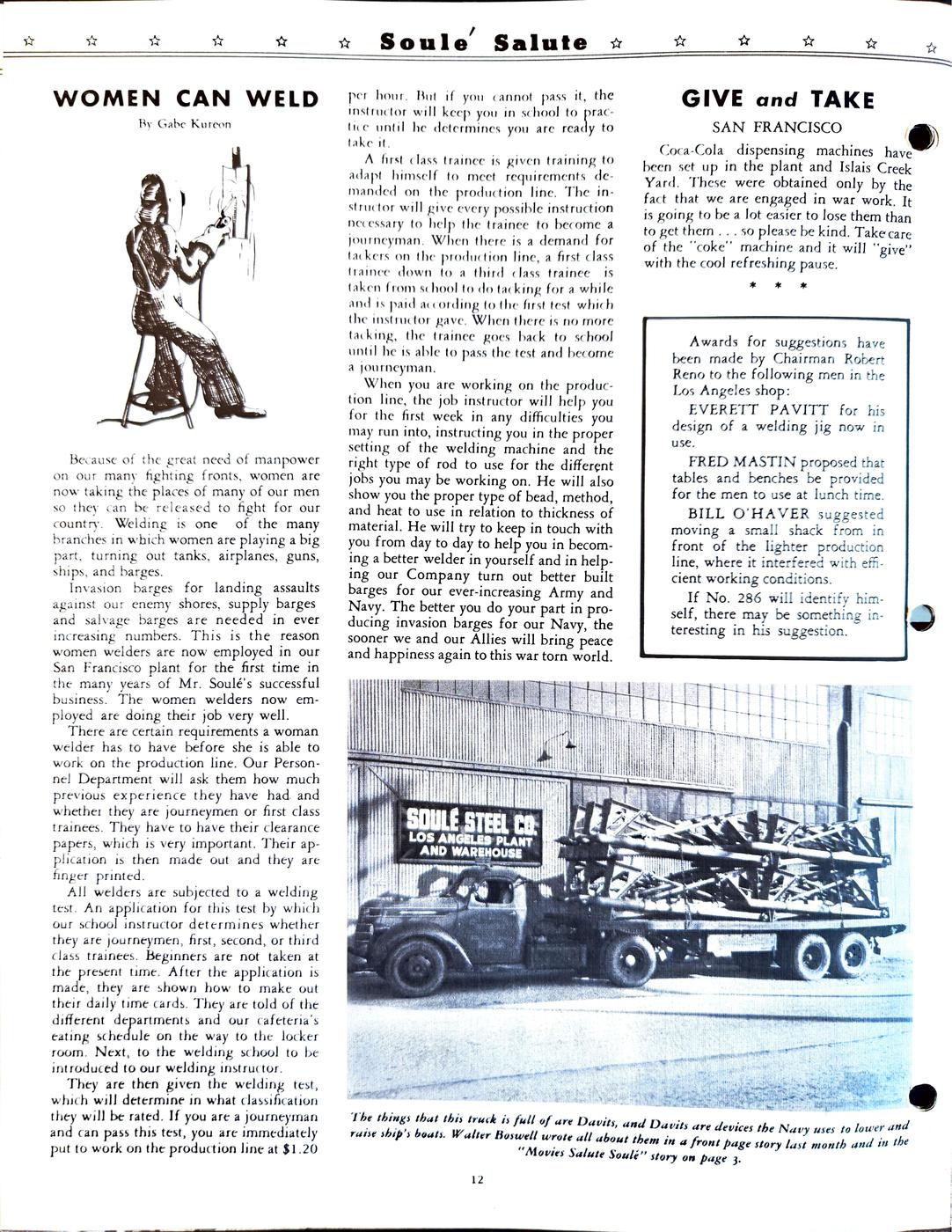
Photo: The things that this truck is full of are Davits, and Davits are devices the Navy uses to lower and raise ship's boats. Walter Boswell wrote all about them in a front page story last month and in the "Movies Salute Soule" story on page 3.
12