Page 1
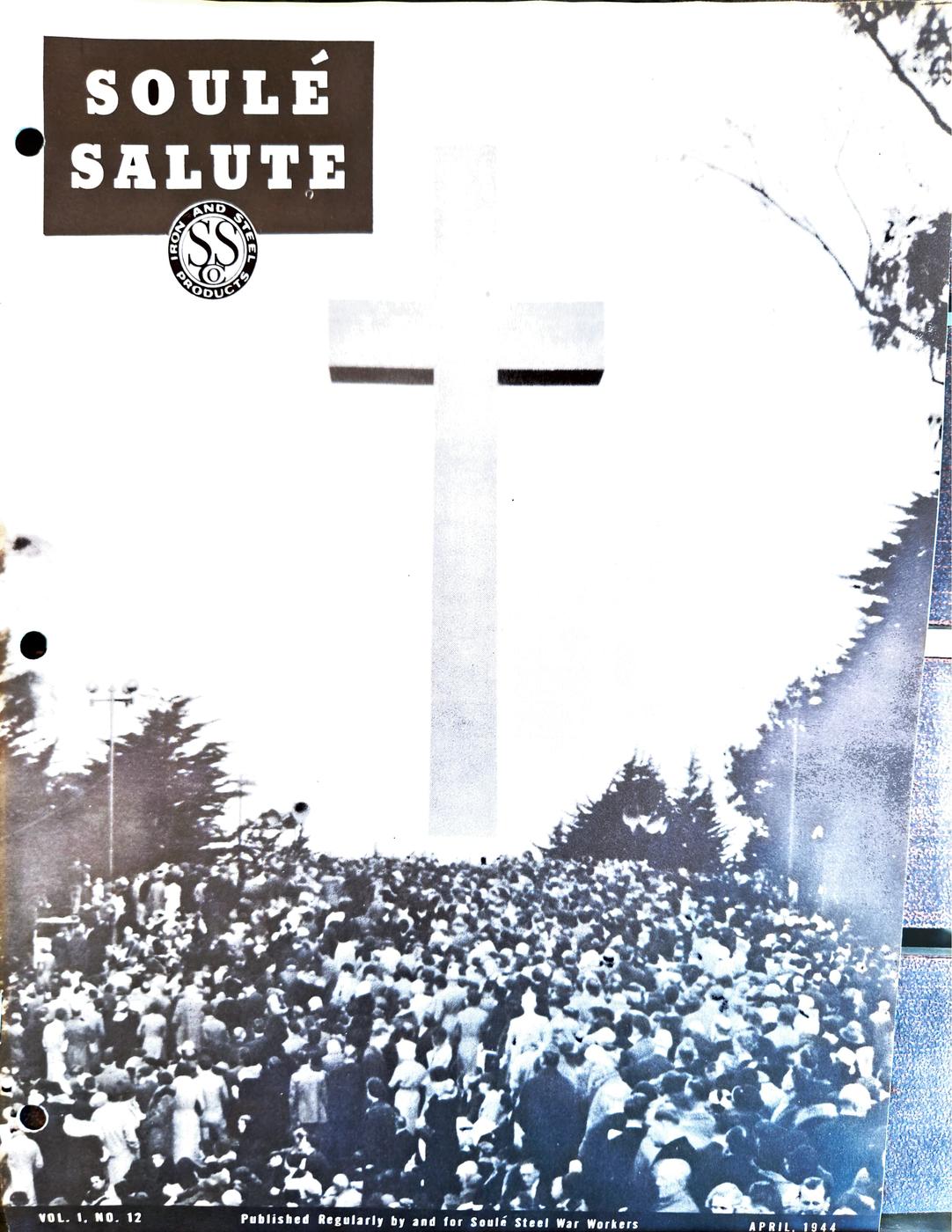
SOULÉ SALUTE
IRON AND STEEL PRODUCTS
VOL. 1, NO. 12
Published Regularly by and for Soulé Steel War Workers
APRIL, 1944
Page 2
* Soule' Salute *
**SOULE SALUTE** Vol. I No. 12 Published Regularly by and for Soule Steel War Workers
Staff: Managing Editor . . . . George Cobb Los Angeles Editor . . . Bill Irwin Portland Editor . . . . . Les Poole San Francisco Editor, Fred Kappelman
Associate Editors Los Angeles San Francisco Art Carter Peter F. Culcas Eddie Dugan Paul Hyner Ted Jones Louise Jones Charles La Fevre Peter Padilla Dorothy Olsen Joe Romero George Thomas Marion Sheehy
Portland Torrance John Vaile A. M. Dowell
Assembly Line ## OF NEWS ABOUT OUR PEOPLE
FRANK KULLMER, Chief Engineer, S. F., tells us he recently received a letter from his nephew, Warren Reinecker, U. S. Navy, on leave from this company. Warren writes that the only mail he received over a long period of time was the Soule Salute. Proof our circulation department is doing a fine job as Warren has been moving around a good deal.
Pfc. Harris H. Grothman, Jr., stationed in New York and due soon for a boat ride. Cpl. Tony (Strikeout) Valenti, down at Camp Bowie, Texas. Pvt. Sid Fitzgerald, Camp Barkeley, Texas. How about the rest of you fellows? Would be glad to hear from all of you.
* * *
IT WAS WITH deep regret S.F. said "Good-bye" to Chief Benjamin Martin, U. S. Navy, when he was re-assigned. While at this plant in the capacity of Resident Inspector of LCM's, Ben made many friends with his spirit of cooperation and friendliness. We all wish him continued success and good fortune.
JOHNNY HER-ZOG, as a young man (and he still is one) worked in the Sash Department in S. F. until Uncle Sam needed young men to become fliers.
Recently a letter was received from him which contained the news he had taken B-17 training and after 130 hours in a Fortress came out as First Pilot, or Aircraft Commander. His instructor wanted him to stay and be an instructor, too, but John didn't like the idea of hanging around for a year teaching. He wanted to "go over" and see action . . . that was what he had signed up for. John is now stationed at MacDill Field, Tampa, Florida.
The Lieutenant admits it is nice in Florida as far as climate is concerned, but considers Tampa as a typical Southern tourist town now full of service men. On week ends he has been going to St. Petersburg, twenty miles away, where they have good beaches and fine fishing.
Lieutenant John concludes with best wishes to all of his friends here and we, in turn, wish him "Happy Landings".
POSTWAR PLANS ASSURE JOBS
From the reports in current newspapers and magazines it looks as if the post-war period is going to be a mighty busy one. Government agencies, both Federal and State, are making vast plans . . . plans which will not only take care of returning service men, but will assure continued employment capacity of all plants now engaged in the manufacture of war materials.
To get down to cases, the State of California alone has to date allocated nearly $20,000,000 for post-war building construction projects. The plans are advanced to the point where they are currently ready to go on the architects' drafting boards. As in the past, Soule peacetime products will be called upon to play their vital part in the building programs of the State and Nation. V-Day should open up new doors of opportunity for the coastwise facilities of the Soule Steel Company.
"FROM PEN PUSHER TO PILL ROLLER" will be the title of the story Clinton Roe is going to write after the war. At least that is what he told us when he visited S.F. offices a short while ago. Clint was a Soule accountant before he received "Greetings" from the President.
* * *
LETTERS FROM THE following boys were recently received at the Los Angeles plant: Sgt. John W. Haley, who is now stationed in England. Pfc. Willis T. Cain, now serving somewhere in the Pacific.
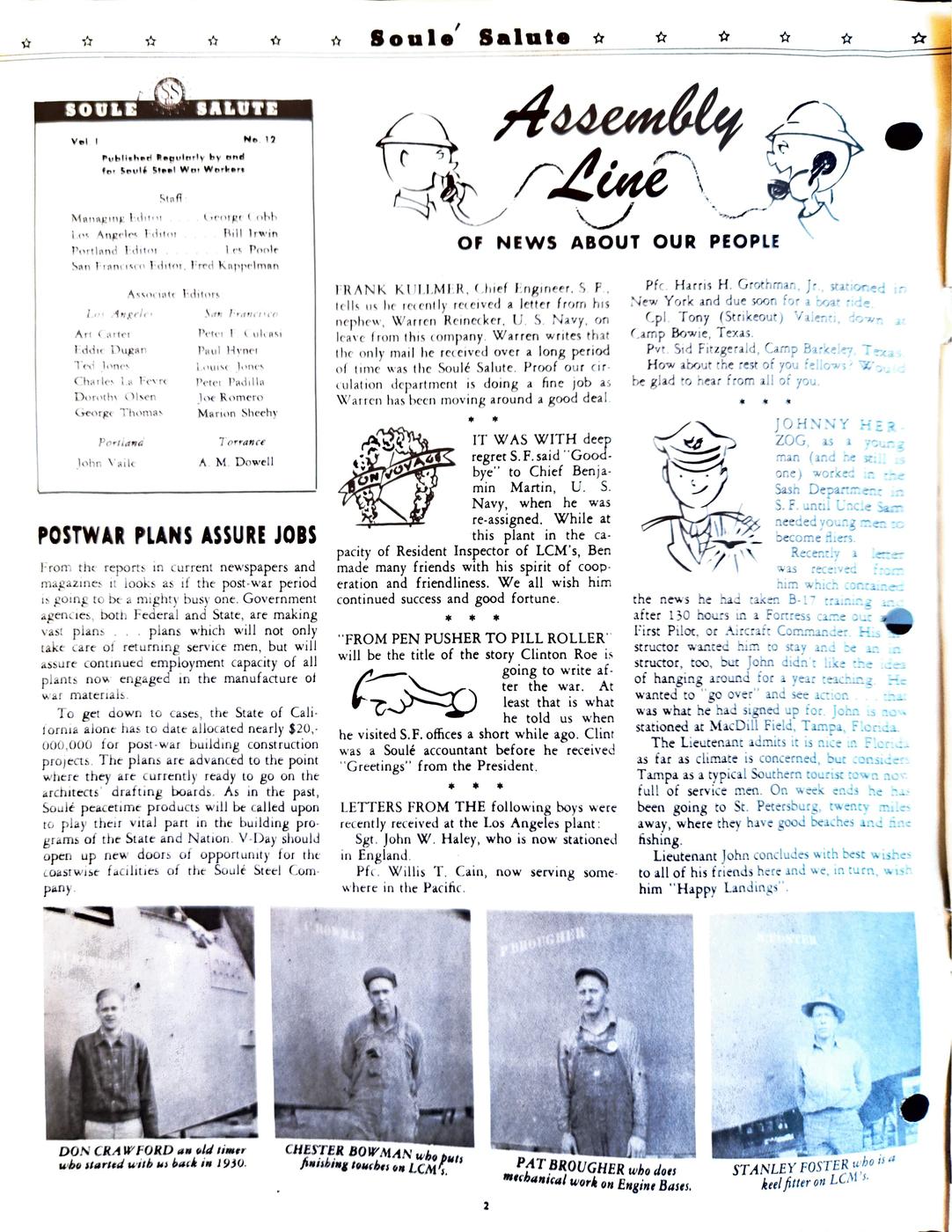
*Photo: DON CRAWFORD an old timer who started with us back in 1930.* *Photo: CHESTER BOWMAN who puts finishing touches on LCM's.* *Photo: PAT BROUGHER who does mechanical work on Engine Bases.* *Photo: STANLEY FOSTER who is a keel fitter on LCM's.*
Page 3
* Soule' Salute *
LOS ANGELES LAUNCHES Elsie-M # 200
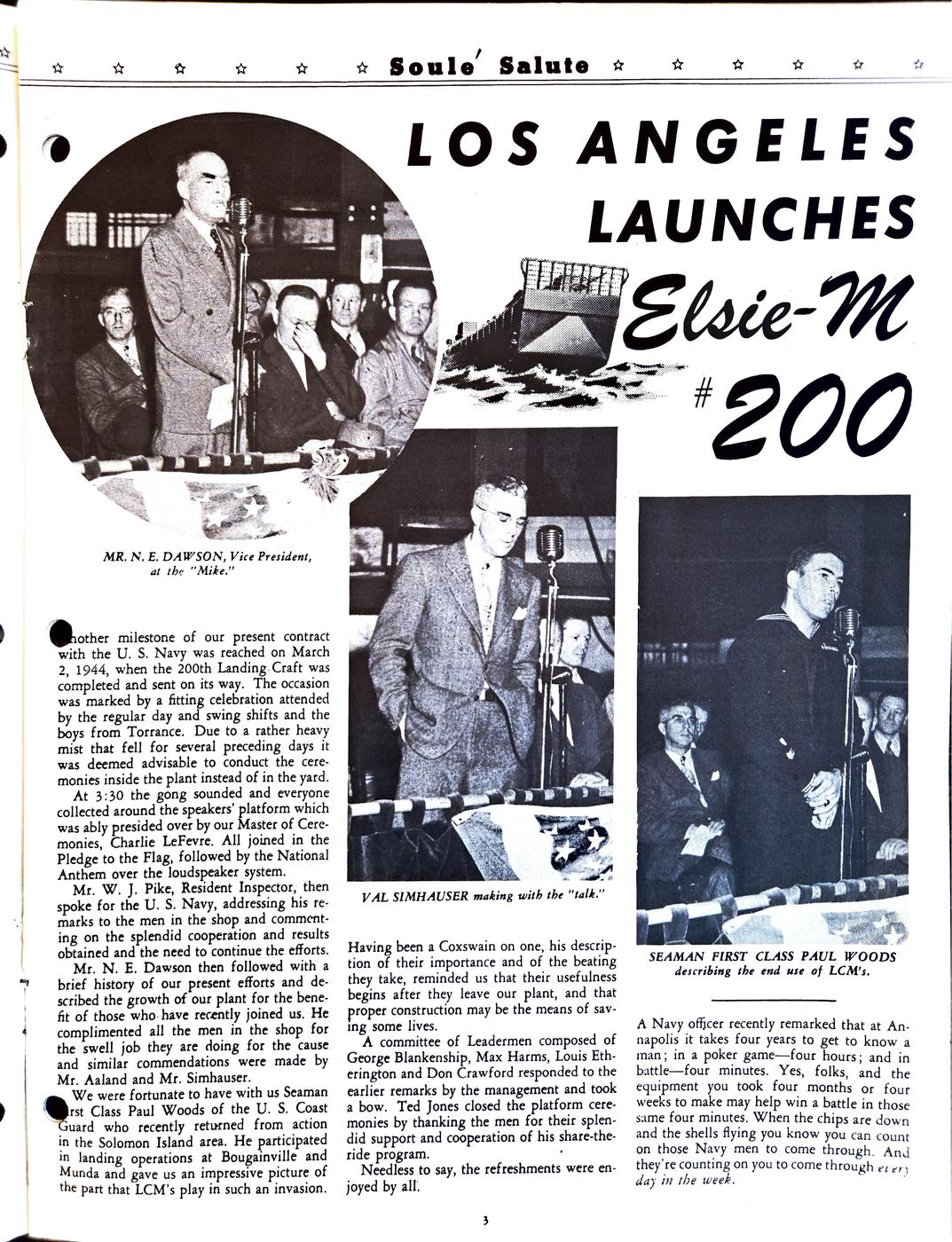
Photo: MR. N. E. DAWSON, Vice President, at the "Mike."
Another milestone of our present contract with the U. S. Navy was reached on March 2, 1944, when the 200th Landing Craft was completed and sent on its way. The occasion was marked by a fitting celebration attended by the regular day and swing shifts and the boys from Torrance. Due to a rather heavy mist that fell for several preceding days it was deemed advisable to conduct the ceremonies inside the plant instead of in the yard.
At 3:30 the gong sounded and everyone collected around the speakers' platform which was ably presided over by our Master of Ceremonies, Charlie LeFevre. All joined in the Pledge to the Flag, followed by the National Anthem over the loudspeaker system.
Mr. W. J. Pike, Resident Inspector, then spoke for the U. S. Navy, addressing his remarks to the men in the shop and commenting on the splendid cooperation and results obtained and the need to continue the efforts.
Mr. N. E. Dawson then followed with a brief history of our present efforts and described the growth of our plant for the benefit of those who have recently joined us. He complimented all the men in the shop for the swell job they are doing for the cause and similar commendations were made by Mr. Aaland and Mr. Simhauser.
We were fortunate to have with us Seaman First Class Paul Woods of the U. S. Coast Guard who recently returned from action in the Solomon Island area. He participated in landing operations at Bougainville and Munda and gave us an impressive picture of the part that LCM's play in such an invasion.
Photo: VAL SIMHAUSER making with the "talk."
Having been a Coxswain on one, his description of their importance and of the beating they take, reminded us that their usefulness begins after they leave our plant, and that proper construction may be the means of saving some lives.
A committee of Leadermen composed of George Blankenship, Max Harms, Louis Etherington and Don Crawford responded to the earlier remarks by the management and took a bow. Ted Jones closed the platform ceremonies by thanking the men for their splendid support and cooperation of his share-the-ride program.
Needless to say, the refreshments were enjoyed by all.
Photo: SEAMAN FIRST CLASS PAUL WOODS describing the end use of LCM's.
A Navy officer recently remarked that at Annapolis it takes four years to get to know a man; in a poker game—four hours; and in battle—four minutes. Yes, folks, and the equipment you took four months or four weeks to make may help win a battle in those same four minutes. When the chips are down and the shells flying you know you can count on those Navy men to come through. And they're counting on you to come through every day in the week.
3
Page 4
☆ ☆ ☆ ☆ ☆ Soule' Salute ☆ ☆ ☆ ☆ ☆
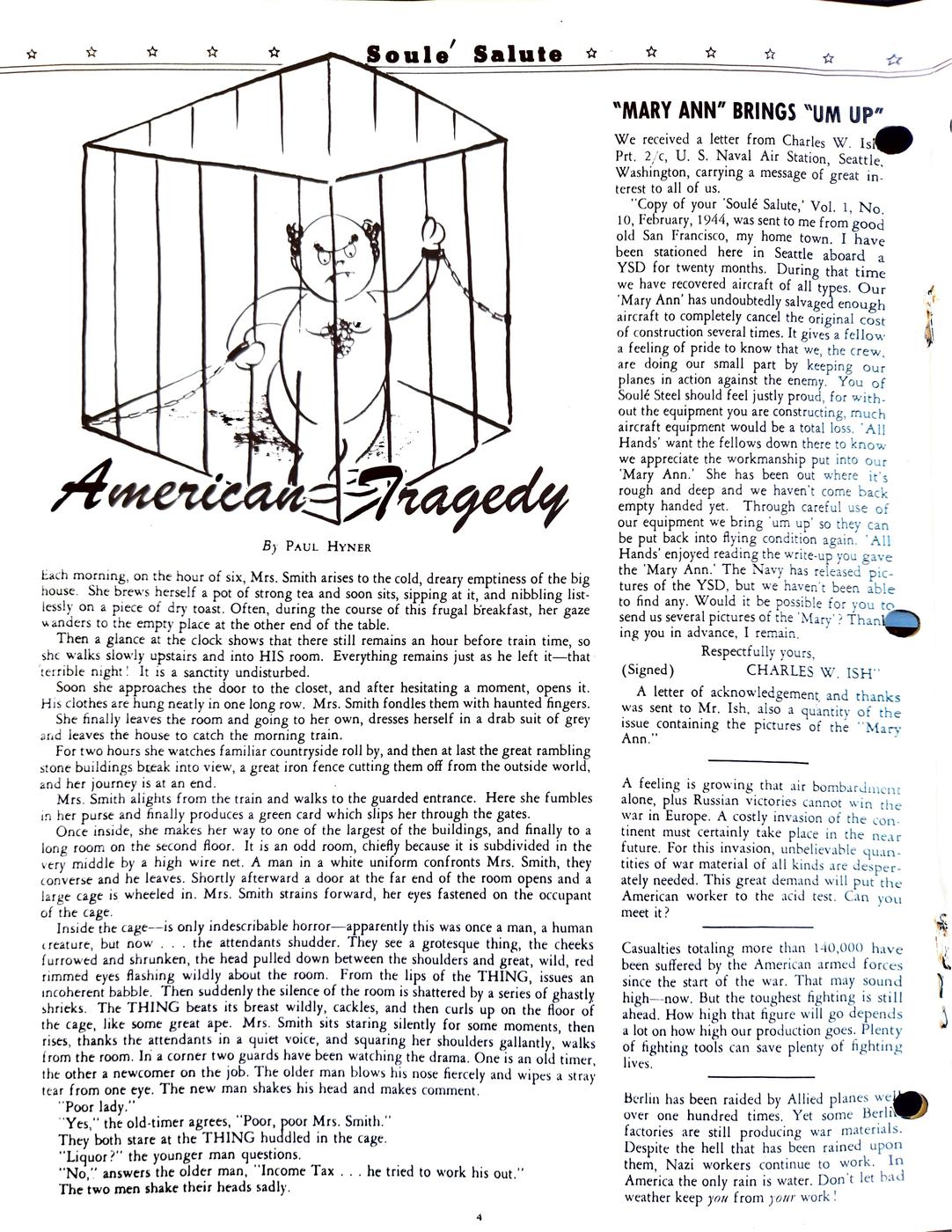
American Tragedy ### By PAUL HYNER
Each morning, on the hour of six, Mrs. Smith arises to the cold, dreary emptiness of the big house. She brews herself a pot of strong tea and soon sits, sipping at it, and nibbling listlessly on a piece of dry toast. Often, during the course of this frugal breakfast, her gaze wanders to the empty place at the other end of the table.
Then a glance at the clock shows that there still remains an hour before train time, so she walks slowly upstairs and into HIS room. Everything remains just as he left it—that terrible night! It is a sanctity undisturbed.
Soon she approaches the door to the closet, and after hesitating a moment, opens it. His clothes are hung neatly in one long row. Mrs. Smith fondles them with haunted fingers.
She finally leaves the room and going to her own, dresses herself in a drab suit of grey and leaves the house to catch the morning train.
For two hours she watches familiar countryside roll by, and then at last the great rambling stone buildings break into view, a great iron fence cutting them off from the outside world, and her journey is at an end.
Mrs. Smith alights from the train and walks to the guarded entrance. Here she fumbles in her purse and finally produces a green card which slips her through the gates.
Once inside, she makes her way to one of the largest of the buildings, and finally to a long room on the second floor. It is an odd room, chiefly because it is subdivided in the very middle by a high wire net. A man in a white uniform confronts Mrs. Smith, they converse and he leaves. Shortly afterward a door at the far end of the room opens and a large cage is wheeled in. Mrs. Smith strains forward, her eyes fastened on the occupant of the cage.
Inside the cage—is only indescribable horror—apparently this was once a man, a human creature, but now . . . the attendants shudder. They see a grotesque thing, the cheeks furrowed and shrunken, the head pulled down between the shoulders and great, wild, red rimmed eyes flashing wildly about the room. From the lips of the THING, issues an incoherent babble. Then suddenly the silence of the room is shattered by a series of ghastly shrieks. The THING beats its breast wildly, cackles, and then curls up on the floor of the cage, like some great ape. Mrs. Smith sits staring silently for some moments, then rises, thanks the attendants in a quiet voice, and squaring her shoulders gallantly, walks from the room. In a corner two guards have been watching the drama. One is an old timer, the other a newcomer on the job. The older man blows his nose fiercely and wipes a stray tear from one eye. The new man shakes his head and makes comment.
"Poor lady."
"Yes," the old-timer agrees, "Poor, poor Mrs. Smith."
They both stare at the THING huddled in the cage.
"Liquor?" the younger man questions.
"No," answers the older man, "Income Tax . . . he tried to work his out."
The two men shake their heads sadly.
"MARY ANN" BRINGS "UM UP"
We received a letter from Charles W. Ish, Prt. 2/c, U. S. Naval Air Station, Seattle, Washington, carrying a message of great interest to all of us.
"Copy of your 'Soule Salute,' Vol. 1, No. 10, February, 1944, was sent to me from good old San Francisco, my home town. I have been stationed here in Seattle aboard a YSD for twenty months. During that time we have recovered aircraft of all types. Our 'Mary Ann' has undoubtedly salvaged enough aircraft to completely cancel the original cost of construction several times. It gives a fellow a feeling of pride to know that we, the crew, are doing our small part by keeping our planes in action against the enemy. You of Soule Steel should feel justly proud, for without the equipment you are constructing, much aircraft equipment would be a total loss. 'All Hands' want the fellows down there to know we appreciate the workmanship put into our 'Mary Ann.' She has been out where it's rough and deep and we haven't come back empty handed yet. Through careful use of our equipment we bring 'um up' so they can be put back into flying condition again. 'All Hands' enjoyed reading the write-up you gave the 'Mary Ann.' The Navy has released pictures of the YSD, but we haven't been able to find any. Would it be possible for you to send us several pictures of the 'Mary'? Thanking you in advance, I remain.
Respectfully yours,
(Signed) CHARLES W. ISH"
A letter of acknowledgement and thanks was sent to Mr. Ish, also a quantity of the issue containing the pictures of the "Mary Ann."
A feeling is growing that air bombardment alone, plus Russian victories cannot win the war in Europe. A costly invasion of the continent must certainly take place in the near future. For this invasion, unbelievable quantities of war material of all kinds are desperately needed. This great demand will put the American worker to the acid test. Can you meet it?
Casualties totaling more than 140,000 have been suffered by the American armed forces since the start of the war. That may sound high—now. But the toughest fighting is still ahead. How high that figure will go depends a lot on how high our production goes. Plenty of fighting tools can save plenty of fighting lives.
Berlin has been raided by Allied planes well over one hundred times. Yet some Berlin factories are still producing war materials. Despite the hell that has been rained upon them, Nazi workers continue to work. In America the only rain is water. Don't let bad weather keep you from your work!
Page 5
Soule' Salute
ON THE LINE By PETER PADILLA
The lighter assembly line is moving them fast these days. The LCM's roll on so rapidly that if you leave a tool out at quitting time you may have to enlist in the Armed Forces to recover it. Any time I expect to hear news of DONALD KNUDSEN, PAUL ADAMS or LAURA KRAUSE sailing to the South Pacific on one of our lighters.
This combination, and others are usually working inside the tight spots. More than once I have seen them crawl out in the middle of the lunch hour because they were working so intently they lost track of time.
Speaking of LAURA KRAUSE, she is a dead ringer for Ingrid Bergman of cinema fame. Is that why FRANK puts her in between the inner wall and outer shell away from admiring gazes of the males or is it because of her petite stature?
Seriously though she is a hard worker and a very pleasant colleague.
As for DON KNUDSEN we hear via the grapevine that he is frequently stirred out of a sound sleep by the telephone. Upon answering he hears the familiar voice of FRANK MENGES, requesting that he get his body out of bed and get to work on time.
We have a former clothing salesman working with us who has had the distinction of meeting film notables, such as Robert Stack and others. His name is JIM BURKE and he now fits the inner shell on Soule lighters. Jim has actually shaken the hand of Captain Clark Gable of the U. S. Air Corps.
My vote for the most congenial character at the S. F. plant goes to GUS AHRENS with his quick wit and twinkling eyes.
Farewell and good luck to LOUISE JONES of the Personnel Dept. She has left us to go East with her husband who is on his way to an Eastern port of embarkation. She has been replaced by VERNIE HERBERT, a very charming and attractive young lady.
We bid welcome to another newcomer. VIOLET WEATHERSBY of the personnel office.
Down at a South Pacific outpost there is a sign that reads: "Washington—11,673 miles—Tokyo—4,231 miles—nearest Jap 1/4 mile away". That's a fine reminder that it's the task on hand that counts. Sure you're wondering when the war is going to end! Who isn't? But don't let looking into the crystal ball of tomorrow cause you to ease up on your job today.
Don't shop for a horn and a paper cap yet! The man-hours wasted in guessing when the war will end would build a battleship. The man-hours lost in dreaming about post-war vacations would outfit a small invasion force. The boys who are fighting this war want to be in on the Victory celebration. Don't jump the gun and toot your horn while there's a single man still fighting.
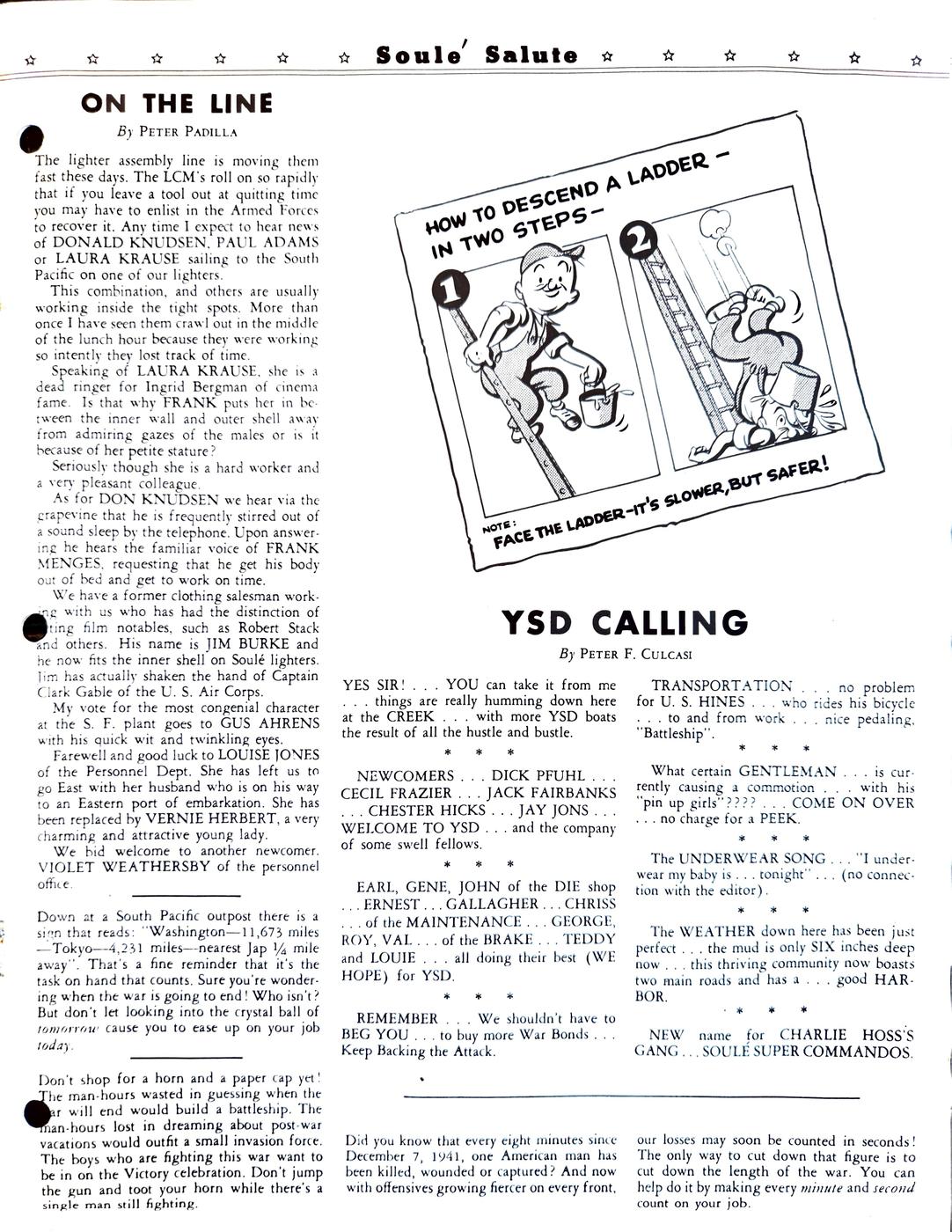
HOW TO DESCEND A LADDER - IN TWO STEPS - 1 2 Photo: NOTE: FACE THE LADDER - IT'S SLOWER, BUT SAFER!
YSD CALLING By PETER F. CULCASI
YES SIR! . . . YOU can take it from me . . . things are really humming down here at the CREEK . . . with more YSD boats the result of all the hustle and bustle.
* * *
NEWCOMERS . . . DICK PFUHL . . . CECIL FRAZIER . . . JACK FAIRBANKS . . . CHESTER HICKS . . . JAY JONS . . . WELCOME TO YSD . . . and the company of some swell fellows.
* * *
EARL, GENE, JOHN of the DIE shop . . . ERNEST . . . GALLAGHER . . . CHRISS . . . of the MAINTENANCE . . . GEORGE, ROY, VAL . . . of the BRAKE . . . TEDDY and LOUIE . . . all doing their best (WE HOPE) for YSD.
* * *
REMEMBER . . . We shouldn't have to BEG YOU . . . to buy more War Bonds . . . Keep Backing the Attack.
TRANSPORTATION . . . no problem for U. S. HINES . . . who rides his bicycle . . . to and from work . . . nice pedaling, "Battleship".
* * *
What certain GENTLEMAN . . . is currently causing a commotion . . . with his "pin up girls"???? . . . COME ON OVER . . . no charge for a PEEK.
* * *
The UNDERWEAR SONG . . . "I under-wear my baby is . . . tonight" . . . (no connection with the editor).
* * *
The WEATHER down here has been just perfect . . . the mud is only SIX inches deep now . . . this thriving community now boasts two main roads and has a . . . good HARBOR.
* * *
NEW name for CHARLIE HOSS'S GANG . . . SOULÉ SUPER COMMANDOS.
Did you know that every eight minutes since December 7, 1941, one American man has been killed, wounded or captured? And now with offensives growing fiercer on every front, our losses may soon be counted in seconds! The only way to cut down that figure is to cut down the length of the war. You can help do it by making every minute and second count on your job.
Page 6
Soule' Salute
3 Generations
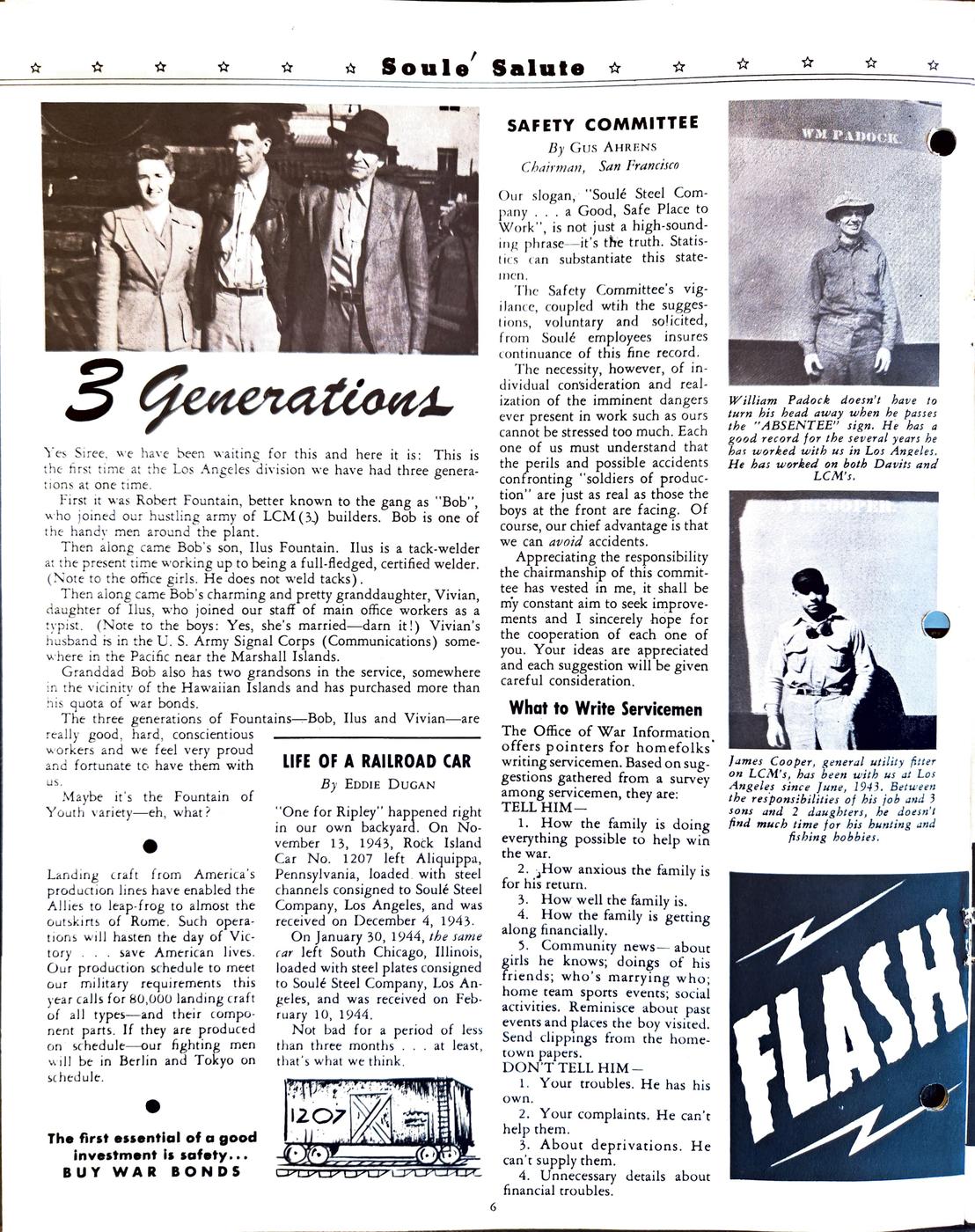
Yes Siree, we have been waiting for this and here it is: This is the first time at the Los Angeles division we have had three generations at one time.
First it was Robert Fountain, better known to the gang as "Bob", who joined our hustling army of LCM (3.) builders. Bob is one of the handy men around the plant.
Then along came Bob's son, Ilus Fountain. Ilus is a tack-welder at the present time working up to being a full-fledged, certified welder. (Note to the office girls. He does not weld tacks).
Then along came Bob's charming and pretty granddaughter, Vivian, daughter of Ilus, who joined our staff of main office workers as a typist. (Note to the boys: Yes, she's married—darn it!) Vivian's husband is in the U. S. Army Signal Corps (Communications) somewhere in the Pacific near the Marshall Islands.
Granddad Bob also has two grandsons in the service, somewhere in the vicinity of the Hawaiian Islands and has purchased more than his quota of war bonds.
The three generations of Fountains—Bob, Ilus and Vivian—are really good, hard, conscientious workers and we feel very proud and fortunate to have them with us.
Maybe it's the Fountain of Youth variety—eh, what?
SAFETY COMMITTEE
By GUS AHRENS Chairman, San Francisco
Our slogan, "Soule Steel Company . . . a Good, Safe Place to Work", is not just a high-sounding phrase—it's the truth. Statistics can substantiate this statement.
The Safety Committee's vigilance, coupled with the suggestions, voluntary and solicited, from Soule employees insures continuance of this fine record.
The necessity, however, of individual consideration and realization of the imminent dangers ever present in work such as ours cannot be stressed too much. Each one of us must understand that the perils and possible accidents confronting "soldiers of production" are just as real as those the boys at the front are facing. Of course, our chief advantage is that we can avoid accidents.
Appreciating the responsibility the chairmanship of this committee has vested in me, it shall be my constant aim to seek improvements and I sincerely hope for the cooperation of each one of you. Your ideas are appreciated and each suggestion will be given careful consideration.
*Photo: William Paddock doesn't have to turn his head away when he passes the "ABSENTEE" sign. He has a good record for the several years he has worked with us in Los Angeles. He has worked on both Davits and LCM's.*
LIFE OF A RAILROAD CAR
By EDDIE DUGAN
"One for Ripley" happened right in our own backyard. On November 13, 1943, Rock Island Car No. 1207 left Aliquippa, Pennsylvania, loaded with steel channels consigned to Soule Steel Company, Los Angeles, and was received on December 4, 1943.
On January 30, 1944, the same car left South Chicago, Illinois, loaded with steel plates consigned to Soule Steel Company, Los Angeles, and was received on February 10, 1944.
Not bad for a period of less than three months . . . at least, that's what we think.
What to Write Servicemen
The Office of War Information offers pointers for homefolks writing servicemen. Based on suggestions gathered from a survey among servicemen, they are: TELL HIM— 1. How the family is doing everything possible to help win the war. 2. How anxious the family is for his return. 3. How well the family is. 4. How the family is getting along financially. 5. Community news—about girls he knows; doings of his friends; who's marrying who; home team sports events; social activities. Reminisce about past events and places the boy visited. Send clippings from the hometown papers. DON'T TELL HIM— 1. Your troubles. He has his own. 2. Your complaints. He can't help them. 3. About privations. He can't supply them. 4. Unnecessary details about financial troubles.
*Photo: James Cooper, general utility fitter on LCM's, has been with us at Los Angeles since June, 1943. Between the responsibilities of his job and 3 sons and 2 daughters, he doesn't find much time for his hunting and fishing hobbies.*
The first essential of a good investment is safety... BUY WAR BONDS
FLASH
6
Page 7
Soule' Salute
LOS ANGELES SUGGESTION BOX
Recent cash award for suggestions have been made to Louis Etherington for his design of a limit stop on the LCM power unit to prevent burning the throw-out bearing. This is in use now and is successful.
Albert Frederick designed a jig for skag plates which has been put into use with a considerable saving of manhours.
Norman Gilreeth submitted an idea for swivel lamps to be used in the dark parts of the Lighters. The lamps are proving valuable.
Ed Dugan hit the jackpot with two good suggestions. One proposed the installation of a gate at a location which would facilitate receiving of certain materials and shipping of empty oil drums. This has been tried and has effected an appreciable saving.
Ed also suggested a guard over the LCM instrument panel. The prevention of breakage of even one set of instruments means a saving of materials and time.
The men in our shop have shown a lively interest in the Suggestion Box. Since it was started there have been about 120 ideas submitted . . . 22 of which were given cash awards.
*Photo: Birger Eklund says he is a 300 bowler. Could be. However, we DO know he has a perfect score for attendance since he started with us in 1930. Birger is leaderman in charge of outfitting LCM's at Los Angeles.*
*Photo: Phil Campbell, leaderman on Mechanical Assemblies, has been with this company for about four years working on Davis. He is now turning out power take-offs for LCM's in Los Angeles.*
**Los Angeles plant of Soule' Steel Company awarded the Army-Navy "E". Presentation Ceremonies will take place April 6, 1944. Watch for the story of events!**
Russ Sweet Dies
The untimely death of Russ Sweet, who passed away on March 11th, 1944, as a result of a heart attack, came as a shock to the employees of the San Francisco plant.
For the past two years, during his vacation months, Russ worked for Kenny Becknell in the Lighter Lay-out Department. The rest of his time was devoted as Athletic Director and Hygiene Instructor at the San Francisco Junior College. He was one of the famous football and track stars of the University of Montana and held many records for sprinting in track meets.
Russ will be missed by us during the School Summer Vacations for we held him in high esteem as a fellow worker and a faithful Soule' employee.
$2,000 More
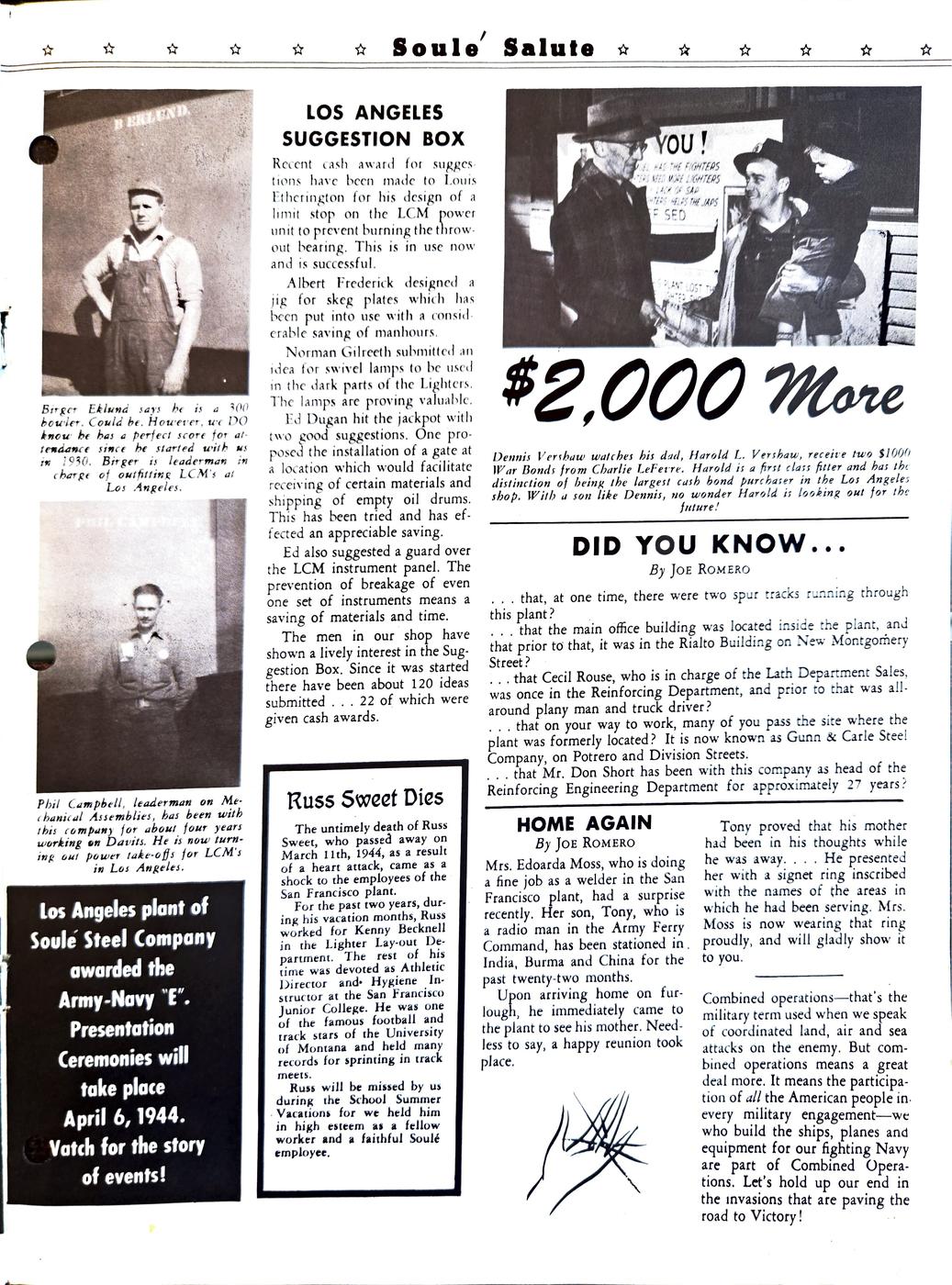
*Photo: Dennis Vershaw watches his dad, Harold L. Vershaw, receive two $1000 War Bonds from Charlie LeFevre. Harold is a first class fitter and has the distinction of being the largest cash bond purchaser in the Los Angeles shop. With a son like Dennis, no wonder Harold is looking out for the future!*
DID YOU KNOW...
*By JOE ROMERO*
. . . that, at one time, there were two spur tracks running through this plant?
. . . that the main office building was located inside the plant, and that prior to that, it was in the Rialto Building on New Montgomery Street?
. . . that Cecil Rouse, who is in charge of the Lath Department Sales, was once in the Reinforcing Department, and prior to that was all-around plany man and truck driver?
. . . that on your way to work, many of you pass the site where the plant was formerly located? It is now known as Gunn & Carle Steel Company, on Potrero and Division Streets.
. . . that Mr. Don Short has been with this company as head of the Reinforcing Engineering Department for approximately 27 years?
HOME AGAIN
*By JOE ROMERO*
Mrs. Edoarda Moss, who is doing a fine job as a welder in the San Francisco plant, had a surprise recently. Her son, Tony, who is a radio man in the Army Ferry Command, has been stationed in India, Burma and China for the past twenty-two months.
Upon arriving home on furlough, he immediately came to the plant to see his mother. Needless to say, a happy reunion took place.
Tony proved that his mother had been in his thoughts while he was away. . . . He presented her with a signet ring inscribed with the names of the areas in which he had been serving. Mrs. Moss is now wearing that ring proudly, and will gladly show it to you.
Combined operations—that's the military term used when we speak of coordinated land, air and sea attacks on the enemy. But combined operations means a great deal more. It means the participation of *all* the American people in every military engagement—we who build the ships, planes and equipment for our fighting Navy are part of Combined Operations. Let's hold up our end in the invasions that are paving the road to Victory!
Page 8
* * * Soule' Salute * * *
NAVY LANDING CRAFT PROGRAM WILL INCLUDE 65,000 VESSELS OF ALL TYPES
Huge coming offensives against Germany and Japan were foreshadowed in the recent announcement by Rear Admiral E. L. Cochrane, Chief of the Bureau of Ships, Navy Department, that the current shipbuilding program involved 65,000 landing craft of all types, excluding miscellaneous small craft and rubber boats. These range from 450-foot dock ships to the amphibian tractors known as "alligators".
Twenty thousand landing craft have already been produced. Many of these have been used in the landing operations in Africa, Sicily and Salerno, and in the landings in the Pacific, starting at Guadalcanal in August, 1942, and extending on down through the recent operations at the Gilberts. These represent a total value of $1,500,000,000, exclusive of ordnance.
There are also on order today 25,000 additional craft totaling the sum of $2,000,000,000, and there is pending before Congress a further authorization of approximately 20,000 more craft, involving an estimated cost of $1,600,000,000.
Thus, the total program will exceed 65,000 vessels, in addition to which there are about 15,000 miscellaneous small craft, rubber boats, rafts, etc., which are needed to supplement and round out the total forces. During the next year one out of every four dollars that the Navy spends for ship construction of all kinds will be spent for landing craft.
As of the 1st of December there were 67 shipyards and plants building landing craft. It has been estimated that the requirements of these yards and plants will fan out to reach from 20,000 to 30,000 subcontractors whose wholehearted cooperation is absolutely essential to meet the delivery schedules required to equip the Army and Marine Corps amphibious divisions.
The tremendous numbers and varieties of landing craft, involving about 15 distinct types are required to cover the various conditions under which the war is being fought around the world.
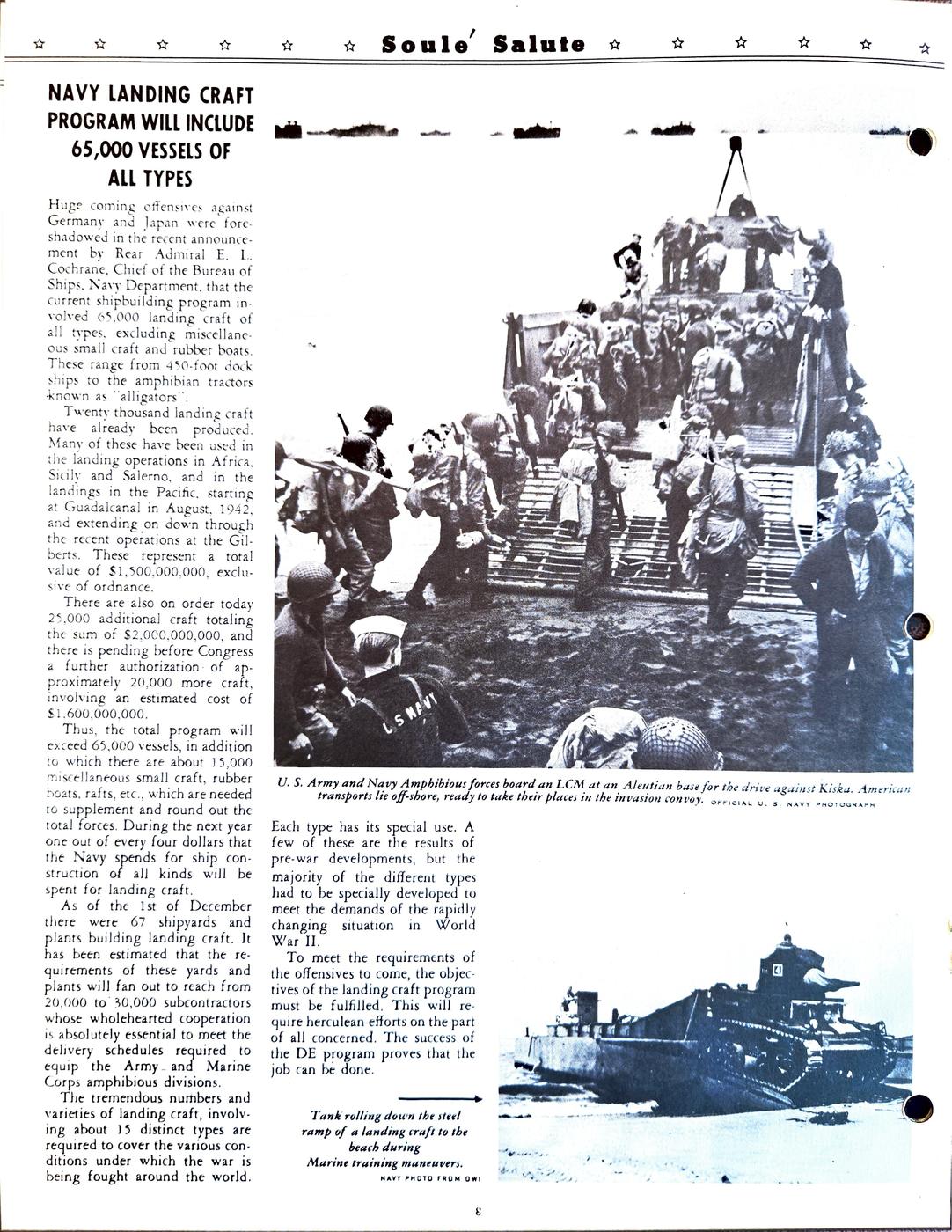
*Photo: U. S. Army and Navy Amphibious forces board an LCM at an Aleutian base for the drive against Kiska. American transports lie off-shore, ready to take their places in the invasion convoy. OFFICIAL U. S. NAVY PHOTOGRAPH*
Each type has its special use. A few of these are the results of pre-war developments, but the majority of the different types had to be specially developed to meet the demands of the rapidly changing situation in World War II.
To meet the requirements of the offensives to come, the objectives of the landing craft program must be fulfilled. This will require herculean efforts on the part of all concerned. The success of the DE program proves that the job can be done.
*Photo: Tank rolling down the steel ramp of a landing craft to the beach during Marine training maneuvers. NAVY PHOTO FROM DWI*
8