Page 1
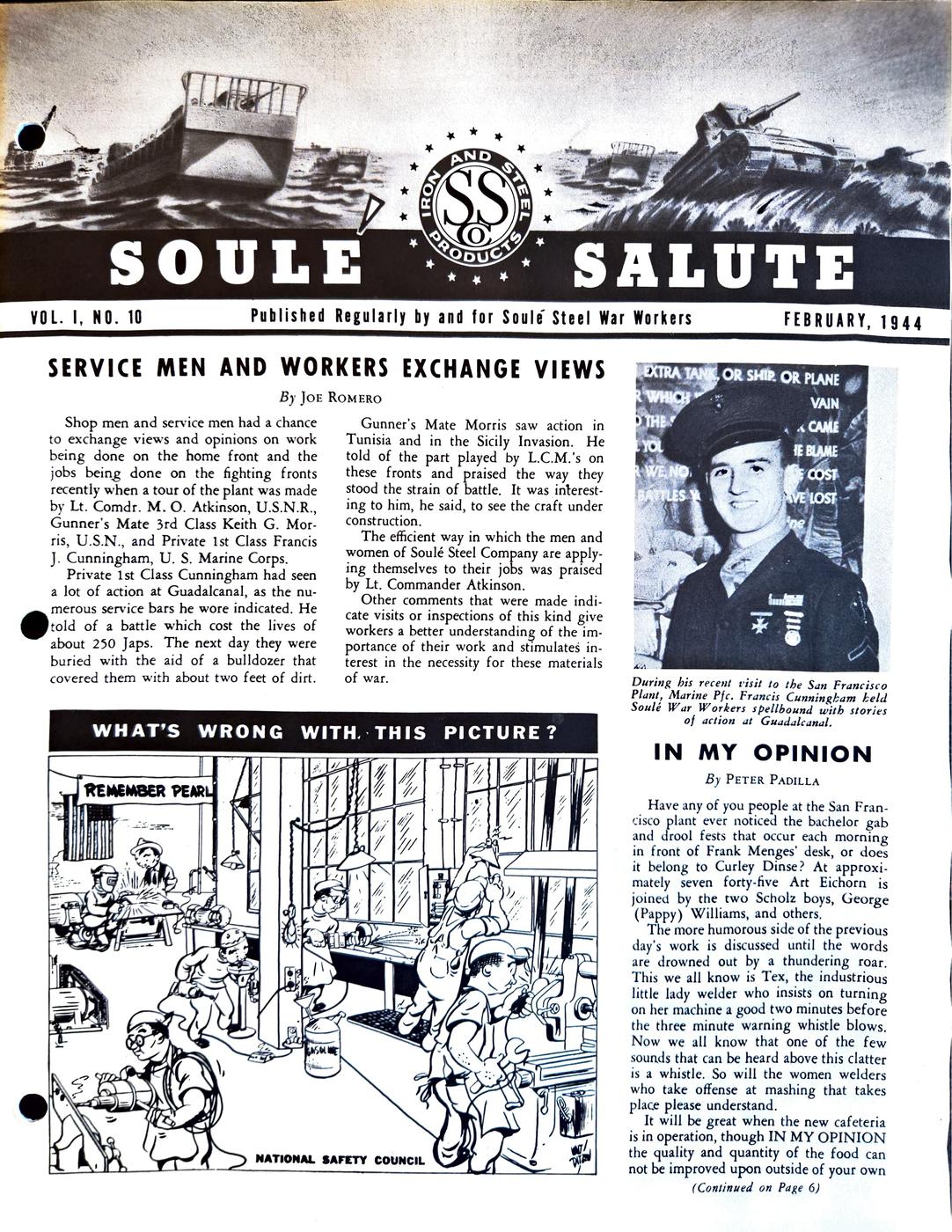
SOULE SALUTE
VOL. I, NO. 10 Published Regularly by and for Soule Steel War Workers FEBRUARY, 1944
SERVICE MEN AND WORKERS EXCHANGE VIEWS
By JOE ROMERO
Shop men and service men had a chance to exchange views and opinions on work being done on the home front and the jobs being done on the fighting fronts recently when a tour of the plant was made by Lt. Comdr. M. O. Atkinson, U.S.N.R., Gunner's Mate 3rd Class Keith G. Morris, U.S.N., and Private 1st Class Francis J. Cunningham, U. S. Marine Corps.
Private 1st Class Cunningham had seen a lot of action at Guadalcanal, as the numerous service bars he wore indicated. He told of a battle which cost the lives of about 250 Japs. The next day they were buried with the aid of a bulldozer that covered them with about two feet of dirt.
Gunner's Mate Morris saw action in Tunisia and in the Sicily Invasion. He told of the part played by L.C.M.'s on these fronts and praised the way they stood the strain of battle. It was interesting to him, he said, to see the craft under construction.
The efficient way in which the men and women of Soule Steel Company are applying themselves to their jobs was praised by Lt. Commander Atkinson.
Other comments that were made indicate visits or inspections of this kind give workers a better understanding of the importance of their work and stimulates interest in the necessity for these materials of war.
During his recent visit to the San Francisco Plant, Marine Pfc. Francis Cunningham held Soule War Workers spellbound with stories of action at Guadalcanal.
WHAT'S WRONG WITH THIS PICTURE?
REMEMBER PEARL
NATIONAL SAFETY COUNCIL
IN MY OPINION
By PETER PADILLA
Have any of you people at the San Francisco plant ever noticed the bachelor gab and drool fests that occur each morning in front of Frank Menges' desk, or does it belong to Curley Dinse? At approximately seven forty-five Art Eichorn is joined by the two Scholz boys, George (Pappy) Williams, and others.
The more humorous side of the previous day's work is discussed until the words are drowned out by a thundering roar. This we all know is Tex, the industrious little lady welder who insists on turning on her machine a good two minutes before the three minute warning whistle blows. Now we all know that one of the few sounds that can be heard above this clutter is a whistle. So will the women welders who take offense at mashing that takes place please understand.
It will be great when the new cafeteria is in operation, though IN MY OPINION the quality and quantity of the food can not be improved upon outside of your own
(Continued on Page 6)
Page 2
ABOUT OUR PEOPLE
**SOULE SALUTE**
Vol. I No. 10 Published Regularly by and for Soule Steel War Workers
Staff: Managing Editor . . . George Cobb Los Angeles Editor . . . Bill Irwin Portland Editor . . . . Les Poole San Francisco Editor, Fred Kappelman
Associate Editors: Los Angeles Art Carter Eddie Dugan Ted Jones Charles La Fevre Dorothy Olsen George Thomas
San Francisco Peter F. Culcasi Art Eichorn Paul Hyner Louise Jones Peter Padilla Joe Romero Marion Shechy
Portland John Vaile
Torrance A. M. Dowell
SAN FRANCISCO
We're all pulling for Curtis Mac Merrick, who is in the Colusa Hospital having skin grafted on the foot he injured while on a hunting trip some months ago. While waiting for the injury to mend, Mac operated a crane with his foot in a partial cast. That's the spirit our fighting men can understand and appreciate.
* * *
Charles Katleba, who worked as shear-man before going into the Navy, paid the "gang" a visit. His rating of MOMM 2/c means that Chuck is a Motor Machinists Mate Second Class. He made the trip from San Diego "by rule of thumb" and beat the train by four hours!
* * *
Louis Tanforan, who was a crane operator before he became a corporal with the Aviation Engineers, sent us his A.P.O. address. We'll see that the Salute is sent his way.
* * *
LIBERTY BELLES
NATIONAL SAFETY COUNCIL
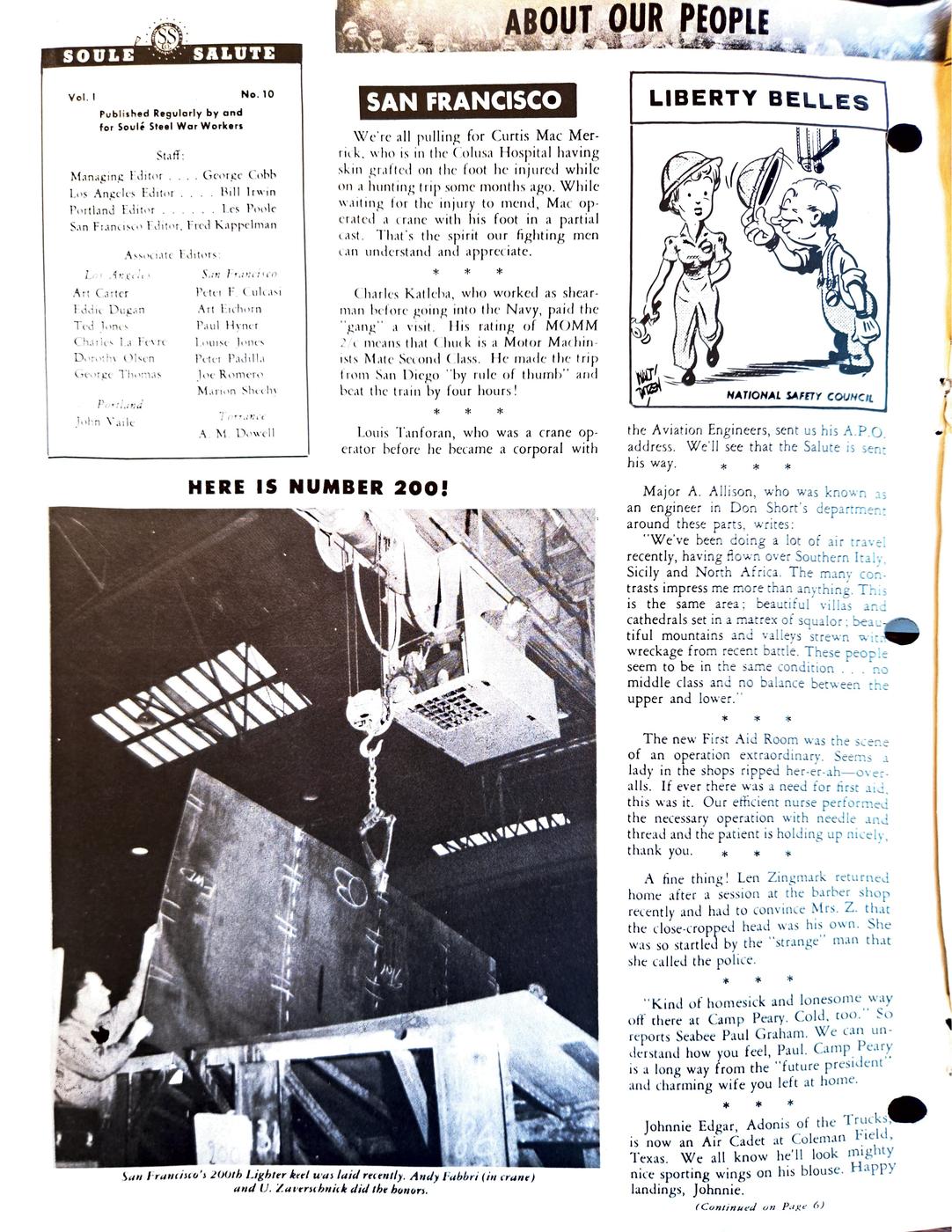
HERE IS NUMBER 200!
*San Francisco's 200th Lighter keel was laid recently. Andy Fabbri (in crane) and U. Zaverschnick did the honors.*
Major A. Allison, who was known as an engineer in Don Short's department around these parts, writes:
"We've been doing a lot of air travel recently, having flown over Southern Italy, Sicily and North Africa. The many contrasts impress me more than anything. This is the same area; beautiful villas and cathedrals set in a matrix of squalor; beautiful mountains and valleys strewn with wreckage from recent battle. These people seem to be in the same condition . . . no middle class and no balance between the upper and lower."
* * *
The new First Aid Room was the scene of an operation extraordinary. Seems a lady in the shops ripped her-er-ah—overalls. If ever there was a need for first aid, this was it. Our efficient nurse performed the necessary operation with needle and thread and the patient is holding up nicely, thank you.
* * *
A fine thing! Len Zingmark returned home after a session at the barber shop recently and had to convince Mrs. Z. that the close-cropped head was his own. She was so startled by the "strange" man that she called the police.
* * *
"Kind of homesick and lonesome way off there at Camp Peary. Cold, too." So reports Seabee Paul Graham. We can understand how you feel, Paul. Camp Peary is a long way from the "future president" and charming wife you left at home.
* * *
Johnnie Edgar, Adonis of the Trucks, is now an Air Cadet at Coleman Field, Texas. We all know he'll look mighty nice sporting wings on his blouse. Happy landings, Johnnie.
(Continued on Page 6)
Page 3
Soule' Salute
IT HAPPENS ON MONDAYS
By PAUL HYNER
Ladies and gentlemen—now before we say a word we want to warn you about something . . . something quite serious. Here it is: The editor is mad as h—l at us. We haven't the faintest idea why, or how it all started, but just the same, we learn he's fairly seething.
We've got an idea he's going to try, in some way, to get even. Maybe louse up our article or something. There have been rumors.
In fact, from a reliable source—a guy named Joe—we heard that whatever we wrote for this issue was going to be printed in reverse. Dirty trick, eh?
(Editor's note: Mr. Hyner! Ew *reven* tnirp gnihtyna ni esrever! As if *we* would go from bad to reverse!)
In any event, there's no use worrying about it. Now, we'd like to call this little contribution, "It Happens on Monday," and what we mean is that here is an hour-by-hour résumé of what happens in the shop on Mondays. Also on Tuesdays, Wednesdays, Thursdays, Fridays and Saturdays. And don't forget about that, Editor.
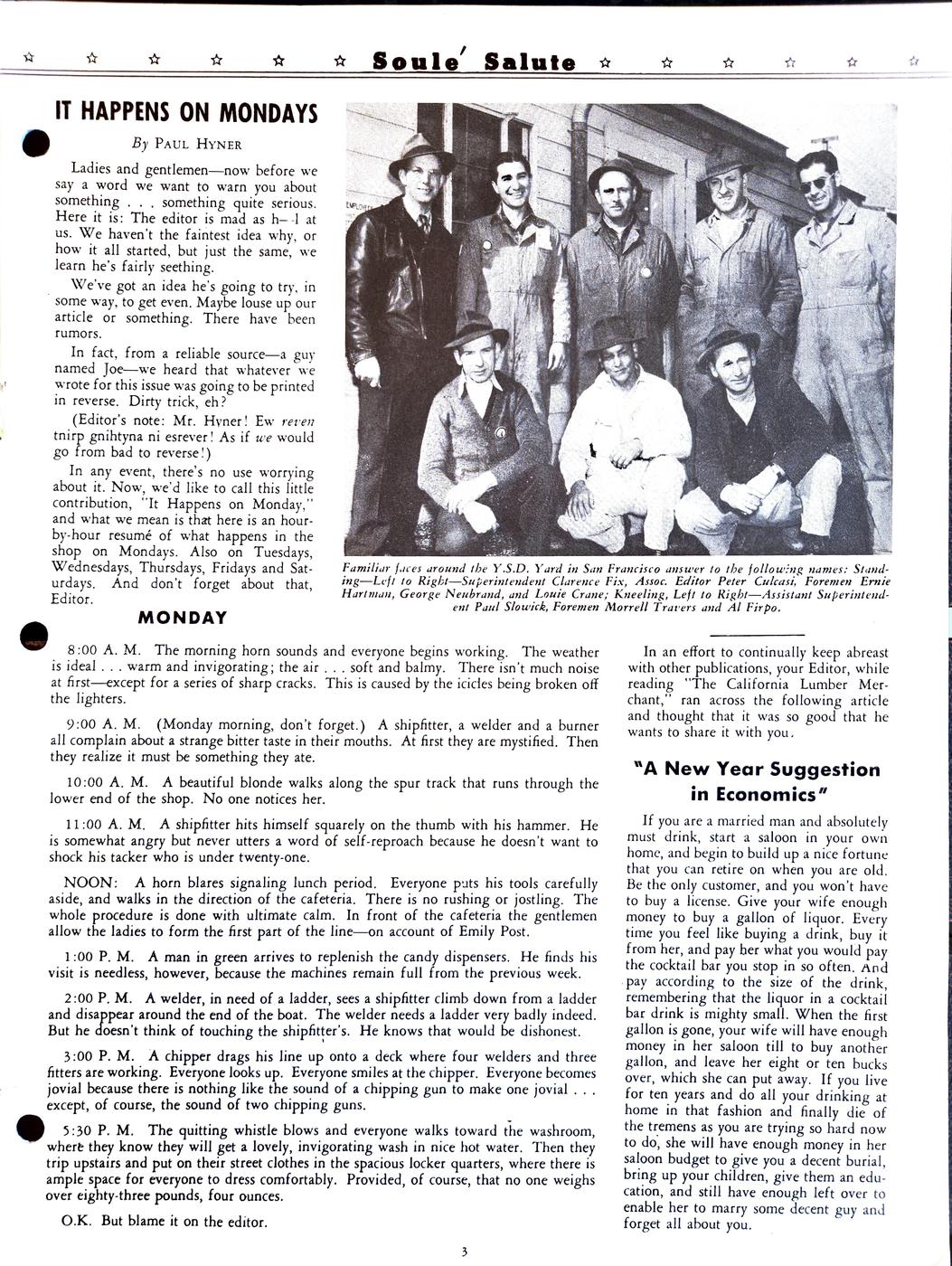
Photo: Familiar faces around the Y.S.D. Yard in San Francisco answer to the following names: Standing—Left to Right—Superintendent Clarence Fix, Assoc. Editor Peter Culcast, Foremen Ernie Hartman, George Neubrand, and Louie Crane; Kneeling, Left to Right—Assistant Superintendent Paul Slowick, Foremen Morrell Travers and Al Firpo.
MONDAY
8:00 A. M. The morning horn sounds and everyone begins working. The weather is ideal . . . warm and invigorating; the air . . . soft and balmy. There isn't much noise at first—except for a series of sharp cracks. This is caused by the icicles being broken off the lighters.
9:00 A. M. (Monday morning, don't forget.) A shipfitter, a welder and a burner all complain about a strange bitter taste in their mouths. At first they are mystified. Then they realize it must be something they ate.
10:00 A. M. A beautiful blonde walks along the spur track that runs through the lower end of the shop. No one notices her.
11:00 A. M. A shipfitter hits himself squarely on the thumb with his hammer. He is somewhat angry but never utters a word of self-reproach because he doesn't want to shock his tacker who is under twenty-one.
NOON: A horn blares signaling lunch period. Everyone puts his tools carefully aside, and walks in the direction of the cafeteria. There is no rushing or jostling. The whole procedure is done with ultimate calm. In front of the cafeteria the gentlemen allow the ladies to form the first part of the line—on account of Emily Post.
1:00 P. M. A man in green arrives to replenish the candy dispensers. He finds his visit is needless, however, because the machines remain full from the previous week.
2:00 P. M. A welder, in need of a ladder, sees a shipfitter climb down from a ladder and disappear around the end of the boat. The welder needs a ladder very badly indeed. But he doesn't think of touching the shipfitter's. He knows that would be dishonest.
3:00 P. M. A chipper drags his line up onto a deck where four welders and three fitters are working. Everyone looks up. Everyone smiles at the chipper. Everyone becomes jovial because there is nothing like the sound of a chipping gun to make one jovial . . . except, of course, the sound of two chipping guns.
5:30 P. M. The quitting whistle blows and everyone walks toward the washroom, where they know they will get a lovely, invigorating wash in nice hot water. Then they trip upstairs and put on their street clothes in the spacious locker quarters, where there is ample space for everyone to dress comfortably. Provided, of course, that no one weighs over eighty-three pounds, four ounces.
O.K. But blame it on the editor.
In an effort to continually keep abreast with other publications, your Editor, while reading "The California Lumber Merchant," ran across the following article and thought that it was so good that he wants to share it with you.
"A New Year Suggestion in Economics"
If you are a married man and absolutely must drink, start a saloon in your own home, and begin to build up a nice fortune that you can retire on when you are old. Be the only customer, and you won't have to buy a license. Give your wife enough money to buy a gallon of liquor. Every time you feel like buying a drink, buy it from her, and pay her what you would pay the cocktail bar you stop in so often. And pay according to the size of the drink, remembering that the liquor in a cocktail bar drink is mighty small. When the first gallon is gone, your wife will have enough money in her saloon till to buy another gallon, and leave her eight or ten bucks over, which she can put away. If you live for ten years and do all your drinking at home in that fashion and finally die of the tremens as you are trying so hard now to do, she will have enough money in her saloon budget to give you a decent burial, bring up your children, give them an education, and still have enough left over to enable her to marry some decent guy and forget all about you.
Page 4
Soule' Salute
YSD WORKERS HELP SAVE MEN AND EQUIPMENT
The Importance of YSD Boats By PETER F. CULCASL
I'd like to take this opportunity to state some interesting facts about the boats which we at Islais Creek Yard are building. We down here have been constantly asked the question: "Why are these YSD boats so important?" so there remains nothing else for me but to attempt to answer this question.
Wherever much over-water flying is done, Navy Ships stand by at all times ready to speed to the rescue of cracked-up planes and their crews. Water is a very hard substance, and in most cases a plane striking it is torn apart by the terrific impact and its engine very often breaks away from the main body. Also, its occupants are very often catapulted out of their seats. A few minutes delay in rescue might possibly mean death for someone. This means that the boats which we are building must be heavy and sturdy enough to maintain high speed through rough choppy waters for off-shore and long range sea rescues.
These huge boats have equally huge over-hanging cranes which can pick up a disabled Flying Boat with ease and lay it gently on its deck. Diving gear is also carried so that men may descend to a sunken wreck to attach hoisting cables. Another fact that I may mention is that a salvage boat generally stands by during take-off and landing operations of large Naval flying boats. These boats have the latest word in equipment and are wonderfully outfitted having: refrigerators, ice water cooler, electric ranges, signal and flood lights, telephone system, CO2 Fire System and other equipment that I can not mention.
Although these boats are not frequently publicized, in my estimation they are as important to the war effort as anything else that the Navy may be building; and the cost of building and maintaining a crew is more than balanced by the recovery of engines, plane parts and most important of all trained, experienced human life.
We were policemen, newspapermen, college students, school teachers, cabinet makers, mechanics, hill billies and music professors, yet combined we now are trained to do a task that is expected of us and we are doing it well. Yes! We are another link in a great chain—a symbol of DEMOCRACY.
Photo: A. L. Johnson has a mighty important task at the Y.S.D. yard. He is the Navy Inspector.
SOME WAR WORKERS MAY BUILD OWN HOMES
War workers have been assured by the War Production Board and the National Housing Agency that it is still possible under certain restrictions to build a privately-financed home . . . but only the builder may live in it.
The first step in constructing a dwelling for the occupancy of the builder is for the war worker to go to his local War Housing Center and be certified as eligible for occupancy of a war housing project. He then will file WPB priority forms with the local Federal Housing Administration field office, and from that point on follow the normal processing pattern. The housing must be situated in a critical area and must be within the housing quota of the area, must conform to War Housing Construction Standards and other regulations which affect the construction of housing costing up to $6,000.
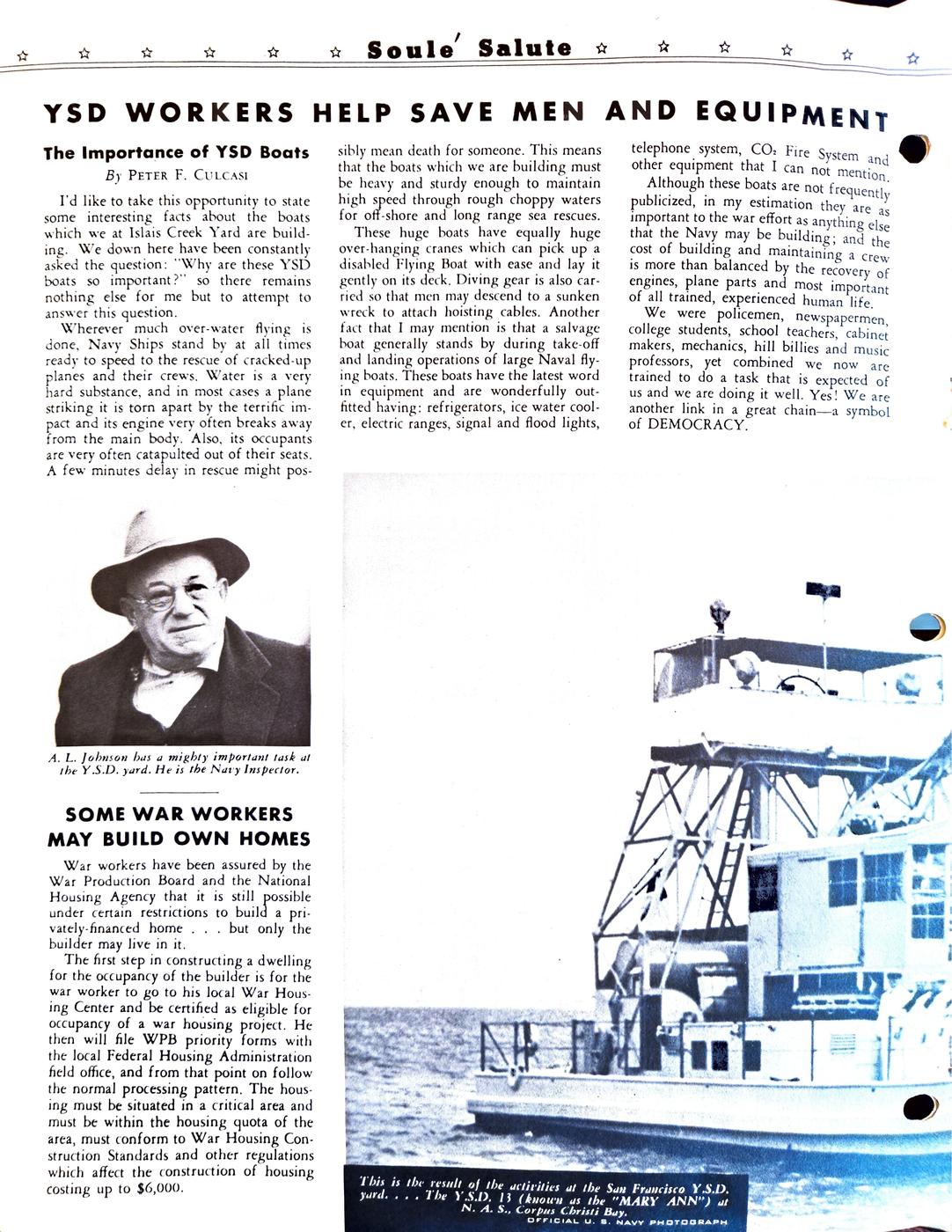
Photo: This is the result of the activities at the San Francisco Y.S.D. yard. . . . The Y.S.D. 13 (known as the "MARY ANN") at N. A. S., Corpus Christi Bay. OFFICIAL U. S. NAVY PHOTOGRAPH
Page 5
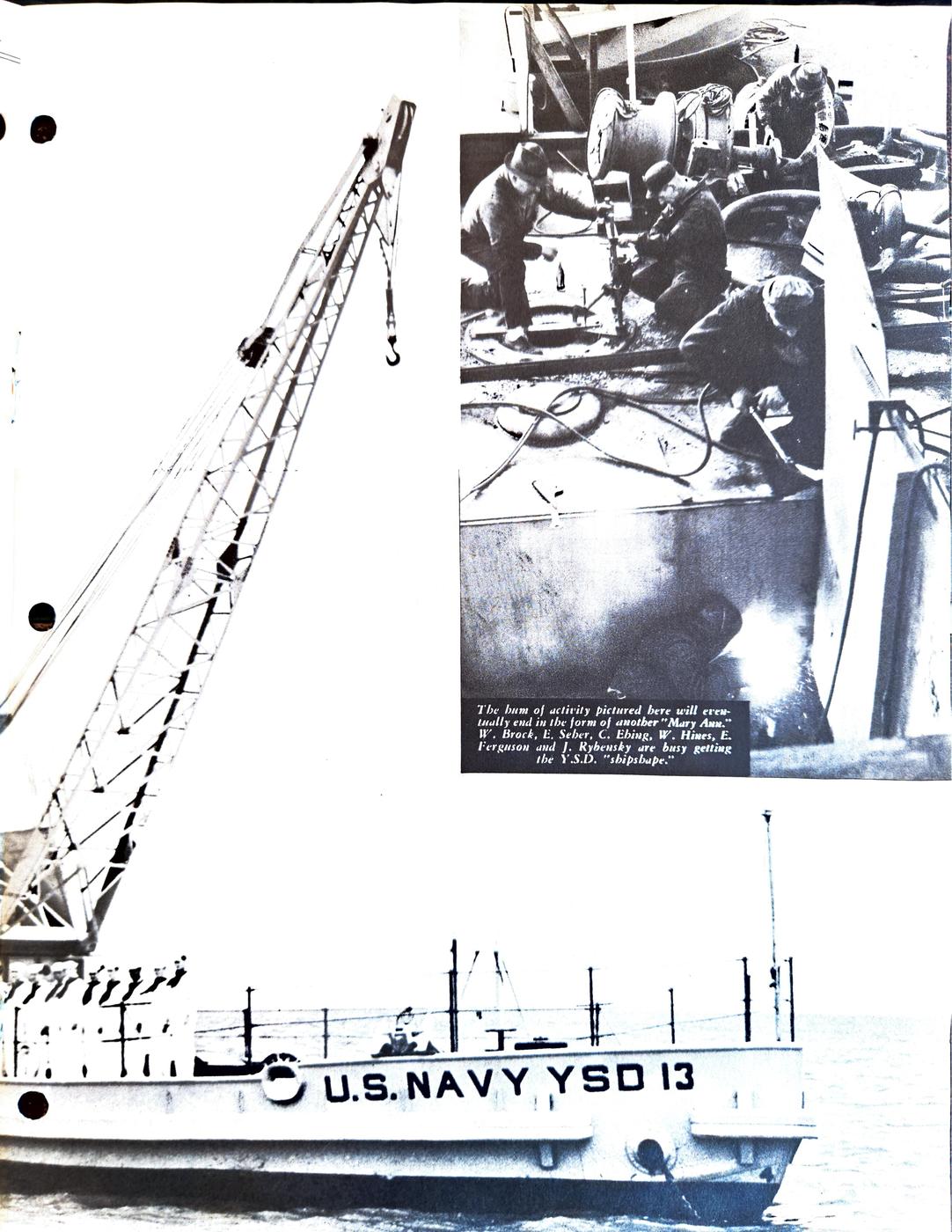
*Photo: The hum of activity pictured here will eventually end in the form of another "Mary Ann." W. Brock, E. Seber, C. Ebing, W. Hines, E. Ferguson and J. Rybensky are busy getting the Y.S.D. "shipsbape."*
U.S. NAVY YSD 13
Page 6
Soule' Salute
WORKERS COUNTED ON IN FOURTH WAR LOAN
The Treasury Department is counting on workers more than in previous drives for the success of the Fourth War Loan, which will start January 18 and continue through February 15.
The Treasury hopes that at least one participant in two of the Payroll Savings Plan will buy an extra $100 bond. In the Second War Loan, only one prospect in five bought an extra bond, and in the Third War Loan, one in three.
The goal of the Fourth War Loan is 14 billion dollars—one billion less than that of the Third War Loan of last September. Of this amount, five-and-a-half billions are wanted from individuals, and eight-and-a-half billions from other non-banking sources.
The Treasury plans to make special efforts in the coming drive at the source of income to reach the quota set for individuals. Plant and office workers will be contacted at their place of business rather than at their homes.
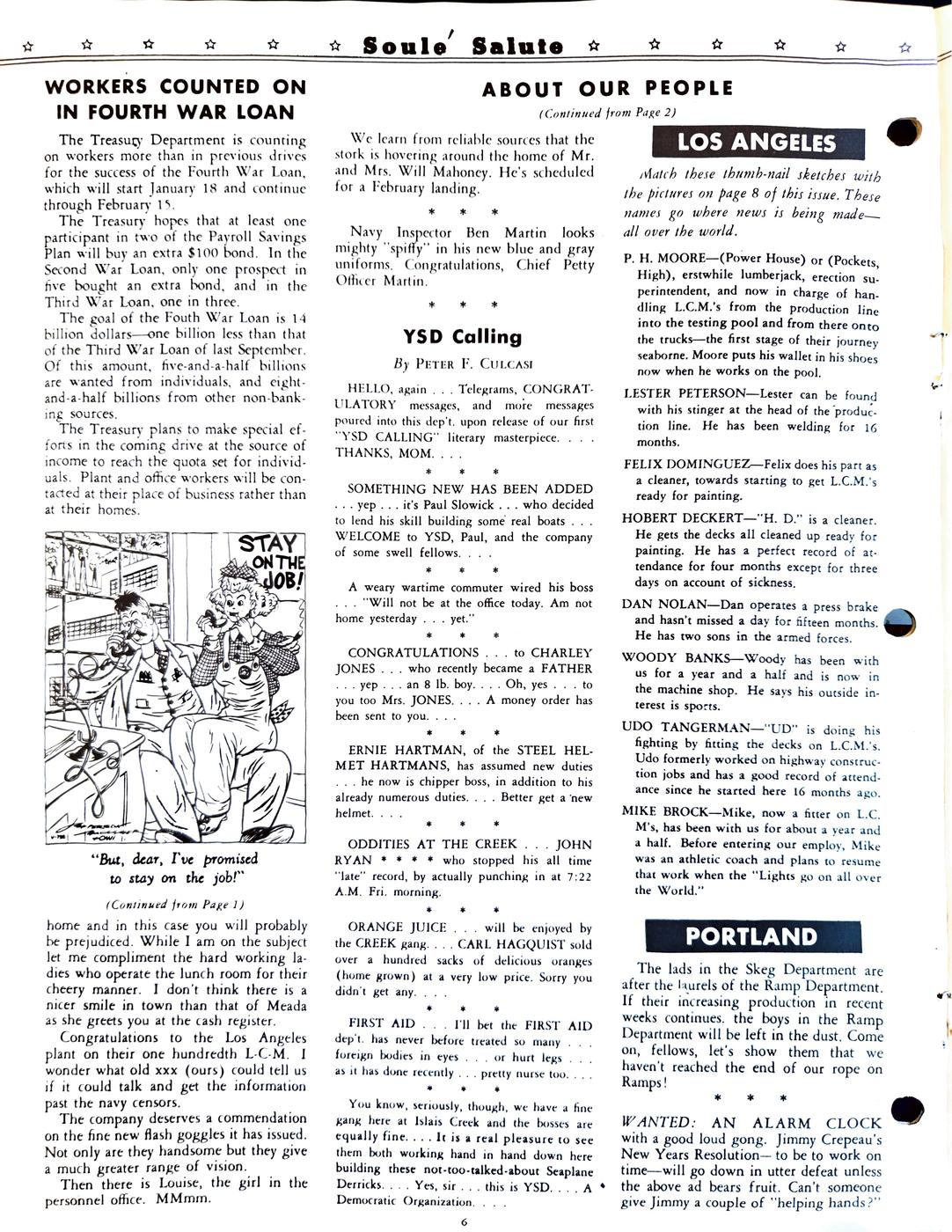
Photo: "But, dear, I’ve promised to stay on the job!" (Continued from Page 1)
home and in this case you will probably be prejudiced. While I am on the subject let me compliment the hard working ladies who operate the lunch room for their cheery manner. I don’t think there is a nicer smile in town than that of Meada as she greets you at the cash register.
Congratulations to the Los Angeles plant on their one hundredth L-C.M. I wonder what old xxx (ours) could tell us if it could talk and get the information past the navy censors.
The company deserves a commendation on the fine new flash goggles it has issued. Not only are they handsome but they give a much greater range of vision.
Then there is Louise, the girl in the personnel office. MMmm.
ABOUT OUR PEOPLE (Continued from Page 2)
We learn from reliable sources that the stork is hovering around the home of Mr. and Mrs. Will Mahoney. He’s scheduled for a February landing.
* * *
Navy Inspector Ben Martin looks mighty “spiffy” in his new blue and gray uniforms. Congratulations, Chief Petty Officer Martin.
* * *
YSD Calling By PETER F. CULCASI
HELLO, again . . . Telegrams, CONGRATULATORY messages, and more messages poured into this dep’t. upon release of our first “YSD CALLING” literary masterpiece. . . . THANKS, MOM. . . .
* * *
SOMETHING NEW HAS BEEN ADDED . . . yep . . . it’s Paul Slowick . . . who decided to lend his skill building some real boats . . . WELCOME to YSD, Paul, and the company of some swell fellows. . . .
* * *
A weary wartime commuter wired his boss . . . “Will not be at the office today. Am not home yesterday . . . yet.”
* * *
CONGRATULATIONS . . . to CHARLEY JONES . . . who recently became a FATHER . . . yep . . . an 8 lb. boy. . . . Oh, yes . . . to you too Mrs. JONES. . . . A money order has been sent to you. . . .
* * *
ERNIE HARTMAN, of the STEEL HELMET HARTMANS, has assumed new duties . . . he now is chipper boss, in addition to his already numerous duties. . . . Better get a ‘new helmet. . . .
* * *
ODDITIES AT THE CREEK . . . JOHN RYAN * * * * who stopped his all time “late” record, by actually punching in at 7:22 A.M. Fri. morning.
* * *
ORANGE JUICE . . . will be enjoyed by the CREEK gang. . . . CARL HAGQUIST sold over a hundred sacks of delicious oranges (home grown) at a very low price. Sorry you didn’t get any. . . .
* * *
FIRST AID . . . I’ll bet the FIRST AID dep’t. has never before treated so many . . . foreign bodies in eyes . . . or hurt legs . . . as it has done recently . . . pretty nurse too. . . .
* * *
You know, seriously, though, we have a fine gang here at Islais Creek and the bosses are equally fine. . . . It is a real pleasure to see them both working hand in hand down here building these not-too-talked-about Seaplane Derricks. . . . Yes, sir . . . this is YSD. . . . A Democratic Organization. . . .
LOS ANGELES
Match these thumb-nail sketches with the pictures on page 8 of this issue. These names go where news is being made— all over the world.
P. H. MOORE—(Power House) or (Pockets, High), erstwhile lumberjack, erection superintendent, and now in charge of handling L.C.M.’s from the production line into the testing pool and from there onto the trucks—the first stage of their journey seaborne. Moore puts his wallet in his shoes now when he works on the pool.
LESTER PETERSON—Lester can be found with his stinger at the head of the production line. He has been welding for 16 months.
FELIX DOMINGUEZ—Felix does his part as a cleaner, towards starting to get L.C.M.’s ready for painting.
HOBERT DECKERT—“H. D.” is a cleaner. He gets the decks all cleaned up ready for painting. He has a perfect record of attendance for four months except for three days on account of sickness.
DAN NOLAN—Dan operates a press brake and hasn’t missed a day for fifteen months. He has two sons in the armed forces.
WOODY BANKS—Woody has been with us for a year and a half and is now in the machine shop. He says his outside interest is sports.
UDO TANGERMAN—“UD” is doing his fighting by fitting the decks on L.C.M.’s. Udo formerly worked on highway construction jobs and has a good record of attendance since he started here 16 months ago.
MIKE BROCK—Mike, now a fitter on L.C. M’s, has been with us for about a year and a half. Before entering our employ, Mike was an athletic coach and plans to resume that work when the “Lights go on all over the World.”
PORTLAND
The lads in the Skeg Department are after the laurels of the Ramp Department. If their increasing production in recent weeks continues, the boys in the Ramp Department will be left in the dust. Come on, fellows, let’s show them that we haven’t reached the end of our rope on Ramps!
* * *
WANTED: AN ALARM CLOCK with a good loud gong. Jimmy Crepeau’s New Years Resolution—to be to work on time—will go down in utter defeat unless the above ad bears fruit. Can’t someone give Jimmy a couple of “helping hands?”
Page 7
Soule' Salute
The Fable of Mabel
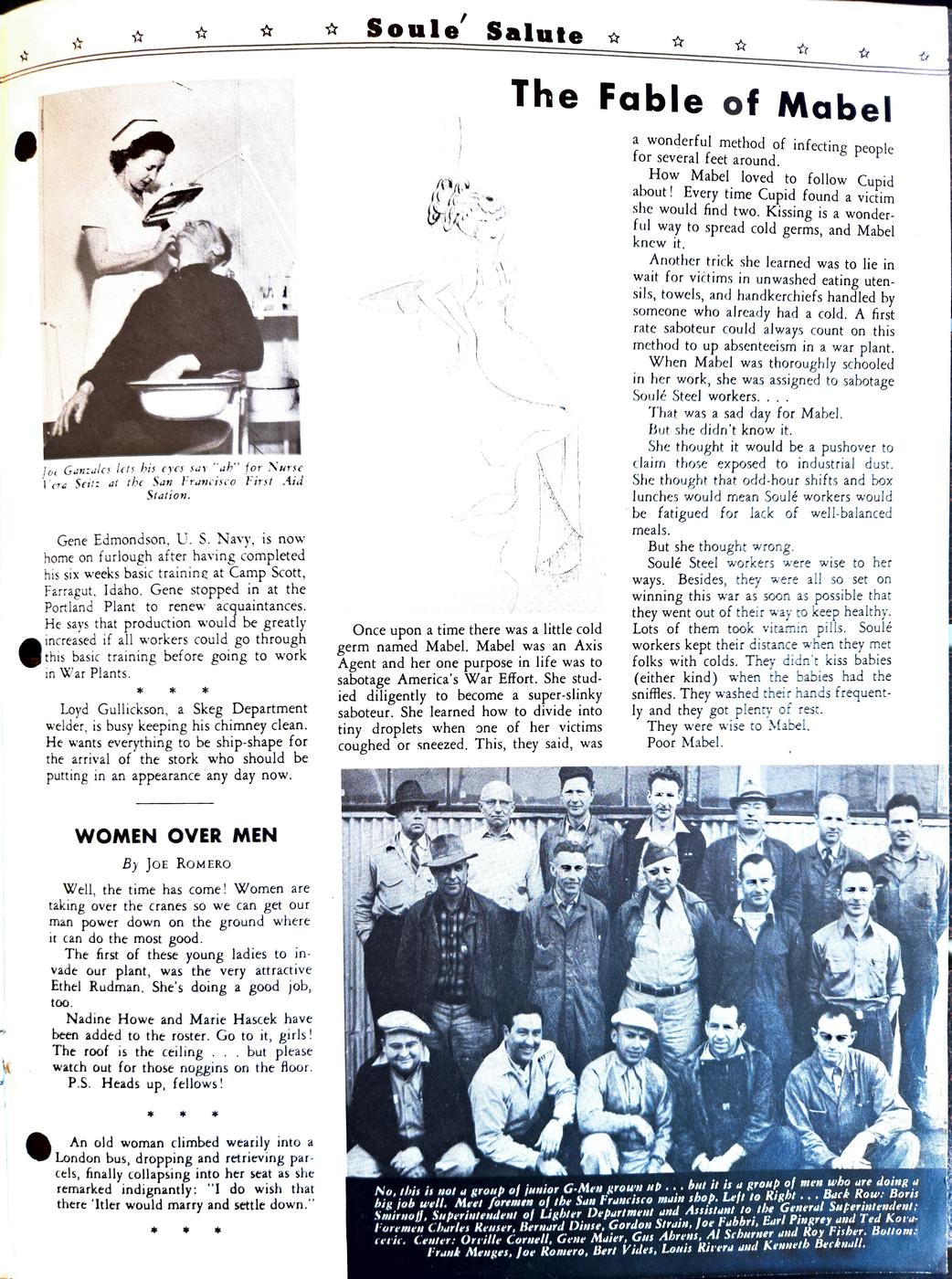
*Joe Gonzales lets his eyes say "ah" for Nurse Vera Seitz at the San Francisco First Aid Station.*
Gene Edmondson, U. S. Navy, is now home on furlough after having completed his six weeks basic training at Camp Scott, Farragut, Idaho. Gene stopped in at the Portland Plant to renew acquaintances. He says that production would be greatly increased if all workers could go through this basic training before going to work in War Plants.
* * *
Loyd Gullickson, a Skeg Department welder, is busy keeping his chimney clean. He wants everything to be ship-shape for the arrival of the stork who should be putting in an appearance any day now.
Once upon a time there was a little cold germ named Mabel. Mabel was an Axis Agent and her one purpose in life was to sabotage America's War Effort. She studied diligently to become a super-slinky saboteur. She learned how to divide into tiny droplets when one of her victims coughed or sneezed. This, they said, was a wonderful method of infecting people for several feet around.
How Mabel loved to follow Cupid about! Every time Cupid found a victim she would find two. Kissing is a wonderful way to spread cold germs, and Mabel knew it.
Another trick she learned was to lie in wait for victims in unwashed eating utensils, towels, and handkerchiefs handled by someone who already had a cold. A first rate saboteur could always count on this method to up absenteeism in a war plant.
When Mabel was thoroughly schooled in her work, she was assigned to sabotage Soule Steel workers. . . .
That was a sad day for Mabel.
But she didn't know it.
She thought it would be a pushover to claim those exposed to industrial dust. She thought that odd-hour shifts and box lunches would mean Soule workers would be fatigued for lack of well-balanced meals.
But she thought wrong.
Soule Steel workers were wise to her ways. Besides, they were all so set on winning this war as soon as possible that they went out of their way to keep healthy. Lots of them took vitamin pills. Soule workers kept their distance when they met folks with colds. They didn't kiss babies (either kind) when the babies had the sniffles. They washed their hands frequently and they got plenty of rest.
They were wise to Mabel.
Poor Mabel.
WOMEN OVER MEN
By JOE ROMERO
Well, the time has come! Women are taking over the cranes so we can get our man power down on the ground where it can do the most good.
The first of these young ladies to invade our plant, was the very attractive Ethel Rudman. She's doing a good job, too.
Nadine Howe and Marie Hascek have been added to the roster. Go to it, girls! The roof is the ceiling . . . but please watch out for those noggins on the floor.
P.S. Heads up, fellows!
* * *
An old woman climbed wearily into a London bus, dropping and retrieving parcels, finally collapsing into her seat as she remarked indignantly: "I do wish that there 'Itler would marry and settle down."
*No, this is not a group of junior G-Men grown up . . . but it is a group of men who are doing a big job well. Meet foremen of the San Francisco main shop. Left to Right . . . Back Row: Boris Smirnoff, Superintendent of Lighter Department and Assistant to the General Superintendent; Foremen Charles Reuser, Bernard Dinse, Gordon Strain, Joe Fabbri, Earl Pingrey and Ted Kova-ceric. Center: Orville Cornell, Gene Maier, Gus Abrens, Al Schurner and Roy Fisher. Bottom: Frank Menges, Joe Romero, Bert Vides, Louis Rivera and Kenneth Becknall.*
Page 8
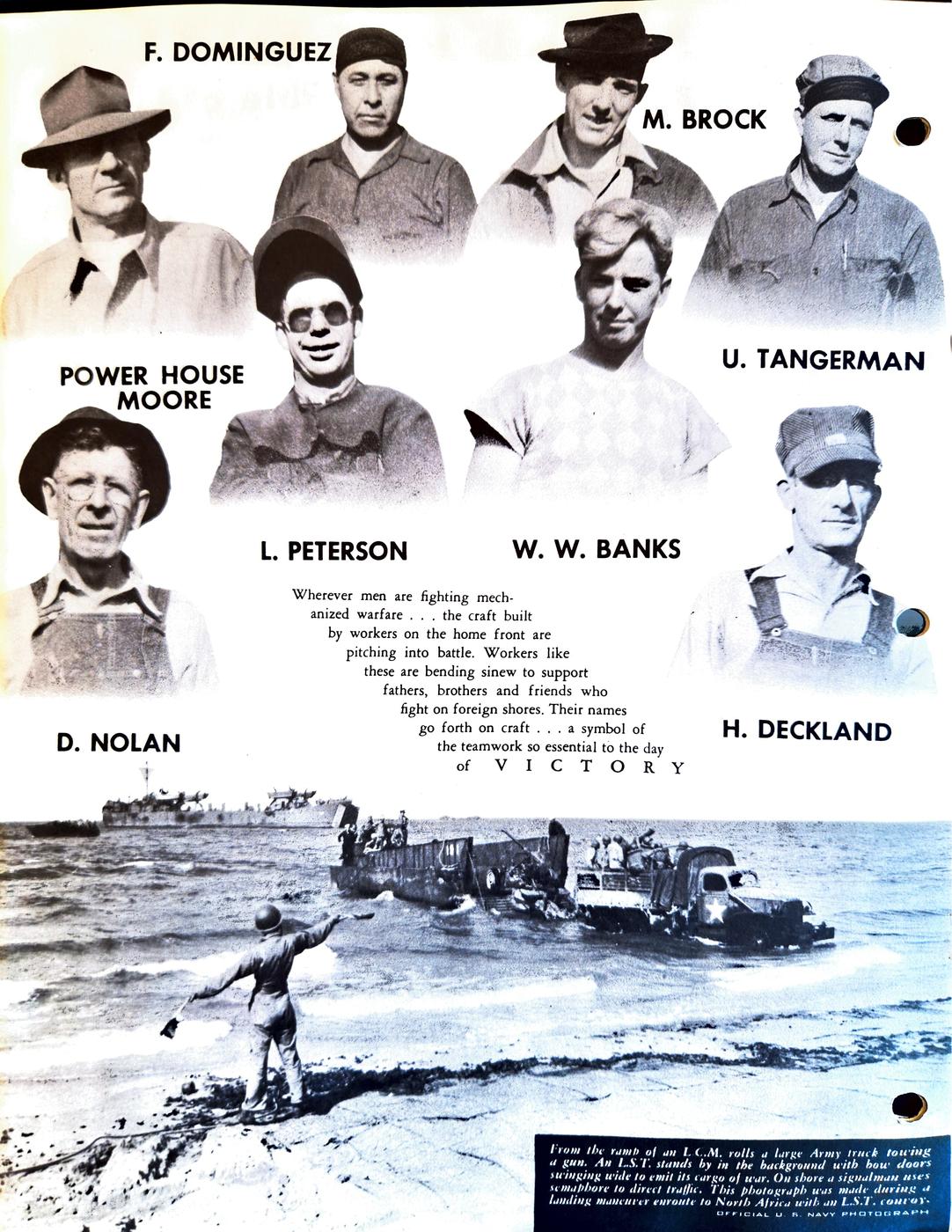
F. DOMINGUEZ M. BROCK POWER HOUSE MOORE U. TANGERMAN L. PETERSON W. W. BANKS D. NOLAN H. DECKLAND
Wherever men are fighting mechanized warfare . . . the craft built by workers on the home front are pitching into battle. Workers like these are bending sinew to support fathers, brothers and friends who fight on foreign shores. Their names go forth on craft . . . a symbol of the teamwork so essential to the day of VICTORY
Photo: From the ramp of an L.C.M. rolls a large Army truck towing a gun. An L.S.T. stands by in the background with bow doors swinging wide to emit its cargo of war. On shore a signalman uses semaphore to direct traffic. This photograph was made during a landing maneuver enroute to North Africa with an L.S.T. convoy. OFFICIAL U. S. NAVY PHOTOGRAPH