Page 1

SOULÉ # SALUTE IRON AND STEEL SS SO PRODUCTS
TOURNEAU MODEL
EXTRA
Soulé Equipment Company ## to distribute ## Le Tourneau Products (Story on page 3)
VOL. 2, NO. 4 Published Regularly by and for Soulé Steel War Workers JULY 22, 1944
Page 2
Soule' Salute
**SOULE SALUTE**
Vol. 2 No. 4 Published Regularly by and for Soule Steel War Workers
Staff: Managing Editor . . . . George Cobb Los Angeles Editor . . . Bill Irwin Portland Editor . . . . . Les Poole San Francisco Editor, Fred Kappelman
Associate Editors: Los Angeles Clarence Balfour Frank Bennett Art Dedrick Eddie Dugan Ted Jones Charlie LeFevre H B Porter
San Francisco Elaine Bradshaw Peter F. Culcasi Paul Hyner Peter Padilla Joe Romero Marion Sheehy
Portland John Vaile
Torrance A. M. Dowell
Assembly Line ## OF NEWS ABOUT OUR PEOPLE
Bill Tedford writes San Francisco "I see a great many LCM's and always check the name plates in hopes of running across one from Soule. So far I have seen one. I would appreciate hearing from any of the old San Francisco gang who have a moment to spare." His latest address is: Lt. (j.g.) W. A. Tedford, U. S. S. Leedstown, Fleet Post Office, San Francisco, California.
Warren C. Reinecker of the San Francisco Plant writes "It takes the Salute almost two months to reach me in the South Pacific." He sends his best wishes to all of his friends in San Francisco. His latest address is: W. C. Reinecker, Storekeeper 1/c, U.S.S. Belleau Wood, 6th Division, Fleet Post Office, San Francisco, California.
FIGHTING DOLLARS
War is costly in money as well as lives. Before a soldier can participate in combat, the Quartermaster Corps estimates it spends $440 in simply feeding and clothing him for a year.
When the soldier is ready for combat, he must be equipped with certain basic weapons such as a 30-caliber semi-automatic M1 Garand rifle (cost, $80), a bayonet (cost, $5), and at least four hand grenades (cost, $6.24).
A soldier may use a flame-thrower (cost, $950), may be part of a gun crew, working a 155-mm. howitzer (cost, $23,000), or keep in communication with other units by means of a walkie-talkie (cost, $200).
Heavy bombers cost about $250,000, medium bombers about $110,000, and fighter planes about $50,000. To make one medium bomber takes about 13,000 man-hours. Food from 20 acres is needed to feed workers who build one bomber. Large bombers take 27,000 man-hours.
Bombs weighing up to 4,000 pounds cost about $875. Oxygen masks for the crew of a Flying Fortress cost about $40. To each mask is attached a regulator costing $60, and a $25 oxygen cylinder from which the flyer draws his breath of life.
To land the units for an invasion, highly-specialized boats are put into action. The smallest type of self-propelled "crocodile boat" costs about $18,500 and the highest model costs $27,000. An ocean-going landing barge runs to about $2 million.
Ten .50-caliber machine guns firing at a maximum rate of fire for two hours and five minutes would use one million rounds of ammunition.
The Los Angeles machine shop loses another good man this week. "Cotton Top" Woody Banks has joined the Marines. Best of luck, we'll pull for you and your early return.
W. J. Pike, the genial Resident Inspector at Los Angeles has just received notice from his boss, the U. S. Navy, that he was awarded the coveted "E" efficiency rating. This is the highest recognition given Naval Inspectors—signifying "that performance in an important phase of the work was outstanding; there was no weakness in performance in any respect." Congratulations!
San Francisco's Andy P. Kalodemas writes from "somewhere in the South Pacific"—"I can say that the tank lighters which you people are building are playing a tremendous part in this war. We need all we can get." Andy's present address is: Cox, Navy Number 3236, c/o Fleet Post Office, San Francisco, California.
Glad to hear from San Francisco's Bill Bjorkquist, S 2/c, V-5, U.S.N.R., Tarmac Training, U. S. NAS, Livermore, California. Bill says he is on K.P. duty but doesn't say just what he did to be put there.
Paul Graham, who used to work in the San Francisco Plant, writes again to say, "the outfit I'm in is a (Censored)." Thanks for the details Paul. Paul also sends best wishes and regards to all his former fellow workers. His present address is: Paul D. Graham Storekeeper 3/c, C.B.D. 1041, Fleet Post Office, San Francisco, California.
School days, school days! It seems they're not over for some people. Through the co-operation of the War Manpower Commission our Los Angeles Leadermen have just completed a successful course. I understand the prize scholar was Don Crawford—naturally. Charlie LeFevre played "Truant Officer."
All we need now, in the Los Angeles Plant, is to hear a juke box loudly play "El Rancho Grande." Please do not be alarmed at those strange mutterings that come from Dorothy Downey's office. It's just Dorothy and Margaret Snoddy (of the Purchasing Department) practicing their Spanish. Seems they are taking a course in conversational Spanish at U. C. L. A. Extension. Can they help it if they only have each other on which to practice?
MIA GRACIAS SEÑOR DIAS NOCHAS
George B. Scholz, now in the Navy, visited the San Francisco Plant on June 20th and renewed his acquaintanceship with the boys in the shop. George has just finished boot training and is off to bigger things. It certainly is a pleasure to have our men in the service drop in to see us.
Page 3
* * * * * Soule' Salute * * * * *
Soulé Equipment Company Created To Distribute LeTourneau Products
Continuing its trend toward expanding wartime services and its policy of post-war planning now, the management of Soulé Steel Company has created Soulé Equipment Company. The new company has been organized for the purpose of selling, distributing, servicing and repairing LeTourneau earthmoving equipment and construction machinery in Northern California. Headquarters will be at 1750 East 12th St., Oakland, California. Other full servicing branches will include Sacramento, Fresno and Redding, California.
Primarily responsible for the idea behind Soulé Equipment Company and its successful bid for the distributorship of R. G. LeTourneau, Inc., is Edward L. Soulé, President of Soulé Steel Company.
Long a believer in the heavy construction and roadbuilding field as an immediate buffer to post-war industrial letdown and a lively opportunity for increasing jobs with private industry at good income levels, Mr. Soulé found his own views paralleled in the ideals and plans of the farseeing LeTourneau management. After some time devoted to necessary preliminary study and conference the relationship was cemented in a contract signed by Mr. Soulé and Mr. LeTourneau at Peoria, Illinois, June 24, 1944.
While Mr. Soulé will head Soulé Equipment Company, Sumner Williams has been appointed Vice President and General Manager. Mr. Williams has had a long association with a LeTourneau distributor in the Northwest and has a thorough knowledge of all problems connected with sales and service, as well as actual repair work in the field.
The story of R. G. LeTourneau, Inc., dominates the history of modern earthmoving. In 1919, G. LeTourneau was operating a tractor in Stockton, California. From repairing his balky outfit, he turned his attention to improvements and soon developed the first power cable controlled positive action for loading and dumping. Next he created an electrically controlled scraper for digging and dumping which rode on spoked iron wheels. In turn this was followed by bulldozers and angledozers, improved Carryall scrapers and rooters, all designed around the ingenious power control unit.
The year 1932 marked the important turning point in LeTourneau earthmoving equipment and allied fields . . . the introduction of pneumatic tires. First used on Carryall scrapers, they immediately proved their increased speed and economy and soon were applied to other equipment. Earthmoving essentially is a problem of transportation and the use of pneumatic tires so materially improved all phases of operations it became only a short series of steps to the creation of the LeTourneau Tournapull. Now, both the earthmoving tool and the tractor that powers it operate on pneumatic rubber at speeds and economies never before experienced.
Today the LeTourneau line embraces equipment ranging from 2 3/10 yard loads to 45 yard loads and is capable of transporting them independently, and speedily, over long hauls and dumping them at controlled spread. They have proven their worth in the record breaking construction of modern highways cut through mountains, spanning chasms and slashing cross-country.
With the U. S. Engineers and other branches of the Armed Services on world-wide battle fronts, LeTourneau Tournapulls, Carryalls, 'Dozers and Rooters are leveling airstrips, cutting new roads through mountains, pushing trails through jungles toward victory.
Although a large portion of the LeTourneau output is now being taken for the armed forces Soulé Equipment Company is being fully organized and will be ready to meet any immediate civilian demands for equipment, servicing and repairs.
Photo: The LeTourneau Model LS Carryall. In the operation above the Carryall is being used to lengthen, widen and straighten city streets.
Photo: A LeTourneau Bulldozer and a Model L Carryall Scraper building a mountain road.
Photo: Earthmovers Limited, one of the largest earthmoving syndicates in England, uses 3 LeTourneau Model C. Tournapulls and a fleet of LeTourneau Carryalls to handle 500,000 cubic yards of earthmoving on an aerodrome project "somewhere in England".
3
Page 4
Soule' Salute
**LINE OF LeTOURNEAU CONSTRUCTION EQUIPMENT**
SUPER C. TOURNAPULL (Capacity—15 heaped yards)
SUPER C. TOURNACRANE (Lifting Capacity up to 20,000 lbs.)
SUPER C. TOURNATRAILER (Capacity—17 heaped yards)
MODEL D. TOURNAPULL (Capacity—2.5 heaped yards)
MODEL D. TOURNACRANE (Lifting Capacity up to 10,000 lbs.)
MODEL D. TOURNATRUCK (Capacity—5 tons)
CARRYALL SCRAPERS (for all tractors fitted with PCU's)
ROOTERS (for all tractors fitted with PCU's)
TRACTOR CRANES (for all tractors fitted with PCU's)
SHEEP'S FOOT ROLLERS (for all tractors)
Photo: Another Model C. Tournapull and LeTourneau Carryall being used on an "aerodrome project "somewhere" in England.
Photo: The Tournacrane in action. Here you see the Tournacrane being used in the construction of a steel frame building.
Photo: LeTourneau Equipment on the job. A tractor equipped with a Bulldozer in front and a Rooter attached behind is helping construct a road.
The Safe Side By J. F. BENNETT Member S. C. I. S. S.
Well here we are again, all of us, we hope. For variety, let's be a bit serious this month.
Did you know according to the American Standard Schedule of time charges for each accidental death, enough man days were lost in a recent year to man forty-five plants the size of ours here in Los Angeles for nineteen and one half years, not to mention the untold hardships and suffering to the families and friends of those men and women.
Men, if we are to keep up production, we must stay on the job. You have heard this statement time and again. We must do something about it. Being Safety Minded is a good way to start. Ninety-eight per cent of all industrial accidents are preventable and the bulk of all accidental deaths and injuries occur in medium and small plants. How may this be prevented? By the application of accident prevention.
You may ask—What is accident prevention? Accident prevention is the science of correct operation. In order to have correct operation, there must be complete cooperation among management, supervision, and workman. That includes all of us fellows.
Come on boys, let's make our plant a model for safety. If you are in doubt about something pertaining to safety, see your foremen or safety man, they should know.
Next month—Lost Time Accidents.
LIMERICKS, Ltd. By ELAINE BRADSHAW San Francisco
Introducing Limericks, Limited. Thru which all our views are exhibited. (They probably will be prohibited before this Salu [illegible] is distributed). Anyway, please meet Limericks, Limited. (Continued on page 8, col. 1)
4
Page 5
Soule' Salute
Three Home Runs in a Row U.S.S. YSD #62 IS THIRD YARD SEAPLANE DERRICK LAUNCHED AT ISLAIS CREEK YARD
By PETER F. CULCASI
"I christen thee the U.S.S. YSD No. 62." With these words by the ship's sponsor, Mrs. Charles Hoss, the third ocean going vessel built by the San Francisco YSD Yard got its customary bath of champagne and was launched at 12:02 p.m. May 20th. It was another jubilant occasion. Relatives and friends of the Soulé men who built the YSD No. 62 turned out in huge numbers to witness this important event.
George Cobb handled the M. C. duties in his usual easy manner and after making the opening address introduced the sponsor of the YSD No. 62, Mrs. Hoss. Then, in turn, he introduced the Matron of Honor, Mrs. Jean Dale and Mr. Charles Hoss. Speakers of the day were Alan Popes, Soulé employee, and Mr. Edw. L. Soulé. Alan Popes, a shipfitter at Islais Creek Yard, delivered a very interesting address on "Teamwork". The theme chosen for his address was very appropriate for the occasion. Mr. Soulé's speech was a tribute to the men at the YSD Yard. He said, "Congratulations on a job well done."
It was odd to see Charlie Hoss dressed in a grey suit with shirt and tie instead of his customary work clothes . . . although he would have preferred the latter.
We now have only three YSD's awaiting completion under our present contract with the United States Navy. Everyone has been amazed at the rapidity of our launchings at Islais Creek. In case you care for statistics, the YSD No. 62 was launched only twenty-eight days after the launching of the YSD No. 61, which followed thirty days after the YSD No. 60. Knowing this is a source of pride to us who are not actually fighting the war on the front lines . . . for this is our contribution to the war effort . . . adding links to an already long chain of ships built for the United States Navy.
Below: Alan Popes, speaker of the day, delivers his inspirational address on "Teamwork".
Mrs. Charles Hoss, sponsor of the YSD No. 62 with her daughter, Mrs. Jean Dale, who acted as Matron of Honor.
Center: The YSD No. 62 slides down the ways.
"CONGRATULATIONS ON A JOB WELL DONE" Edw. L. Soulé's talk at YSD No. 62 Launching
"Coming down to the Yard to help you fellows celebrate the launching of YSD's is beginning to be a regular thing and it is just that same rhythm of achievement in production that our Armed Forces needs to bring this war to an early end. Three home runs in a row, however, is an unusual batting average and I want to congratulate you fellows again and bring you the thanks of the entire Soulé organization.
"Since its early beginning of thirty years ago, the Soulé Steel Company has been an organization of builders — our products having been used in the construction of a large number of the West's greatest projects. Today, however, we face a new job of building, not only here at Soulé Steel but throughout the civilized world. I refer to the building of good will among men that must follow the building of these ships. Once the enemy forces are smashed, a new world must be rebuilt. A world in which co-operation among men and among nations must prevail.
"By demonstrating what teamwork can accomplish here at Soulé Steel, each and everyone of us is helping to lay the foundation for the kind of new world we all want.
"And so I say to you all, congratulations on a job well done. And let us all stick to our guns unceasingly until our goal is attained and this war is won."
5
Page 6
Soule' Salute
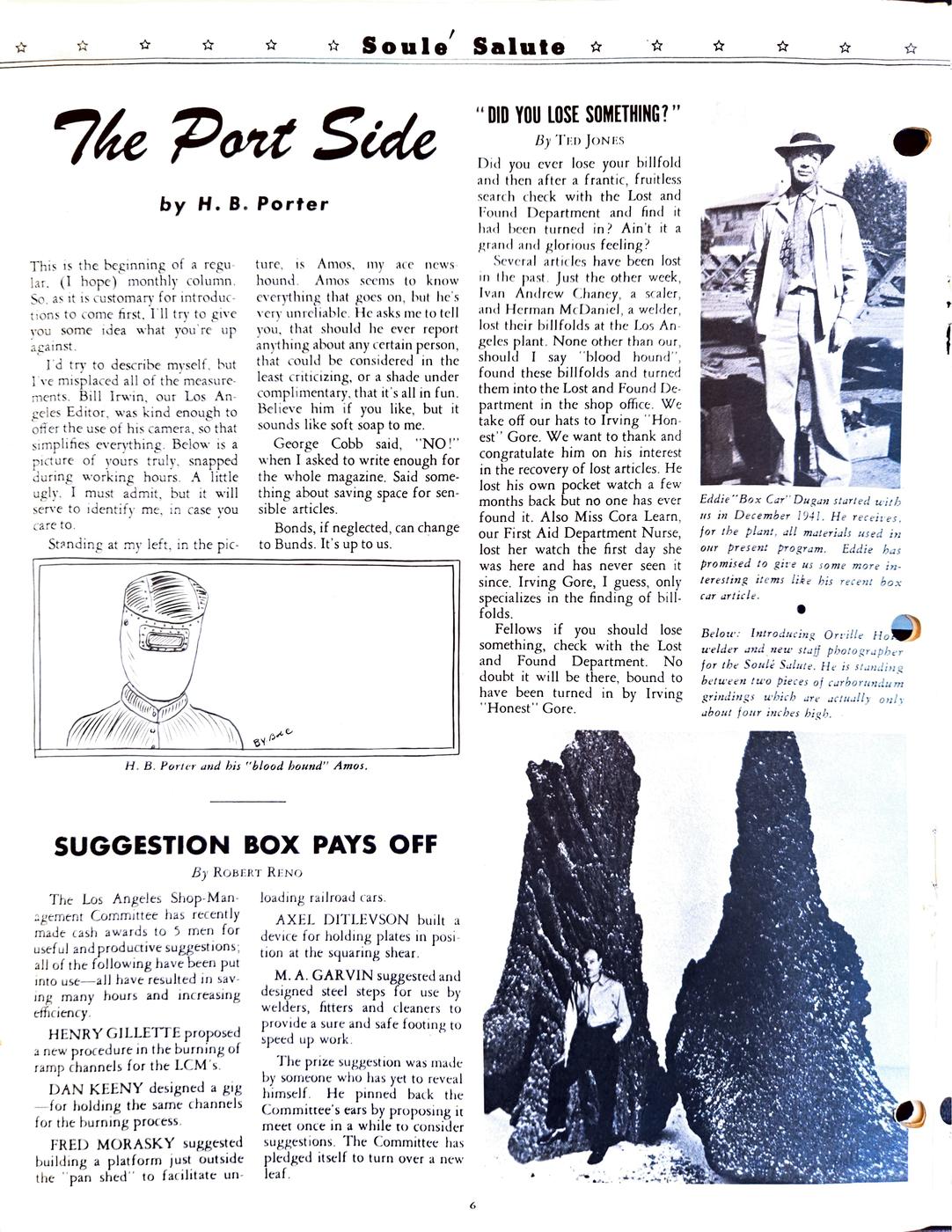
The Port Side by H. B. Porter
This is the beginning of a regular. (I hope) monthly column. So, as it is customary for introductions to come first, I'll try to give you some idea what you're up against.
I'd try to describe myself, but I've misplaced all of the measurements. Bill Irwin, our Los Angeles Editor, was kind enough to offer the use of his camera, so that simplifies everything. Below is a picture of yours truly, snapped during working hours. A little ugly, I must admit, but it will serve to identify me, in case you care to.
Standing at my left, in the picture, is Amos, my ace news-hound. Amos seems to know everything that goes on, but he's very unreliable. He asks me to tell you, that should he ever report anything about any certain person, that could be considered in the least criticizing, or a shade under complimentary, that it's all in fun. Believe him if you like, but it sounds like soft soap to me.
George Cobb said, "NO!" when I asked to write enough for the whole magazine. Said something about saving space for sensible articles.
Bonds, if neglected, can change to Bunds. It's up to us.
*Photo: H. B. Porter and his "blood bound" Amos.*
"DID YOU LOSE SOMETHING?" By TED JONES
Did you ever lose your billfold and then after a frantic, fruitless search check with the Lost and Found Department and find it had been turned in? Ain't it a grand and glorious feeling?
Several articles have been lost in the past. Just the other week, Ivan Andrew Chaney, a scaler, and Herman McDaniel, a welder, lost their billfolds at the Los Angeles plant. None other than our, should I say "blood hound", found these billfolds and turned them into the Lost and Found Department in the shop office. We take off our hats to Irving "Honest" Gore. We want to thank and congratulate him on his interest in the recovery of lost articles. He lost his own pocket watch a few months back but no one has ever found it. Also Miss Cora Learn, our First Aid Department Nurse, lost her watch the first day she was here and has never seen it since. Irving Gore, I guess, only specializes in the finding of billfolds.
Fellows if you should lose something, check with the Lost and Found Department. No doubt it will be there, bound to have been turned in by Irving "Honest" Gore.
*Photo: Eddie "Box Car" Dugan started with us in December 1941. He receives, for the plant, all materials used in our present program. Eddie has promised to give us some more interesting items like his recent box car article.*
SUGGESTION BOX PAYS OFF By ROBERT RENO
The Los Angeles Shop-Management Committee has recently made cash awards to 5 men for useful and productive suggestions; all of the following have been put into use—all have resulted in saving many hours and increasing efficiency.
HENRY GILLETTE proposed a new procedure in the burning of ramp channels for the LCM's.
DAN KEENY designed a gig —for holding the same channels for the burning process.
FRED MORASKY suggested building a platform just outside the "pan shed" to facilitate unloading railroad cars.
AXEL DITLEVSON built a device for holding plates in position at the squaring shear.
M. A. GARVIN suggested and designed steel steps for use by welders, fitters and cleaners to provide a sure and safe footing to speed up work.
The prize suggestion was made by someone who has yet to reveal himself. He pinned back the Committee's ears by proposing it meet once in a while to consider suggestions. The Committee has pledged itself to turn over a new leaf.
*Photo: Below: Introducing Orville Hor, welder and new staff photographer for the Soule Salute. He is standing between two pieces of carborundum grindings which are actually only about four inches high.*
Page 7
Soule' Salute
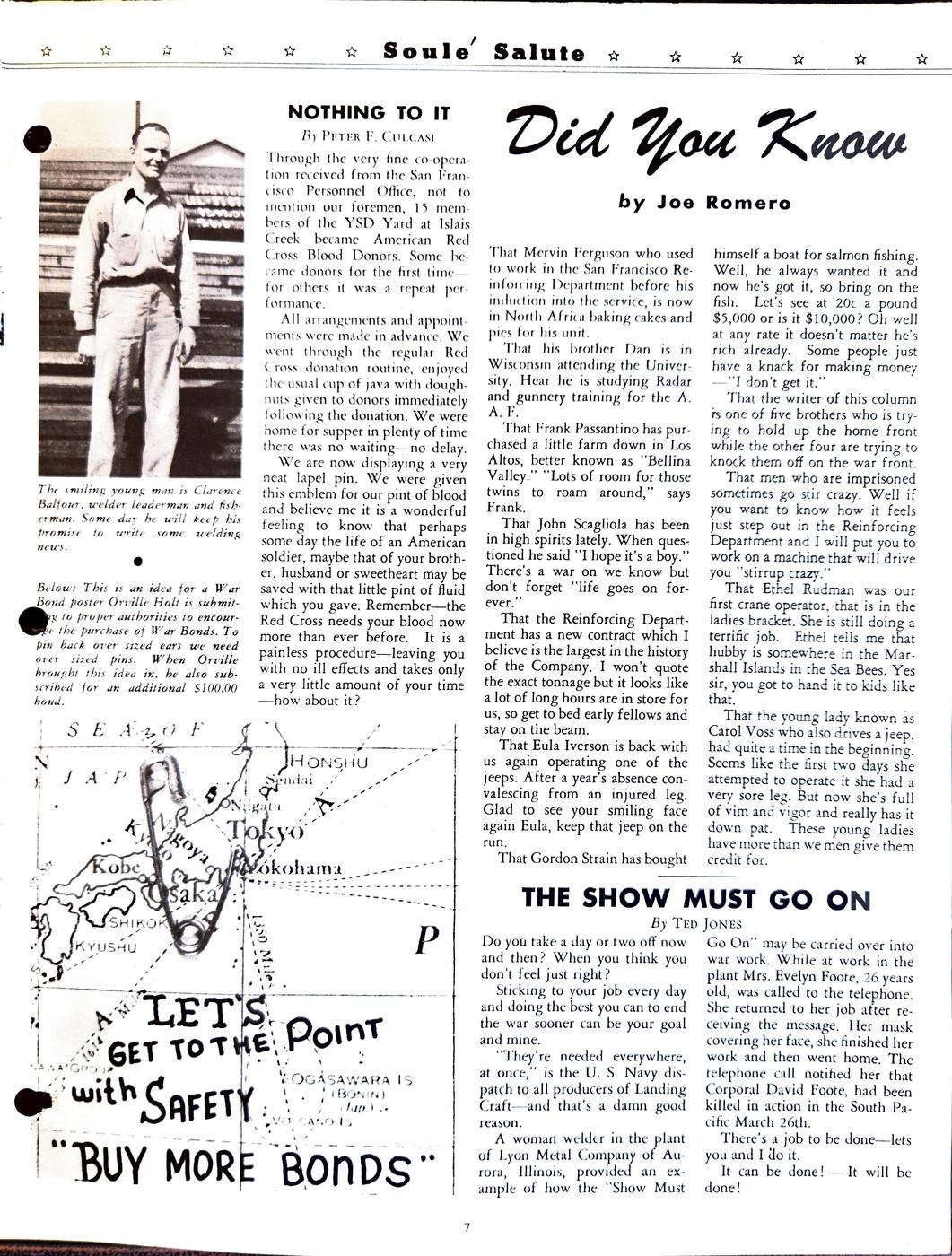
Did You Know by Joe Romero
NOTHING TO IT By PETER F. CULCASI
Through the very fine co-operation received from the San Francisco Personnel Office, not to mention our foremen, 15 members of the YSD Yard at Islais Creek became American Red Cross Blood Donors. Some became donors for the first time—for others it was a repeat performance.
All arrangements and appointments were made in advance. We went through the regular Red Cross donation routine, enjoyed the usual cup of java with doughnuts given to donors immediately following the donation. We were home for supper in plenty of time there was no waiting—no delay.
We are now displaying a very neat lapel pin. We were given this emblem for our pint of blood and believe me it is a wonderful feeling to know that perhaps some day the life of an American soldier, maybe that of your brother, husband or sweetheart may be saved with that little pint of fluid which you gave. Remember—the Red Cross needs your blood now more than ever before. It is a painless procedure—leaving you with no ill effects and takes only a very little amount of your time—how about it?
Photo: The smiling young man is Clarence Balfour, welder leaderman and fisherman. Some day he will keep his promise to write some welding news.
Below: This is an idea for a War Bond poster Orville Holt is submitting to proper authorities to encourage the purchase of War Bonds. To pin back over sized ears we need over sized pins. When Orville brought this idea in, he also subscribed for an additional $100.00 bond.
S E A O F J A P HONSHU Sendai Niigata Tokyo Yokohama Kobe Osaka SHIKOKU KYUSHU P LET'S GET TO THE POINT with SAFETY "BUY MORE BONDS" OGASAWARA IS (BONIN) (Jap.) VOLCANO IS
That Mervin Ferguson who used to work in the San Francisco Reinforcing Department before his induction into the service, is now in North Africa baking cakes and pies for his unit.
That his brother Dan is in Wisconsin attending the University. Hear he is studying Radar and gunnery training for the A. A. F.
That Frank Passantino has purchased a little farm down in Los Altos, better known as "Bellina Valley." "Lots of room for those twins to roam around," says Frank.
That John Scagliola has been in high spirits lately. When questioned he said "I hope it's a boy." There's a war on we know but don't forget "life goes on forever."
That the Reinforcing Department has a new contract which I believe is the largest in the history of the Company. I won't quote the exact tonnage but it looks like a lot of long hours are in store for us, so get to bed early fellows and stay on the beam.
That Eula Iverson is back with us again operating one of the jeeps. After a year's absence convalescing from an injured leg. Glad to see your smiling face again Eula, keep that jeep on the run.
That Gordon Strain has bought himself a boat for salmon fishing. Well, he always wanted it and now he's got it, so bring on the fish. Let's see at 20c a pound $5,000 or is it $10,000? Oh well at any rate it doesn't matter he's rich already. Some people just have a knack for making money —"I don't get it."
That the writer of this column is one of five brothers who is trying to hold up the home front while the other four are trying to knock them off on the war front.
That men who are imprisoned sometimes go stir crazy. Well if you want to know how it feels just step out in the Reinforcing Department and I will put you to work on a machine that will drive you "stirrup crazy."
That Ethel Rudman was our first crane operator, that is in the ladies bracket. She is still doing a terrific job. Ethel tells me that hubby is somewhere in the Marshall Islands in the Sea Bees. Yes sir, you got to hand it to kids like that.
That the young lady known as Carol Voss who also drives a jeep, had quite a time in the beginning. Seems like the first two days she attempted to operate it she had a very sore leg. But now she's full of vim and vigor and really has it down pat. These young ladies have more than we men give them credit for.
THE SHOW MUST GO ON By TED JONES
Do you take a day or two off now and then? When you think you don't feel just right?
Sticking to your job every day and doing the best you can to end the war sooner can be your goal and mine.
"They're needed everywhere, at once," is the U. S. Navy dispatch to all producers of Landing Craft—and that's a damn good reason.
A woman welder in the plant of Lyon Metal Company of Aurora, Illinois, provided an example of how the "Show Must Go On" may be carried over into war work. While at work in the plant Mrs. Evelyn Foote, 26 years old, was called to the telephone. She returned to her job after receiving the message. Her mask covering her face, she finished her work and then went home. The telephone call notified her that Corporal David Foote, had been killed in action in the South Pacific March 26th.
There's a job to be done—lets you and I do it.
It can be done! — It will be done!
Page 8
Soule' Salute
LOS ANGELES FITTERS ROMP WELDERS 18-13
By C. V. GAMBINA
**DON'T BE AN ACCIDENTEE!** TOSS IT BACK UP, WILLYA, CHARLIE? CLANK I'LL SAY I WILL! NATIONAL SAFETY COUNCIL
(Continued from Page 4, Column 4) We know a fellow named Gus with whom all our woes we discuss. He's a real diplomat, each employee knows that. Hats off to that fellow named Gus. * * * In office 13 resides Bob. Receiving just part of his job. Is it in—where's it gone— did you do it—that's wrong— In office 13, what a mob! * * * Al Schurner keeps telling us all of the size of his roses, etal. Could it be that this guy grows a chicken so high his fence must be 50 feet tall? (Continued in Column 4)
The day was cut out for the event as the welders and fitters of the Los Angeles Plant clashed in a spectacular game of softball on the Roosevelt Park diamond Sunday afternoon, June 5th. It was the first of the season, as the fitters greeted a winning score of 18 - 13.
An outstanding performance was given by Louie Lazarovitz (fitter) whose pitching ability was shown with ease. Louie is a burner leadman and has been with us for some time. Most of us sat with anxiety as we watched those curved balls cross the plate with great speed. "Rocky" Gesselman gave the crowd something to cheer about when he made three runs for his team. "Rocky" played baseball at Fremont High School for three years. Probably that is the reason for his batting ability. Mike Broch was the master of the field while playing short stop.
Mike, who was a physical instructor for many years in the east, had more interest than anyone in the game. He hopes to return to this work at the end of the war.
The welders put on an outstanding fight. Max Harms, welding leadman, made four runs. Max is also a baseball enthusiast.
Floyd Reed, a new-comer at the Los Angeles Plant, played with flying colors. Reed has a fine background in baseball. He had a team in the Navy in 1939. He also played semi-pro in the east and with the Los Angeles Giants in the west.
The fellows are taking a great deal of interest in the recreational program which is getting underway. There is hopes of a water polo team getting started. I have even greater hopes that it will be soon.
LINE UP
**Fitters** "Rocky" Gesselman .................... 2b Warren Moyer ........................ 3b Mike Brock ........................... SS Joe Slovacek ........................ 1b Louie Lazarovitz ..................... Pitcher Barney Brotnow ....................... RF Joe Ramirez .......................... LF Bill Harper .......................... CF Jim Bolicek .......................... C
**Welders** Lon Ferra ............................ 1b Max Harms ............................ 2b Griffith ............................. Pitcher Clarence Belfour ..................... SS Floyd Reed ........................... 3b George Ridgley ....................... Catcher Ted Harms ............................ LF David Bison .......................... CF Walter Williams ...................... RF
**DON'T BE AN ACCIDENTEE!** WHY DON'TCHA GIVE THIS GUY A OUTSIDE JOB, BOSS? WE DON'T WANT HIM HANGIN' AROUND IN HERE! NATIONAL SAFETY COUNCIL
(Continued from Column 1) The girls in the plant have a jewel in Mrs. Minnie, the Matron, no foolin'. O'er time out she presides for but one thing she chides Ten minutes is all you can rest in * * * So material arrives sans hiatus we turn to our friend "H.C." Freitas. If we need it, he calls, and allays all their stalls. But Tay-Holbrook was almost his fate-us.
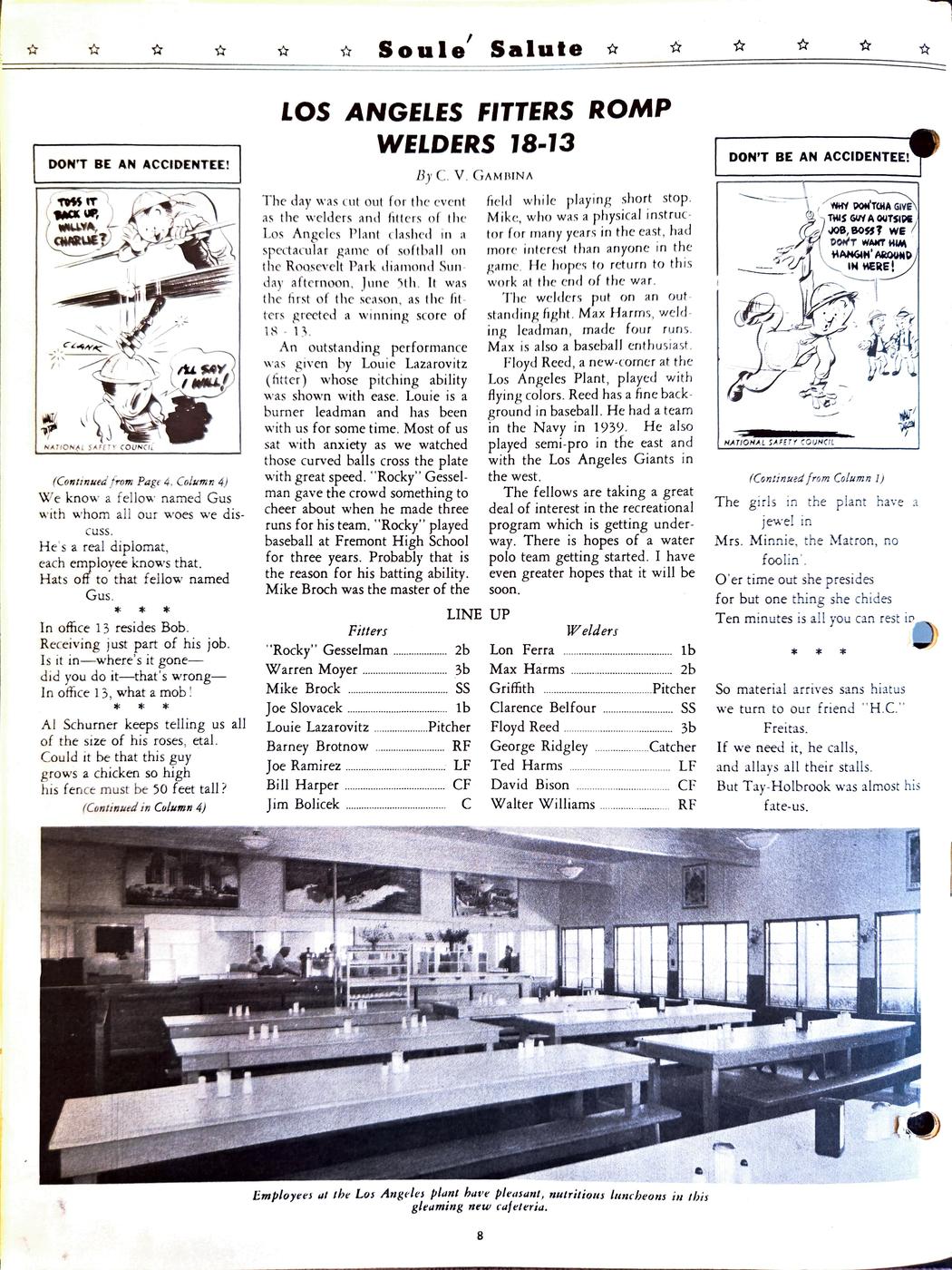
Photo: Employees at the Los Angeles plant have pleasant, nutritious luncheons in this gleaming new cafeteria.
8