Page 1
SOULÉ SALUTE
(SS) IRON AND STEEL PRODUCTS
ARMY E NAVY
Los Angeles ARMY-NAVY "E" ISSUE
VOL. 2, NO. 2 Published Regularly by and for Soule Steel War Workers JUNE, 1944
Page 2
Soule' Salute
SOULE SALUTE
Vol. 2 No. 2
Published Regularly by and for Soule Steel War Workers
**Staff**
Managing Editor — George Cobb Los Angeles Editor — Bill Irwin Portland Editor — Les Poole San Francisco Editor — Fred Kappelman
**Associate Editors:**
*Los Angeles* Clarence Balfour Frank Bennett Art Dedrick Eddie Dugan Ted Jones Charlie LeFevre H. B. Porter Hartman Reno
*Portland* John Vaile
*San Francisco* Peter F. Culcasi Paul Hyner Peter Padilla Joe Romero Marion Sheehy
*Torrance* A. M. Dowell
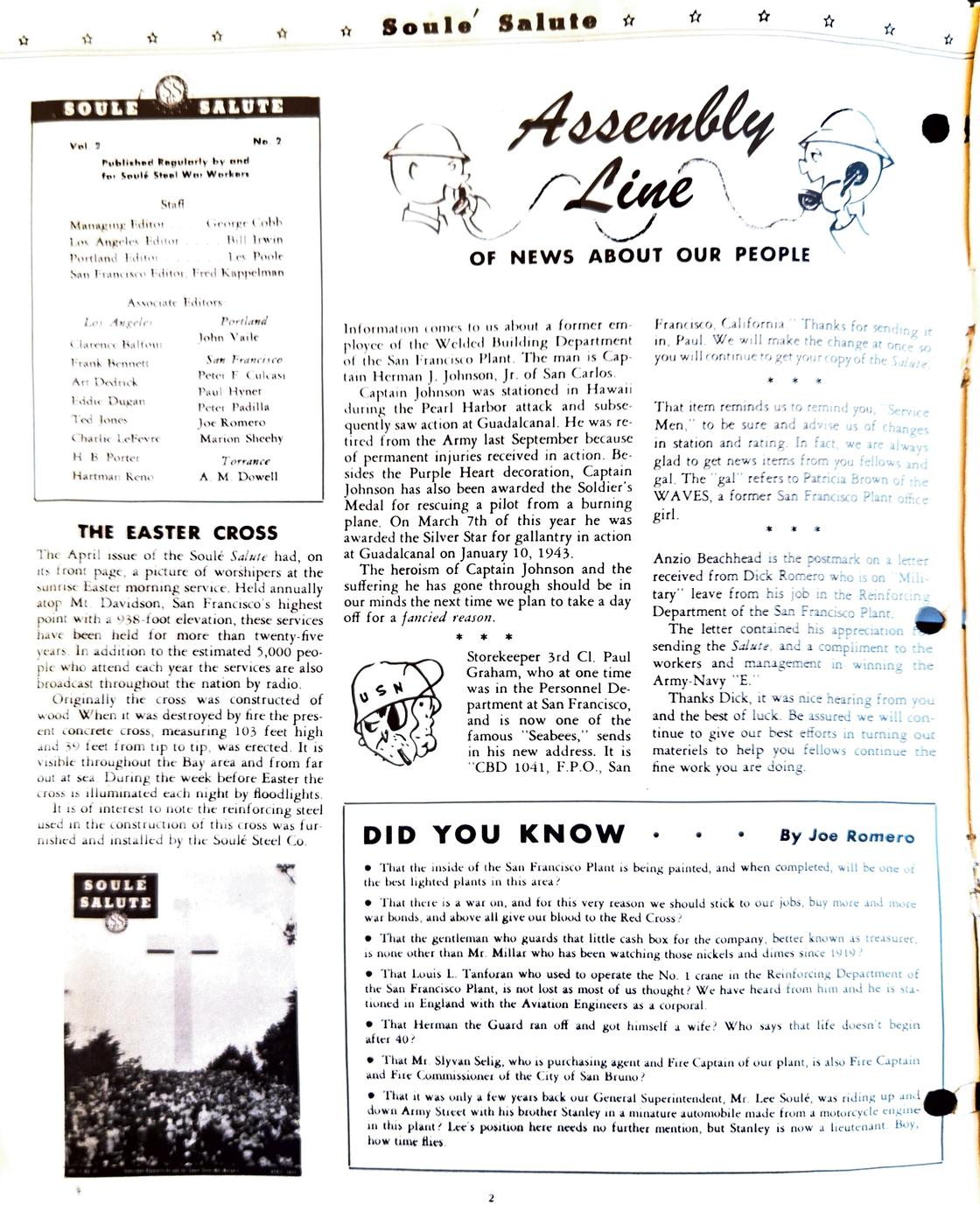
THE EASTER CROSS
The April issue of the Soule *Salute* had, on its front page, a picture of worshipers at the sunrise Easter morning service. Held annually atop Mt. Davidson, San Francisco's highest point with a 938-foot elevation, these services have been held for more than twenty-five years. In addition to the estimated 5,000 people who attend each year the services are also broadcast throughout the nation by radio.
Originally the cross was constructed of wood. When it was destroyed by fire the present concrete cross, measuring 103 feet high and 39 feet from tip to tip, was erected. It is visible throughout the Bay area and from far out at sea. During the week before Easter the cross is illuminated each night by floodlights.
It is of interest to note the reinforcing steel used in the construction of this cross was furnished and installed by the Soule Steel Co.
*Photo: SOULE SALUTE — a tall concrete cross rising above a dense crowd of people gathered on a hillside.*
Assembly Line
OF NEWS ABOUT OUR PEOPLE
Information comes to us about a former employee of the Welded Building Department of the San Francisco Plant. The man is Captain Herman J. Johnson, Jr. of San Carlos.
Captain Johnson was stationed in Hawaii during the Pearl Harbor attack and subsequently saw action at Guadalcanal. He was retired from the Army last September because of permanent injuries received in action. Besides the Purple Heart decoration, Captain Johnson has also been awarded the Soldier's Medal for rescuing a pilot from a burning plane. On March 7th of this year he was awarded the Silver Star for gallantry in action at Guadalcanal on January 10, 1943.
The heroism of Captain Johnson and the suffering he has gone through should be in our minds the next time we plan to take a day off for a *fancied reason*.
\* \* \*
Storekeeper 3rd Cl. Paul Graham, who at one time was in the Personnel Department at San Francisco, and is now one of the famous "Seabees," sends in his new address. It is "CBD 1041, F.P.O., San Francisco, California." Thanks for sending it in, Paul. We will make the change at once so you will continue to get your copy of the *Salute*.
\* \* \*
That item reminds us to remind you, "Service Men," to be sure and advise us of changes in station and rating. In fact, we are always glad to get news items from you fellows and gal. The "gal" refers to Patricia Brown of the WAVES, a former San Francisco Plant office girl.
\* \* \*
Anzio Beachhead is the postmark on a letter received from Dick Romero who is on "Military" leave from his job in the Reinforcing Department of the San Francisco Plant.
The letter contained his appreciation for sending the *Salute*, and a compliment to the workers and management in winning the Army-Navy "E."
Thanks Dick, it was nice hearing from you and the best of luck. Be assured we will continue to give our best efforts in turning out materials to help you fellows continue the fine work you are doing.
DID YOU KNOW · · · By Joe Romero
- That the inside of the San Francisco Plant is being painted, and when completed, will be one of the best lighted plants in this area?
- That there is a war on, and for this very reason we should stick to our jobs, buy more and more war bonds, and above all give our blood to the Red Cross?
- That the gentleman who guards that little cash box for the company, better known as treasurer, is none other than Mr. Millar who has been watching those nickels and dimes since 1919?
- That Louis L. Tanforan who used to operate the No. 1 crane in the Reinforcing Department of the San Francisco Plant, is not lost as most of us thought? We have heard from him and he is stationed in England with the Aviation Engineers as a corporal.
- That Herman the Guard ran off and got himself a wife? Who says that life doesn't begin after 40?
- That Mr. Slyvan Selig, who is purchasing agent and Fire Captain of our plant, is also Fire Captain and Fire Commissioner of the City of San Bruno?
- That it was only a few years back our General Superintendent, Mr. Lee Soule, was riding up and down Army Street with his brother Stanley in a miniature automobile made from a motorcycle engine in this plant? Lee's position here needs no further mention, but Stanley is now a lieutenant. Boy, how time flies.
2
Page 3
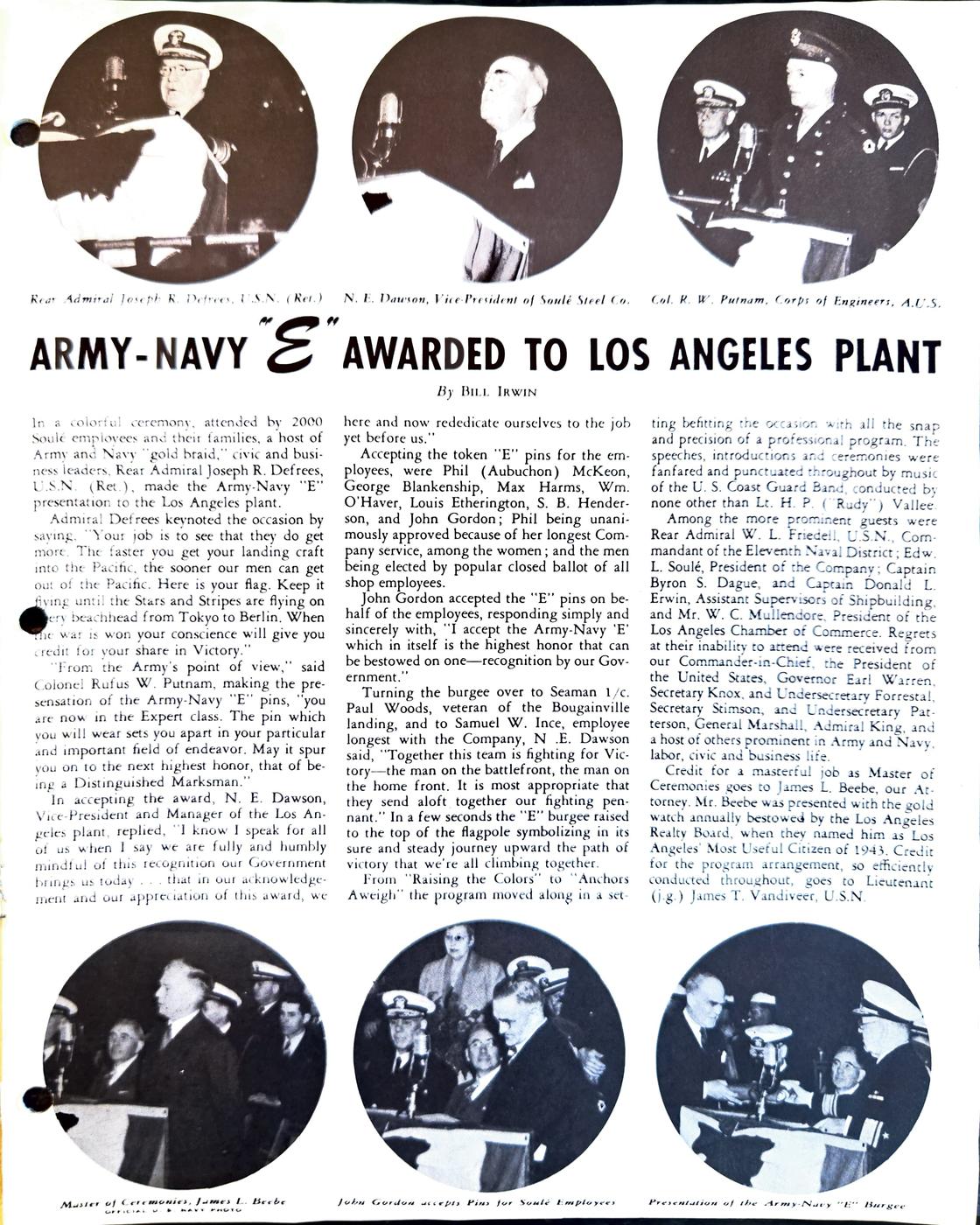
Photo: Rear Admiral Joseph R. Defrees, U.S.N. (Ret.) Photo: N. E. Dawson, Vice-President of Soule Steel Co. Photo: Col. R. W. Putnam, Corps of Engineers, A.U.S.
ARMY-NAVY "E" AWARDED TO LOS ANGELES PLANT
By BILL IRWIN
In a colorful ceremony, attended by 2000 Soule employees and their families, a host of Army and Navy "gold braid," civic and business leaders, Rear Admiral Joseph R. Defrees, U.S.N. (Ret.), made the Army-Navy "E" presentation to the Los Angeles plant.
Admiral Defrees keyed the occasion by saying, "Your job is to see that they do get more. The faster you get your landing craft into the Pacific, the sooner our men can get out of the Pacific. Here is your flag. Keep it flying until the Stars and Stripes are flying on every beachhead from Tokyo to Berlin. When the war is won your conscience will give you credit for your share in Victory."
"From the Army's point of view," said Colonel Rufus W. Putnam, making the presentation of the Army-Navy "E" pins, "you are now in the Expert class. The pin which you will wear sets you apart in your particular and important field of endeavor. May it spur you on to the next highest honor, that of being a Distinguished Marksman."
In accepting the award, N. E. Dawson, Vice-President and Manager of the Los Angeles plant, replied, "I know I speak for all of us when I say we are fully and humbly mindful of this recognition our Government brings us today . . . that in our acknowledgement and our appreciation of this award, we here and now rededicate ourselves to the job yet before us."
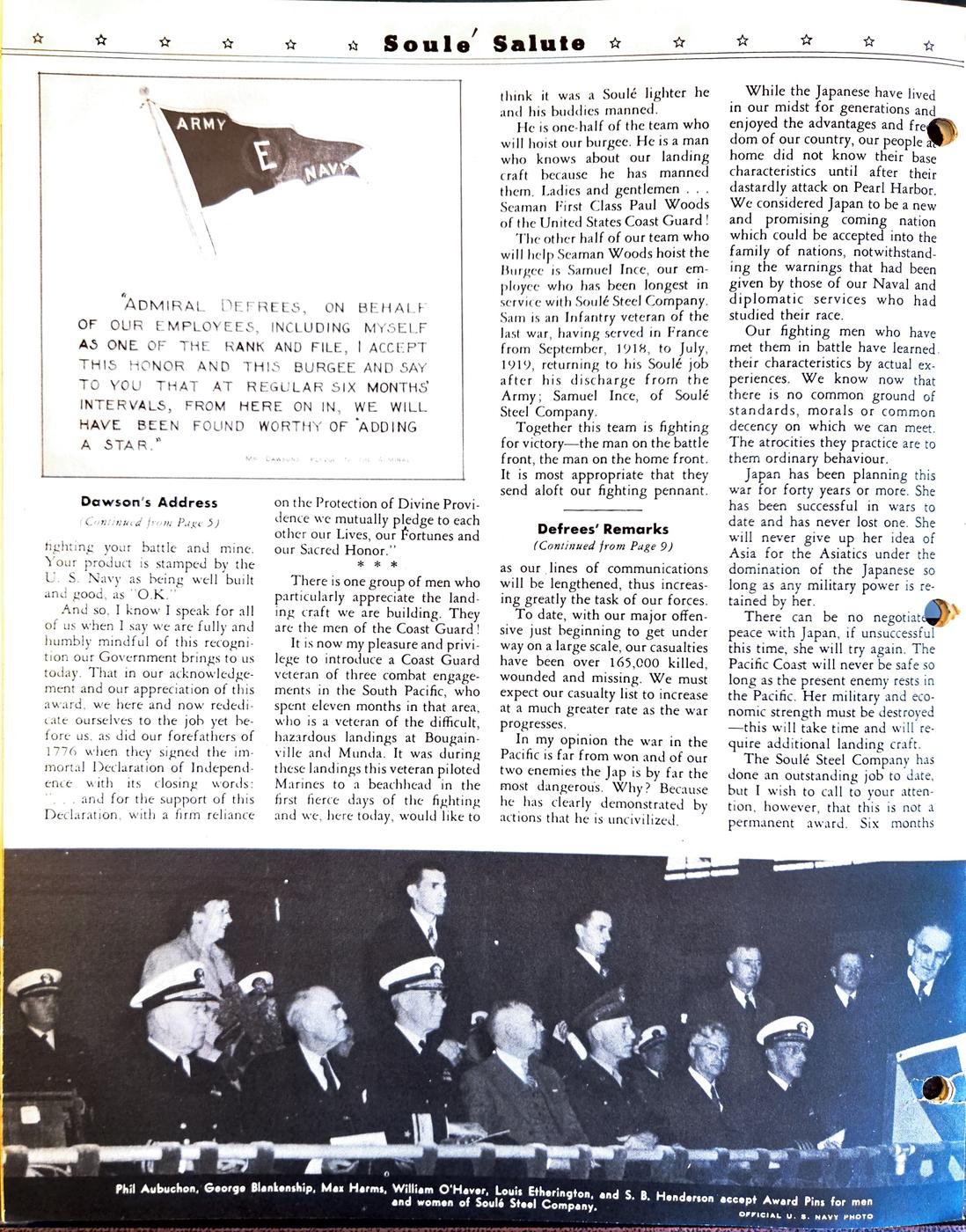
Accepting the token "E" pins for the employees, were Phil (Aubuchon) McKeon, George Blankenship, Max Harms, Wm. O'Haver, Louis Etherington, S. B. Henderson, and John Gordon; Phil being unanimously approved because of her longest Company service, among the women; and the men being elected by popular closed ballot of all shop employees.
John Gordon accepted the "E" pins on behalf of the employees, responding simply and sincerely with, "I accept the Army-Navy 'E' which in itself is the highest honor that can be bestowed on one—recognition by our Government."
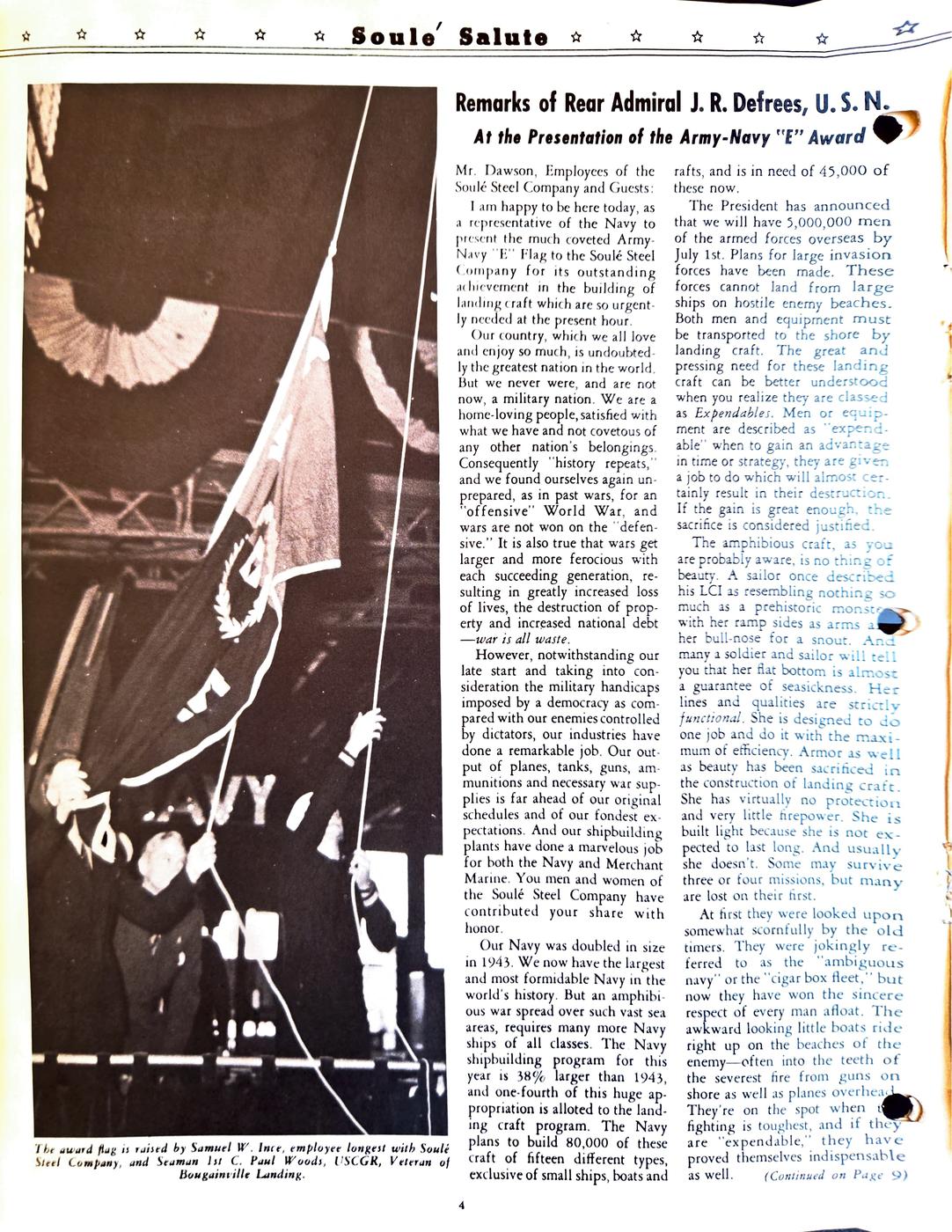
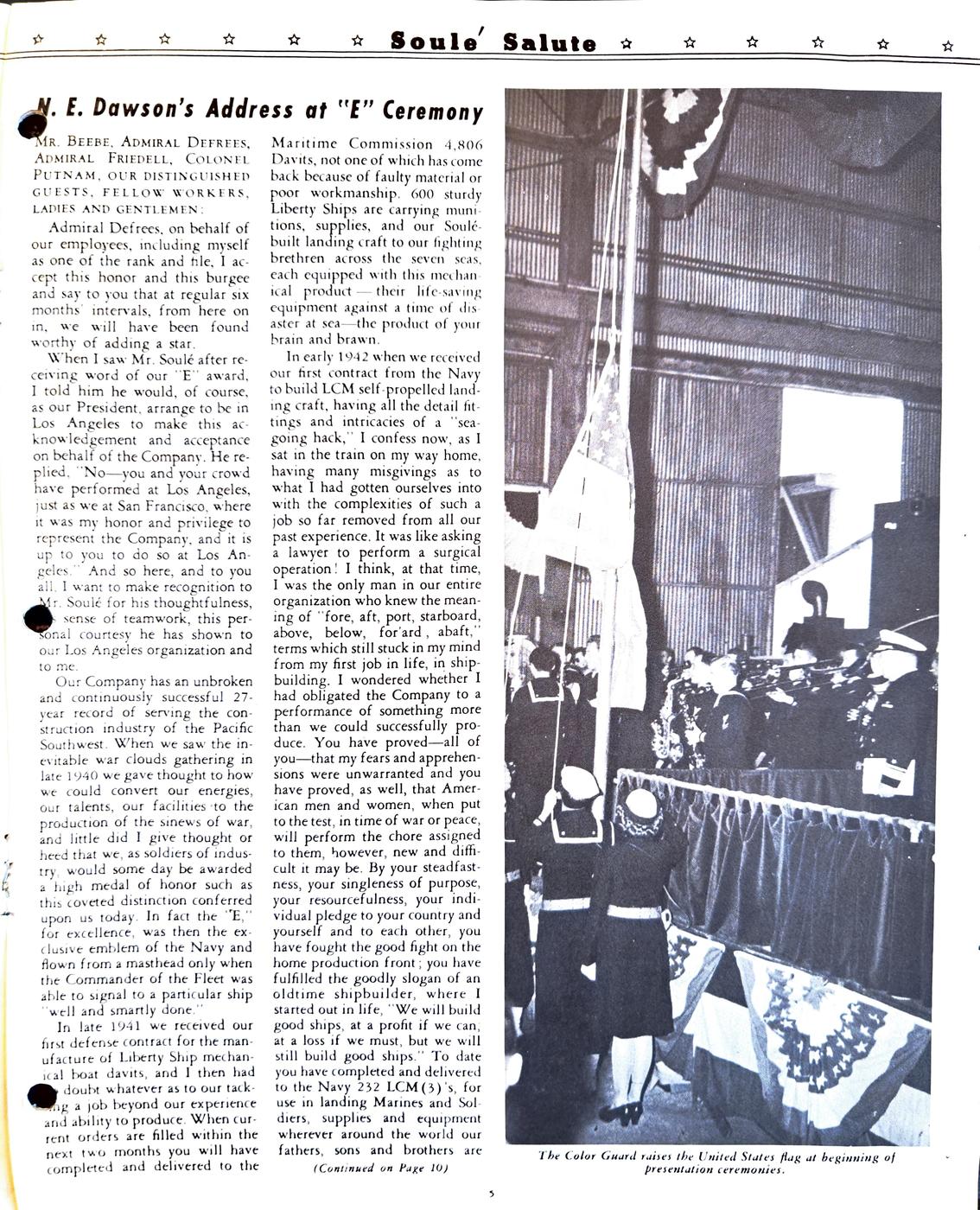
Turning the burgee over to Seaman 1/c. Paul Woods, veteran of the Bougainville landing, and to Samuel W. Ince, employee longest with the Company, N. E. Dawson said, "Together this team is fighting for Victory—the man on the battlefront, the man on the home front. It is most appropriate that they send aloft together our fighting pendant." In a few seconds the "E" burgee raised to the top of the flagpole symbolizing in its sure and steady journey upward the path of victory that we're all climbing together.
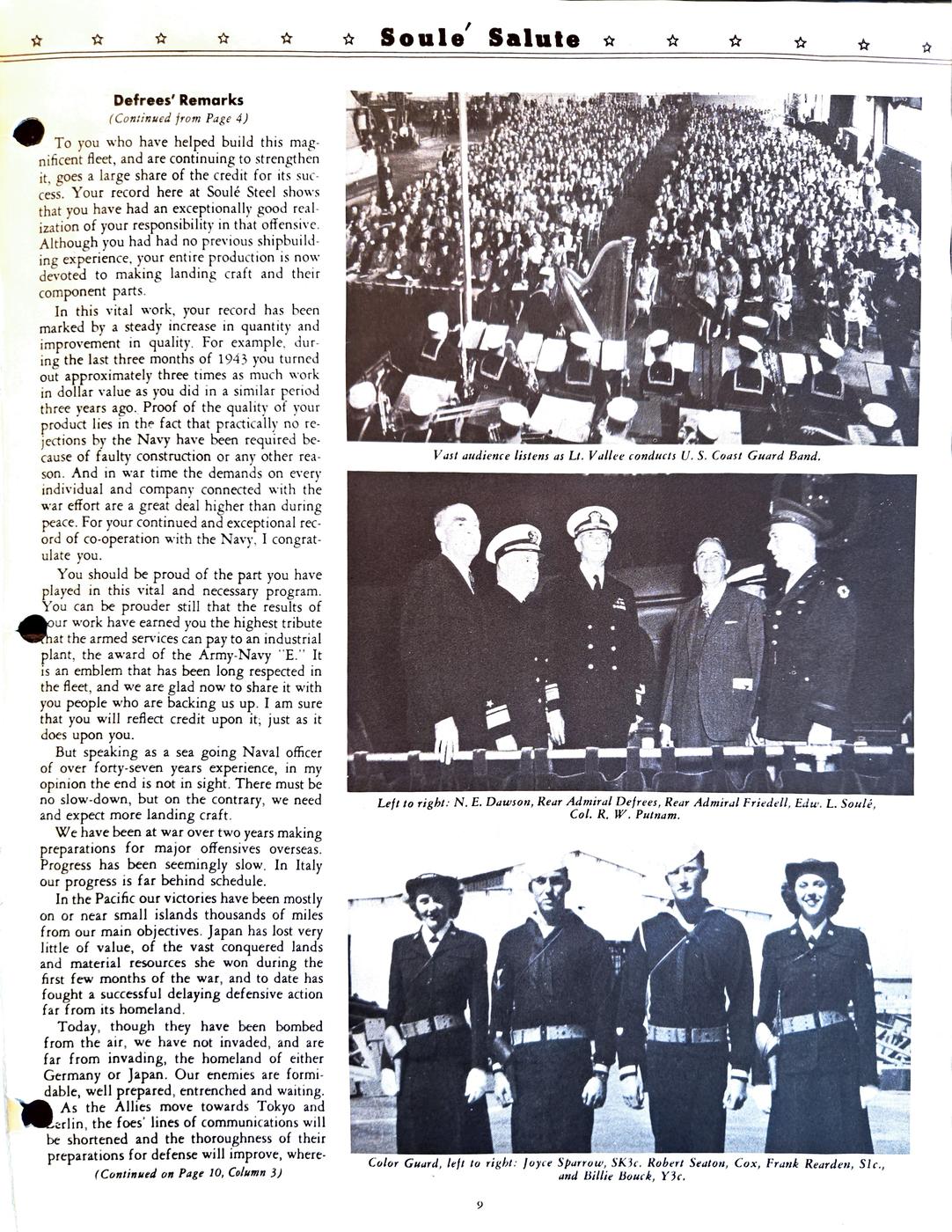
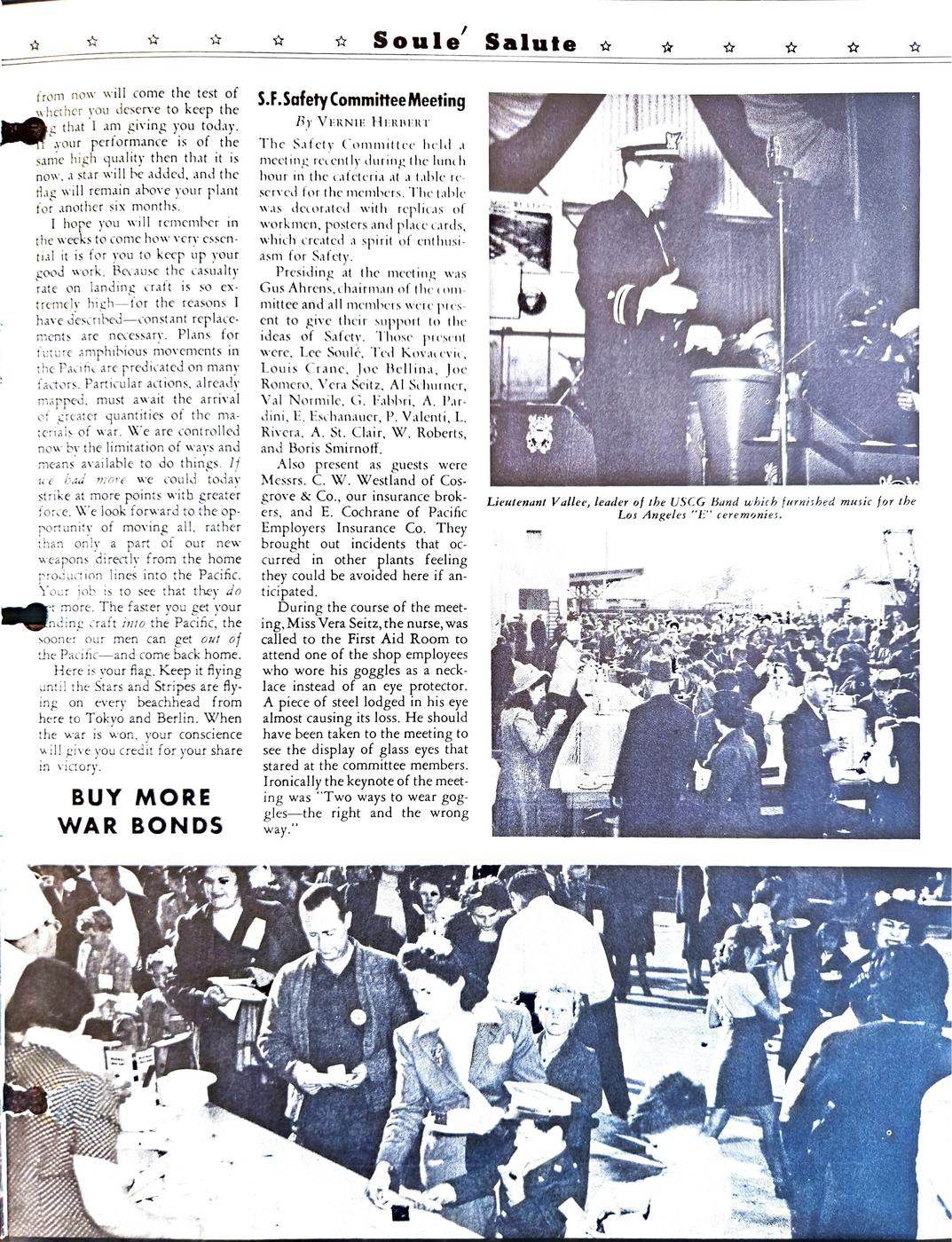
From "Raising the Colors" to "Anchors Aweigh" the program moved along in a setting befitting the occasion with all the snap and precision of a professional program. The speeches, introductions and ceremonies were fanfared and punctuated throughout by music of the U. S. Coast Guard Band, conducted by none other than Lt. H. P. ("Rudy") Vallee.
Among the more prominent guests were Rear Admiral W. L. Friedell, U.S.N., Commandant of the Eleventh Naval District; Edw. L. Soule, President of the Company; Captain Byron S. Dague, and Captain Donald L. Erwin, Assistant Supervisors of Shipbuilding, and Mr. W. C. Mullendore, President of the Los Angeles Chamber of Commerce. Regrets at their inability to attend were received from our Commander-in-Chief, the President of the United States, Governor Earl Warren, Secretary Knox, and Undersecretary Forrestal, Secretary Stimson, and Undersecretary Patterson, General Marshall, Admiral King, and a host of others prominent in Army and Navy, labor, civic and business life.
Credit for a masterful job as Master of Ceremonies goes to James L. Beebe, our Attorney. Mr. Beebe was presented with the gold watch annually bestowed by the Los Angeles Realty Board, when they named him as Los Angeles' Most Useful Citizen of 1943. Credit for the program arrangement, so efficiently conducted throughout, goes to Lieutenant (j.g.) James T. Vandiveer, U.S.N.
Photo: Master of Ceremonies, James L. Beebe Photo: John Gordon accepts Pins for Soule Employees Photo: Presentation of the Army-Navy "E" Burgee
Page 4
Soule' Salute
Remarks of Rear Admiral J. R. Defrees, U. S. N. ### At the Presentation of the Army-Navy "E" Award
Mr. Dawson, Employees of the Soule Steel Company and Guests:
I am happy to be here today, as a representative of the Navy to present the much coveted Army-Navy "E" Flag to the Soule Steel Company for its outstanding achievement in the building of landing craft which are so urgently needed at the present hour.
Our country, which we all love and enjoy so much, is undoubtedly the greatest nation in the world. But we never were, and are not now, a military nation. We are a home-loving people, satisfied with what we have and not covetous of any other nation's belongings. Consequently "history repeats," and we found ourselves again unprepared, as in past wars, for an "offensive" World War, and wars are not won on the "defensive." It is also true that wars get larger and more ferocious with each succeeding generation, resulting in greatly increased loss of lives, the destruction of property and increased national debt —war is all waste.
However, notwithstanding our late start and taking into consideration the military handicaps imposed by a democracy as compared with our enemies controlled by dictators, our industries have done a remarkable job. Our output of planes, tanks, guns, ammunitions and necessary war supplies is far ahead of our original schedules and of our fondest expectations. And our shipbuilding plants have done a marvelous job for both the Navy and Merchant Marine. You men and women of the Soule Steel Company have contributed your share with honor.
Our Navy was doubled in size in 1943. We now have the largest and most formidable Navy in the world's history. But an amphibious war spread over such vast sea areas, requires many more Navy ships of all classes. The Navy shipbuilding program for this year is 38% larger than 1943, and one-fourth of this huge appropriation is allotted to the landing craft program. The Navy plans to build 80,000 of these craft of fifteen different types, exclusive of small ships, boats and
rafts, and is in need of 45,000 of these now.
The President has announced that we will have 5,000,000 men of the armed forces overseas by July 1st. Plans for large invasion forces have been made. These forces cannot land from large ships on hostile enemy beaches. Both men and equipment must be transported to the shore by landing craft. The great and pressing need for these landing craft can be better understood when you realize they are classed as Expendables. Men or equipment are described as "expendable" when to gain an advantage in time or strategy, they are given a job to do which will almost certainly result in their destruction. If the gain is great enough, the sacrifice is considered justified.
The amphibious craft, as you are probably aware, is no thing of beauty. A sailor once described his LCI as resembling nothing so much as a prehistoric monster with her ramp sides as arms and her bull-nose for a snout. And many a soldier and sailor will tell you that her flat bottom is almost a guarantee of seasickness. Her lines and qualities are strictly functional. She is designed to do one job and do it with the maximum of efficiency. Armor as well as beauty has been sacrificed in the construction of landing craft. She has virtually no protection and very little firepower. She is built light because she is not expected to last long. And usually she doesn't. Some may survive three or four missions, but many are lost on their first.
At first they were looked upon somewhat scornfully by the old timers. They were jokingly referred to as the "ambiguous navy" or the "cigar box fleet," but now they have won the sincere respect of every man afloat. The awkward looking little boats ride right up on the beaches of the enemy—often into the teeth of the severest fire from guns on shore as well as planes overhead. They're on the spot when the fighting is toughest, and if they are "expendable," they have proved themselves indispensable as well. (Continued on Page 9)
*The award flag is raised by Samuel W. Ince, employee longest with Soule Steel Company, and Seaman 1st C. Paul Woods, USCGR, Veteran of Bougainville Landing.*
Page 5
Soule' Salute
N. E. Dawson's Address at "E" Ceremony
MR. BEEBE, ADMIRAL DEFREES, ADMIRAL FRIEDELL, COLONEL PUTNAM, OUR DISTINGUISHED GUESTS, FELLOW WORKERS, LADIES AND GENTLEMEN:
Admiral Defrees, on behalf of our employees, including myself as one of the rank and file, I accept this honor and this burgee and say to you that at regular six months' intervals, from here on in, we will have been found worthy of adding a star.
When I saw Mr. Soulé after receiving word of our "E" award, I told him he would, of course, as our President, arrange to be in Los Angeles to make this acknowledgement and acceptance on behalf of the Company. He replied, "No—you and your crowd have performed at Los Angeles, just as we at San Francisco, where it was my honor and privilege to represent the Company, and it is up to you to do so at Los Angeles." And so here, and to you all, I want to make recognition to Mr. Soulé for his thoughtfulness, sense of teamwork, this personal courtesy he has shown to our Los Angeles organization and to me.
Our Company has an unbroken and continuously successful 27-year record of serving the construction industry of the Pacific Southwest. When we saw the inevitable war clouds gathering in late 1940 we gave thought to how we could convert our energies, our talents, our facilities to the production of the sinews of war, and little did I give thought or heed that we, as soldiers of industry, would some day be awarded a high medal of honor such as this coveted distinction conferred upon us today. In fact the "E," for excellence, was then the exclusive emblem of the Navy and flown from a masthead only when the Commander of the Fleet was able to signal to a particular ship "well and smartly done."
In late 1941 we received our first defense contract for the manufacture of Liberty Ship mechanical boat davits, and I then had doubt whatever as to our tackling a job beyond our experience and ability to produce. When current orders are filled within the next two months you will have completed and delivered to the Maritime Commission 4,806 Davits, not one of which has come back because of faulty material or poor workmanship. 600 sturdy Liberty Ships are carrying munitions, supplies, and our Soulé-built landing craft to our fighting brethren across the seven seas, each equipped with this mechanical product — their life-saving equipment against a time of disaster at sea—the product of your brain and brawn.
In early 1942 when we received our first contract from the Navy to build LCM self-propelled landing craft, having all the detail fittings and intricacies of a "sea-going hack," I confess now, as I sat in the train on my way home, having many misgivings as to what I had gotten ourselves into with the complexities of such a job so far removed from all our past experience. It was like asking a lawyer to perform a surgical operation! I think, at that time, I was the only man in our entire organization who knew the meaning of "fore, aft, port, starboard, above, below, for'ard, abaft," terms which still stuck in my mind from my first job in life, in shipbuilding. I wondered whether I had obligated the Company to a performance of something more than we could successfully produce. You have proved—all of you—that my fears and apprehensions were unwarranted and you have proved, as well, that American men and women, when put to the test, in time of war or peace, will perform the chore assigned to them, however, new and difficult it may be. By your steadfastness, your singleness of purpose, your resourcefulness, your individual pledge to your country and yourself and to each other, you have fought the good fight on the home production front; you have fulfilled the goodly slogan of an oldtime shipbuilder, where I started out in life, "We will build good ships, at a profit if we can, at a loss if we must, but we will still build good ships." To date you have completed and delivered to the Navy 232 LCM(3)'s, for use in landing Marines and Soldiers, supplies and equipment wherever around the world our fathers, sons and brothers are
(Continued on Page 10)
*Photo: The Color Guard raises the United States flag at beginning of presentation ceremonies.*
Page 6
Soule' Salute
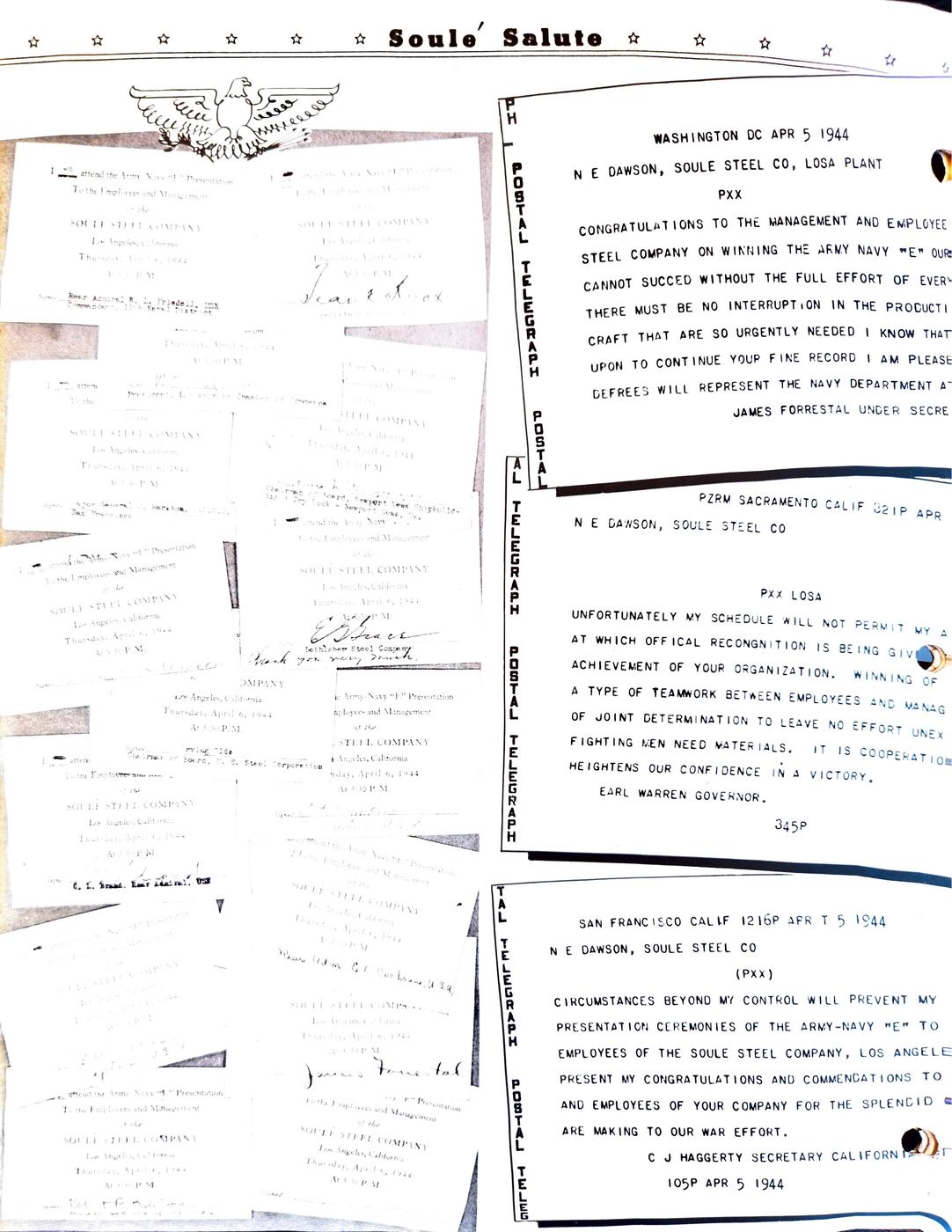
Invitations to the Army‑Navy "E" Presentation (Thursday, April 6, 1944)
I will attend the Army‑Navy "E" Presentation To the Employees and Management of the SOULE STEEL COMPANY, Los Angeles, California. Thursday April 6, 1944 At [illegible] P.M.
*Signatories (as legibly visible on the invitation cards):* - Rear Admiral W. L. Friedell, USN — Commandant 13th Naval District - [illegible signature] (J. … Fox) — Secretary of Commerce? / Chamber of Commerce - [illegible signature] (Bethlehem Steel Company) — "Thank you very much." - [illegible signature] (Chairman of Board, Hooper V. S. Steel Corporation) - [illegible signature] (… Newport News Shipbuilding & Dry Dock — Newport News, Va.) - C. I. Strand, Rear Admiral USN
Postal Telegraph — Washington DC Apr 5 1944
To: N E Dawson, Soule Steel Co, Losa Plant — PXX
CONGRATULATIONS TO THE MANAGEMENT AND EMPLOYEE[ES] OF SOULE STEEL COMPANY ON WINNING THE ARMY NAVY "E". OUR [COUNTRY] CANNOT SUCCEED WITHOUT THE FULL EFFORT OF EVERY[ONE]. THERE MUST BE NO INTERRUPTION IN THE PRODUCTI[ON] CRAFT THAT ARE SO URGENTLY NEEDED. I KNOW THAT [YOU WILL CONTINUE UPON] TO CONTINUE YOUR FINE RECORD. I AM PLEASE[D]. DEFREEES WILL REPRESENT THE NAVY DEPRTMENT A[ND] JAMES FORRESTAL UNDER SECRE[TARY].
Postal Telegraph — Sacramento Calif Apr 1944 (PZRM)
To: N E Dawson, Soule Steel Co — PXX Losa
UNFORTUNATELY MY SCHEDULE WILL NOT PERMIT MY A[TTE] AT WHICH OFFICIAL RECOGNITION IS BEING GIV[EN]. [I REGRET THAT I CANNOT ATTEND] ACHIEVEMENT OF YOUR ORGANIZATION. WINNING OF [THE "E" IS AN EXAMPLE] A TYPE OF TEAMWORK BETWEEN EMPLOYEES AND MANAG[ERS]. [IT IS THE RESULT] OF JOINT DETERMINATION TO LEAVE NO EFFORT UNEX[PLOITED]. FIGHTING MEN NEED MATERIALS. IT IS COOPERATIO[N] HEIGHTENS OUR CONFIDENCE IN A VICTORY.
EARL WARREN GOVERNOR — 345P
Postal Telegraph — San Francisco Calif Apr T‑5 1944 (I216)
To: N E Dawson, Soule Steel Co — PXX
CIRCUMSTANCES BEYOND MY CONTROL WILL PREVENT MY [ATTENDING THE] PRESENTATION CEREMONIES OF THE ARMY‑NAVY "E" TO [THE MANAGERS AND] EMPLOYEES OF THE SOULE STEEL COMPANY, LOS ANGELE[S]. [I WISH TO] PRESENT MY CONGRATULATIONS AND COMMENDATIONS TO [MANAGERS] AND EMPLOYEES OF YOUR COMPANY FOR THE SPLENDID [EFFORTS YOU ARE] MAKING TO OUR WAR EFFORT.
C J HAGGERTY, SECRETARY CALIFORNIA [STATE] — 105P Apr 5 1944
Page 7
Soule' Salute
THE SOULE MING INVASIONS AMERICAN WORKER OF LANDING U CAN BE DEPENDED HAT ADMIRAL UR CEREMONY. Y OF THE NAVY 1018A
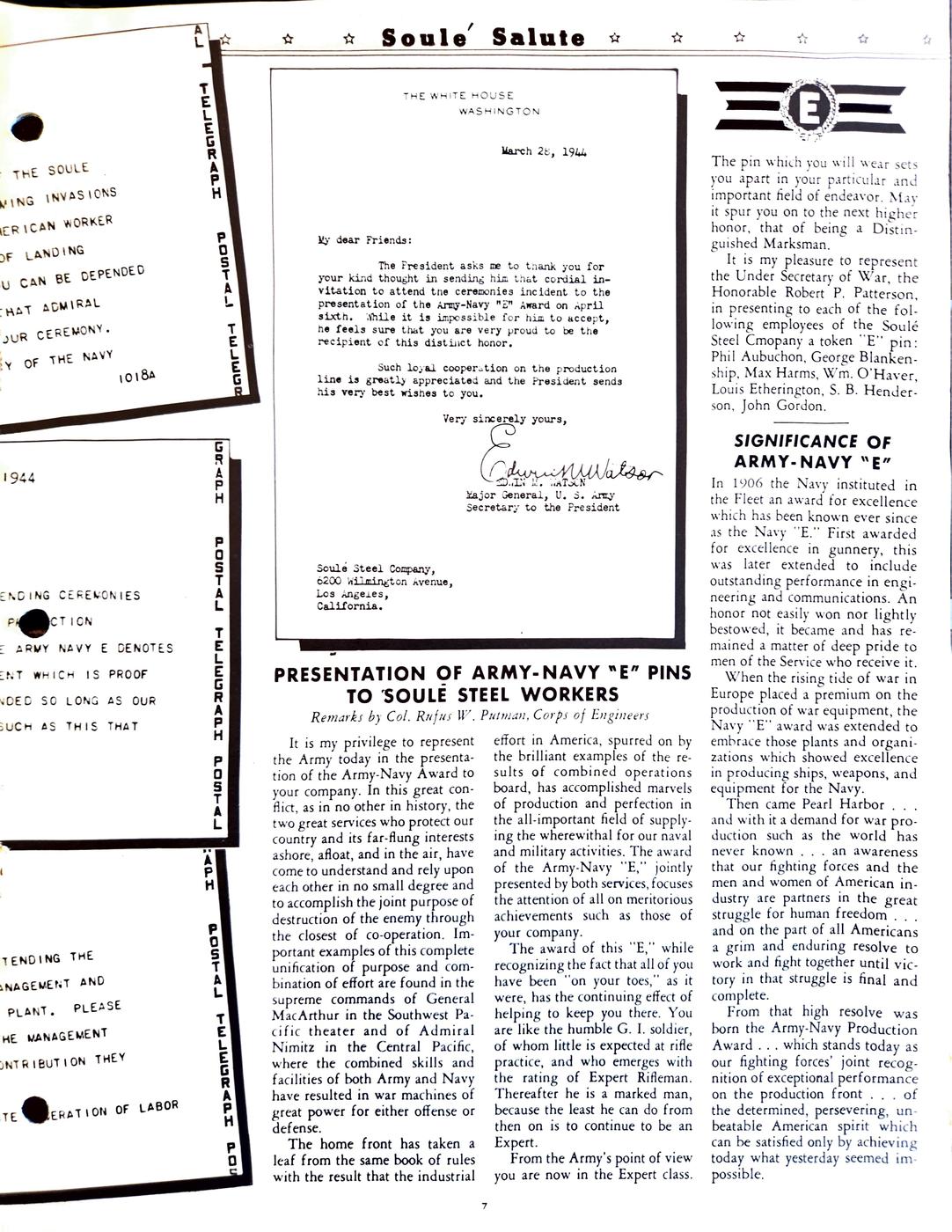
THE WHITE HOUSE WASHINGTON
March 28, 1944
My dear Friends:
The President asks me to thank you for your kind thought in sending him that cordial invitation to attend the ceremonies incident to the presentation of the Army-Navy "E" Award on April sixth. While it is impossible for him to accept, he feels sure that you are very proud to be the recipient of this distinct honor.
Such loyal cooperation on the production line is greatly appreciated and the President sends his very best wishes to you.
Very sincerely yours,
Edwin M. Watson Major General, U. S. Army Secretary to the President
Soule Steel Company, 6200 Wilmington Avenue, Los Angeles, California.
The pin which you will wear sets you apart in your particular and important field of endeavor. May it spur you on to the next higher honor, that of being a Distinguished Marksman.
It is my pleasure to represent the Under Secretary of War, the Honorable Robert P. Patterson, in presenting to each of the following employees of the Soule Steel Company a token "E" pin: Phil Aubuchon, George Blankenship, Max Harms, Wm. O'Haver, Louis Etherington, S. B. Henderson, John Gordon.
SIGNIFICANCE OF ARMY-NAVY "E"
In 1906 the Navy instituted in the Fleet an award for excellence which has been known ever since as the Navy "E." First awarded for excellence in gunnery, this was later extended to include outstanding performance in engineering and communications. An honor not easily won nor lightly bestowed, it became and has remained a matter of deep pride to men of the Service who receive it.
When the rising tide of war in Europe placed a premium on the production of war equipment, the Navy "E" award was extended to embrace those plants and organizations which showed excellence in producing ships, weapons, and equipment for the Navy.
Then came Pearl Harbor . . . and with it a demand for war production such as the world has never known . . . an awareness that our fighting forces and the men and women of American industry are partners in the great struggle for human freedom . . . and on the part of all Americans a grim and enduring resolve to work and fight together until victory in that struggle is final and complete.
From that high resolve was born the Army-Navy Production Award . . . which stands today as our fighting forces' joint recognition of exceptional performance on the production front . . . of the determined, persevering, unbeatable American spirit which can be satisfied only by achieving today what yesterday seemed impossible.
1944 ENDING CEREMONIES DUCTION E ARMY NAVY E DENOTES ENT WHICH IS PROOF NDED SO LONG AS OUR SUCH AS THIS THAT
TENDING THE NAGEMENT AND PLANT. PLEASE HE MANAGEMENT NTRIBUTION THEY TE ERATION OF LABOR
PRESENTATION OF ARMY-NAVY "E" PINS TO SOULÉ STEEL WORKERS Remarks by Col. Rufus W. Putman, Corps of Engineers
It is my privilege to represent the Army today in the presentation of the Army-Navy Award to your company. In this great conflict, as in no other in history, the two great services who protect our country and its far-flung interests ashore, afloat, and in the air, have come to understand and rely upon each other in no small degree and to accomplish the joint purpose of destruction of the enemy through the closest of co-operation. Important examples of this complete unification of purpose and combination of effort are found in the supreme commands of General MacArthur in the Southwest Pacific theater and of Admiral Nimitz in the Central Pacific, where the combined skills and facilities of both Army and Navy have resulted in war machines of great power for either offense or defense.
The home front has taken a leaf from the same book of rules with the result that the industrial effort in America, spurred on by the brilliant examples of the results of combined operations board, has accomplished marvels of production and perfection in the all-important field of supplying the wherewithal for our naval and military activities. The award of the Army-Navy "E," jointly presented by both services, focuses the attention of all on meritorious achievements such as those of your company.
The award of this "E," while recognizing the fact that all of you have been "on your toes," as it were, has the continuing effect of helping to keep you there. You are like the humble G. I. soldier, of whom little is expected at rifle practice, and who emerges with the rating of Expert Rifleman. Thereafter he is a marked man, because the least he can do from then on is to continue to be an Expert.
From the Army's point of view you are now in the Expert class.
Page 8
* * * * * Soule' Salute * * * * *
John Gordon Accepts Award Pin for Workers
"This is the greatest pleasure of my many years of association with Soule Steel Company. I feel highly honored to be chosen to receive on behalf of my friends and fellow employees this Army and Navy "E" pin.
The fabrication of windows, doors, reinforcing and structural steel is quite different from landing craft but with the Soule organization it was not difficult to go from land to sea.
We have had our problems of course, but overcoming them has made us worthy of the award which we so proudly receive.
All have shown their interest in the job we have been doing and all richly deserve the emblem of a job well done. We shall continue to do our best in the work we are doing, feeling that in doing this we are backing up our fellow workers and all the gallant men and women now in the services, and aiding in bringing to a final victory this great war.
Upon behalf of the employees of the Soule Steel Company I accept the Army-Navy "E" pin which in itself is the highest honor that can be bestowed on one, it is recognition by our Government. I thank you."
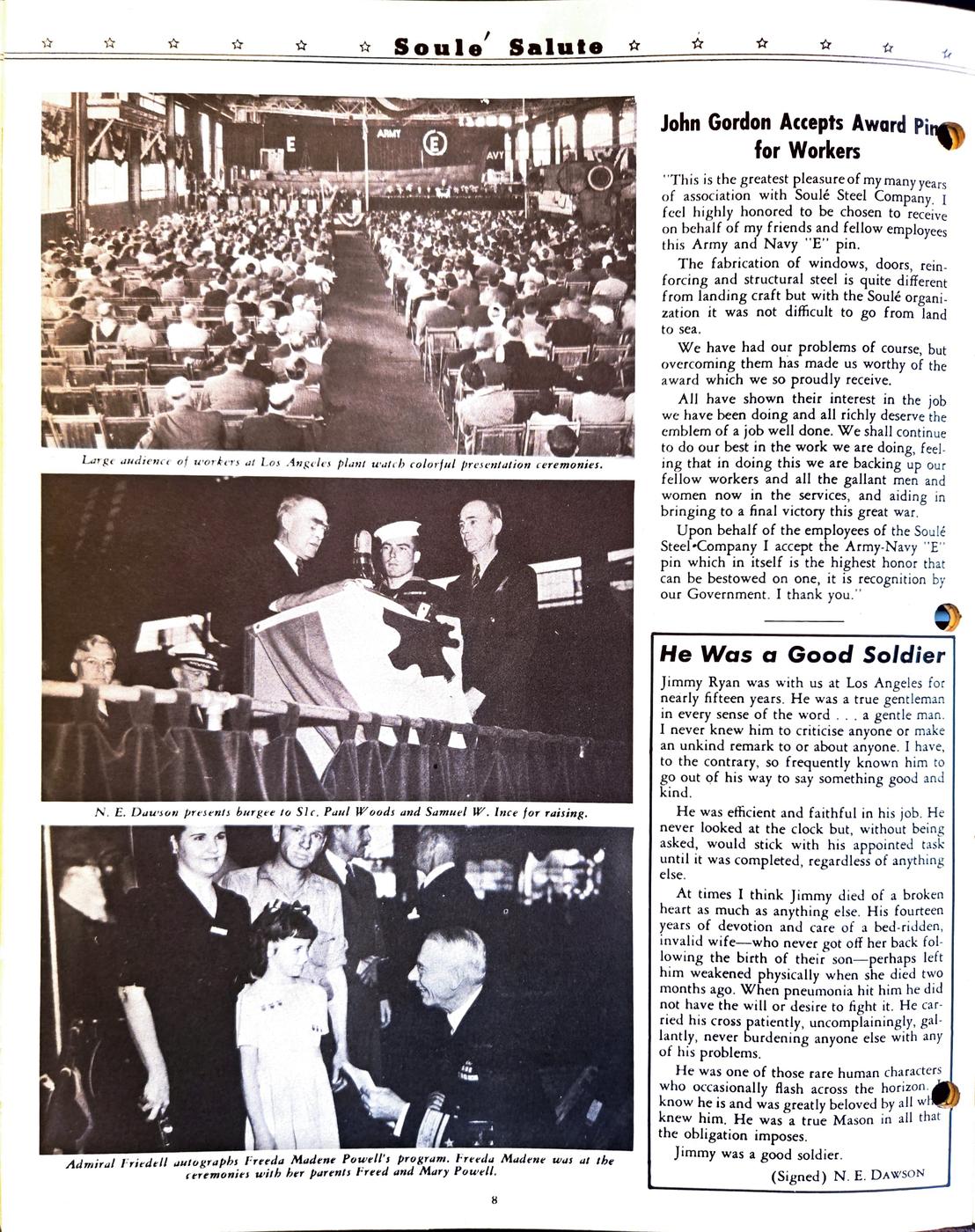
*Large audience of workers at Los Angeles plant watch colorful presentation ceremonies.*
*N. E. Dawson presents burgee to Slc. Paul Woods and Samuel W. Ince for raising.*
*Admiral Friedell autographs Freeda Madene Powell's program. Freeda Madene was at the ceremonies with her parents Freed and Mary Powell.*
He Was a Good Soldier
Jimmy Ryan was with us at Los Angeles for nearly fifteen years. He was a true gentleman in every sense of the word . . . a gentle man. I never knew him to criticise anyone or make an unkind remark to or about anyone. I have, to the contrary, so frequently known him to go out of his way to say something good and kind.
He was efficient and faithful in his job. He never looked at the clock but, without being asked, would stick with his appointed task until it was completed, regardless of anything else.
At times I think Jimmy died of a broken heart as much as anything else. His fourteen years of devotion and care of a bed-ridden, invalid wife—who never got off her back following the birth of their son—perhaps left him weakened physically when she died two months ago. When pneumonia hit him he did not have the will or desire to fight it. He carried his cross patiently, uncomplainingly, gallantly, never burdening anyone else with any of his problems.
He was one of those rare human characters who occasionally flash across the horizon. I know he is and was greatly beloved by all who knew him. He was a true Mason in all that the obligation imposes.
Jimmy was a good soldier.
(Signed) N. E. DAWSON
8
Page 9
Soule' Salute
Defrees' Remarks (Continued from Page 4)
To you who have helped build this magnificent fleet, and are continuing to strengthen it, goes a large share of the credit for its success. Your record here at Soule Steel shows that you have had an exceptionally good realization of your responsibility in that offensive. Although you had had no previous shipbuilding experience, your entire production is now devoted to making landing craft and their component parts.
In this vital work, your record has been marked by a steady increase in quantity and improvement in quality. For example, during the last three months of 1943 you turned out approximately three times as much work in dollar value as you did in a similar period three years ago. Proof of the quality of your product lies in the fact that practically no rejections by the Navy have been required because of faulty construction or any other reason. And in war time the demands on every individual and company connected with the war effort are a great deal higher than during peace. For your continued and exceptional record of co-operation with the Navy, I congratulate you.
You should be proud of the part you have played in this vital and necessary program. You can be prouder still that the results of our work have earned you the highest tribute that the armed services can pay to an industrial plant, the award of the Army-Navy "E." It is an emblem that has been long respected in the fleet, and we are glad now to share it with you people who are backing us up. I am sure that you will reflect credit upon it, just as it does upon you.
But speaking as a sea going Naval officer of over forty-seven years experience, in my opinion the end is not in sight. There must be no slow-down, but on the contrary, we need and expect more landing craft.
We have been at war over two years making preparations for major offensives overseas. Progress has been seemingly slow. In Italy our progress is far behind schedule.
In the Pacific our victories have been mostly on or near small islands thousands of miles from our main objectives. Japan has lost very little of value, of the vast conquered lands and material resources she won during the first few months of the war, and to date has fought a successful delaying defensive action far from its homeland.
Today, though they have been bombed from the air, we have not invaded, and are far from invading, the homeland of either Germany or Japan. Our enemies are formidable, well prepared, entrenched and waiting.
As the Allies move towards Tokyo and Berlin, the foes' lines of communications will be shortened and the thoroughness of their preparations for defense will improve, where-
(Continued on Page 10, Column 3)
*Photo: Vast audience listens as Lt. Vallee conducts U. S. Coast Guard Band.*
*Photo: Left to right: N. E. Dawson, Rear Admiral Defrees, Rear Admiral Friedell, Edw. L. Soule, Col. R. W. Putnam.*
*Photo: Color Guard, left to right: Joyce Sparrow, SK3c. Robert Seaton, Cox, Frank Rearden, Slc., and Billie Bouck, Y3c.*
9
Page 10
Soule' Salute
[Image: A flag on a pole reading "ARMY" on the left, a large "E" in the center, and "NAVY" on the right.]
"ADMIRAL DEFREES, ON BEHALF OF OUR EMPLOYEES, INCLUDING MYSELF AS ONE OF THE RANK AND FILE, I ACCEPT THIS HONOR AND THIS BURGEE AND SAY TO YOU THAT AT REGULAR SIX MONTHS' INTERVALS, FROM HERE ON IN, WE WILL HAVE BEEN FOUND WORTHY OF ADDING A STAR."
Dawson's Address *(Continued from Page 5)*
fighting your battle and mine. Your product is stamped by the U. S. Navy as being well built and good, as "O.K."
And so, I know I speak for all of us when I say we are fully and humbly mindful of this recognition our Government brings to us today. That in our acknowledgement and our appreciation of this award, we here and now rededicate ourselves to the job yet before us, as did our forefathers of 1776 when they signed the immortal Declaration of Independence with its closing words: "... and for the support of this Declaration, with a firm reliance on the Protection of Divine Providence we mutually pledge to each other our Lives, our Fortunes and our Sacred Honor."
* * *
There is one group of men who particularly appreciate the landing craft we are building. They are the men of the Coast Guard!
It is now my pleasure and privilege to introduce a Coast Guard veteran of three combat engagements in the South Pacific, who spent eleven months in that area, who is a veteran of the difficult, hazardous landings at Bougainville and Munda. It was during these landings this veteran piloted Marines to a beachhead in the first fierce days of the fighting and we, here today, would like to think it was a Soulé lighter he and his buddies manned.
He is one-half of the team who will hoist our burgee. He is a man who knows about our landing craft because he has manned them. Ladies and gentlemen . . . Seaman First Class Paul Woods of the United States Coast Guard!
The other half of our team who will help Seaman Woods hoist the Burgee is Samuel Ince, our employee who has been longest in service with Soulé Steel Company. Sam is an Infantry veteran of the last war, having served in France from September, 1918, to July, 1919, returning to his Soulé job after his discharge from the Army; Samuel Ince, of Soulé Steel Company.
Together this team is fighting for victory—the man on the battle front, the man on the home front. It is most appropriate that they send aloft our fighting pennant.
Defrees' Remarks *(Continued from Page 9)*
as our lines of communications will be lengthened, thus increasing greatly the task of our forces.
To date, with our major offensive just beginning to get under way on a large scale, our casualties have been over 165,000 killed, wounded and missing. We must expect our casualty list to increase at a much greater rate as the war progresses.
In my opinion the war in the Pacific is far from won and of our two enemies the Jap is by far the most dangerous. Why? Because he has clearly demonstrated by actions that he is uncivilized.
While the Japanese have lived in our midst for generations and enjoyed the advantages and freedom of our country, our people at home did not know their base characteristics until after their dastardly attack on Pearl Harbor. We considered Japan to be a new and promising coming nation which could be accepted into the family of nations, notwithstanding the warnings that had been given by those of our Naval and diplomatic services who had studied their race.
Our fighting men who have met them in battle have learned their characteristics by actual experiences. We know now that there is no common ground of standards, morals or common decency on which we can meet. The atrocities they practice are to them ordinary behaviour.
Japan has been planning this war for forty years or more. She has been successful in wars to date and has never lost one. She will never give up her idea of Asia for the Asiatics under the domination of the Japanese so long as any military power is retained by her.
There can be no negotiated peace with Japan, if unsuccessful this time, she will try again. The Pacific Coast will never be safe so long as the present enemy rests in the Pacific. Her military and economic strength must be destroyed—this will take time and will require additional landing craft.
The Soulé Steel Company has done an outstanding job to date, but I wish to call to your attention, however, that this is not a permanent award. Six months
*Photo: Phil Aubuchon, George Blankenship, Max Harms, William O'Haver, Louis Etherington, and S. B. Henderson accept Award Pins for men and women of Soulé Steel Company. OFFICIAL U. S. NAVY PHOTO*
Page 11
* * * * * Soule' Salute * * * * *
from now will come the test of whether you deserve to keep the flag that I am giving you today. If your performance is of the same high quality then that it is now, a star will be added, and the flag will remain above your plant for another six months.
I hope you will remember in the weeks to come how very essential it is for you to keep up your good work. Because the casualty rate on landing craft is so extremely high—for the reasons I have described—constant replacements are necessary. Plans for future amphibious movements in the Pacific are predicated on many factors. Particular actions, already mapped, must await the arrival of greater quantities of the materials of war. We are controlled now by the limitation of ways and means available to do things. If we had more we could today strike at more points with greater force. We look forward to the opportunity of moving all, rather than only a part of our new weapons directly from the home production lines into the Pacific. Your job is to see that they do get more. The faster you get your landing craft into the Pacific, the sooner our men can get out of the Pacific—and come back home.
Here is your flag. Keep it flying until the Stars and Stripes are flying on every beachhead from here to Tokyo and Berlin. When the war is won, your conscience will give you credit for your share in victory.
**BUY MORE WAR BONDS**
S.F. Safety Committee Meeting By VERNIE HERBERT
The Safety Committee held a meeting recently during the lunch hour in the cafeteria at a table reserved for the members. The table was decorated with replicas of workmen, posters and place cards, which created a spirit of enthusiasm for Safety.
Presiding at the meeting was Gus Ahrens, chairman of the committee and all members were present to give their support to the ideas of Safety. Those present were, Lee Soule, Ted Kovacevic, Louis Crane, Joe Bellina, Joe Romero, Vera Seitz, Al Schurner, Val Normile, G. Fabbri, A. Pardini, E. Eschanauer, P. Valenti, L. Rivera, A. St. Clair, W. Roberts, and Boris Smirnoff.
Also present as guests were Messrs. C. W. Westland of Cosgrove & Co., our insurance brokers, and E. Cochrane of Pacific Employers Insurance Co. They brought out incidents that occurred in other plants feeling they could be avoided here if anticipated.
During the course of the meeting, Miss Vera Seitz, the nurse, was called to the First Aid Room to attend one of the shop employees who wore his goggles as a necklace instead of an eye protector. A piece of steel lodged in his eye almost causing its loss. He should have been taken to the meeting to see the display of glass eyes that stared at the committee members. Ironically the keynote of the meeting was "Two ways to wear goggles—the right and the wrong way."
Photo: Lieutenant Vallee, leader of the USCG Band which furnished music for the Los Angeles "E" ceremonies.
Page 12
Soule' Salute
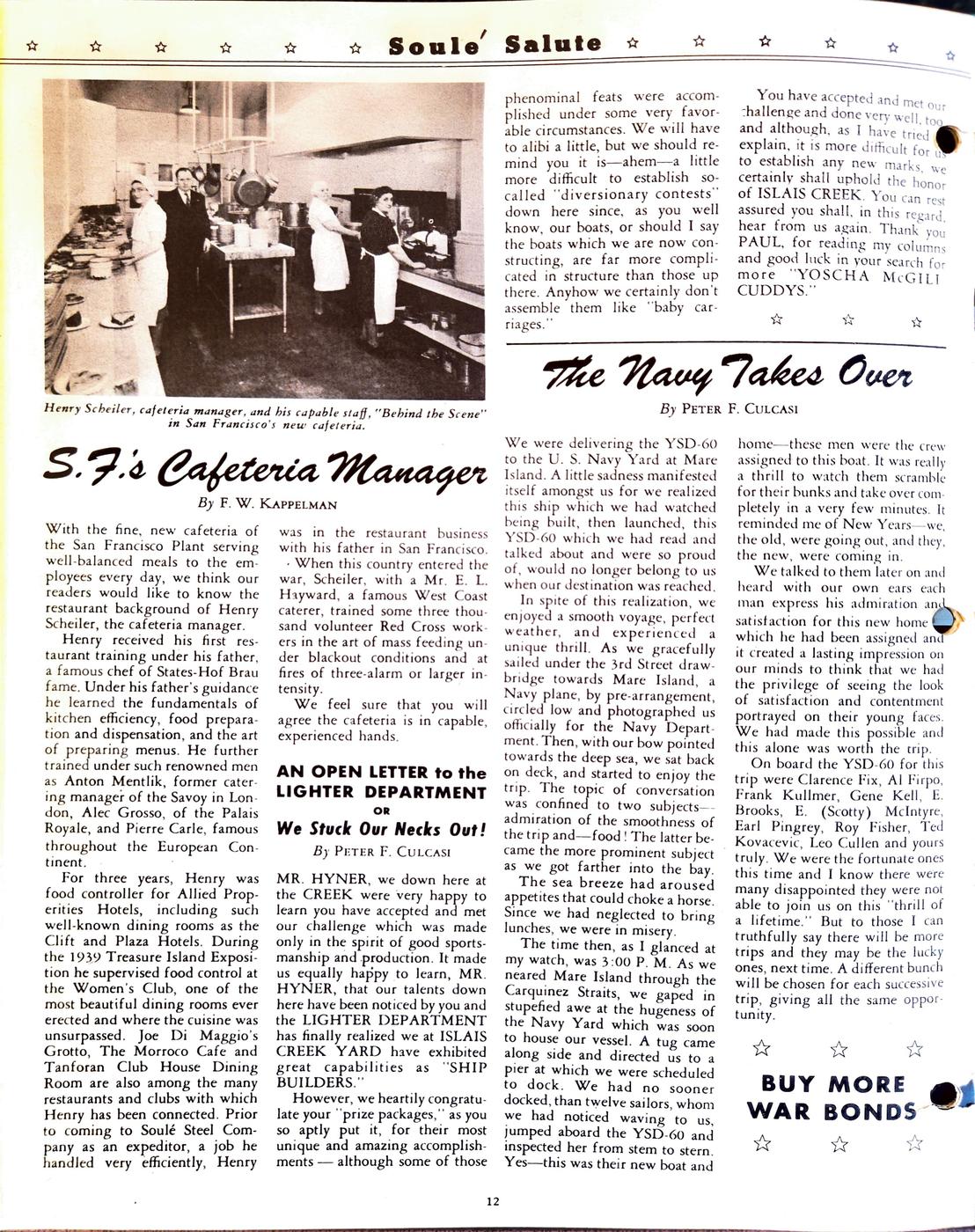
*Photo: Henry Scheiler, cafeteria manager, and his capable staff, "Behind the Scene" in San Francisco's new cafeteria.*
S.F.'s Cafeteria Manager
By F. W. KAPPELMAN
With the fine, new cafeteria of the San Francisco Plant serving well-balanced meals to the employees every day, we think our readers would like to know the restaurant background of Henry Scheiler, the cafeteria manager.
Henry received his first restaurant training under his father, a famous chef of States-Hof Brau fame. Under his father's guidance he learned the fundamentals of kitchen efficiency, food preparation and dispensation, and the art of preparing menus. He further trained under such renowned men as Anton Mentlik, former catering manager of the Savoy in London, Alec Grosso, of the Palais Royale, and Pierre Carle, famous throughout the European Continent.
For three years, Henry was food controller for Allied Properties Hotels, including such well-known dining rooms as the Cliff and Plaza Hotels. During the 1939 Treasure Island Exposition he supervised food control at the Women's Club, one of the most beautiful dining rooms ever erected and where the cuisine was unsurpassed. Joe Di Maggio's Grotto, The Morocco Cafe and Tanforan Club House Dining Room are also among the many restaurants and clubs with which Henry has been connected. Prior to coming to Soule' Steel Company as an expeditor, a job he handled very efficiently, Henry was in the restaurant business with his father in San Francisco.
When this country entered the war, Scheiler, with a Mr. E. L. Hayward, a famous West Coast caterer, trained some three thousand volunteer Red Cross workers in the art of mass feeding under blackout conditions and at fires of three-alarm or larger intensity.
We feel sure that you will agree the cafeteria is in capable, experienced hands.
AN OPEN LETTER to the LIGHTER DEPARTMENT OR We Stuck Our Necks Out!
By PETER F. CULCASI
MR. HYNER, we down here at the CREEK were very happy to learn you have accepted and met our challenge which was made only in the spirit of good sportsmanship and production. It made us equally happy to learn, MR. HYNER, that our talents down here have been noticed by you and the LIGHTER DEPARTMENT has finally realized we at ISLAIS CREEK YARD have exhibited great capabilities as "SHIP BUILDERS."
However, we heartily congratulate your "prize packages," as you so aptly put it, for their most unique and amazing accomplishments—although some of those phenomenal feats were accomplished under some very favorable circumstances. We will have to alibi a little, but we should remind you it is—ahem—a little more difficult to establish so-called "diversionary contests" down here since, as you well know, our boats, or should I say the boats which we are now constructing, are far more complicated in structure than those up there. Anyhow we certainly don't assemble them like "baby carriages."
You have accepted and met our challenge and done very well, too—and although, as I have tried to explain, it is more difficult for us to establish any new marks, we certainly shall uphold the honor of ISLAIS CREEK. You can rest assured you shall, in this regard, hear from us again. Thank you PAUL, for reading my columns and good luck in your search for more "YOSCHA McGILL CUDDYS."
The Navy Takes Over
By PETER F. CULCASI
We were delivering the YSD-60 to the U. S. Navy Yard at Mare Island. A little sadness manifested itself amongst us for we realized this ship which we had watched being built, then launched, this YSD-60 which we had read and talked about and were so proud of, would no longer belong to us when our destination was reached.
In spite of this realization, we enjoyed a smooth voyage, perfect weather, and experienced a unique thrill. As we gracefully sailed under the 3rd Street drawbridge towards Mare Island, a Navy plane, by pre-arrangement, circled low and photographed us officially for the Navy Department. Then, with our bow pointed towards the deep sea, we sat back on deck, and started to enjoy the trip. The topic of conversation was confined to two subjects—admiration of the smoothness of the trip and—food! The latter became the more prominent subject as we got farther into the bay.
The sea breeze had aroused appetites that could choke a horse. Since we had neglected to bring lunches, we were in misery.
The time then, as I glanced at my watch, was 3:00 P. M. As we neared Mare Island through the Carquinez Straits, we gaped in stupefied awe at the hugeness of the Navy Yard which was soon to house our vessel. A tug came along side and directed us to a pier at which we were scheduled to dock. We had no sooner docked, than twelve sailors, whom we had noticed waving to us, jumped aboard the YSD-60 and inspected her from stem to stern. Yes—this was their new boat and home—these men were the crew assigned to this boat. It was really a thrill to watch them scramble for their bunks and take over completely in a very few minutes. It reminded me of New Years—we, the old, were going out, and they, the new, were coming in.
We talked to them later on and heard with our own ears each man express his admiration and satisfaction for this new home which he had been assigned and it created a lasting impression on our minds to think that we had the privilege of seeing the look of satisfaction and contentment portrayed on their young faces. We had made this possible and this alone was worth the trip.
On board the YSD-60 for this trip were Clarence Fix, Al Firpo, Frank Kullmer, Gene Kell, E. Brooks, E. (Scotty) McIntyre, Earl Pingrey, Roy Fisher, Ted Kovacevic, Leo Cullen and yours truly. We were the fortunate ones this time and I know there were many disappointed they were not able to join us on this "thrill of a lifetime." But to those I can truthfully say there will be more trips and they may be the lucky ones, next time. A different bunch will be chosen for each successive trip, giving all the same opportunity.
**BUY MORE WAR BONDS**