Page 1
SOULE SALUTE
VOL. 2, NO. 6 Published Regularly by and for Soule Steel War Workers SEPTEMBER 15, 1944
Three Who Were There
PAUL HYNER
...Of all the millions of words of adventure that have been written and spoken about this war, none have the same quiet ring of conviction, nor the breathtaking drama, of those coming from the lips of the men who have gone through them personally. From them we learn the simple unvarnished truths of war.
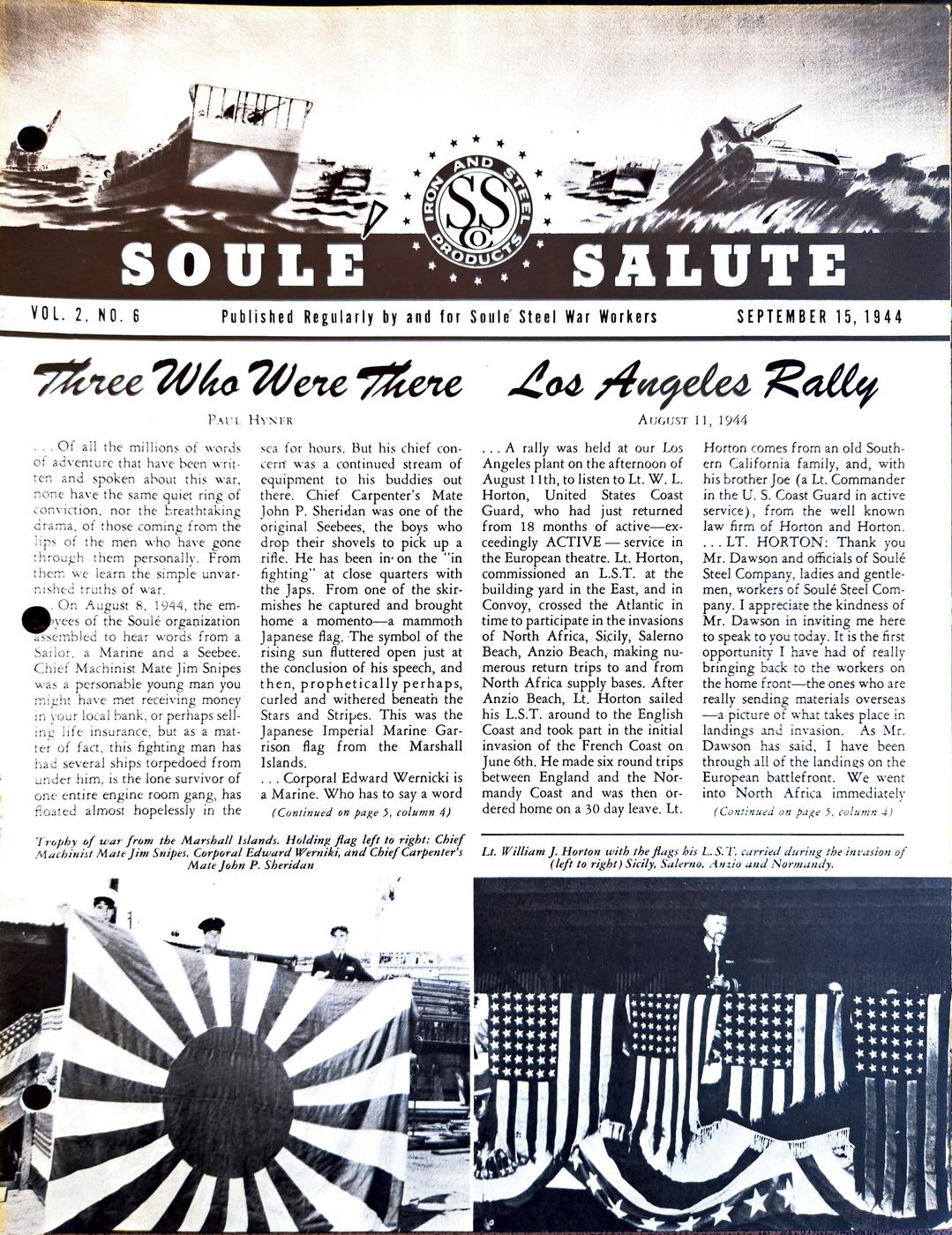
On August 8, 1944, the employees of the Soule organization assembled to hear words from a Sailor, a Marine and a Seebee. Chief Machinist Mate Jim Snipes was a personable young man you might have met receiving money in your local bank, or perhaps selling life insurance, but as a matter of fact, this fighting man has had several ships torpedoed from under him, is the lone survivor of one entire engine room gang, has floated almost hopelessly in the sea for hours. But his chief concern was a continued stream of equipment to his buddies out there. Chief Carpenter's Mate John P. Sheridan was one of the original Seebees, the boys who drop their shovels to pick up a rifle. He has been in on the "in fighting" at close quarters with the Japs. From one of the skirmishes he captured and brought home a momento—a mammoth Japanese flag. The symbol of the rising sun fluttered open just at the conclusion of his speech, and then, prophetically perhaps, curled and withered beneath the Stars and Stripes. This was the Japanese Imperial Marine Garrison flag from the Marshall Islands.
...Corporal Edward Wernicki is a Marine. Who has to say a word (Continued on page 5, column 4)
Los Angeles Rally
AUGUST 11, 1944
...A rally was held at our Los Angeles plant on the afternoon of August 11th, to listen to Lt. W. L. Horton, United States Coast Guard, who had just returned from 18 months of active—exceedingly ACTIVE—service in the European theatre. Lt. Horton, commissioned an L.S.T. at the building yard in the East, and in Convoy, crossed the Atlantic in time to participate in the invasions of North Africa, Sicily, Salerno Beach, Anzio Beach, making numerous return trips to and from North Africa supply bases. After Anzio Beach, Lt. Horton sailed his L.S.T. around to the English Coast and took part in the initial invasion of the French Coast on June 6th. He made six round trips between England and the Normandy Coast and was then ordered home on a 30 day leave. Lt. Horton comes from an old Southern California family, and, with his brother Joe (a Lt. Commander in the U. S. Coast Guard in active service), from the well known law firm of Horton and Horton.
...LT. HORTON: Thank you Mr. Dawson and officials of Soule Steel Company, ladies and gentlemen, workers of Soule Steel Company. I appreciate the kindness of Mr. Dawson in inviting me here to speak to you today. It is the first opportunity I have had of really bringing back to the workers on the home front—the ones who are really sending materials overseas—a picture of what takes place in landings and invasion. As Mr. Dawson has said, I have been through all of the landings on the European battlefront. We went into North Africa immediately (Continued on page 5, column 4)
*Trophy of war from the Marshall Islands. Holding flag left to right: Chief Machinist Mate Jim Snipes, Corporal Edward Werniki, and Chief Carpenter's Mate John P. Sheridan*
*Lt. William J. Horton with the flags his L.S.T. carried during the invasion of (left to right) Sicily, Salerno, Anzio and Normandy.*
Page 2
Soule' Salute
**SOULE SALUTE**
Vol. 2 No. 6 Published Regularly by and for Soule Steel War Workers
Staff: Managing Editor . . . George Cobb Los Angeles Editor . . . Bill Irwin Portland Editor . . . . . Les Poole San Francisco Editor, Fred Kappelman
Associate Editors: Los Angeles San Francisco Clarence Balfour Elaine Bradshaw Frank Bennett Peter F. Culcasi Eddie Dugan Paul Hyner G. V. Gambina Joe Romero Charlie LeFevre Marion Sheehy H. B. Porter Greta Siemens
Portland Torrance John Vaile A. M. Dowell
Assembly Line ## OF NEWS ABOUT OUR PEOPLE
Johnnie Herzog, on Military leave from the San Francisco Plant, writes from somewhere in England that he has the same bomber crew, is seeing a lot of action and enjoying his work there, but hopes to see us soon. His address is Lt. John H. Herzog, O-755689, 545 Bomb Sq., 384 Bomb. Gr., APO 557, c/o Postmaster New York City, N. Y.
"Hats off to Civilian Navy Inspector, C. J. Mee who at regular intervals for the past two years has written letters to a great list of Servicemen.
Mr. Mee's 'Episodes', as he titles them, take the style of a diary which chronicles his everyday activities. At the cost of a great deal of time and personal expense he has them mimeographed and mails them overseas. But the pleasure given by these episodes cannot be measured in time or money . . . we can all understand what a morale builder they must be to the boys who get them.
"Just a little note to let you know of my new mailing address," says P. D. Graham, S. K. 3/c, on leave from the San Francisco Plant, "it's 27th U. S. N. C. B. (Special), Co. B., F. P. O., San Francisco, California.
How's everything going at the Company. Gee, I sure wish I were back there right now. Give my regards and a big hell-o to all my friends in the shop.
We're still as busy as ever. I'm in Pearl Harbor, Hawaii. Do you want a Hula gal? I'll try to sell them some sash for their post-war huts . . . O.K.?
God bless you all."
PAUL
There was a six pound son born to the Lee Soulés on July 19, 1944. Name: Edward Lee Soulé III. He is to have the nickname of "Ward," derived from Edward. Mrs. Soulé and Ward are doing fine and Lee is feeling almost normal again.
Heartiest congratulations to the new Pa and Ma from all.
On August 12th, 1944, Carolyn Ann Culcasi made her debut into the world. Pete Culcasi, storekeeper at the Islais Creek yard had to take a week off to recover.
Carolyn tipped the scales at seven pounds . . . for the first time in his life Pete got a "seven."
Mrs. Culcasi is doing fine and our congratulations are extended to both.
The many friends of Ted Jones, Los Angeles, will be glad to hear he has started to recover from his serious illness. At present he is still in the hospital but should be home by the time this is published. We all hope for his speedy and complete recovery.
In a Los Angeles restaurant a customer ordered chicken chow mein without onions. His check for the meal read: Chow Mein ........................ 75c No Onions ......................... 05c Total ............................. 80c
The waiter, pressed for an explanation, replied: "With onion, easy; without onion Chef get mixed up, so five cents more without onion."
Asa Bumps, shipfitter in lighter assembly bay, San Francisco, suffered the loss of both his parents a short time ago. His mother lived but two hours after the death of his father. Our sincerest sympathies are extended to Mr. Bumps in his doubly deep sorrow.
If you're writing to your friends on the fighting front, don't bore them with your gripes about the things you can't buy or the things you have to do without. Write 'em a good short snappy note like: "Dear Joe—I hope you can use the job I finished up today. It's just about the best plane, ship or gun I ever made."
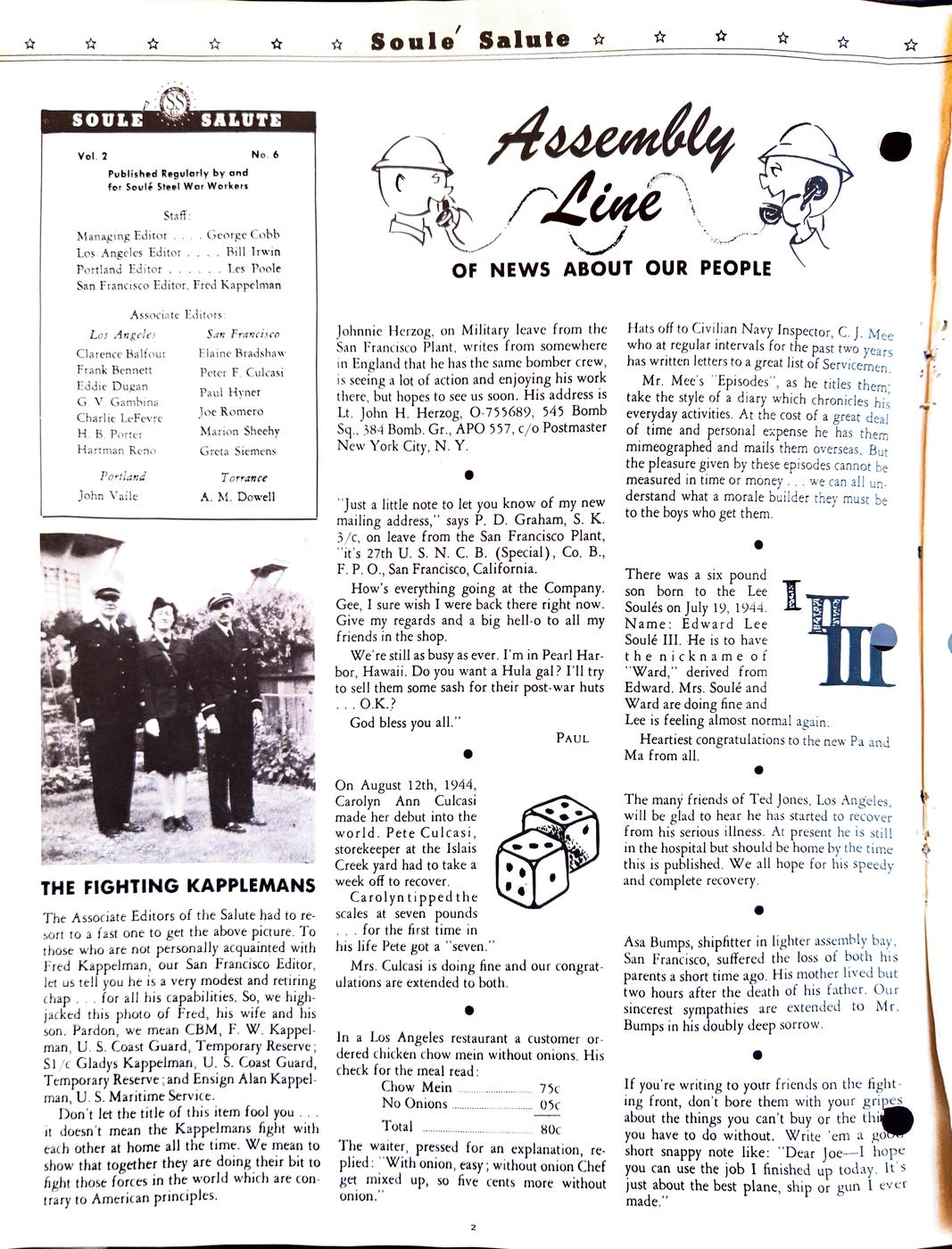
Photo: THE FIGHTING KAPPLEMANS The Associate Editors of the Salute had to resort to a fast one to get the above picture. To those who are not personally acquainted with Fred Kappelman, our San Francisco Editor, let us tell you he is a very modest and retiring chap . . . for all his capabilities. So, we highjacked this photo of Fred, his wife and his son. Pardon, we mean CBM, F. W. Kappelman, U. S. Coast Guard, Temporary Reserve; S1/c Gladys Kappelman, U. S. Coast Guard, Temporary Reserve; and Ensign Alan Kappelman, U. S. Maritime Service.
Don't let the title of this item fool you . . . it doesn't mean the Kappelmans fight with each other at home all the time. We mean to show that together they are doing their bit to fight those forces in the world which are contrary to American principles.
Page 3
Soule' Salute
REPORT FROM "Somewhere"
Several months ago H. C. Haller, a Chief Machinist Mate of the U.S.S. Welles, came to see us at the Los Angeles Plant. He had just returned from the South Pacific where he had been in charge of several LCM (3)'s. His wife telephoned Mr. Dawson the other morning and quoted the following from a letter just received from him:
"Would you call Mr. Dawson of Soule Steel and tell him that I said hello and where you think I am. Tell him, too, that I have seen with my own eyes several of the LCM's they were making at the time I was home last. I remembered the number. He will be pleased with that. They aren't pretty or as well painted as originally . . . for they have been in three landings. They have worn very well and are still going."
Bread Line in '49?
Those are the words on a sign erected by fighting Americans on Tarawa. They tell in their own grim way what the men are thinking — fearing — about post-war jobs.
This is one of the best reasons why our military men—several million of them—are buying War Bonds through Pay Roll Savings.
War Bonds are going to provide the "cushion" of buying power which will enable private industry to convert from making munitions of war to peace time pursuits. Thus War Bonds will provide jobs for our military men and women and civilians when victory is won.
Will you help alleviate those fears by Buying War Bonds, not with just the money you can spare but with every dollar you don't absolutely have to have now.
Let us help to insure everyone against a bread line in '49, by buying War Bonds NOW. The most convenient, systematic way to do it is through Pay Roll Savings.
BACK THE ATTACK—DO MORE THAN BEFORE
Wounded Soldier Asks to Fight Until War Is Won
The following article, from the Florence (California) Messenger, describes the son of Alfred Gallegos. Mr. Gallegos has been with us at the Los Angeles plant for over a year as a fitter on the ramps.
Pat Gallegos, who made his home with his sister, Mrs. Cecilia Morgan of Florence, has asked for a transfer from the Air Corps to the Infantry. The war department has granted his request . . . but here is the story about Pat.
Pat is a Florence boy who has seen plenty of service . . . has seen enough action in the Air Corps in the South Pacific to be awarded the Purple Heart for wounds received during one of the battles.
Not only was he given the Purple Heart, but they wanted to give him an Honorable Discharge.
Pat did not want an Honorable Discharge . . . he wanted to stay in there fighting . . . fighting until this war is over.
Refusing the discharge, the boy asked his government to let him transfer to the Infantry. Perhaps he would not do any more flying . . . but if they would only let him transfer . . . he could still fight in hand to hand combat with the Infantry.
Pat knows not only wounds to the body . . . but he knows what it is to have the heart wounded in war. In June the sad news was sent him that his wife, an Army Nurse, was killed in Italy.
Pat fights on! The people of Florence and the Soule Steel Company send every good wish to him . . . and to the thousands of other boys carrying on under difficulties little known to those safe in this country.
This is not only the story of Pat Gallegos . . . it is the story of the spirit of the fighting men of America . . . the fighting men of Florence.
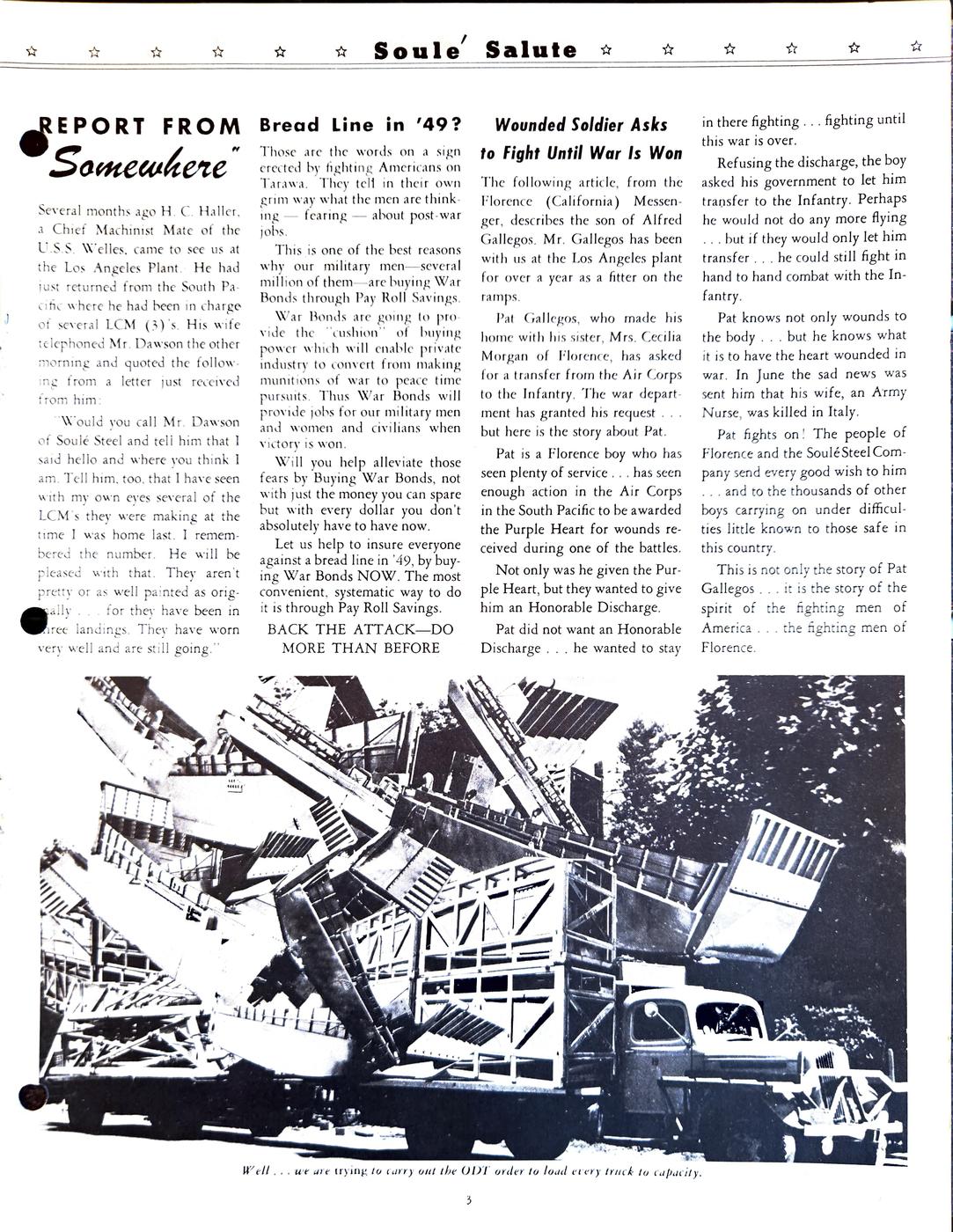
Photo: Well . . . we are trying to carry out the ODT order to load every truck to capacity.
3
Page 4
Soule' Salute
Did You Know by Joe Romero
... That since June 1944 to August 1944, this Company has had only 85 blood donors out of a possible 525. This seems to be a very poor showing. How about some of you red-blooded men and women boosting this average. It's so little to give for a human life.
... That Irene Cory, who used to operate our jeeps for us, is back in the fold again. She has just spent two months back East. Nice seeing her around again.
... That Richard Romero, who is convalescing from wounds received at Anzio Beachhead in Italy, has another medal to add to his Silver Star award. The Purple Heart was sent home to his mother.
... That the tall, dark and handsome Lieutenant, who walked through our plant recently was none other than Johnny Edgar. He used to operate our big Semi ... who said these truck drivers didn't know anything.
... That the Reinforcing Department is going to be in there pitching again ... reconstructing the damage done at Port Chicago by the explosion. Some of us heard it, but most of us read about it.
Miss Blanche Bonino Marries By DOROTHY DOWNEY SMITH
On August 16th, Miss Blanche Bonino . . . until recently Mr. Purchasing Agent Cole's secretary . . . became Mrs. Joseph Fornasero. Following a honeymoon at Santa Barbara, the couple will live in Holtville in Imperial Valley. The groom's family have been prominent ranchers there for many years.
In anticipation of the event a party was held in the Los Angeles Company cafeteria at noon on July 26th. Miss Dorothy Olsen acted as hostess. All of the girls in the office, as well as two former employees and Blanche's sister, Mrs. Wesley Jones, attended. The tables were nicely appointed and refreshments of cake, ice cream and punch, were delicious.
Blanche received many nice items for personal wear . . . we won't go into detail about them. Suffice to say practically every girl there was drooling with envy. The few men scattered throughout the cafeteria were not missing a thing.
Blanche was with us nearly three years. She is the type who likes everyone and everyone likes her. We all miss her, of course, but having met the groom it is plain to see she made a good "trade."
Safety First By J. F. BENNET
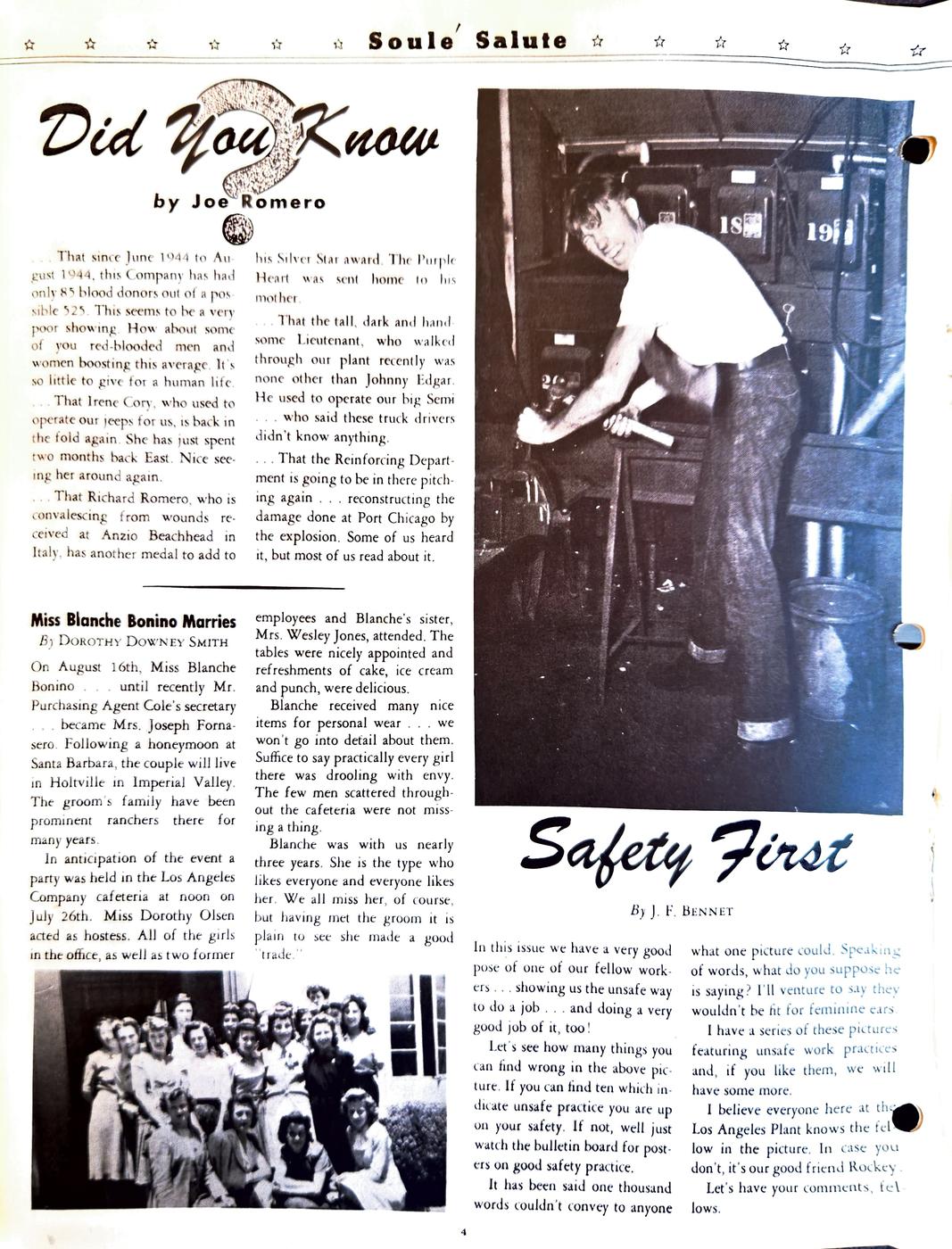
In this issue we have a very good pose of one of our fellow workers . . . showing us the unsafe way to do a job . . . and doing a very good job of it, too!
Let's see how many things you can find wrong in the above picture. If you can find ten which indicate unsafe practice you are up on your safety. If not, well just watch the bulletin board for posters on good safety practice.
It has been said one thousand words couldn't convey to anyone what one picture could. Speaking of words, what do you suppose he is saying? I'll venture to say they wouldn't be fit for feminine ears.
I have a series of these pictures featuring unsafe work practices and, if you like them, we will have some more.
I believe everyone here at the Los Angeles Plant knows the fellow in the picture. In case you don't, it's our good friend Rockey.
Let's have your comments, fellows.
Page 5
☆ ☆ ☆ ☆ ☆ Soule' Salute ☆ ☆ ☆ ☆ ☆
THE PORT SIDE By H. B. PORTER
Walt Heckert claims that for a man to be a good fitter he doesn't necessarily have to "fit" . . . but it helps. Welcome back to Melvin (Jack) Horner. A seven month layoff is a pretty tough "row to hoe" in any language. We're all glad to see you back in the line up again Jack.
YSD CALLING By PETER F. CULCASI
We should be changing the name of this column soon now—the last YSD boat is nearing completion—How about Soule' Shipyard No. 1??—or—Kitten Creek—or can you suggest something better?
To HERB ANTHONY, TONY FIRPO, HOWARD BRANCH, ANGELO DILLES —welcome to YSD and some really grand guys—not to mention a real place to work—
CAROLYN ANN—thanks all her generous friends at the CREEK—for those lovely flowers—those 2 War Bonds—that big sum put in a savings account for her—of course—her "daddy" joins her (chest expansion—54")
Bell discovered the Telephone —Marconi the wireless—Edison the incandescent lamp—AND, Lewis Crane, a litter of KITTENS—yep—4 of them were born in his locker—It's father Crane now—
CONGRATULATIONS — to T. Firpo—no relation to THE WILD CAT—also becoming a father this month and—coming out of it nicely—to Homer Craig —who recently became Paint Foreman and keeping the same size hat—to A. Papini and C. Ehring—leadermen de luxe—doing a swell job—
Have you visited the CREEK lately?—and seen what is going on there? The super-half of the Soulé Steel Co. is currently engaged in the following activities: —sectionalizing LCM's —building YSD's and YF barges—planning to build YC barges—getting ready to build Tuna Clipper Boats —and maybe perhaps a couple more odd jobs here and there— Yes Sir!!—a real thriving community—
HATS OFF!! to Jimmy Hayden—Kid Hayden for short—
who finds time—after a hard day's work—to go roller skating —and tap dancing—He's only 59 —nice going young feller—we won't mention the BLOOD BANK—
SHORT SHOTS By GRETA SIEMENS
Ronald miss bus Ronald in big hurry RONALD RUSH Lawrence take bath House catch on fire Lawrence run from house LAWRENCE BAER Francis at Beach Francis goes to sleep Sand covers Francis FRANCIS HILL James in Haunted House James scared and whistle James see ghost JAMES WHITE William sit on bus Man give William hot foot WILLIAM JUMP Louis on baseball team Louis at bat Our team 1 run behind LOUIS TRYFORUS Thomas out in sun Thomas fall asleep Sun hot THOMAS BROWN Frank play Blackjack Man win lots of money from Frank Man the winner FRANK DE LOSA Frank Big, Bad Wolf Frank try blow down house Frank puff FRANK HUFF Louis sat in room Girl come into room LOUIS ROSA Flora drink fast Drink strong Martini FLORA HICKS
Mr. Stork Has Busy Days By C. V. GAMBINA
Here I am doing a bit of news reporting in a different light. It seems as though the stork has been a very busy bird out Los Angeles way. Here are four recent blessed events.
Paul Partnoff, one of our serenade burners, has been *in the mood* ever since the "blessed event" of six pound, eight and one-half ounce, Diane Louise, the first child of the Partnoffs. Little Diane Louise is a "D" Day baby born on June 6th . . . the day of the great invasion. Mrs. Partnoff and child are doing fine. Congratulations, Paul.
Photo: Mr. and Mrs. Paul Partnoff
Then we have John Seabert, ship fitter, the proud father of an eight and one-half pound baby girl, Julie Ann Seabert, born June 28th. Mrs. Seabert and child are doing fine. The best of luck to you and the family, John.
Photo: John Seabert and daughter Julie Ann
Murray Moss running around the plant with a box of cigars (where did he get them?) with a beaming smile . . . "Have a cigar, for today I am a father." The blessed event was ten pound Jan-
ice Ann, born August 7th. Janice is their first child. When asked how he felt, he responded, "I have gained ten pounds over night". Of course, there is no telling how much he lost!
Odell Pound has really been pouring out production. Seeing this I of course had to do a bit of inquiring. Low and behold, we have another one! It's a boy this time . . . a big boy, too! Nine pound, four ounce Norman Isaac Pound was born to Mr. and Mrs. Odell Pound . . . making the score two boys and one girl. Congratulations Odell.
Three Who Were There *(Continued from page 1, column 2)* about the marines? He looks like a young man; probably he had been a boy when he went "out there." Yet he carries the scar of a Jap bullet in his chest.
. . . In his introductory address, Mr. Edw. L. Soule' spoke of a personal war map, one of those which show the gradual biting off of the Axis-overrun lands by our forces. These maps show Axis-bound territory in black, the encroaching Allied gains in white.
. . . After listening to these three men, we knew we were face to face with three of the cogs of that vast machine which is rubbing the black blots off the face of the earth. We wish them luck and Godspeed in this fight that belongs to all of us.
Los Angeles Rally *(Continued from page 1, col. 4)* after the fall of Tunisia. From there we went into Sicily in the initial landing. It would probably be better to give you a chronological picture of these landings.
. . . I have brought with me the four American Flags which we flew in Sicily, Salerno, Anzio and Normandy. On each one of the invasions and to me—and I am sure to all of you as well—there is nothing as thrilling as such a flag. You will note they are pretty well frayed and battle worn. I would like to have you see them because I, particularly, am quite proud of these flags.
. . . This is the flag that we carried into Sicily. To give you a picture of it: First, we assembled at various ports — the large landing craft, minesweepers, warships and transports—on the North African Coast. At various times these craft
Photo: Mr. and Mrs. Murray Moss
(Continued on page 6, column 1)
5
Page 6
* * * * * Soule' Salute * * * * *
Los Angeles Rally (Continued from page 5, column 4) were sent away from the particular points where we assembled, and cruised about but not in direct line to where we wanted to land. On the Sicilian invasion we left 48 hours prior to H-hour, whereas, this trip ordinarily takes only 20 hours at the most. That is to throw the enemy off and try to keep him guessing as to our plans. The various convoys cruised about the Mediterranean and assembled at a point known as the "transport area" off Sicily. First, the minesweepers go in and clean up whatever mines there might be. Then the warships, battlewagons, cruisers and destroyers move in to bombard the selected invasion point. The transports carrying troops are put ashore by means of the smaller landing craft and there is where the particular landing craft you are building plays a tremendous part. The landing craft are carried on decks of the transports to the area and lowered away prior to H-hour and take the troops and vehicles direct to the beaches. At Sicily there was a rough sea—as you have all probably read—and as a result of this and no little short bombardment, heavy losses resulted in both men and small craft. It got to such a point at one time that many of the transports were practically without small craft. Sicily was considerably hot from the air. The Jerries came over night after night and bombed the ships in the transport area and the landing area. ... From Sicily we went into Salerno, and here again I want to stress to you the magnificent job done on the home front in supplying the needs of our fighting men. Lt. Horton's Invasion Adventures will be continued in the next issue of the Salute.
Here's one we recently heard— Looking over the job application forms to see if they had been properly filled out, a personnel manager came across one which read: "Age of Mother, if living —112. Age of Father, if living— 120." The director called the applicant over and asked in amazement. "But your parents are not that old, are they?" "Oh no sir." was the reply. "but they would have been—if living."—See you later.
Foremen Facts
By GRETA SIEMENS S. F. Plant
The first unlucky victim we tied to the chair long enough to interview turned out to be none other than ALWIN ERNST SCHURNER. If you don't recognize that monicker, any worker on the lighter ways can point him out to you as "Al," the burner machinist foreman. Red-wood City means "home" to him, his wife, two children and various barnyard pets. This year marks his tenth with Soulé. He celebrated by taking his first vacation in all that time. Hunting and fishing take up his spare time—where he fishes, or what he hunts, remains unsaid.
*Photo: A. E. Schurner*
FRANK MENGES, welder foreman, dashed into the Personnel Office to say something about women "absentees", so we stopped him long enough to find out that he is "29 years old" and has worked at Soulé 21 summers. Just shows what an early start in life and a little initiative does for you. When he had time to learn the trade, we don't know, but it seems that Cabinet Making takes up his spare time and ingenuity. When we asked if he was married, he said, "not yet" . but we have other ideas!
*Photo: F. Menges*
The Irishman of this group turned up next . . . none other than LEWIS PATRICK RIVEIRA, St. Patrick's own little child. Aside from the fact he has two brothers, Harry and Marshall, also working at Soulé, we found that this General Foreman bowls a "hot" 150 about twice a week at the Downtown Alleys, has worked here twenty-one years, and is not married. A Shop Safety Committeeman of three years standing, he may be spotted anywhere because of the Safety Pins and badge he wears on his cap. Lewis believes that Safety Rules are observed pretty well . . . is always more than willing to turn in any suggestions from plant workers to the Committee.
*Photo: L. P. Riveira*
Cornering KENNY BECKNELL, we got him to say that women workers were exceptionally good . . . especially welders. Greatly encouraged, we asked how he like the SALUTE . . . "very good," was the verdict. Ken has been at Soulé for ten and one-half years, is married with two children, and likes to go to the movies . . . where Jan [illegible] Cagney places among his favorites. If any of your welders turn up with chips on their shoulders and snarls on their faces tomorrow, Ken, you know why.
*Photo: K. Becknell*
Page 7
Soule' Salute
To Production Workers the Shipyards and Shore Establishments of the Navy and in the Private Plants and Shipyards of Navy Suppliers Throughout the Country
By RALPH A. BARD Under Secretary of the Navy
... As loyal members of the great force which has been mobilized to supply our "fighting Navy" with the ships and planes and guns needed on the fighting fronts, I feel you are entitled to a frank statement from that Navy as to what are your future prospects and obligations. To put it in one word — it is work — and more work.
... The Navy's production program is still increasing. The last 6 months of 1944 will show an increase in production of approximately 10% over the first 6 months of 1944, and the program for the first 6 months of 1945 will be approximately 3% greater than the first 6 months of 1944. At the present time, we are short some thirty thousand workers in the Naval establishments, principally on the Pacific Coast. We expect this production program will be carried out, and it is not expected that the ending of the war in Europe during this period will affect this program. Our battle of production will end only with the defeat of Japan.
... This means that for the next year the Navy must rely upon the civilian employees of its own Naval establishments and upon the workers in the private plants and shipyards of Navy suppliers throughout the country to keep our Pacific operations going at top speed; as we approach nearer and nearer Japan, the tempo will increase and the necessity for more and more supplies available at the proper place and time will become more and more vital to our success. We therefore call upon all such employees, regardless of peace talk and developments in Europe, to stick on their jobs—back up the Navy—and prepare to pour on the Japanese the cumulative power of our fleet and our production lines—so that the fleet will be effective and our soldiers and sailors will have the necessary arms and ammunition to take an instant advantage of the opportunities which will be presented to shorten this war.
... While our over all demands will show little if any material decrease — there will of course be some terminations and here and there cutbacks based upon the changing war conditions. Based upon the program for the year ahead as we now see it, there should be just as many workers employed on the Navy production program a year from now as there are at the present time. The Navy depends upon you — we know you will not fail.
SOLDIER VOTING
Under the new California law, any member of the United States Armed Forces or Merchant Marine, or any citizen serving in the American Red Cross, the Society of Friends, the Women's Auxiliary Service Pilots, or the United Service Organizations and attached to and serving with the Armed Forces, or any civilian employed by the United States and serving outside the territorial limits of the United States, if of legal voting age, is classified as a "war voter."
To obtain an absentee ballot such person may secure a post card form, from his Commanding Officer. The completed form must be forwarded to their own County Clerk or Registrar of Voters.
The State Constitutional requirements apply to war voters just as they do to civilians. Every voter must be at least 21 years of age on the day of election, have lived in the State of California one year, his respective county 90 days and the precinct 40 days before entering the military service. If the person is not a registered voter, he may become one by signing the affidavit of registration which will be mailed at the same time as the absentee ballot, thus qualifying him to cast his vote.
Absentee ballots will be mailed between September 8 and November 2, 1944 and must be voted on not later than the day of election (November 7, 1944). Ballots for the General Election must be received by the Registrar's Office not later than midnight, November 23. Air Mail handling both ways will permit adherence to this time schedule. Complete instructions for absentee voting will be forwarded to each applicant with his ballot.
Lieutenant A. O. Tate
By FRED KAPPLEMAN
We would like to introduce, and welcome, Lieutenant A. O. Tate, United States Navy, Assistant Supervisor of Shipbuilding under Captain C. O. Kell in charge of Navy Contracts at the San Francisco Plant.
Lieutenant Tate is a Navy man of pre-war days. He enlisted as a "Boot" or Apprentice Seaman on August 4, 1931. Progressing through the various rates and ranks, he is now a Lieutenant.
During these thirteen years of service, his tours of duty include service aboard the Destroyer-tender Melville, Submarine Force Squadron Three. He was aboard the carrier U.S.S. Yorktown when it was sunk in the battle of Midway in June 1942. He comes to this station from the new U.S.S. Lexington.
The campaign ribbons the Lieutenant wears are American Defense with star for Foreign Service, American Theatre of War, and Asiatic-Pacific with ten stars denoting ten engagements. And that red one with the star means "Good Behavior" . . . awarded twice.
These ribbons indicate that the Lieutenant has seen plenty of action and many of the horrors and hells of war. Having seen men torn and mangled and helped by blood plasma, Lieutenant Tate commends the people of Soule Steel who have donated blood and hopes that all others who can do so will visit the Blood Bank. Knowing the value of having plenty of supplies and equipment at the right time, Lieutenant Tate also urges the purchase of War Bonds. Service people are on the job twenty-four hours a day and depend on folks at home to furnish the equipment to bring peace and freedom from aggression . . . he asks all to "Stay on the job and finish the job."
*Clarence Hodge, Blacksmith and Walter Mathis, Helper, working in the Los Angeles Plant blacksmith shop . . . which is not under a spreading Chestnut tree.*
Page 8
* * * Soule' Salute * * *
"Soule' Invaders" Lead in Industrial League By C. V. GAMBINA
... Last night I saw a ball team born. Last week it was just nine of the boys at Soule Steel Co., but last night it was one coordinated team. From Floyd Reed, the catcher, right down to the last man in the outfield, the team clicked. I saw one unit (known to baseball lovers as the infield) field as did the Million Dollar infield of Chicago in the old days, Rocky Gesselman the Keystone sacker (better known as the "Hat") was the spark plug of this unit, ably backed up by Lon Ferra on first, Mike Brock at short stop and in-
*Photo: Lon Ferra*
troducing a newcomer at third—Danny Rodriguez — who is a comer. ... In all machines there must be a cover; the cover on this machine is the outfield. Three boys cover the outer garden like a tent. Rex Campbell in left, "Speedy" Warren Moyer in center and Jack Rosberg in right. ... In the machine the brain was of the best. Of course, by the brain I mean the pitching staff. In this department we boast of two of the highest skill. Veteran Irv. Halliday, who has pitched Soule to several pennants in the past, and "Fireball" Lou Lazarovitz. Another one, standing alone guarding the home gate was Floyd Reed, one of our heaviest sluggers keeping his eye on those doubtful runs. ... Ah! yes, we
must not forget our rooting section, one of the finest that we could expect to have. It consisted of wives and families of the players, plus many friends and employees. It's no wonder we have a winning team every game. If I could yell as loud as some of the wives and families, I do believe I would be a happy rooting section all my own. ... It is a pleasant thought to sit there and watch your fellow workers do such a fine job in presenting us with a fine game.
Navy Passes Halfway Mark Toward 100,000 Landing Craft Goal
With all the major types of landing craft now developed, and for the most part proven in the landings on the coast of Western Europe and in the Pacific campaigns, the Navy announced that the half-
way mark has been passed toward the production goal of 100,000 such vessels authorized by Congress. To date, 1,624,162 tons of landing craft have been produced, representing some 48,267 vessels which range from small personal boats to the giant LSD's—Landing Ships, Dock. Now engaged in rushing the program to completion are some 4,000 prime contractors, 30,000 sub-contractors and their hundreds of thousands of employees. The vessels are being assembled at approximately 75 shipyards throughout the nation. As an index of the marked increase in the production of landing craft, 56,289 tons were produced in June 1943; the figure rose to 69,575 tons in November, 1943, while May, 1944 the monthly tonnage soared to 197,901. Three and a half times the tonnage of landing craft is now sliding off the ways, compared with a year ago. Today, as many landing craft are being produced in a single month as in an entire quarter previously.
Below: The Soule Invaders. Left to right, back row: Dorsey Cooper, Rex Campbell, Manuel Bison, O'Connel, Joe Slovecck, Louie Lazarovitz, Jack Rosberg, Chuck Gambina, Business Manager. Front row: Mike Brock, George Ridgely, Manager, Rocky Gesselman, Warren Moyer, Lon Ferra, Max Harms.
8