Page 1
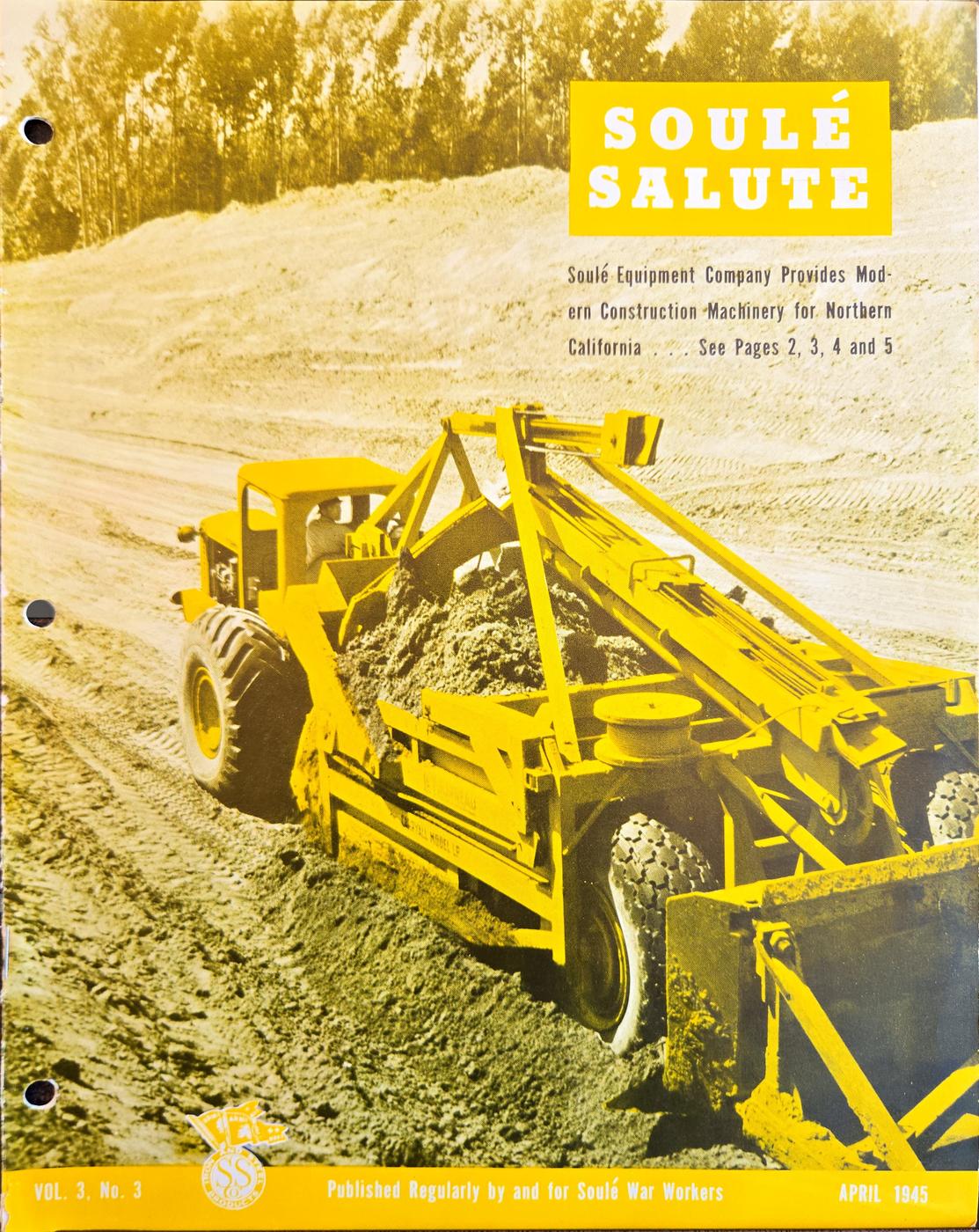
SOULÉ SALUTE
Soulé Equipment Company Provides Modern Construction Machinery for Northern California . . . See Pages 2, 3, 4 and 5
VOL. 3, No. 3 Published Regularly by and for Soulé War Workers APRIL 1945
Page 2
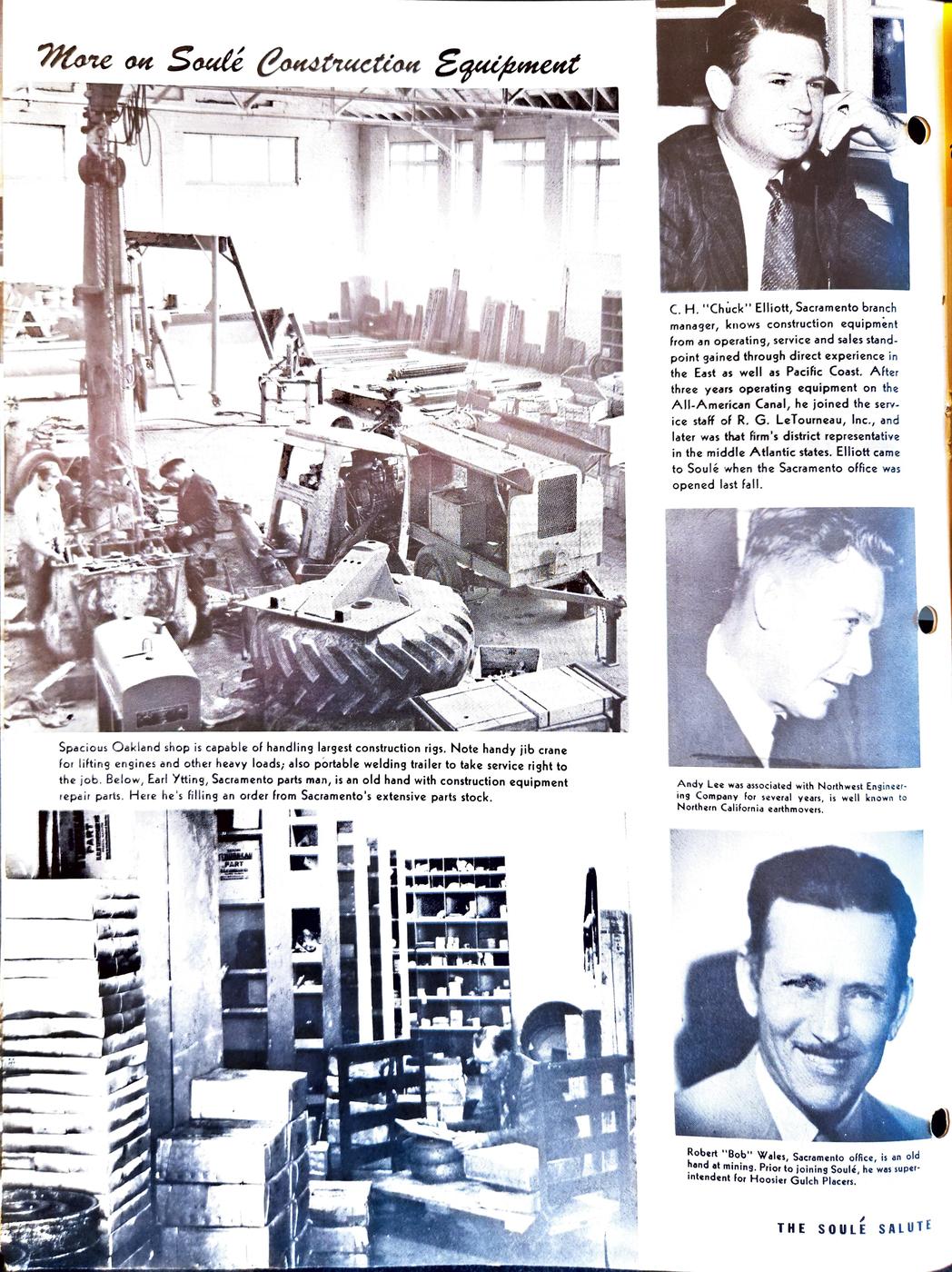
More on Soulé Construction Equipment
*Photo: Spacious Oakland shop is capable of handling largest construction rigs. Note handy jib crane for lifting engines and other heavy loads; also portable welding trailer to take service right to the job. Below, Earl Ytting, Sacramento parts man, is an old hand with construction equipment repair parts. Here he's filling an order from Sacramento's extensive parts stock.*
*Photo: C. H. "Chuck" Elliott, Sacramento branch manager, knows construction equipment from an operating, service and sales standpoint gained through direct experience in the East as well as Pacific Coast. After three years operating equipment on the All-American Canal, he joined the service staff of R. G. LeTourneau, Inc., and later was that firm's district representative in the middle Atlantic states. Elliott came to Soulé when the Sacramento office was opened last fall.*
*Photo: Andy Lee was associated with Northwest Engineering Company for several years, is well known to Northern California earthmovers.*
*Photo: Robert "Bob" Wales, Sacramento office, is an old hand at mining. Prior to joining Soulé, he was superintendent for Hoosier Gulch Placers.*
THE SOULÉ SALUTE
Page 3
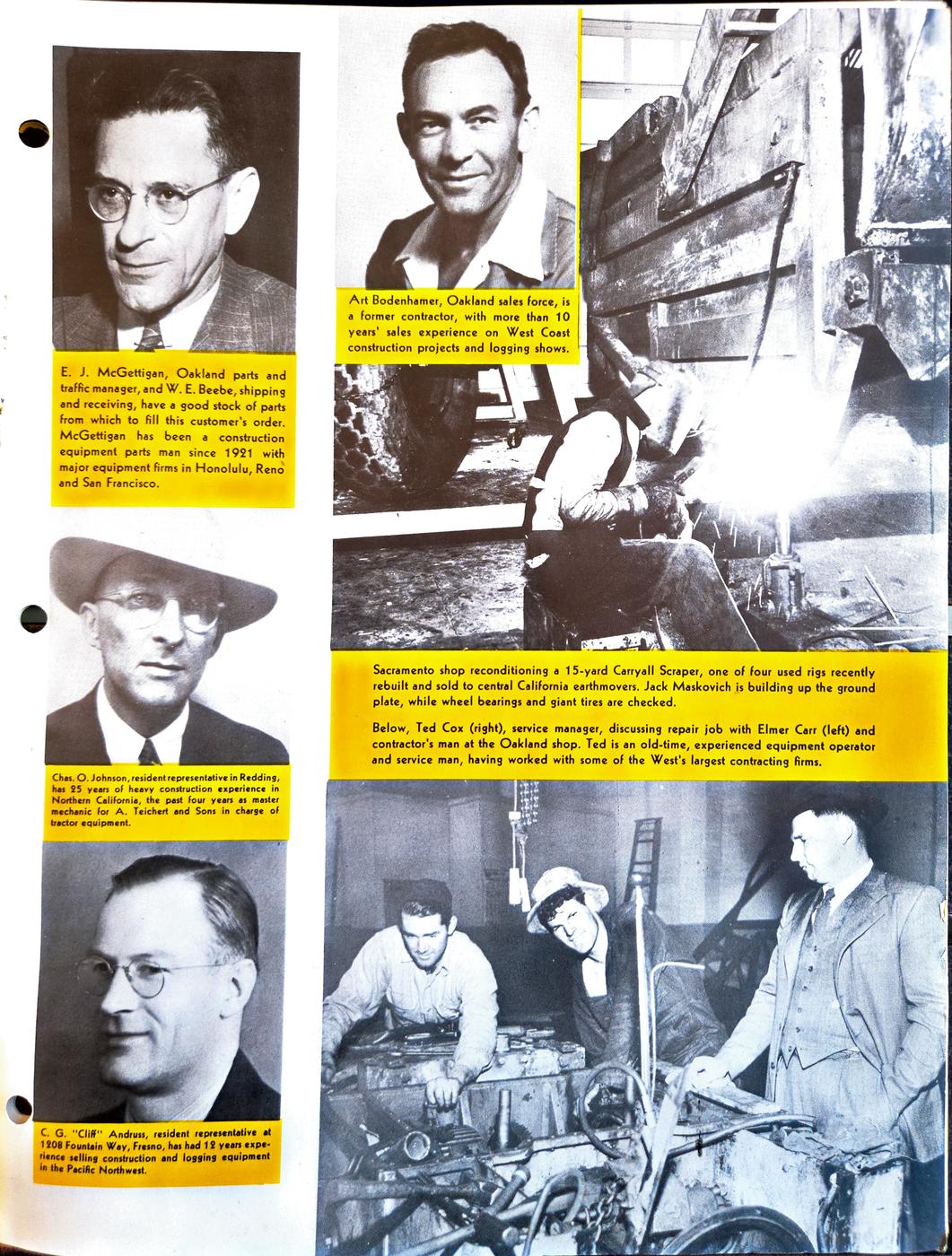
E. J. McGettigan, Oakland parts and traffic manager, and W. E. Beebe, shipping and receiving, have a good stock of parts from which to fill this customer's order. McGettigan has been a construction equipment parts man since 1921 with major equipment firms in Honolulu, Reno and San Francisco.
Art Bodenhamer, Oakland sales force, is a former contractor, with more than 10 years' sales experience on West Coast construction projects and logging shows.
Chas. O. Johnson, resident representative in Redding, has 25 years of heavy construction experience in Northern California, the past four years as master mechanic for A. Teichert and Sons in charge of tractor equipment.
Sacramento shop reconditioning a 15-yard Carryall Scraper, one of four used rigs recently rebuilt and sold to central California earthmovers. Jack Maskovich is building up the ground plate, while wheel bearings and giant tires are checked.
C. G. "Cliff" Andruss, resident representative at 1208 Fountain Way, Fresno, has had 12 years experience selling construction and logging equipment in the Pacific Northwest.
Below, Ted Cox (right), service manager, discussing repair job with Elmer Carr (left) and contractor's man at the Oakland shop. Ted is an old-time, experienced equipment operator and service man, having worked with some of the West's largest contracting firms.
Page 4
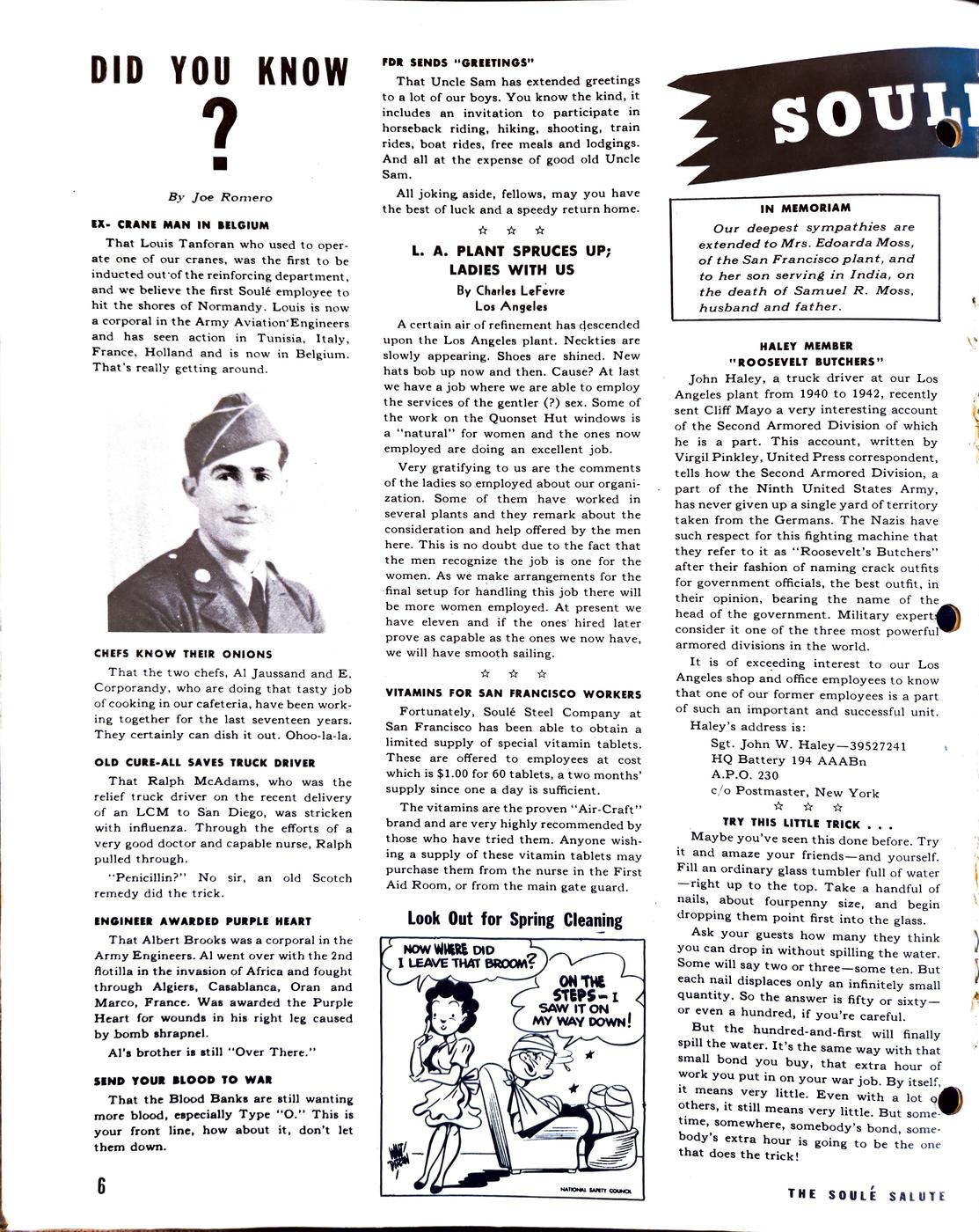
DID YOU KNOW ?
*By Joe Romero*
EX- CRANE MAN IN BELGIUM
That Louis Tanforan who used to operate one of our cranes, was the first to be inducted out of the reinforcing department, and we believe the first Soulé employee to hit the shores of Normandy. Louis is now a corporal in the Army Aviation' Engineers and has seen action in Tunisia, Italy, France, Holland and is now in Belgium. That's really getting around.
*Photo: A young soldier in uniform and garrison cap, smiling at the camera.*
CHEFS KNOW THEIR ONIONS
That the two chefs, Al Jaussand and E. Corporandy, who are doing that tasty job of cooking in our cafeteria, have been working together for the last seventeen years. They certainly can dish it out. Oho-la-la.
OLD CURE-ALL SAVES TRUCK DRIVER
That Ralph McAdams, who was the relief truck driver on the recent delivery of an LCM to San Diego, was stricken with influenza. Through the efforts of a very good doctor and capable nurse, Ralph pulled through.
"Penicillin?" No sir, an old Scotch remedy did the trick.
ENGINEER AWARDED PURPLE HEART
That Albert Brooks was a corporal in the Army Engineers. Al went over with the 2nd flotilla in the invasion of Africa and fought through Algiers, Casablanca, Oran and Marco, France. Was awarded the Purple Heart for wounds in his right leg caused by bomb shrapnel.
Al's brother is still "Over There."
SEND YOUR BLOOD TO WAR
That the Blood Banks are still wanting more blood, especially Type "O." This is your front line, how about it, don't let them down.
FDR SENDS "GREETINGS"
That Uncle Sam has extended greetings to a lot of our boys. You know the kind, it includes an invitation to participate in horseback riding, hiking, shooting, train rides, boat rides, free meals and lodgings. And all at the expense of good old Uncle Sam.
All joking aside, fellows, may you have the best of luck and a speedy return home.
L. A. PLANT SPRUCES UP; LADIES WITH US
*By Charles Lefèvre* *Los Angeles*
A certain air of refinement has descended upon the Los Angeles plant. Neckties are slowly appearing. Shoes are shined. New hats bob up now and then. Cause? At last we have a job where we are able to employ the services of the gentler (?) sex. Some of the work on the Quonset Hut windows is a "natural" for women and the ones now employed are doing an excellent job.
Very gratifying to us are the comments of the ladies so employed about our organization. Some of them have worked in several plants and they remark about the consideration and help offered by the men here. This is no doubt due to the fact that the men recognize the job is one for the women. As we make arrangements for the final setup for handling this job there will be more women employed. At present we have eleven and if the ones hired later prove as capable as the ones we now have, we will have smooth sailing.
VITAMINS FOR SAN FRANCISCO WORKERS
Fortunately, Soulé Steel Company at San Francisco has been able to obtain a limited supply of special vitamin tablets. These are offered to employees at cost which is $1.00 for 60 tablets, a two months' supply since one a day is sufficient.
The vitamins are the proven "Air-Craft" brand and are very highly recommended by those who have tried them. Anyone wishing a supply of these vitamin tablets may purchase them from the nurse in the First Aid Room, or from the main gate guard.
Look Out for Spring Cleaning
*Photo: A cartoon showing a woman holding a broom asking "NOW WHERE DID I LEAVE THAT BROOM?" while a bandaged man on a stretcher replies "ON THE STEPS— I SAW IT ON MY WAY DOWN!" Signed "NATIONAL SAFETY COUNCIL."*
SOULÉ
IN MEMORIAM
*Our deepest sympathies are extended to Mrs. Edoarda Moss, of the San Francisco plant, and to her son serving in India, on the death of Samuel R. Moss, husband and father.*
HALEY MEMBER "ROOSEVELT BUTCHERS"
John Haley, a truck driver at our Los Angeles plant from 1940 to 1942, recently sent Cliff Mayo a very interesting account of the Second Armored Division of which he is a part. This account, written by Virgil Pinkley, United Press correspondent, tells how the Second Armored Division, a part of the Ninth United States Army, has never given up a single yard of territory taken from the Germans. The Nazis have such respect for this fighting machine that they refer to it as "Roosevelt's Butchers" after their fashion of naming crack outfits for government officials, the best outfit, in their opinion, bearing the name of the head of the government. Military experts consider it one of the three most powerful armored divisions in the world.
It is of exceeding interest to our Los Angeles shop and office employees to know that one of our former employees is a part of such an important and successful unit.
Haley's address is:
Sgt. John W. Haley—39527241 HQ Battery 194 AAAAbn A.P.O. 230 c/o Postmaster, New York
TRY THIS LITTLE TRICK . . .
Maybe you've seen this done before. Try it and amaze your friends—and yourself. Fill an ordinary glass tumbler full of water—right up to the top. Take a handful of nails, about fourpenny size, and begin dropping them point first into the glass.
Ask your guests how many they think you can drop in without spilling the water. Some will say two or three—some ten. But each nail displaces only an infinitely small quantity. So the answer is fifty or sixty—or even a hundred, if you're careful.
But the hundred-and-first will finally spill the water. It's the same way with that small bond you buy, that extra hour of work you put in on your war job. By itself, it means very little. Even with a lot of others, it still means very little. But some time, somewhere, somebody's bond, somebody's extra hour is going to be the one that does the trick!
6
THE SOULÉ SALUTE
Page 5
É NEWS # A Peek at the Creek By Peter F. Culcasi
WELCOME NEW NURSE By Emma Kochart A hearty welcome is extended to Miss Helen Connell, the new nurse in the first aid room. Miss Connell is a registered nurse of over five years nursing experience. She has served on the staff of a New York hospital and for the past two and a half years has been engaged in industrial nursing in various parts of the country, including Marinship. She is a pleasant and charming "Colleen" and proudly wore her "bit of green" on St. Patrick's Day.
INCOME TAX QUIZ Cutter - What big American companies remind you of income tax? Bender - That's easy - U. S. Steel & H. S. Gypsum.
TUNA BOATS GIVEN PRIORITY Well—we couldn't very well write anything about the Creek last issue—you see we were all so busy launching all our Tuna Boats. But in spite of our loss—we got a new boss.
NEW SUPER Congratulations to Paul Schenck—erstwhile Naval Inspector, now the new super at the Creek yard. Best of luck to you, Paul—you will have no trouble.
20 DONATE BLOOD Well, our third trip to the Blood Bank brought along its usual side laughs—for instance: Rooney was seen playing with a child's rattle in the waiting room—he evidently didn't get very much from Santa Claus. Iorio needed two arms to fill the pint bottle . . . Fairbanks found out
that they wanted Plasma and not Asthma. Nice going fellas . . . I think I counted 20 members from the Creek.
SAM GOT 'EM A lot of people down here are boasting that they know the president of the U.S.—in fact they have shown me letters which FDR wrote them: "Greetings, for you—there will be no more play, for you are now in 1-A." Good luck, Pat Iorio, J. Bailey, Abe DeVargas, S. Farace—I'll be seeing you soon.
DROCCO PULLS THROUGH We went to see Drocco the other day at the St. Luke's Hospital—he had just been relieved of his bad tonsils. I asked him, "How do you feel, Charley?" His typical answer, "I can't squawk."
A SOULÉ "SALUTE" TO YOU A hard worker seldom spoken of—Joe Rogers—Naval Inspector at the Creek yard—who always looks so trim in his khakis—you heard what the man said, Joe . . .
OLSON TAKES PUBLIC BATH Everything happens at the Creek. C. Hoss's man, Ole Olson, watched a huge plate being loaded on the barge which rested in the Creek—all of a sudden lost his footing and—splash!—Oh well!—outside of the terrible smell, the clinging mud and debris—it wasn't such a bad bath.
WIN A PACK OF CIGARETTES Puzzle at the Creek this month: Where did the Indians come from? We all know that Columbus found them here when he discovered America. But who are they descendents of? Where in the heck did they come from? Anyone that can furnish me with a correct answer or even a possible, logical theory will receive—one pack of cigarettes.
BUY SHOES? BUY BONDS! Seen on the Creek bulletin board: "For Sale—one pair of city shoes like new—owner going back to the Ozarks." "You think the war is about over, and that the Allies are about set—well don't be a sap if you hate the Jap and stop buying Bonds just yet! Of course the authors are Annon.
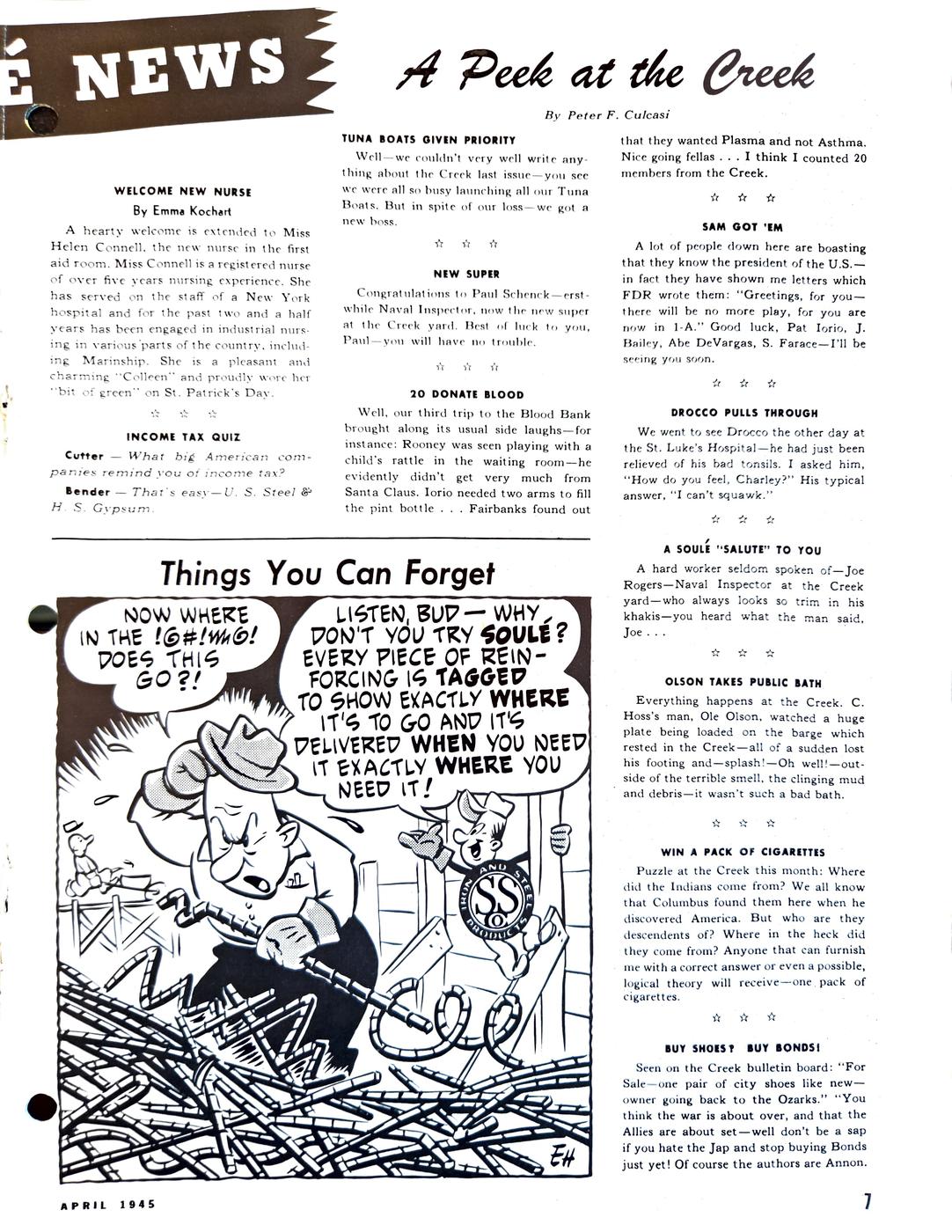
Things You Can Forget NOW WHERE IN THE !@#!%G! DOES THIS GO ?! LISTEN, BUD — WHY DON'T YOU TRY SOULÉ? EVERY PIECE OF REINFORCING IS TAGGED TO SHOW EXACTLY WHERE IT'S TO GO AND IT'S DELIVERED WHEN YOU NEED IT EXACTLY WHERE YOU NEED IT!
IRON AND STEEL PRODUCTS EH
APRIL 1945 7
Page 6
Soule-Built YSD ## Operating in
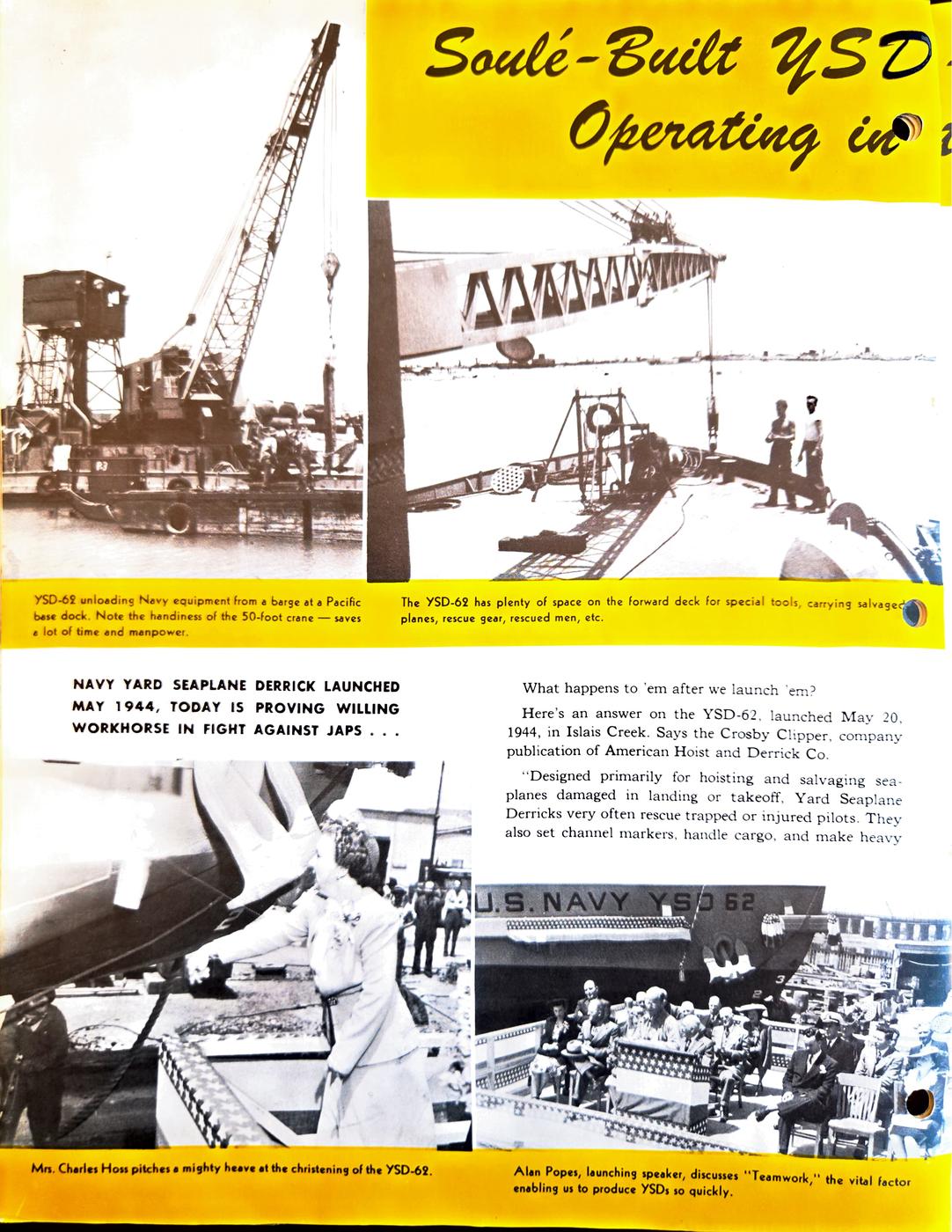
Photo: YSD-62 unloading Navy equipment from a barge at a Pacific base dock. Note the handiness of the 50-foot crane — saves a lot of time and manpower.
Photo: The YSD-62 has plenty of space on the forward deck for special tools, carrying salvaged planes, rescue gear, rescued men, etc.
**NAVY YARD SEAPLANE DERRICK LAUNCHED** **MAY 1944, TODAY IS PROVING WILLING** **WORKHORSE IN FIGHT AGAINST JAPS . . .**
What happens to 'em after we launch 'em?
Here's an answer on the YSD-62, launched May 20, 1944, in Islais Creek. Says the Crosby Clipper, company publication of American Hoist and Derrick Co.
"Designed primarily for hoisting and salvaging sea-planes damaged in landing or takeoff, Yard Seaplane Derricks very often rescue trapped or injured pilots. They also set channel markers, handle cargo, and make heavy
Photo: Mrs. Charles Hoss pitches a mighty heave at the christening of the YSD-62.
U.S. NAVY YSD 62
Photo: Alan Popes, launching speaker, discusses "Teamwork," the vital factor enabling us to produce YSDs so quickly.
Page 7
-62 Now # the Pacific . . .
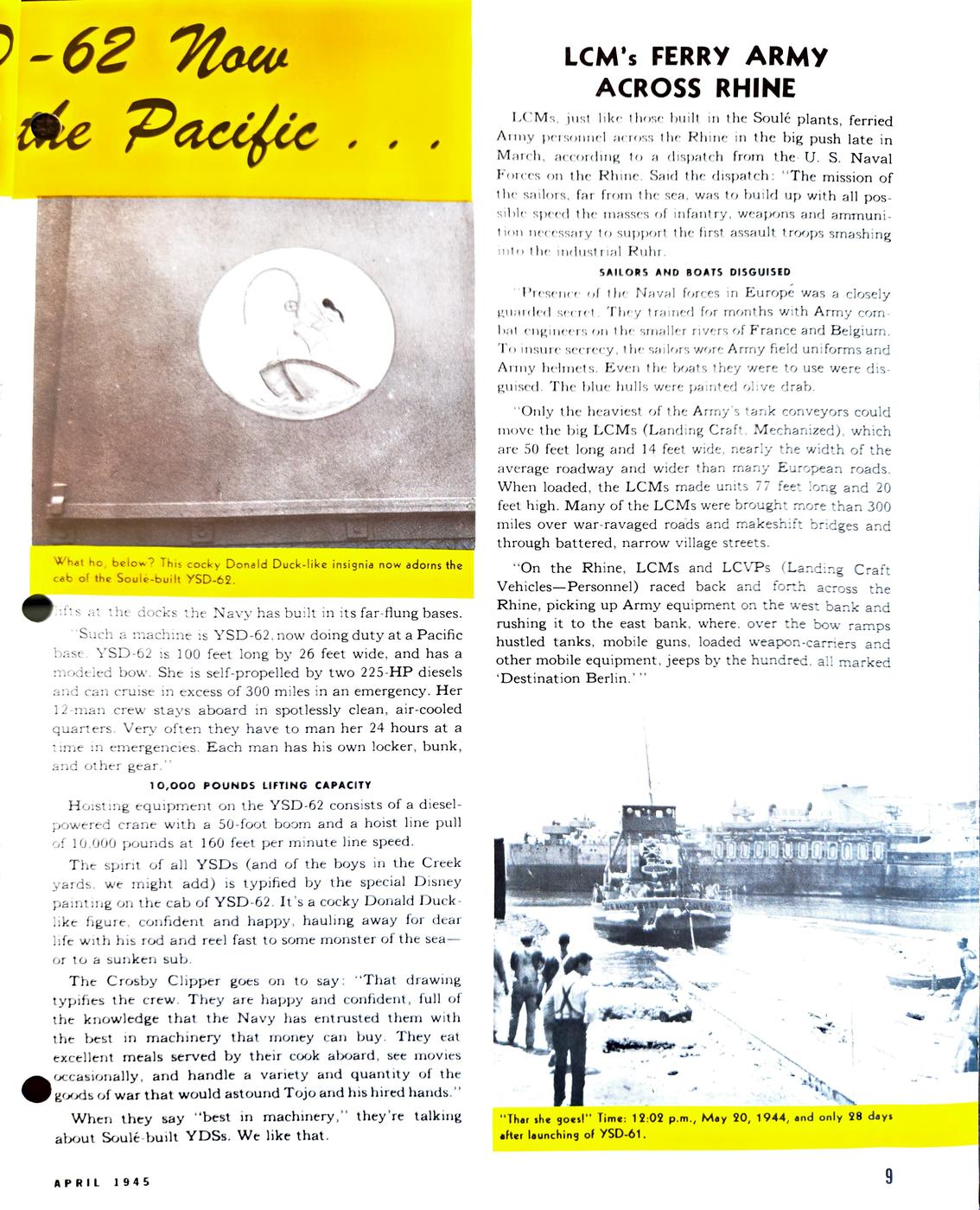
*Photo: What ho, below? This cocky Donald Duck-like insignia now adorns the cab of the Soulé-built YSD-62.*
lifts at the docks the Navy has built in its far-flung bases.
"Such a machine is YSD-62, now doing duty at a Pacific base. YSD-62 is 100 feet long by 26 feet wide, and has a modeled bow. She is self-propelled by two 225-HP diesels and can cruise in excess of 300 miles in an emergency. Her 12-man crew stays aboard in spotlessly clean, air-cooled quarters. Very often they have to man her 24 hours at a time in emergencies. Each man has his own locker, bunk, and other gear."
10,000 POUNDS LIFTING CAPACITY
Hoisting equipment on the YSD-62 consists of a diesel-powered crane with a 50-foot boom and a hoist line pull of 10,000 pounds at 160 feet per minute line speed.
The spirit of all YSDs (and of the boys in the Creek yards, we might add) is typified by the special Disney painting on the cab of YSD-62. It's a cocky Donald Duck-like figure, confident and happy, hauling away for dear life with his rod and reel fast to some monster of the sea—or to a sunken sub.
The Crosby Clipper goes on to say: "That drawing typifies the crew. They are happy and confident, full of the knowledge that the Navy has entrusted them with the best in machinery that money can buy. They eat excellent meals served by their cook aboard, see movies occasionally, and handle a variety and quantity of the goods of war that would astound Tojo and his hired hands."
When they say "best in machinery," they're talking about Soulé-built YDSs. We like that.
LCM's FERRY ARMY ## ACROSS RHINE
LCMs, just like those built in the Soulé plants, ferried Army personnel across the Rhine in the big push late in March, according to a dispatch from the U. S. Naval Forces on the Rhine. Said the dispatch: "The mission of the sailors, far from the sea, was to build up with all possible speed the masses of infantry, weapons and ammunition necessary to support the first assault troops smashing into the industrial Ruhr."
SAILORS AND BOATS DISGUISED
Presence of the Naval forces in Europe was a closely guarded secret. They trained for months with Army combat engineers on the smaller rivers of France and Belgium. To insure secrecy, the sailors wore Army field uniforms and Army helmets. Even the boats they were to use were disguised. The blue hulls were painted olive drab.
"Only the heaviest of the Army's tank conveyors could move the big LCMs (Landing Craft, Mechanized), which are 50 feet long and 14 feet wide, nearly the width of the average roadway and wider than many European roads. When loaded, the LCMs made units 77 feet long and 20 feet high. Many of the LCMs were brought more than 300 miles over war-ravaged roads and makeshift bridges and through battered, narrow village streets."
"On the Rhine, LCMs and LCVPs (Landing Craft Vehicles—Personnel) raced back and forth across the Rhine, picking up Army equipment on the west bank and rushing it to the east bank, where, over the bow ramps hustled tanks, mobile guns, loaded weapon-carriers and other mobile equipment, jeeps by the hundred, all marked 'Destination Berlin.'"
*Photo: "Thar she goes!" Time: 12:02 p.m., May 20, 1944, and only 28 days after launching of YSD-61.*
APRIL 1945 9
Page 8
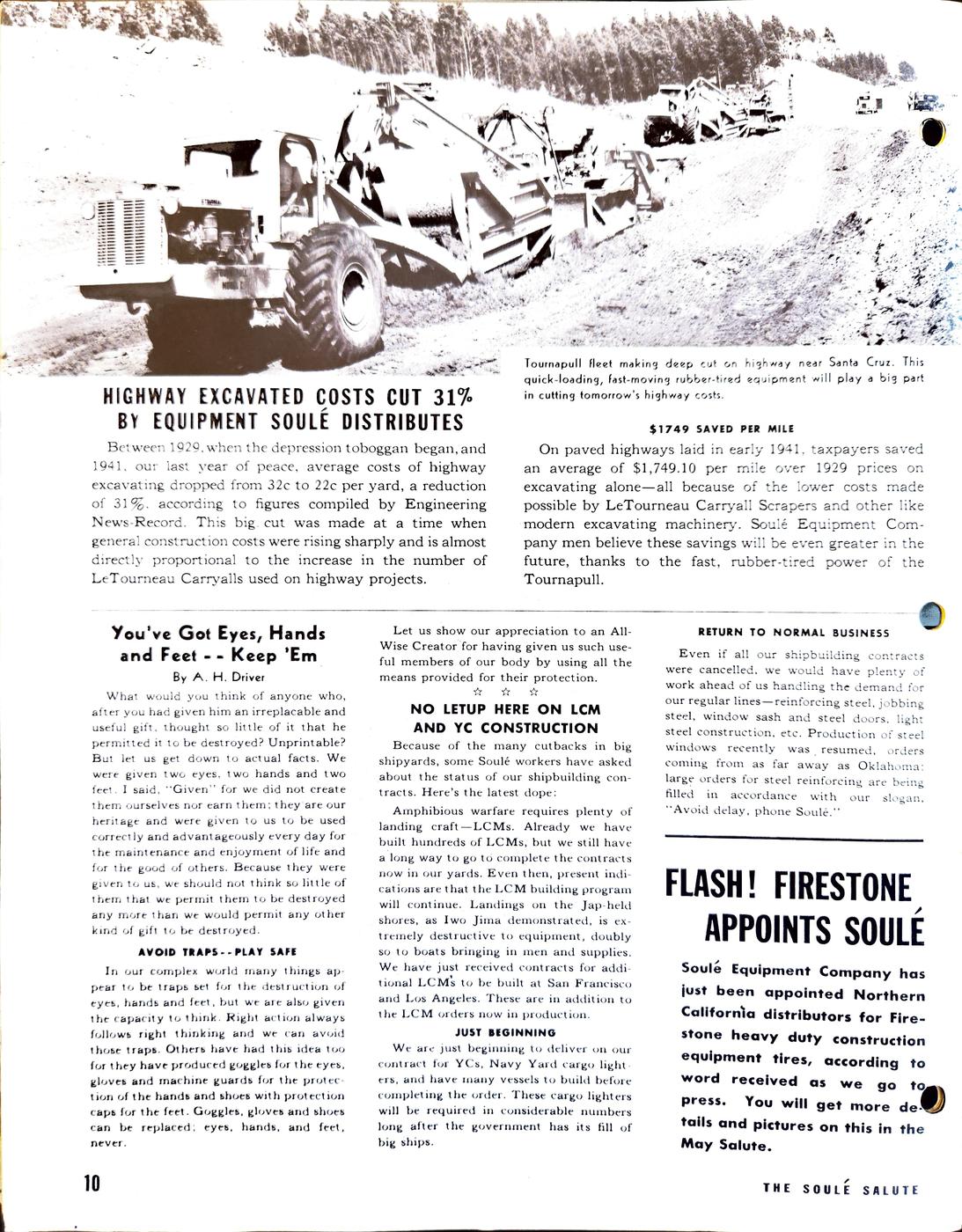
Photo: Tournapull fleet making deep cut on highway near Santa Cruz. This quick-loading, fast-moving rubber-tired equipment will play a big part in cutting tomorrow's highway costs.
HIGHWAY EXCAVATED COSTS CUT 31% BY EQUIPMENT SOULÉ DISTRIBUTES
Between 1929, when the depression toboggan began, and 1941, our last year of peace, average costs of highway excavating dropped from 32c to 22c per yard, a reduction of 31%, according to figures compiled by Engineering News-Record. This big cut was made at a time when general construction costs were rising sharply and is almost directly proportional to the increase in the number of LeTourneau Carryalls used on highway projects.
$1749 SAVED PER MILE
On paved highways laid in early 1941, taxpayers saved an average of $1,749.10 per mile over 1929 prices on excavating alone—all because of the lower costs made possible by LeTourneau Carryall Scrapers and other like modern excavating machinery. Soulé Equipment Company men believe these savings will be even greater in the future, thanks to the fast, rubber-tired power of the Tournapull.
You've Got Eyes, Hands and Feet - - Keep 'Em
By A. H. Driver
What would you think of anyone who, after you had given him an irreplacable and useful gift, thought so little of it that he permitted it to be destroyed? Unprintable? But let us get down to actual facts. We were given two eyes, two hands and two feet. I said, "Given" for we did not create them ourselves nor earn them; they are our heritage and were given to us to be used correctly and advantageously every day for the maintenance and enjoyment of life and for the good of others. Because they were given to us, we should not think so little of them that we permit them to be destroyed any more than we would permit any other kind of gift to be destroyed.
AVOID TRAPS -- PLAY SAFE
In our complex world many things appear to be traps set for the destruction of eyes, hands and feet, but we are also given the capacity to think. Right action always follows right thinking and we can avoid those traps. Others have had this idea too for they have produced goggles for the eyes, gloves and machine guards for the protection of the hands and shoes with protection caps for the feet. Goggles, gloves and shoes can be replaced; eyes, hands, and feet, never.
Let us show our appreciation to an All-Wise Creator for having given us such useful members of our body by using all the means provided for their protection. ☆ ☆ ☆
NO LETUP HERE ON LCM AND YC CONSTRUCTION
Because of the many cutbacks in big shipyards, some Soulé workers have asked about the status of our shipbuilding contracts. Here's the latest dope:
Amphibious warfare requires plenty of landing craft—LCMs. Already we have built hundreds of LCMs, but we still have a long way to go to complete the contracts now in our yards. Even then, present indications are that the LCM building program will continue. Landings on the Jap-held shores, as Iwo Jima demonstrated, is extremely destructive to equipment, doubly so to boats bringing in men and supplies. We have just received contracts for additional LCM's to be built at San Francisco and Los Angeles. These are in addition to the LCM orders now in production.
JUST BEGINNING
We are just beginning to deliver on our contract for YCs, Navy Yard cargo lighters, and have many vessels to build before completing the order. These cargo lighters will be required in considerable numbers long after the government has its fill of big ships.
RETURN TO NORMAL BUSINESS
Even if all our shipbuilding contracts were cancelled, we would have plenty of work ahead of us handling the demand for our regular lines—reinforcing steel, jobbing steel, window sash and steel doors, light steel construction, etc. Production of steel windows recently was resumed, orders coming from as far away as Oklahoma; large orders for steel reinforcing are being filled in accordance with our slogan, "Avoid delay, phone Soulé."
FLASH! FIRESTONE APPOINTS SOULÉ
Soulé Equipment Company has just been appointed Northern California distributors for Firestone heavy duty construction equipment tires, according to word received as we go to press. You will get more details and pictures on this in the May Salute.
10 THE SOULÉ SALUTE
Page 9
Now We Can Start to Fight ## Guerrilla Leader Tells S. F. By Claire Davis
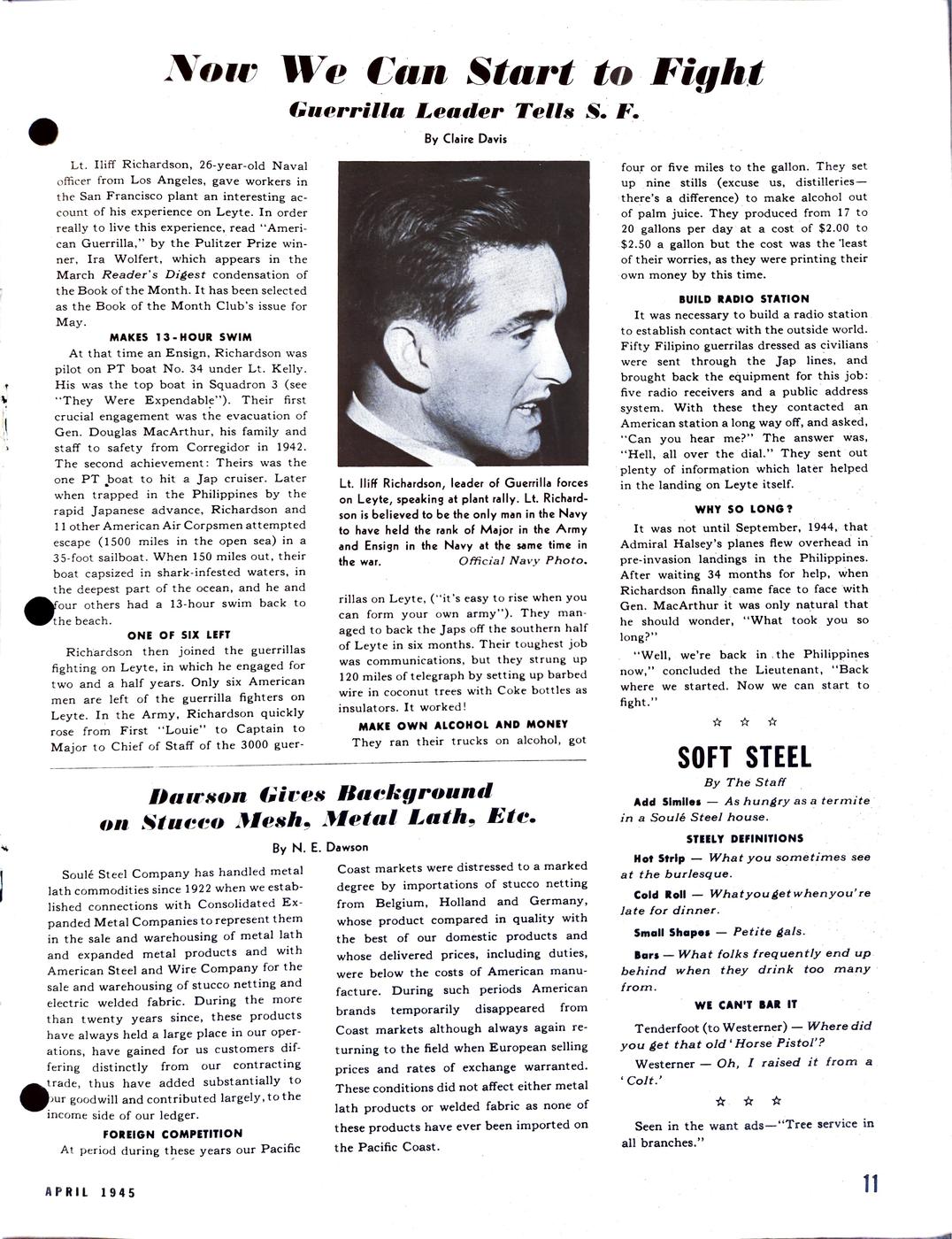
Lt. Iliff Richardson, 26-year-old Naval officer from Los Angeles, gave workers in the San Francisco plant an interesting account of his experience on Leyte. In order really to live this experience, read "American Guerrilla," by the Pulitzer Prize winner, Ira Wolfert, which appears in the March Reader's Digest condensation of the Book of the Month. It has been selected as the Book of the Month Club's issue for May.
MAKES 13-HOUR SWIM At that time an Ensign, Richardson was pilot on PT boat No. 34 under Lt. Kelly. His was the top boat in Squadron 3 (see "They Were Expendable"). Their first crucial engagement was the evacuation of Gen. Douglas MacArthur, his family and staff to safety from Corregidor in 1942. The second achievement: Theirs was the one PT boat to hit a Jap cruiser. Later when trapped in the Philippines by the rapid Japanese advance, Richardson and 11 other American Air Corpsmen attempted escape (1500 miles in the open sea) in a 35-foot sailboat. When 150 miles out, their boat capsized in shark-infested waters, in the deepest part of the ocean, and he and four others had a 13-hour swim back to the beach.
ONE OF SIX LEFT Richardson then joined the guerrillas fighting on Leyte, in which he engaged for two and a half years. Only six American men are left of the guerrilla fighters on Leyte. In the Army, Richardson quickly rose from First "Louie" to Captain to Major to Chief of Staff of the 3000 guer-
Lt. Iliff Richardson, leader of Guerrilla forces on Leyte, speaking at plant rally. Lt. Richardson is believed to be the only man in the Navy to have held the rank of Major in the Army and Ensign in the Navy at the same time in the war. Official Navy Photo.
rillas on Leyte, ("it's easy to rise when you can form your own army"). They managed to back the Japs off the southern half of Leyte in six months. Their toughest job was communications, but they strung up 120 miles of telegraph by setting up barbed wire in coconut trees with Coke bottles as insulators. It worked!
MAKE OWN ALCOHOL AND MONEY They ran their trucks on alcohol, got four or five miles to the gallon. They set up nine stills (excuse us, distilleries—there's a difference) to make alcohol out of palm juice. They produced from 17 to 20 gallons per day at a cost of $2.00 to $2.50 a gallon but the cost was the least of their worries, as they were printing their own money by this time.
BUILD RADIO STATION It was necessary to build a radio station to establish contact with the outside world. Fifty Filipino guerrillas dressed as civilians were sent through the Jap lines, and brought back the equipment for this job: five radio receivers and a public address system. With these they contacted an American station a long way off, and asked, "Can you hear me?" The answer was, "Hell, all over the dial." They sent out plenty of information which later helped in the landing on Leyte itself.
WHY SO LONG? It was not until September, 1944, that Admiral Halsey's planes flew overhead in pre-invasion landings in the Philippines. After waiting 34 months for help, when Richardson finally came face to face with Gen. MacArthur it was only natural that he should wonder, "What took you so long?"
"Well, we're back in the Philippines now," concluded the Lieutenant, "Back where we started. Now we can start to fight."
***
Dawson Gives Background on Stucco Mesh, Metal Lath, Etc. By N. E. Dawson
Soulé Steel Company has handled metal lath commodities since 1922 when we established connections with Consolidated Expanded Metal Companies to represent them in the sale and warehousing of metal lath and expanded metal products and with American Steel and Wire Company for the sale and warehousing of stucco netting and electric welded fabric. During the more than twenty years since, these products have always held a large place in our operations, have gained for us customers differing distinctly from our contracting trade, thus have added substantially to our goodwill and contributed largely, to the income side of our ledger.
FOREIGN COMPETITION At period during these years our Pacific Coast markets were distressed to a marked degree by importations of stucco netting from Belgium, Holland and Germany, whose product compared in quality with the best of our domestic products and whose delivered prices, including duties, were below the costs of American manufacture. During such periods American brands temporarily disappeared from Coast markets although always again returning to the field when European selling prices and rates of exchange warranted. These conditions did not affect either metal lath products or welded fabric as none of these products have ever been imported on the Pacific Coast.
SOFT STEEL By The Staff
Add Smiles — As hungry as a termite in a Soulé Steel house.
STEELY DEFINITIONS **Hot Strip** — What you sometimes see at the burlesque. **Cold Roll** — What you get when you're late for dinner. **Small Shapes** — Petite gals. **Bars** — What folks frequently end up behind when they drink too many from.
WE CAN'T BAR IT Tenderfoot (to Westerner) — Where did you get that old 'Horse Pistol'? Westerner — Oh, I raised it from a 'Colt.'
☆ ☆ ☆
Seen in the want ads—"Tree service in all branches."
APRIL 1945 11
Page 10
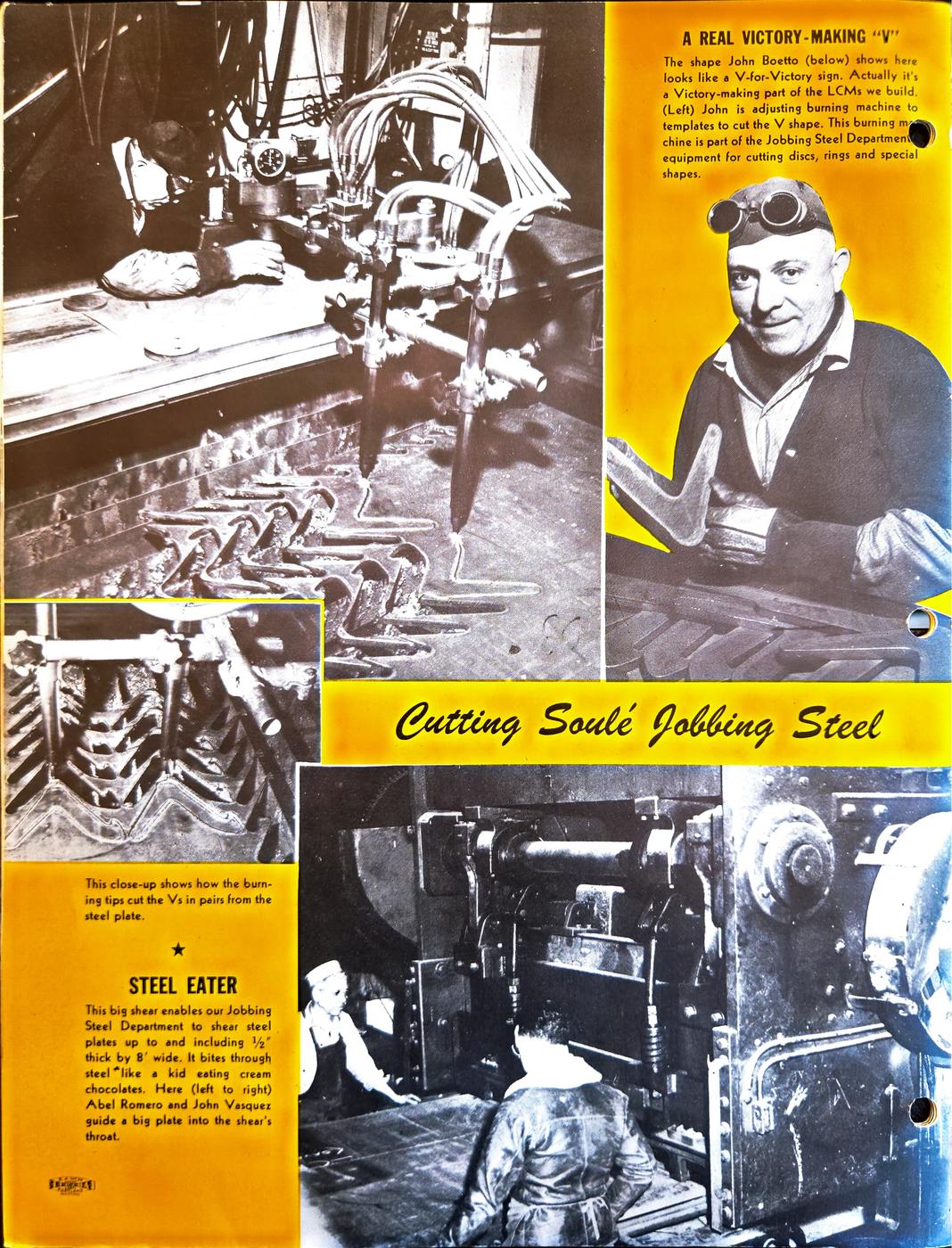
A REAL VICTORY-MAKING "V" The shape John Boetto (below) shows here looks like a V-for-Victory sign. Actually it's a Victory-making part of the LCMs we build. (Left) John is adjusting burning machine to templates to cut the V shape. This burning machine is part of the Jobbing Steel Department equipment for cutting discs, rings and special shapes.
Cutting Soule Jobbing Steel
*Photo: This close-up shows how the burning tips cut the Vs in pairs from the steel plate.*