Page 1
SOULÉ SALUTE
SOULÉ SALUTE
SOULÉ SALUTE
SOULÉ SALUTE
SOULÉ SALUTE ARMY E
INVASION! A CHALLENGE TO THE BEST IN ALL OF US
SOULÉ TE EXTRA SOULÉ SALUTE
DOUBLE DUTY
SOULÉ SALUTE
SOULÉ SALUTE
APRIL, 1944
VOL. 3, No. 5 Published Regularly by and for Soule Steel War Workers JUNE 1945
Page 2
25-30 YEAR CLUB
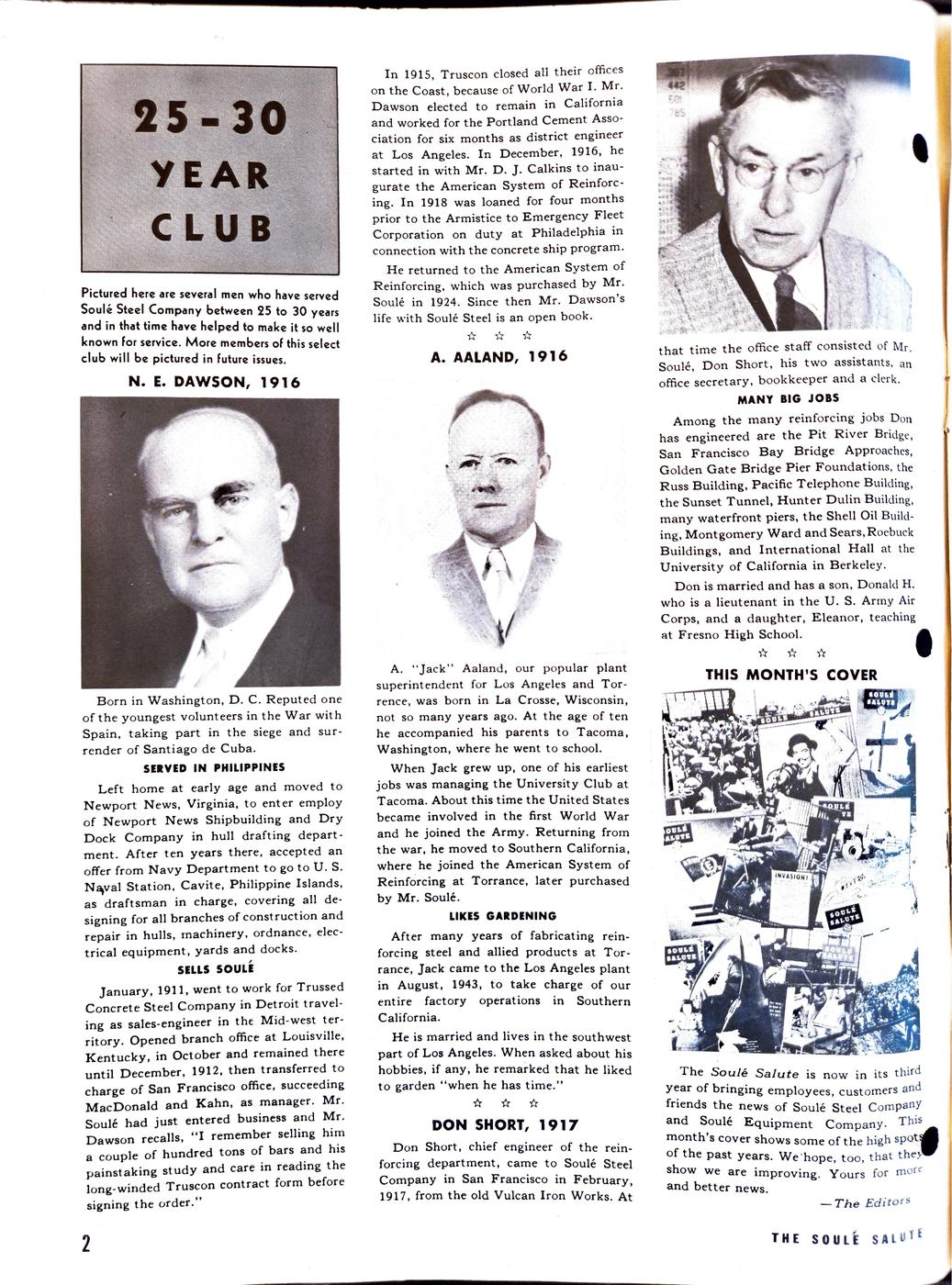
*Photo: Pictured here are several men who have served Soulé Steel Company between 25 to 30 years and in that time have helped to make it so well known for service. More members of this select club will be pictured in future issues.*
N. E. DAWSON, 1916
Born in Washington, D. C. Reputed one of the youngest volunteers in the War with Spain, taking part in the siege and surrender of Santiago de Cuba.
SERVED IN PHILIPPINES
Left home at early age and moved to Newport News, Virginia, to enter employ of Newport News Shipbuilding and Dry Dock Company in hull drafting department. After ten years there, accepted an offer from Navy Department to go to U. S. Naval Station, Cavite, Philippine Islands, as draftsman in charge, covering all designing for all branches of construction and repair in hulls, machinery, ordnance, electrical equipment, yards and docks.
SELLS SOULÉ
January, 1911, went to work for Trussed Concrete Steel Company in Detroit traveling as sales-engineer in the Mid-west territory. Opened branch office at Louisville, Kentucky, in October and remained there until December, 1912, then transferred to charge of San Francisco office, succeeding MacDonald and Kahn, as manager. Mr. Soulé had just entered business and Mr. Dawson recalls, "I remember selling him a couple of hundred tons of bars and his painstaking study and care in reading the long-winded Truscon contract form before signing the order."
In 1915, Truscon closed all their offices on the Coast, because of World War I. Mr. Dawson elected to remain in California and worked for the Portland Cement Association for six months as district engineer at Los Angeles. In December, 1916, he started in with Mr. D. J. Calkins to inaugurate the American System of Reinforcing. In 1918 was loaned for four months prior to the Armistice to Emergency Fleet Corporation on duty at Philadelphia in connection with the concrete ship program.
He returned to the American System of Reinforcing, which was purchased by Mr. Soulé in 1924. Since then Mr. Dawson's life with Soulé Steel is an open book.
A. AALAND, 1916
A. "Jack" Aaland, our popular plant superintendent for Los Angeles and Torrance, was born in La Crosse, Wisconsin, not so many years ago. At the age of ten he accompanied his parents to Tacoma, Washington, where he went to school.
When Jack grew up, one of his earliest jobs was managing the University Club at Tacoma. About this time the United States became involved in the first World War and he joined the Army. Returning from the war, he moved to Southern California, where he joined the American System of Reinforcing at Torrance, later purchased by Mr. Soulé.
LIKES GARDENING
After many years of fabricating reinforcing steel and allied products at Torrance, Jack came to the Los Angeles plant in August, 1943, to take charge of our entire factory operations in Southern California.
He is married and lives in the southwest part of Los Angeles. When asked about his hobbies, if any, he remarked that he liked to garden "when he has time."
DON SHORT, 1917
Don Short, chief engineer of the reinforcing department, came to Soulé Steel Company in San Francisco in February, 1917, from the old Vulcan Iron Works. At that time the office staff consisted of Mr. Soulé, Don Short, his two assistants, an office secretary, bookkeeper and a clerk.
MANY BIG JOBS
Among the many reinforcing jobs Don has engineered are the Pit River Bridge, San Francisco Bay Bridge Approaches, Golden Gate Bridge Pier Foundations, the Russ Building, Pacific Telephone Building, the Sunset Tunnel, Hunter Dulin Building, many waterfront piers, the Shell Oil Building, Montgomery Ward and Sears, Roebuck Buildings, and International Hall at the University of California in Berkeley.
Don is married and has a son, Donald H. who is a lieutenant in the U. S. Army Air Corps, and a daughter, Eleanor, teaching at Fresno High School.
THIS MONTH'S COVER
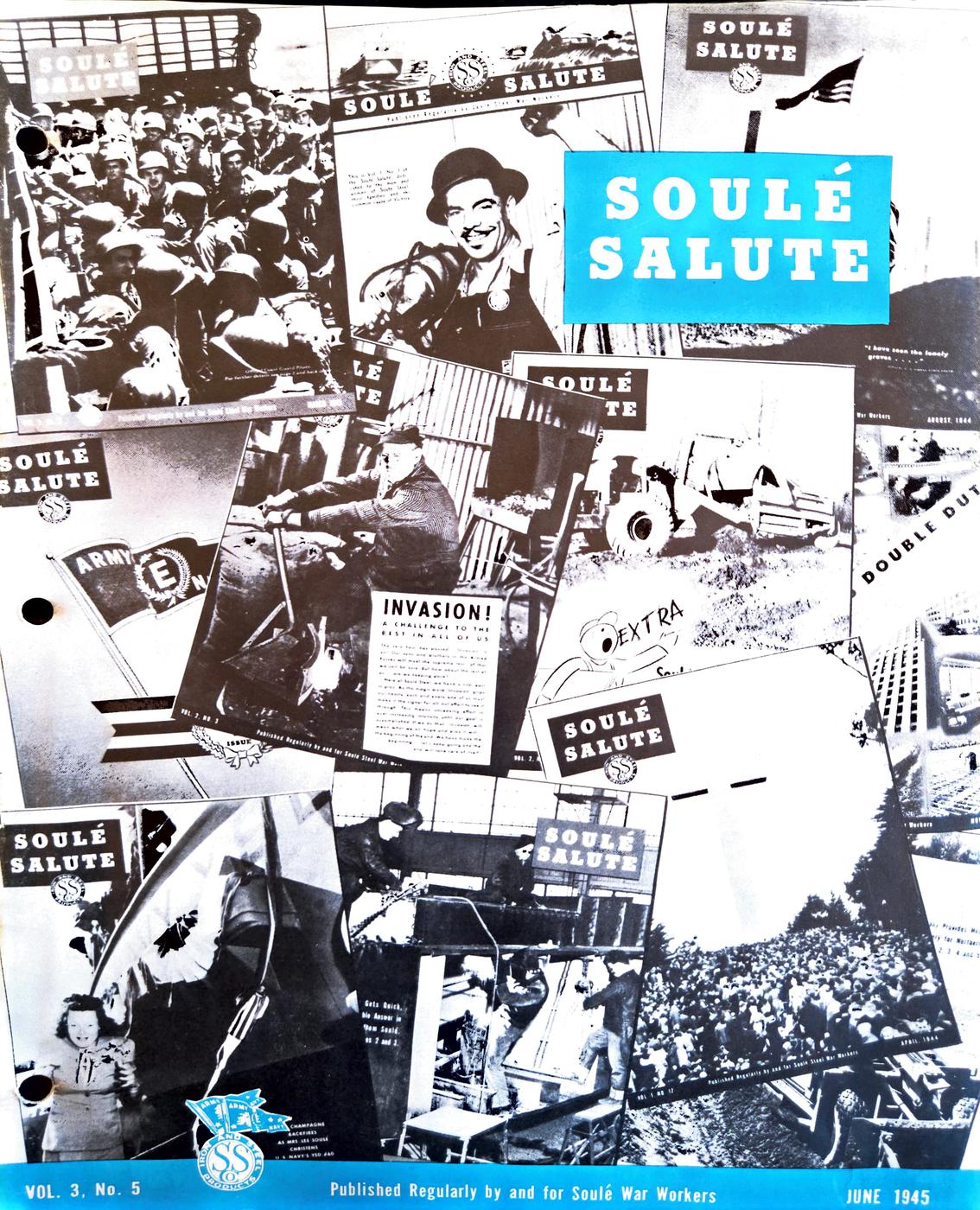
*Photo: The Soulé Salute is now in its third year of bringing employees, customers and friends the news of Soulé Steel Company and Soulé Equipment Company. This month's cover shows some of the high spots of the past years. We hope, too, that they show we are improving. Yours for more and better news.*
—The Editors
THE SOULÉ SALUTE
Page 3
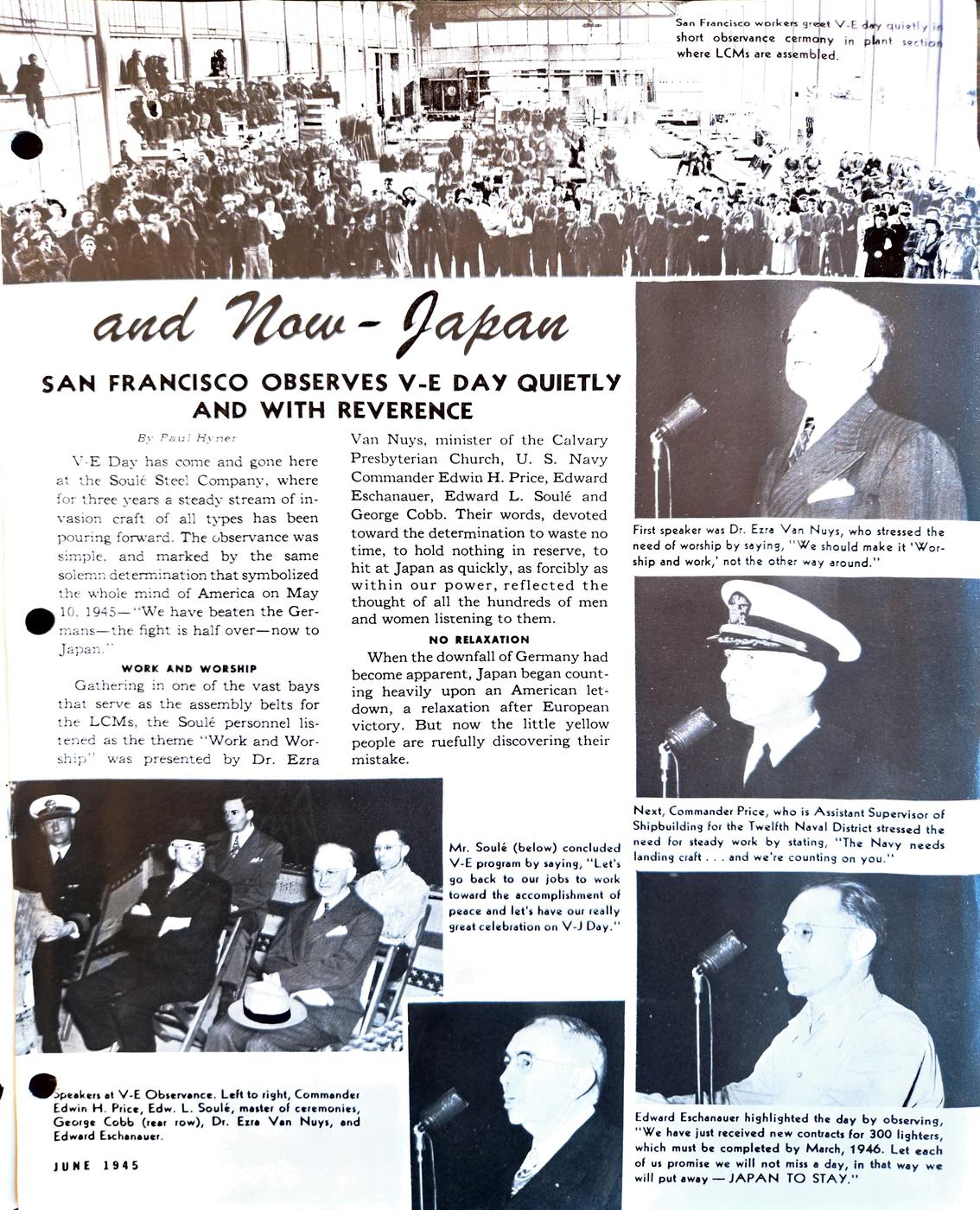
San Francisco workers greet V-E day quietly in short observance ceremony in plant section where LCMs are assembled.
and Now - Japan
SAN FRANCISCO OBSERVES V-E DAY QUIETLY AND WITH REVERENCE
By Paul Hyner
V-E Day has come and gone here at the Soulé Steel Company, where for three years a steady stream of invasion craft of all types has been pouring forward. The observance was simple, and marked by the same solemn determination that symbolized the whole mind of America on May 10, 1945—"We have beaten the Germans—the fight is half over—now to Japan."
WORK AND WORSHIP
Gathering in one of the vast bays that serve as the assembly belts for the LCMs, the Soulé personnel listened as the theme "Work and Worship" was presented by Dr. Ezra Van Nuys, minister of the Calvary Presbyterian Church, U. S. Navy Commander Edwin H. Price, Edward Eschanauer, Edward L. Soulé and George Cobb. Their words, devoted toward the determination to waste no time, to hold nothing in reserve, to hit at Japan as quickly, as forcibly as within our power, reflected the thought of all the hundreds of men and women listening to them.
NO RELAXATION
When the downfall of Germany had become apparent, Japan began counting heavily upon an American let-down, a relaxation after European victory. But now the little yellow people are ruefully discovering their mistake.
*Photo: First speaker was Dr. Ezra Van Nuys, who stressed the need of worship by saying, "We should make it 'Worship and work,' not the other way around."*
*Photo: Next, Commander Price, who is Assistant Supervisor of Shipbuilding for the Twelfth Naval District stressed the need for steady work by stating, "The Navy needs landing craft . . . and we're counting on you."*
*Photo: Edward Eschanauer highlighted the day by observing, "We have just received new contracts for 300 lighters, which must be completed by March, 1946. Let each of us promise we will not miss a day, in that way we will put away — JAPAN TO STAY."*
*Photo: Speakers at V-E Observance. Left to right, Commander Edwin H. Price, Edw. L. Soulé, master of ceremonies, George Cobb (rear row), Dr. Ezra Van Nuys, and Edward Eschanauer.*
*Photo: Mr. Soulé (below) concluded V-E program by saying, "Let's go back to our jobs to work toward the accomplishment of peace and let's have our really great celebration on V-J Day."*
JUNE 1945
Page 4
Portland Plant Makes Lift Arms
By Les Poole
The Portland plant was happy a few weeks ago to find itself a week ahead of schedule in the production of lift arms for Hyster lift trucks. It is common these days for a firm in the United States to receive a memo from a customer asking that production be speeded up—but when a customer asks you to slow down, that's news, and how!
These lift arms are a very important part of the lift trucks that Hyster makes for the Navy, as they are the fingers that reach under the load and support the weight when it is lifted.
MANY NAMES FOR FINGERS
Hyster lift trucks are used by the Navy for transporting and stacking all kinds of materials. The Hyster people have substituted the nickname "Chisel" for the blueprint name of "Lift Arm." When production is going good, the Soulé gang call them "Teeth" because of their resemblance to fangs. What they call them when
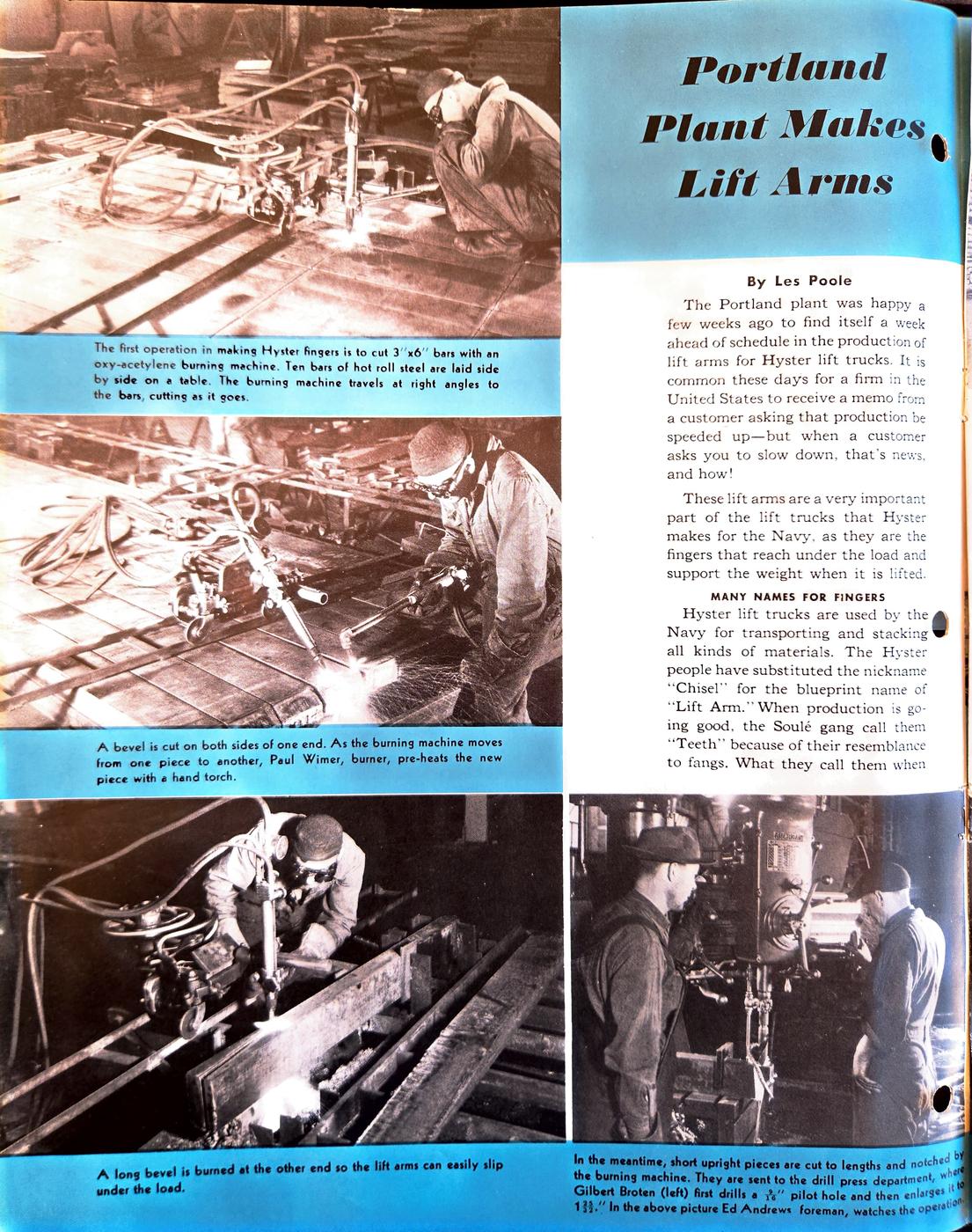
*Photo: The first operation in making Hyster fingers is to cut 3"x6" bars with an oxy-acetylene burning machine. Ten bars of hot roll steel are laid side by side on a table. The burning machine travels at right angles to the bars, cutting as it goes.*
*Photo: A bevel is cut on both sides of one end. As the burning machine moves from one piece to another, Paul Wimer, burner, pre-heats the new piece with a hand torch.*
*Photo: A long bevel is burned at the other end so the lift arms can easily slip under the load.*
*Photo: In the meantime, short upright pieces are cut to lengths and notched by the burning machine. They are sent to the drill press department, where Gilbert Broten (left) first drills a 3/16" pilot hole and then enlarges it to 1 3/8." In the above picture Ed Andrews foreman, watches the operation.*
Page 5
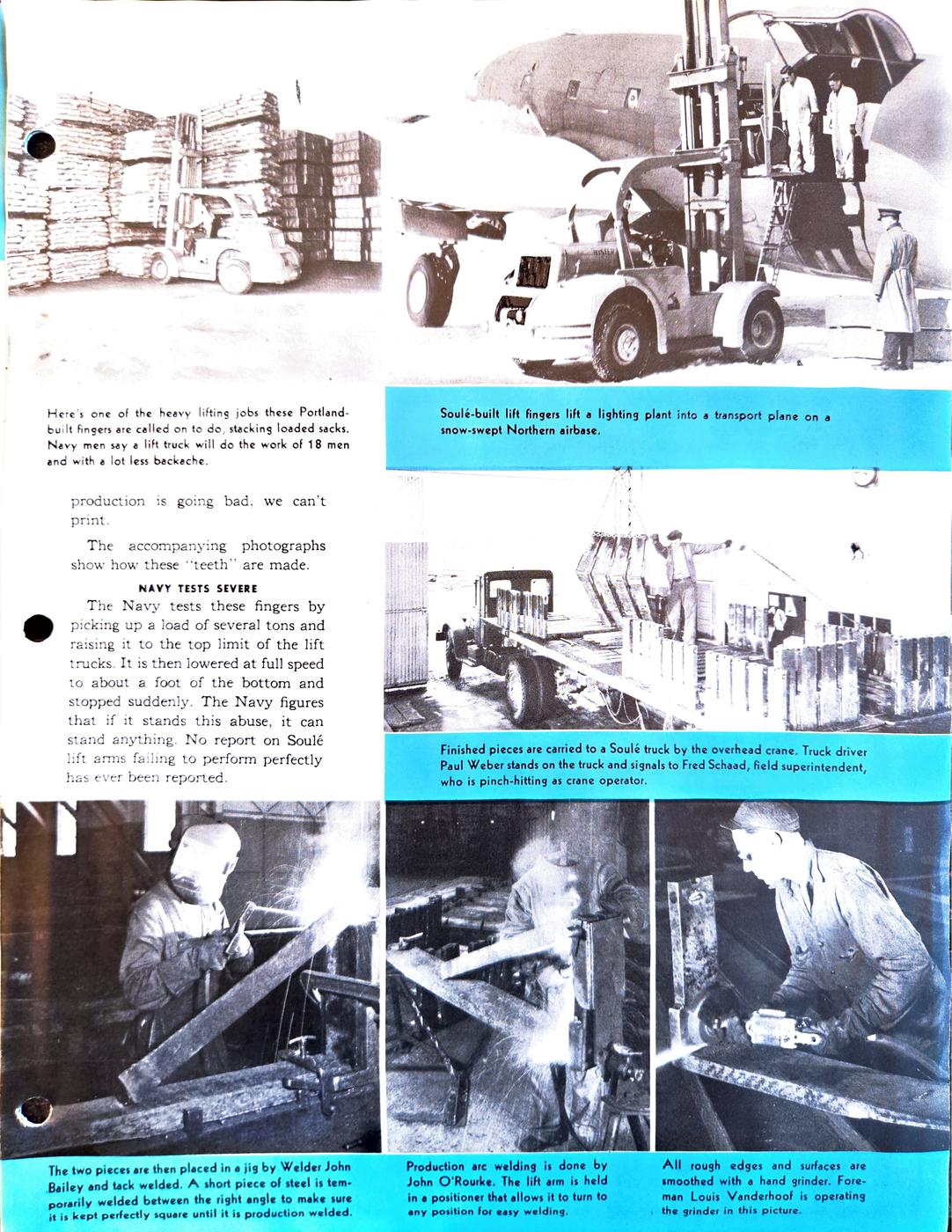
Here's one of the heavy lifting jobs these Portland-built fingers are called on to do, stacking loaded sacks. Navy men say a lift truck will do the work of 18 men and with a lot less backache.
Soulé-built lift fingers lift a lighting plant into a transport plane on a snow-swept Northern airbase.
production is going bad, we can't print.
The accompanying photographs show how these "teeth" are made.
NAVY TESTS SEVERE
The Navy tests these fingers by picking up a load of several tons and raising it to the top limit of the lift trucks. It is then lowered at full speed to about a foot of the bottom and stopped suddenly. The Navy figures that if it stands this abuse, it can stand anything. No report on Soulé lift arms failing to perform perfectly has ever been reported.
Finished pieces are carried to a Soulé truck by the overhead crane. Truck driver Paul Weber stands on the truck and signals to Fred Schaad, field superintendent, who is pinch-hitting as crane operator.
The two pieces are then placed in a jig by Welder John Bailey and tack welded. A short piece of steel is temporarily welded between the right angle to make sure it is kept perfectly square until it is production welded.
Production arc welding is done by John O'Rourke. The lift arm is held in a positioner that allows it to turn to any position for easy welding.
All rough edges and surfaces are smoothed with a hand grinder. Foreman Louis Vanderhoof is operating the grinder in this picture.
Page 6
SOULÉ
LOOK IN ### on ## LOS ANGELES
LEADMAN CIVILIAN FLYER
Everett Pavitt, leadman in the Los Angeles plant, owns his own airplane and holds a civilian pilot's license. He has been flying for five years. One of his recent Sunday passengers was Val Simhauser. They flew out to San Bernardino and back, and from all reports it was a complete success. Everett says his main trouble in interesting his friends in going flying with him is that they seem to think they need at least three engines to keep them aloft and don't quite trust the single-motored civilian models. (That B-17 and B-29 influence, no doubt.)
DISPLAYS AIR MEDAL
Margaret Roddick, Los Angeles office payroll department, has been proudly displaying the Air Medal awarded to her husband, Master Sergeant John Roddick, turret-gunner on a Flying Fortress. We are proud *for* you, Margaret.
IRISH LUCK
Engisn James Stewart Pike, whose picture recently appeared in the *Salute* (you will remember he is the son of W. J. Pike, our Navy inspector), bade a fond farewell to his parents and sailed out into the blue Pacific under orders to report, as LCM officer, to an attack transport somewhere in the South Pacific. He met his ship at Honolulu, only to find it was headed for San Francisco, so within three weeks of leaving that same port he was back, with 72 hours' leave in the bargain. It would happen only to an Irishman!
☆ ☆ ☆
*Wooden You Say This Was Heroism?*
*By C. LeFevre*
One reads and hears of the deeds of bravery performed by our fighting men in the various theatres of war. In visualizing these various acts one is likely to overlook the heroism displayed here at home. The writer witnessed such an act performed by two of our organization—without thought of the danger involved but solely with the thought of the organization as a whole. The act? Hold your breath, readers. It was Val Simhauser and Verne Brose on their hands and knees with their *heads* near a termite nest!
WRITE OFTEN TO BOYS IN SERVICE -- USE V-MAIL
Servicemen tell us that frequent letters from home, no matter how short, are better builders of morale than longer infrequent letters, and that bright, cheerful letters can give a lift as nothing else can, reports the OWI and suggests further that:
1. Short frequent letters are best and V-Mail is the right size. 2. Servicemen want frequent letters and V-Mail will guarantee his getting them speedily. 3. A soldier's morale can be ruined by the wrong kind of letter. Spare him home front worries and the really small hardships of civilian life. Main points to be emphasized are: a. Is your letter fit to be read in a fox-hole? b. Tell about family projects, how it is planning on his return. c. Tell about his friends. d. Speak of familiar places, of what's going on, of the town and neighborhood.
V-Mail, says OWI, always goes by air, is confidential in every sense.
☆ ☆ ☆
HALL AT CAMP CROWDER
Photo: *Portrait of a smiling soldier in uniform and cap.*
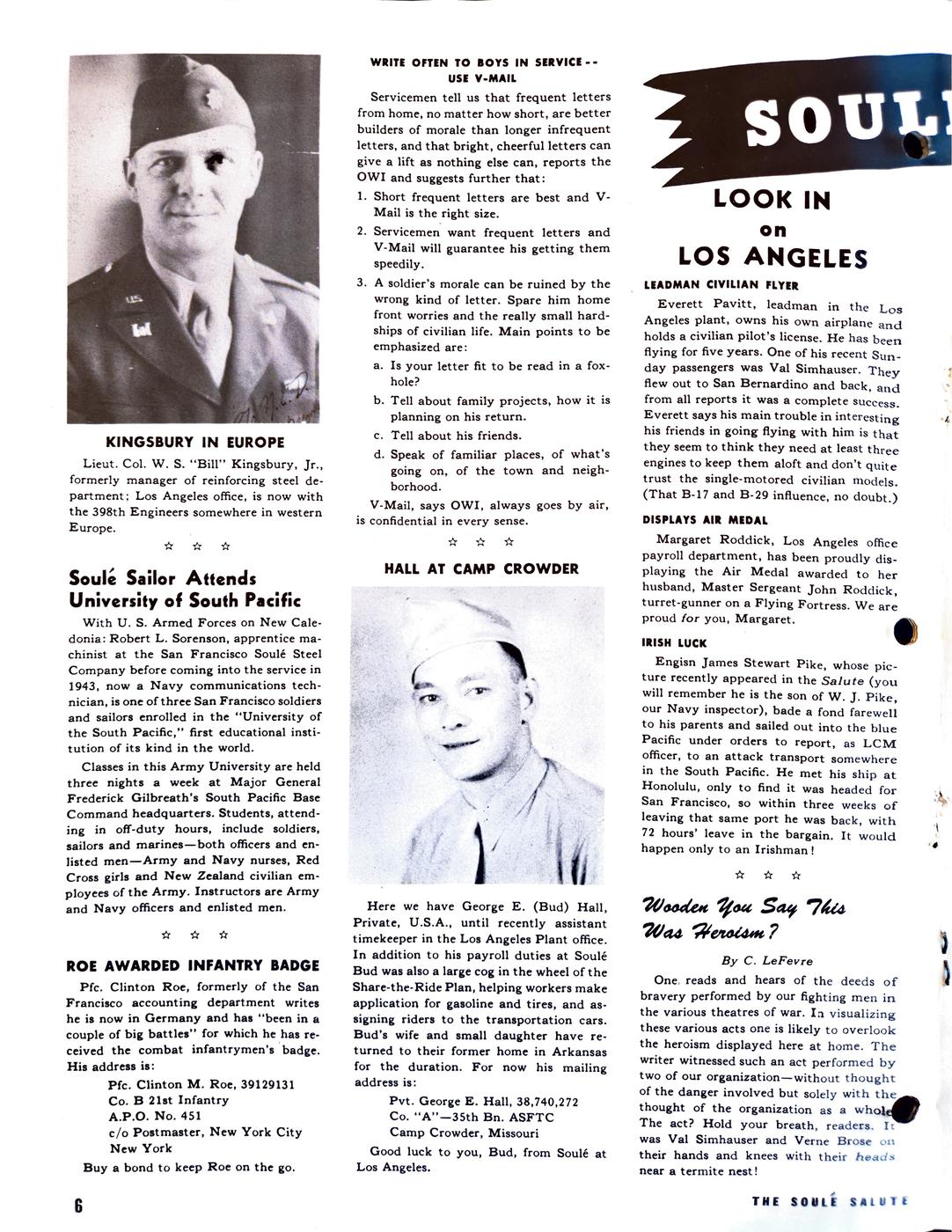
Here we have George E. (Bud) Hall, Private, U.S.A., until recently assistant timekeeper in the Los Angeles Plant office. In addition to his payroll duties at Soulé Bud was also a large cog in the wheel of the Share-the-Ride Plan, helping workers make application for gasoline and tires, and assigning riders to the transportation cars. Bud's wife and small daughter have returned to their former home in Arkansas for the duration. For now his mailing address is:
Pvt. George E. Hall, 38,740,272 Co. "A"—35th Bn. ASFTC Camp Crowder, Missouri
Good luck to you, Bud, from Soulé at Los Angeles.
Photo: *Portrait of a smiling soldier in uniform and cap with "US" insignia.*
KINGSBURY IN EUROPE
Lieut. Col. W. S. "Bill" Kingsbury, Jr., formerly manager of reinforcing steel department; Los Angeles office, is now with the 398th Engineers somewhere in western Europe.
☆ ☆ ☆
Soulé Sailor Attends University of South Pacific
With U. S. Armed Forces on New Caledonia: Robert L. Sorenson, apprentice machinist at the San Francisco Soulé Steel Company before coming into the service in 1943, now a Navy communications technician, is one of three San Francisco soldiers and sailors enrolled in the "University of the South Pacific," first educational institution of its kind in the world.
Classes in this Army University are held three nights a week at Major General Frederick Gilbreath's South Pacific Base Command headquarters. Students, attending in off-duty hours, include soldiers, sailors and marines—both officers and enlisted men—Army and Navy nurses, Red Cross girls and New Zealand civilian employees of the Army. Instructors are Army and Navy officers and enlisted men.
☆ ☆ ☆
ROE AWARDED INFANTRY BADGE
Pfc. Clinton Roe, formerly of the San Francisco accounting department writes he is now in Germany and has "been in a couple of big battles" for which he has received the combat infantrymen's badge. His address is:
Pfc. Clinton M. Roe, 39129131 Co. B 21st Infantry A.P.O. No. 451 c/o Postmaster, New York City New York
Buy a bond to keep Roe on the go.
6
THE SOULÉ SALUTE
Page 7
NEWS
Around the Place *By Emma Kochart*
ROMERO "PAPPY" Evelyn and Joe Romero became the parents of six pound, one ounce Richard John Romero on the morning of Monday, May 7, 1945, at 9:28. Mother and son are fine but "Pappy" Romero had to take his vacation to recuperate. Isn't that a man for you!
DAVIS A HOBBLER Claire Davis thought she needed a rest so as she was going up the cafeteria steps one noontime, she turned her ankle and thought she sprained it. She went to see Helen Connell, our nurse, for some first aid treatments. Miss Connell sent her to the doctor to have an X-ray taken and in so doing found she had fractured a bone in the side of her foot. She's hobbling to work on crutches now.
ACCOUNTING ADDS FOUR Our accounting office is growing in the last few weeks. We now have three men in the office, John Finley, Jim Brown and Melvin Moore. We also have Tess Griffiths working with us. Tess was transferred from the tool room out in the shop.
NEW SAN FRANCISCO VOICE A "salute" to our new telephone operator, Miss Eileen Jesson. We hope that you will be happy with us, Eileen.
INVEST IN A SURE THING "The Mighty 7th." Have you bought your extra bond yet?
ROUSE HIT WINS CHAMPIONSHIP With the score tied 1-1, one out in the last half of the seventh and final inning and the Peninsula Athletic League title hanging in the balance, Sequoia High School's Dick Rouse, Frosh-Soph pitcher, came through with a home run which cinched the game and the championship yesterday afternoon against San Mateo High School. Dick is the son of "Cec" Rouse of the San Francisco lath and expanded metal sales force.
THINGS YOU CAN FORGET
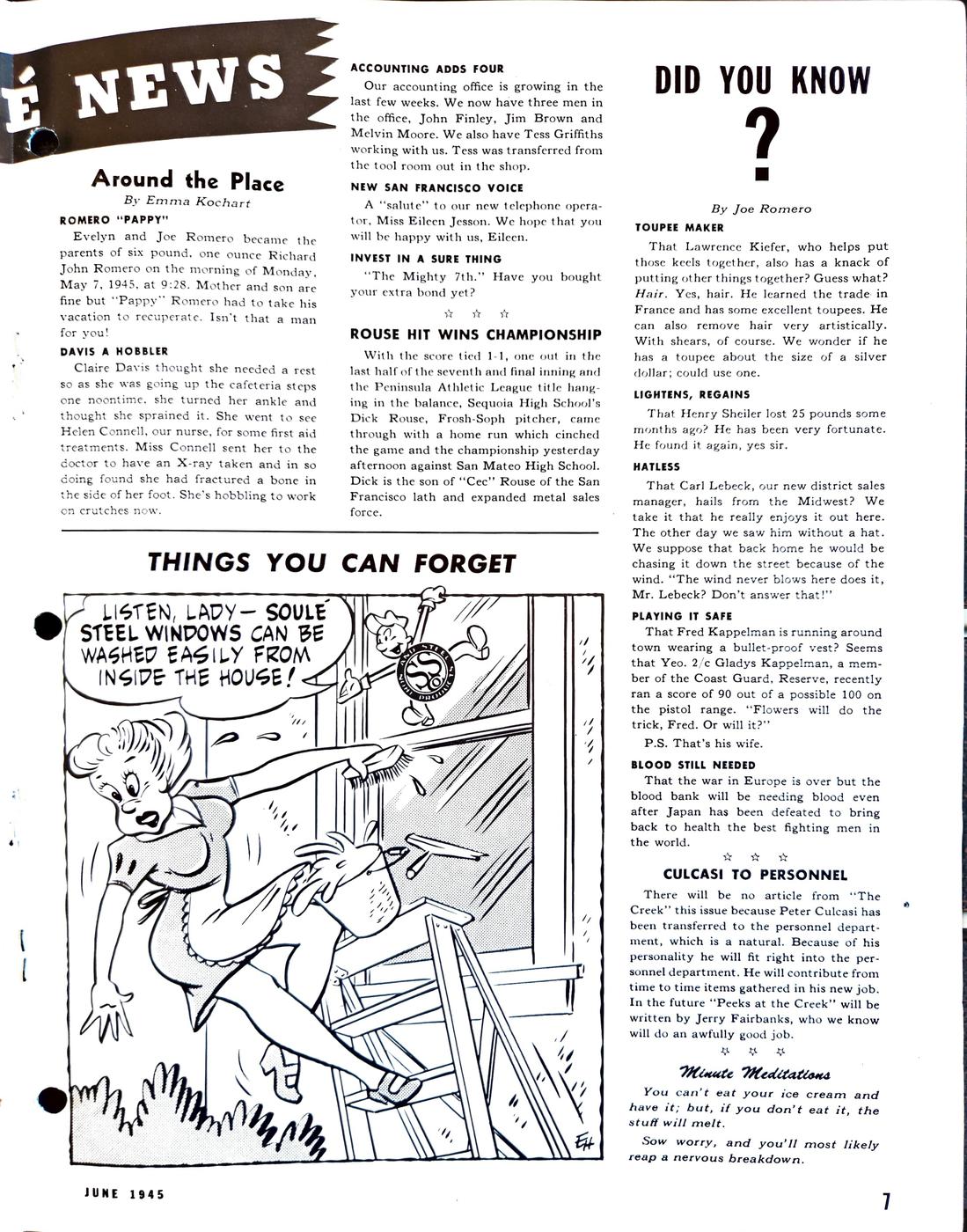
*Photo: Cartoon of a woman on a ladder washing a window, with a speech bubble reading "LISTEN, LADY— SOULE STEEL WINDOWS CAN BE WASHED EASILY FROM INSIDE THE HOUSE!" and a small cartoon figure in a circle labeled "SOULE STEEL WINDOW DIVISION."*
DID YOU KNOW? ?
*By Joe Romero*
TOUPEE MAKER That Lawrence Kiefer, who helps put those keels together, also has a knack of putting other things together? Guess what? *Hair.* Yes, hair. He learned the trade in France and has some excellent toupees. He can also remove hair very artistically. With shears, of course. We wonder if he has a toupee about the size of a silver dollar; could use one.
LIGHTENS, REGAINS That Henry Sheiler lost 25 pounds some months ago? He has been very fortunate. He found it again, yes sir.
HATLESS That Carl Lebeck, our new district sales manager, hails from the Midwest? We take it that he really enjoys it out here. The other day we saw him without a hat. We suppose that back home he would be chasing it down the street because of the wind. "The wind never blows here does it, Mr. Lebeck? Don't answer that!"
PLAYING IT SAFE That Fred Kappelman is running around town wearing a bullet-proof vest? Seems that Yeo. 2/c Gladys Kappelman, a member of the Coast Guard, Reserve, recently ran a score of 90 out of a possible 100 on the pistol range. "Flowers will do the trick, Fred. Or will it?"
P.S. That's his wife.
BLOOD STILL NEEDED That the war in Europe is over but the blood bank will be needing blood even after Japan has been defeated to bring back to health the best fighting men in the world.
CULCASI TO PERSONNEL There will be no article from "The Creek" this issue because Peter Culcasi has been transferred to the personnel department, which is a natural. Because of his personality he will fit right into the personnel department. He will contribute from time to time items gathered in his new job. In the future "Peeks at the Creek" will be written by Jerry Fairbanks, who we know will do an awfully good job.
*Minute Meditations* *You can't eat your ice cream and have it; but, if you don't eat it, the stuff will melt.*
*Sow worry, and you'll most likely reap a nervous breakdown.*
JUNE 1945
7
Page 8
NOW 3 STARS ## ON SAN FRANCISCO'S ## ARMY-NAVY "E" FLAG
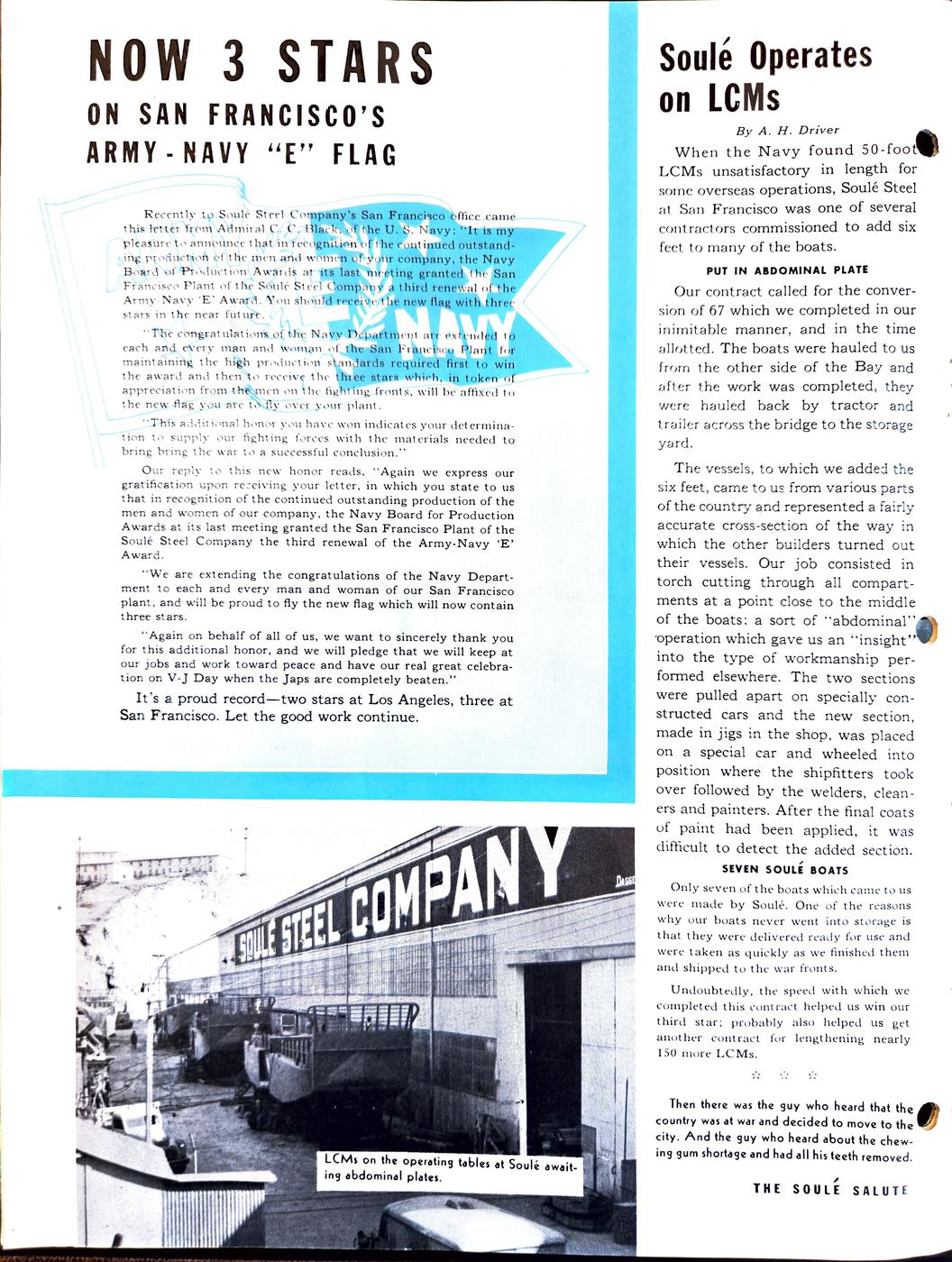
Recently to Soule Steel Company's San Francisco office came this letter from Admiral C. C. Black, of the U. S. Navy: "It is my pleasure to announce that in recognition of your continued outstanding production of the men and women of your company, the Navy Board of Production Awards at its last meeting granted the San Francisco Plant of the Soulé Steel Company a third renewal of the Army-Navy 'E' Award. You should receive the new flag with three stars in the near future.
"The congratulations of the Navy Department are extended to each and every man and woman of the San Francisco Plant for maintaining the high production standards required first to win the award and then to receive the three stars which, in token of appreciation from the men on the fighting fronts, will be affixed to the new flag you are to fly over your plant.
"This additional honor you have won indicates your determination to supply our fighting forces with the materials needed to bring bring the war to a successful conclusion."
Our reply to this new honor reads, "Again we express our gratification upon receiving your letter, in which you state to us that in recognition of the continued outstanding production of the men and women of our company, the Navy Board for Production Awards at its last meeting granted the San Francisco Plant of the Soulé Steel Company the third renewal of the Army-Navy 'E' Award.
"We are extending the congratulations of the Navy Department to each and every man and woman of our San Francisco plant, and will be proud to fly the new flag which will now contain three stars.
"Again on behalf of all of us, we want to sincerely thank you for this additional honor, and we will pledge that we will keep at our jobs and work toward peace and have our real great celebration on V-J Day when the Japs are completely beaten."
It's a proud record—two stars at Los Angeles, three at San Francisco. Let the good work continue.
Soulé Operates ## on LCMs
*By A. H. Driver*
When the Navy found 50-foot LCMs unsatisfactory in length for some overseas operations, Soulé Steel at San Francisco was one of several contractors commissioned to add six feet to many of the boats.
PUT IN ABDOMINAL PLATE
Our contract called for the conversion of 67 which we completed in our inimitable manner, and in the time allotted. The boats were hauled to us from the other side of the Bay and after the work was completed, they were hauled back by tractor and trailer across the bridge to the storage yard.
The vessels, to which we added the six feet, came to us from various parts of the country and represented a fairly accurate cross-section of the way in which the other builders turned out their vessels. Our job consisted in torch cutting through all compartments at a point close to the middle of the boats; a sort of "abdominal" operation which gave us an "insight" into the type of workmanship performed elsewhere. The two sections were pulled apart on specially constructed cars and the new section, made in jigs in the shop, was placed on a special car and wheeled into position where the shipfitters took over followed by the welders, cleaners and painters. After the final coats of paint had been applied, it was difficult to detect the added section.
SEVEN SOULÉ BOATS
Only seven of the boats which came to us were made by Soulé. One of the reasons why our boats never went into storage is that they were delivered ready for use and were taken as quickly as we finished them and shipped to the war fronts.
Undoubtedly, the speed with which we completed this contract helped us win our third star; probably also helped us get another contract for lengthening nearly 150 more LCMs.
Then there was the guy who heard that the country was at war and decided to move to the city. And the guy who heard about the chewing gum shortage and had all his teeth removed.
THE SOULÉ SALUTE
*Photo: LCMs on the operating tables at Soulé awaiting abdominal plates.*
Page 9
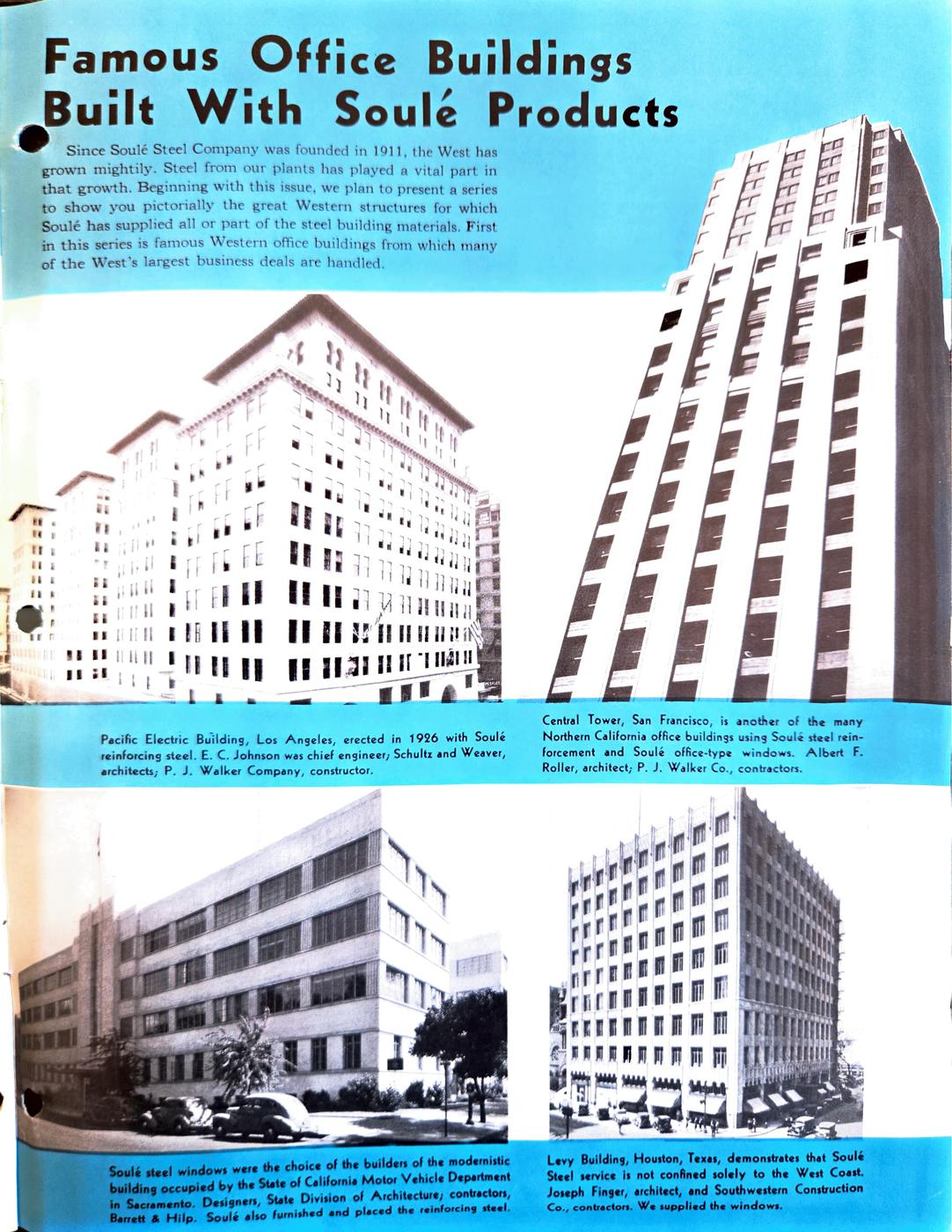
Famous Office Buildings Built With Soulé Products
Since Soulé Steel Company was founded in 1911, the West has grown mightily. Steel from our plants has played a vital part in that growth. Beginning with this issue, we plan to present a series to show you pictorially the great Western structures for which Soulé has supplied all or part of the steel building materials. First in this series is famous Western office buildings from which many of the West's largest business deals are handled.
Photo: Pacific Electric Building, Los Angeles, erected in 1926 with Soulé reinforcing steel. E. C. Johnson was chief engineer, Schultz and Weaver, architects; P. J. Walker Company, constructor.
Photo: Central Tower, San Francisco, is another of the many Northern California office buildings using Soulé steel reinforcement and Soulé office-type windows. Albert F. Roller, architect; P. J. Walker Co., contractors.
Photo: Soulé steel windows were the choice of the builders of the modernistic building occupied by the State of California Motor Vehicle Department in Sacramento. Designers, State Division of Architecture; contractors, Barrett & Hilp. Soulé also furnished and placed the reinforcing steel.
Photo: Levy Building, Houston, Texas, demonstrates that Soulé Steel service is not confined solely to the West Coast. Joseph Finger, architect, and Southwestern Construction Co., contractors. We supplied the windows.
Page 10
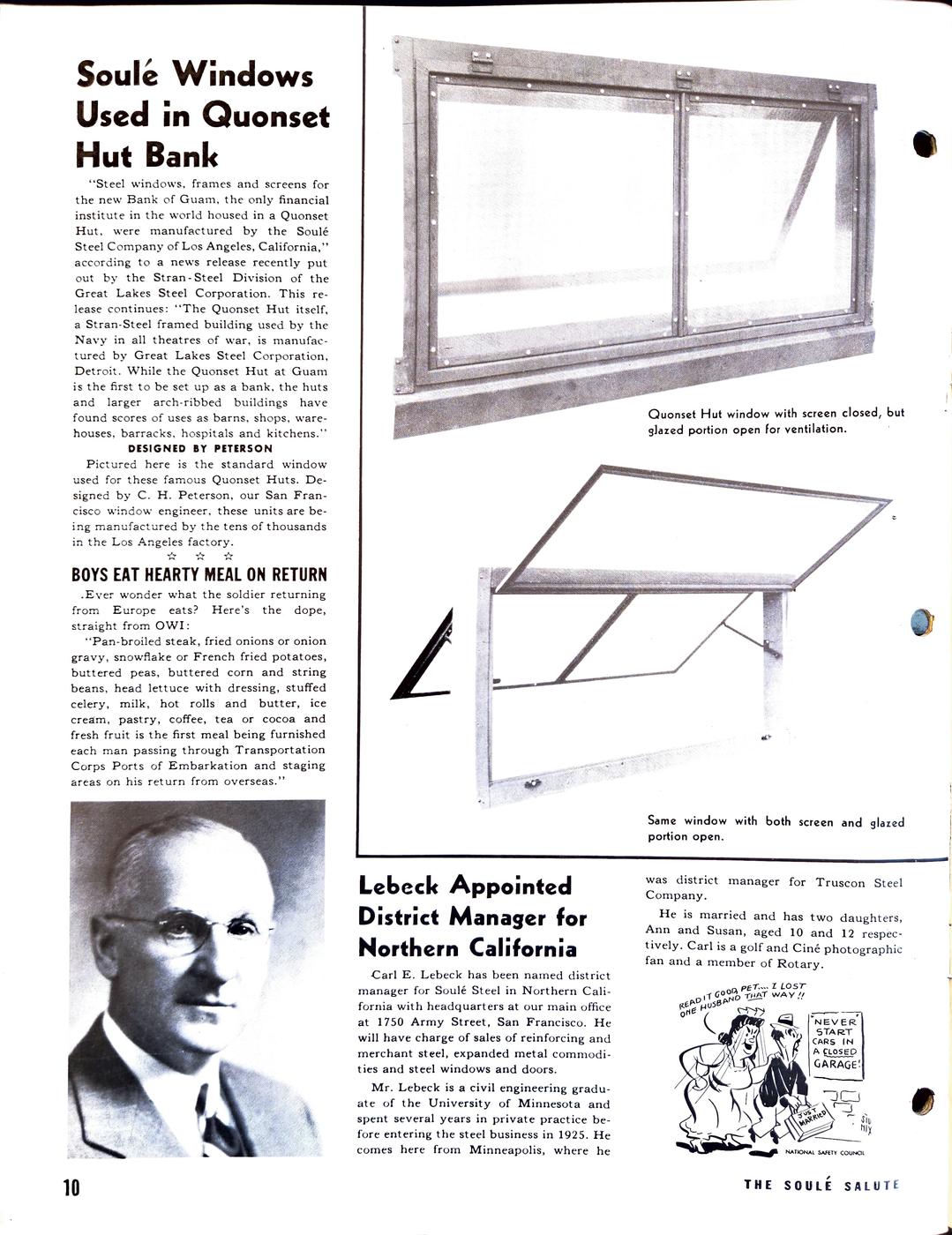
Soulé Windows Used in Quonset Hut Bank
"Steel windows, frames and screens for the new Bank of Guam, the only financial institute in the world housed in a Quonset Hut, were manufactured by the Soulé Steel Company of Los Angeles, California," according to a news release recently put out by the Stran-Steel Division of the Great Lakes Steel Corporation. This release continues: "The Quonset Hut itself, a Stran-Steel framed building used by the Navy in all theatres of war, is manufactured by Great Lakes Steel Corporation, Detroit. While the Quonset Hut at Guam is the first to be set up as a bank, the huts and larger arch-ribbed buildings have found scores of uses as barns, shops, warehouses, barracks, hospitals and kitchens."
DESIGNED BY PETERSON
Pictured here is the standard window used for these famous Quonset Huts. Designed by C. H. Peterson, our San Francisco window engineer, these units are being manufactured by the tens of thousands in the Los Angeles factory. ☆ ☆ ☆
Photo: Quonset Hut window with screen closed, but glazed portion open for ventilation.
Photo: Same window with both screen and glazed portion open.
BOYS EAT HEARTY MEAL ON RETURN
.Ever wonder what the soldier returning from Europe eats? Here's the dope, straight from OWI:
"Pan-broiled steak, fried onions or onion gravy, snowflake or French fried potatoes, buttered peas, buttered corn and string beans, head lettuce with dressing, stuffed celery, milk, hot rolls and butter, ice cream, pastry, coffee, tea or cocoa and fresh fruit is the first meal being furnished each man passing through Transportation Corps Ports of Embarkation and staging areas on his return from overseas."
Lebeck Appointed District Manager for Northern California
Carl E. Lebeck has been named district manager for Soulé Steel in Northern California with headquarters at our main office at 1750 Army Street, San Francisco. He will have charge of sales of reinforcing and merchant steel, expanded metal commodities and steel windows and doors.
Mr. Lebeck is a civil engineering graduate of the University of Minnesota and spent several years in private practice before entering the steel business in 1925. He comes here from Minneapolis, where he was district manager for Truscon Steel Company.
He is married and has two daughters, Ann and Susan, aged 10 and 12 respectively. Carl is a golf and Ciné photographic fan and a member of Rotary.
READ IT GOOD, PET... I LOST ONE HUSBAND THAT WAY!! NEVER START CARS IN A CLOSED GARAGE! SID NIX NATIONAL SAFETY COUNCIL
THE SOULÉ SALUTE 10
Page 11
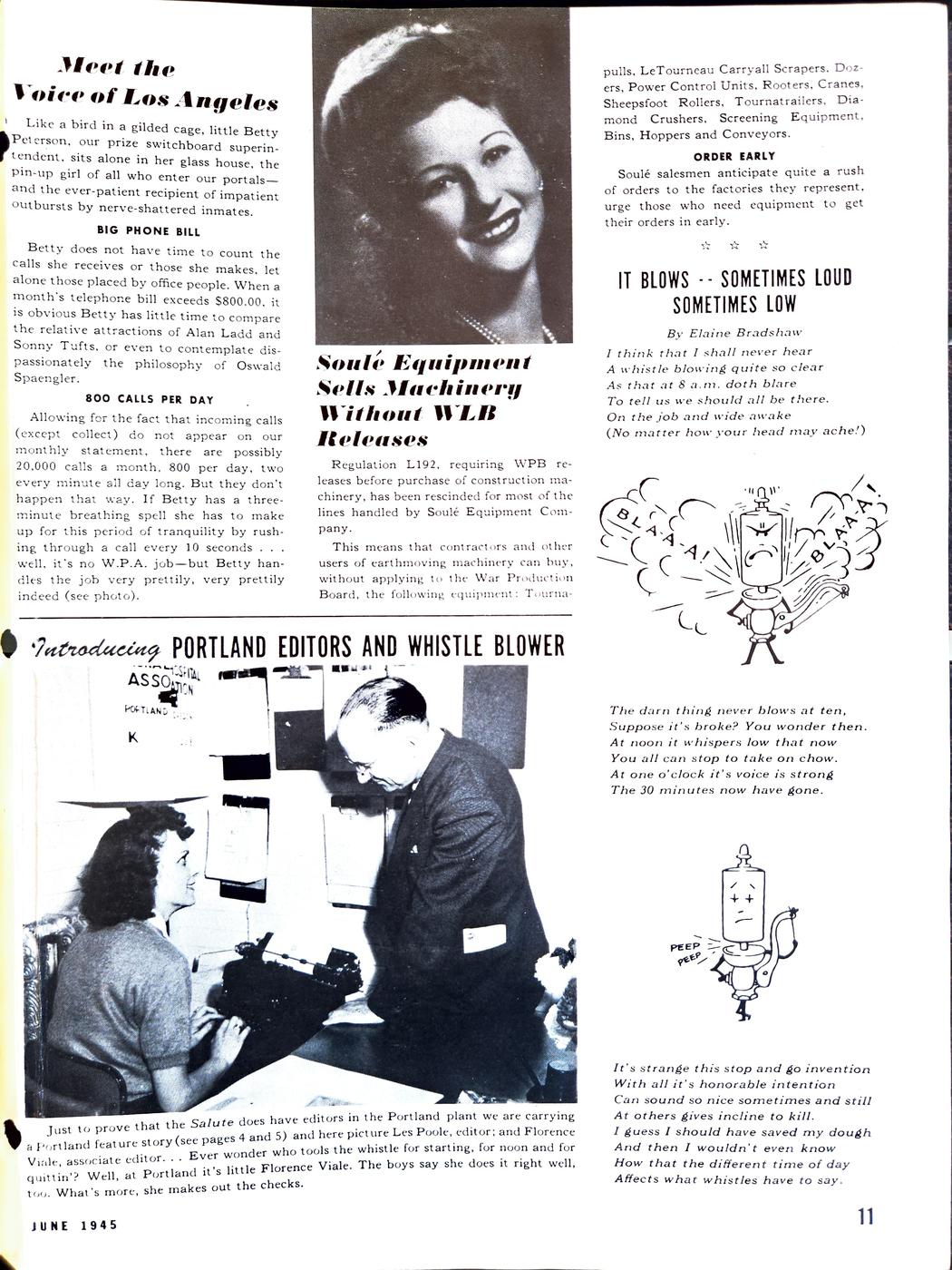
Meet the Voice of Los Angeles
Like a bird in a gilded cage, little Betty Peterson, our prize switchboard superintendent, sits alone in her glass house, the pin-up girl of all who enter our portals—and the ever-patient recipient of impatient outbursts by nerve-shattered inmates.
BIG PHONE BILL
Betty does not have time to count the calls she receives or those she makes, let alone those placed by office people. When a month's telephone bill exceeds $800.00, it is obvious Betty has little time to compare the relative attractions of Alan Ladd and Sonny Tufts, or even to contemplate dispassionately the philosophy of Oswald Spaengler.
800 CALLS PER DAY
Allowing for the fact that incoming calls (except collect) do not appear on our monthly statement, there are possibly 20,000 calls a month, 800 per day, two every minute all day long. But they don't happen that way. If Betty has a three-minute breathing spell she has to make up for this period of tranquility by rushing through a call every 10 seconds . . . well, it's no W.P.A. job—but Betty handles the job very prettily, very prettily indeed (see photo).
Photo: Soulé Equipment Sells Machinery Without WLB Releases
Regulation L192, requiring WPB releases before purchase of construction machinery, has been rescinded for most of the lines handled by Soulé Equipment Company.
This means that contractors and other users of earthmoving machinery can buy, without applying to the War Production Board, the following equipment: Tourna- pulls, LeTourneau Carryall Scrapers, Dozers, Power Control Units, Rooters, Cranes, Sheepfoot Rollers, Tournatrailers, Diamond Crushers, Screening Equipment, Bins, Hoppers and Conveyors.
ORDER EARLY
Soulé salesmen anticipate quite a rush of orders to the factories they represent, urge those who need equipment to get their orders in early.
☆ ☆ ☆
IT BLOWS -- SOMETIMES LOUD SOMETIMES LOW
By Elaine Bradshaw
I think that I shall never hear A whistle blowing quite so clear As that at 8 a.m. doth blare To tell us we should all be there. On the job and wide awake (No matter how your head may ache!)
BLAA-A! BLAA-A!
The darn thing never blows at ten, Suppose it's broke? You wonder then. At noon it whispers low that now You all can stop to take on chow. At one o'clock it's voice is strong The 30 minutes now have gone.
PEEP PEEP
It's strange this stop and go invention With all it's honorable intention Can sound so nice sometimes and still At others gives incline to kill. I guess I should have saved my dough And then I wouldn't even know How that the different time of day Affects what whistles have to say.
Introducing PORTLAND EDITORS AND WHISTLE BLOWER
Just to prove that the *Salute* does have editors in the Portland plant we are carrying a Portland feature story (see pages 4 and 5) and here picture Les Poole, editor; and Florence Viale, associate editor. . . Ever wonder who tools the whistle for starting, for noon and for quittin'? Well, at Portland it's little Florence Viale. The boys say she does it right well, too. What's more, she makes out the checks.
JUNE 1945 11
Page 12
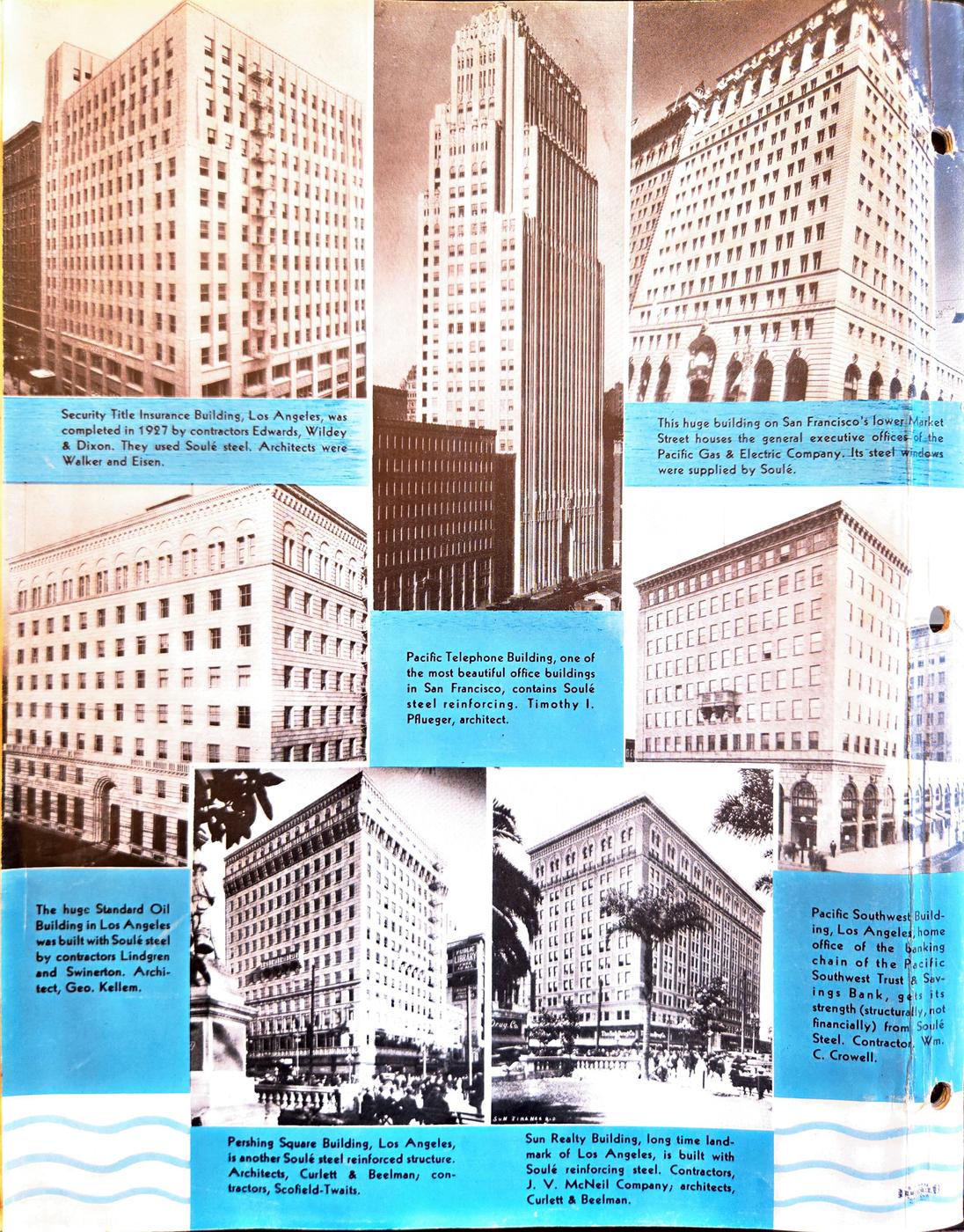
Security Title Insurance Building, Los Angeles, was completed in 1927 by contractors Edwards, Wildey & Dixon. They used Soulé steel. Architects were Walker and Eisen.
Pacific Telephone Building, one of the most beautiful office buildings in San Francisco, contains Soulé steel reinforcing. Timothy I. Pflueger, architect.
This huge building on San Francisco's lower Market Street houses the general executive offices of the Pacific Gas & Electric Company. Its steel windows were supplied by Soulé.
The huge Standard Oil Building in Los Angeles was built with Soulé steel by contractors Lindgren and Swinerton. Architect, Geo. Kellem.
Pacific Southwest Building, Los Angeles, home office of the banking chain of the Pacific Southwest Trust & Savings Bank, gets its strength (structurally, not financially) from Soulé Steel. Contractor, Wm. C. Crowell.
Pershing Square Building, Los Angeles, is another Soulé steel reinforced structure. Architects, Curlett & Beelman; contractors, Scofield-Twails.
Sun Realty Building, long time landmark of Los Angeles, is built with Soulé reinforcing steel. Contractors, J. V. McNeil Company; architects, Curlett & Beelman.