Page 1
SOULÉ SALUTE
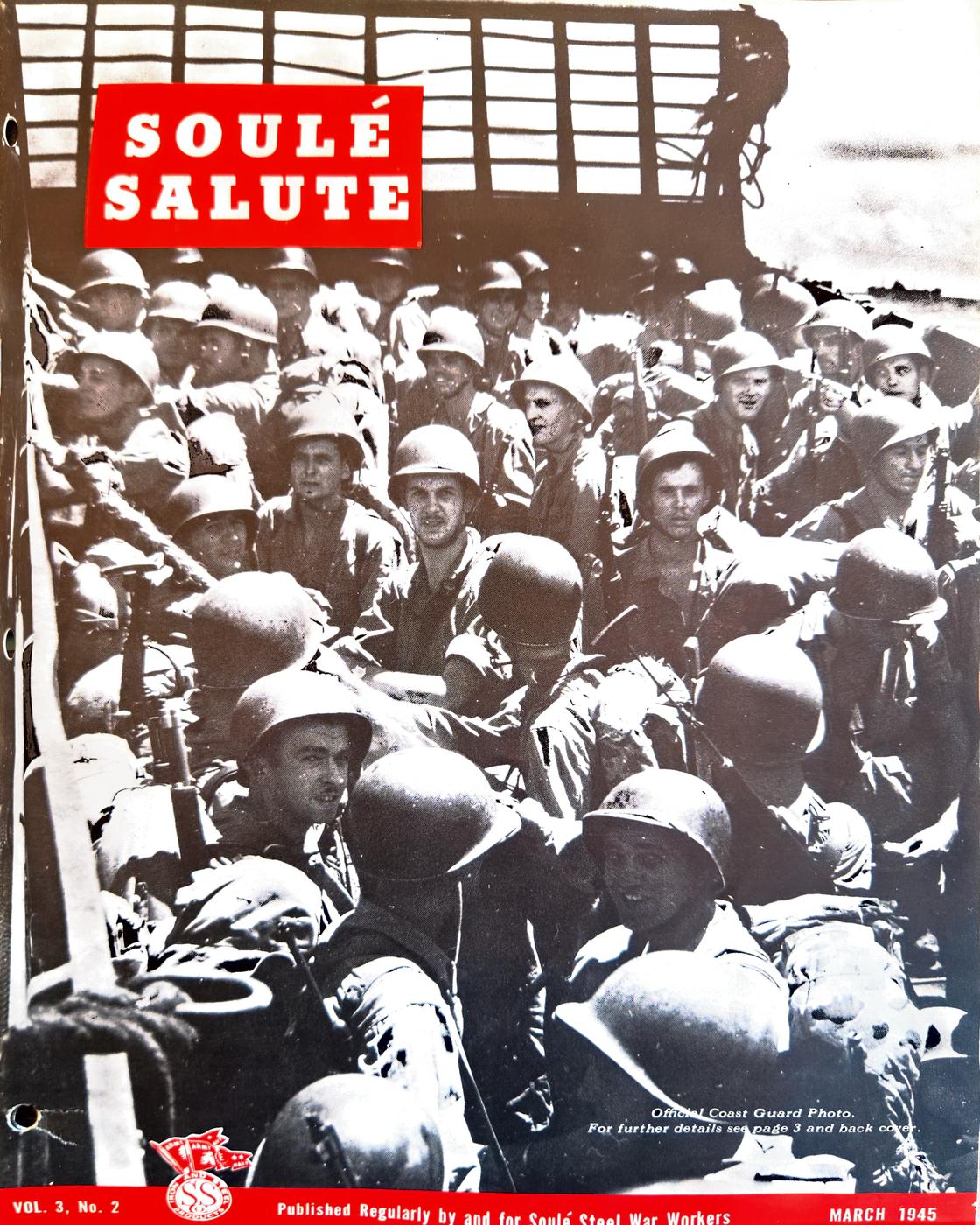
*Photo: Official Coast Guard Photo. For further details see page 3 and back cover.*
VOL. 3, No. 2
Published Regularly by and for Soulé Steel War Workers
MARCH 1945
Page 2
Meet METAL LATH...
*Stout Fellow and Backbone of Modern Plaster*
By Cecil Rouse San Francisco
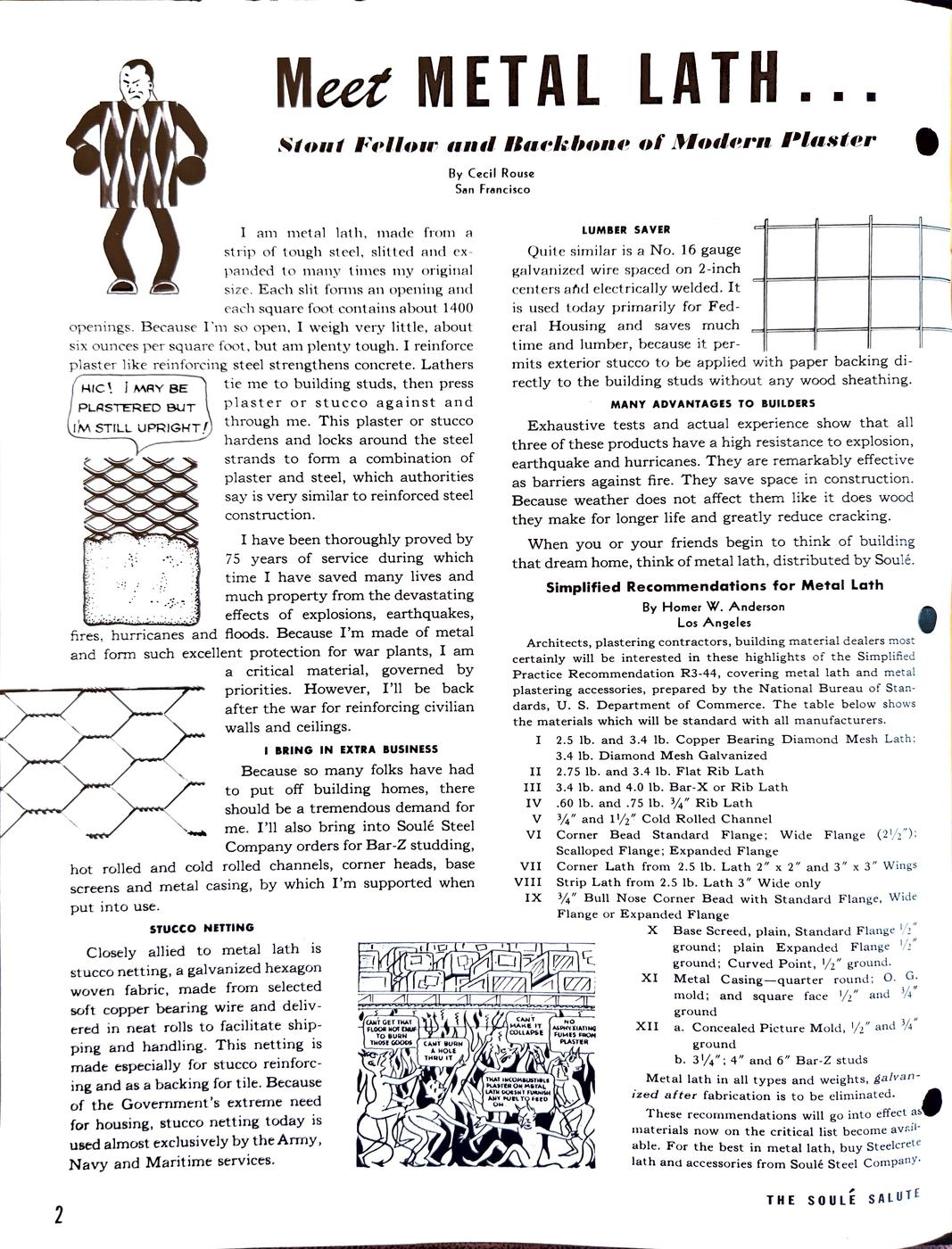
I am metal lath, made from a strip of tough steel, slitted and expanded to many times my original size. Each slit forms an opening and each square foot contains about 1400 openings. Because I'm so open, I weigh very little, about six ounces per square foot, but am plenty tough. I reinforce plaster like reinforcing steel strengthens concrete. Lathers tie me to building studs, then press plaster or stucco against and through me. This plaster or stucco hardens and locks around the steel strands to form a combination of plaster and steel, which authorities say is very similar to reinforced steel construction.
*HIC! I MAY BE PLASTERED BUT I'M STILL UPRIGHT!*
I have been thoroughly proved by 75 years of service during which time I have saved many lives and much property from the devastating effects of explosions, earthquakes, fires, hurricanes and floods. Because I'm made of metal and form such excellent protection for war plants, I am a critical material, governed by priorities. However, I'll be back after the war for reinforcing civilian walls and ceilings.
I BRING IN EXTRA BUSINESS
Because so many folks have had to put off building homes, there should be a tremendous demand for me. I'll also bring into Soulé Steel Company orders for Bar-Z studding, hot rolled and cold rolled channels, corner heads, base screens and metal casing, by which I'm supported when put into use.
STUCCO NETTING
Closely allied to metal lath is stucco netting, a galvanized hexagon woven fabric, made from selected soft copper bearing wire and delivered in neat rolls to facilitate shipping and handling. This netting is made especially for stucco reinforcing and as a backing for tile. Because of the Government's extreme need for housing, stucco netting today is used almost exclusively by the Army, Navy and Maritime services.
LUMBER SAVER
Quite similar is a No. 16 gauge galvanized wire spaced on 2-inch centers and electrically welded. It is used today primarily for Federal Housing and saves much time and lumber, because it permits exterior stucco to be applied with paper backing directly to the building studs without any wood sheathing.
MANY ADVANTAGES TO BUILDERS
Exhaustive tests and actual experience show that all three of these products have a high resistance to explosion, earthquake and hurricanes. They are remarkably effective as barriers against fire. They save space in construction. Because weather does not affect them like it does wood they make for longer life and greatly reduce cracking.
When you or your friends begin to think of building that dream home, think of metal lath, distributed by Soulé.
Simplified Recommendations for Metal Lath
By Homer W. Anderson Los Angeles
Architects, plastering contractors, building material dealers most certainly will be interested in these highlights of the Simplified Practice Recommendation R3-44, covering metal lath and metal plastering accessories, prepared by the National Bureau of Standards, U. S. Department of Commerce. The table below shows the materials which will be standard with all manufacturers.
I 2.5 lb. and 3.4 lb. Copper Bearing Diamond Mesh Lath; 3.4 lb. Diamond Mesh Galvanized
II 2.75 lb. and 3.4 lb. Flat Rib Lath
III 3.4 lb. and 4.0 lb. Bar-X or Rib Lath
IV .60 lb. and .75 lb. 3/4" Rib Lath
V 3/4" and 1 1/2" Cold Rolled Channel
VI Corner Bead Standard Flange; Wide Flange (2 1/2"); Scalloped Flange; Expanded Flange
VII Corner Lath from 2.5 lb. Lath 2" x 2" and 3" x 3" Wings
VIII Strip Lath from 2.5 lb. Lath 3" Wide only
IX 3/4" Bull Nose Corner Bead with Standard Flange, Wide Flange or Expanded Flange
X Base Sreed, plain, Standard Flange 1/2" ground; plain Expanded Flange 1/2" ground; Curved Point, 1/2" ground.
XI Metal Casing—quarter round; O. G. mold; and square face 1/2" and 3/4" ground
XII a. Concealed Picture Mold, 1/2" and 3/4" ground
b. 3 1/4"; 4" and 6" Bar-Z studs
Metal lath in all types and weights, *galvanized after fabrication* is to be eliminated.
These recommendations will go into effect as materials now on the critical list become available. For the best in metal lath, buy Steelcrete lath and accessories from Soulé Steel Company.
*Photo: Cartoon of figures with speech bubbles reading: "CAN'T GET THAT FLOOR HOT ENUF TO BURN THOSE GOODS", "CAN'T BURN A HOLE THRU IT", "CAN'T MAKE IT COLLAPSE", "NO ASPHYXIATING FUMES FROM PLASTER", "THAT INCOMBUSTIBLE PLASTER ON METAL LATH DOESN'T FURNISH ANY FUEL TO FEED ON".*
THE SOULÉ SALUTE
2
Page 3
Western Steel Fate Discussed at Salt Lake Meeting
**Edw. L. Soulé Chosen Chairman Iron and Steel Section San Francisco Chamber of Commerce, Attends Conference; Research Expert Reports Plenty of Iron, Coal for Continued Operation at Competitive Prices**
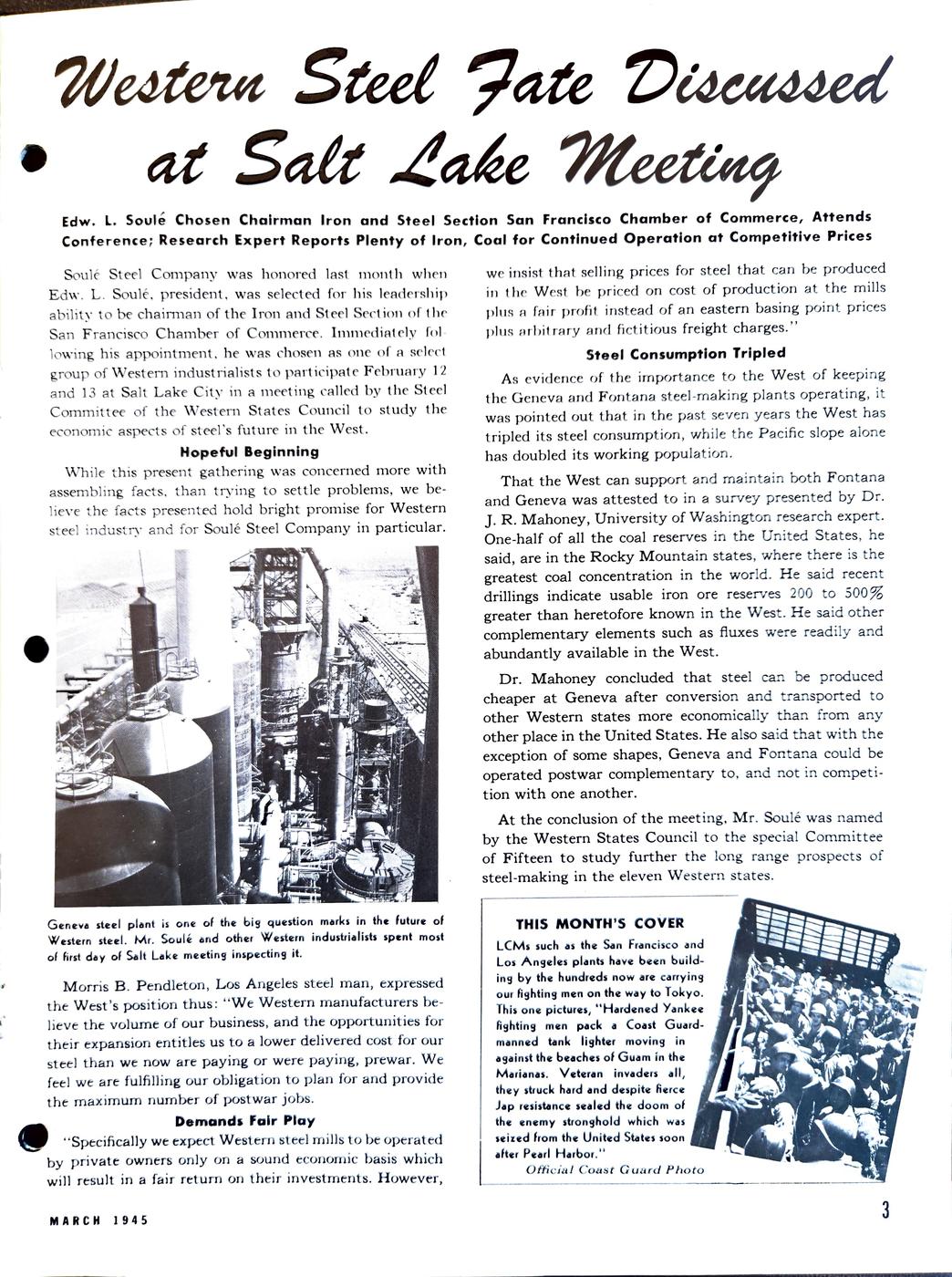
Soulé Steel Company was honored last month when Edw. L. Soulé, president, was selected for his leadership ability to be chairman of the Iron and Steel Section of the San Francisco Chamber of Commerce. Immediately following his appointment, he was chosen as one of a select group of Western industrialists to participate February 12 and 13 at Salt Lake City in a meeting called by the Steel Committee of the Western States Council to study the economic aspects of steel's future in the West.
Hopeful Beginning
While this present gathering was concerned more with assembling facts, than trying to settle problems, we believe the facts presented hold bright promise for Western steel industry and for Soulé Steel Company in particular.
*Photo: Geneva steel plant is one of the big question marks in the future of Western steel. Mr. Soulé and other Western industrialists spent most of first day of Salt Lake meeting inspecting it.*
Morris B. Pendleton, Los Angeles steel man, expressed the West's position thus: "We Western manufacturers believe the volume of our business, and the opportunities for their expansion entitles us to a lower delivered cost for our steel than we now are paying or were paying, prewar. We feel we are fulfilling our obligation to plan for and provide the maximum number of postwar jobs.
Demands Fair Play
"Specifically we expect Western steel mills to be operated by private owners only on a sound economic basis which will result in a fair return on their investments. However, we insist that selling prices for steel that can be produced in the West be priced on cost of production at the mills plus a fair profit instead of an eastern basing point prices plus arbitrary and fictitious freight charges."
Steel Consumption Tripled
As evidence of the importance to the West of keeping the Geneva and Fontana steel-making plants operating, it was pointed out that in the past seven years the West has tripled its steel consumption, while the Pacific slope alone has doubled its working population.
That the West can support and maintain both Fontana and Geneva was attested to in a survey presented by Dr. J. R. Mahoney, University of Washington research expert. One-half of all the coal reserves in the United States, he said, are in the Rocky Mountain states, where there is the greatest coal concentration in the world. He said recent drillings indicate usable iron ore reserves 200 to 500% greater than heretofore known in the West. He said other complementary elements such as fluxes were readily and abundantly available in the West.
Dr. Mahoney concluded that steel can be produced cheaper at Geneva after conversion and transported to other Western states more economically than from any other place in the United States. He also said that with the exception of some shapes, Geneva and Fontana could be operated postwar complementary to, and not in competition with one another.
At the conclusion of the meeting, Mr. Soulé was named by the Western States Council to the special Committee of Fifteen to study further the long range prospects of steel-making in the eleven Western states.
THIS MONTH'S COVER
LCMs such as the San Francisco and Los Angeles plants have been building by the hundreds now are carrying our fighting men on the way to Tokyo. This one pictures, "Hardened Yankee fighting men pack a Coast Guard-manned tank lighter moving in against the beaches of Guam in the Marianas. Veteran invaders all, they struck hard and despite fierce Jap resistance sealed the doom of the enemy stronghold which was seized from the United States soon after Pearl Harbor."
*Official Coast Guard Photo*
MARCH 1945
3
Page 4
How Soulé Steel Jobbing
By W. W. FLEMING Manager, Steel Jobbing Dept.
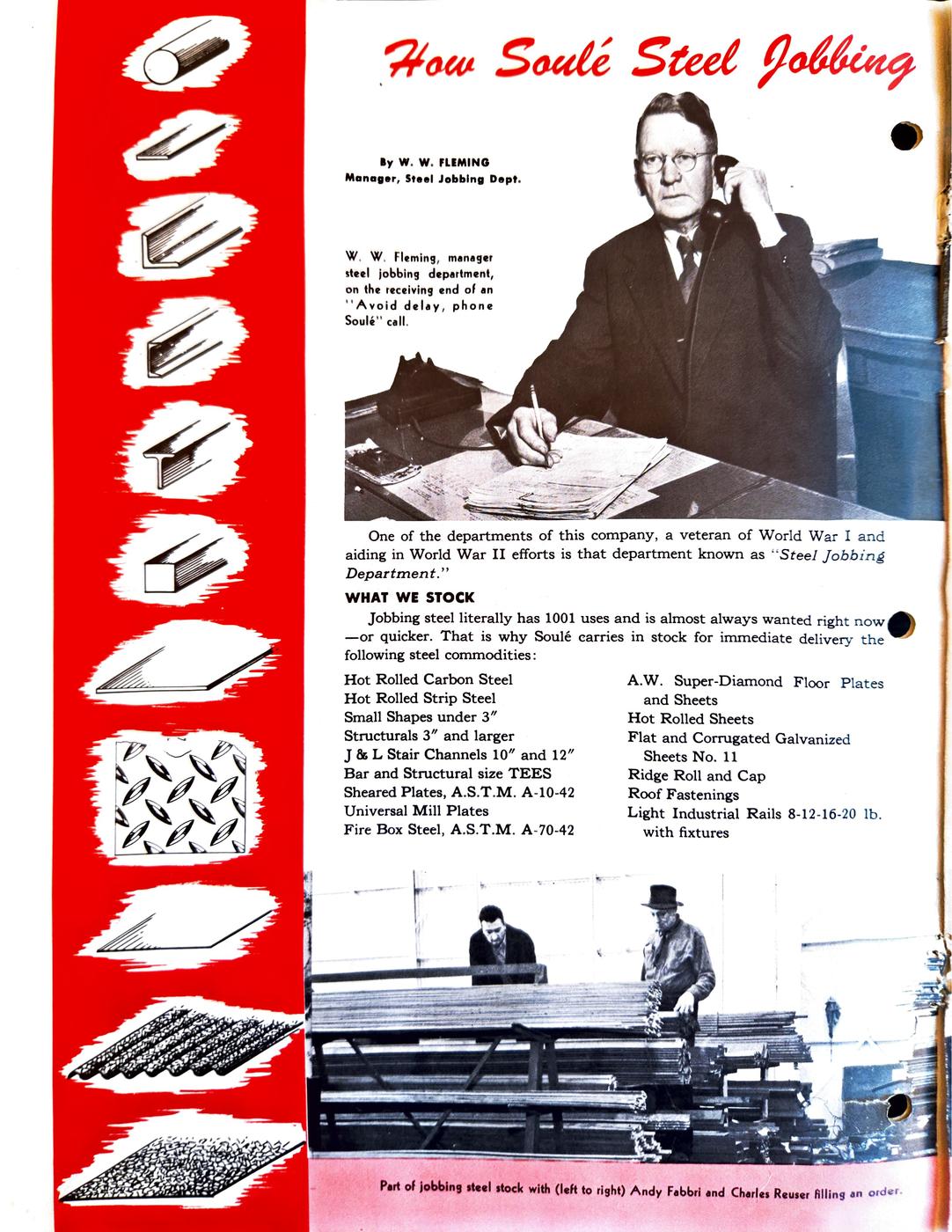
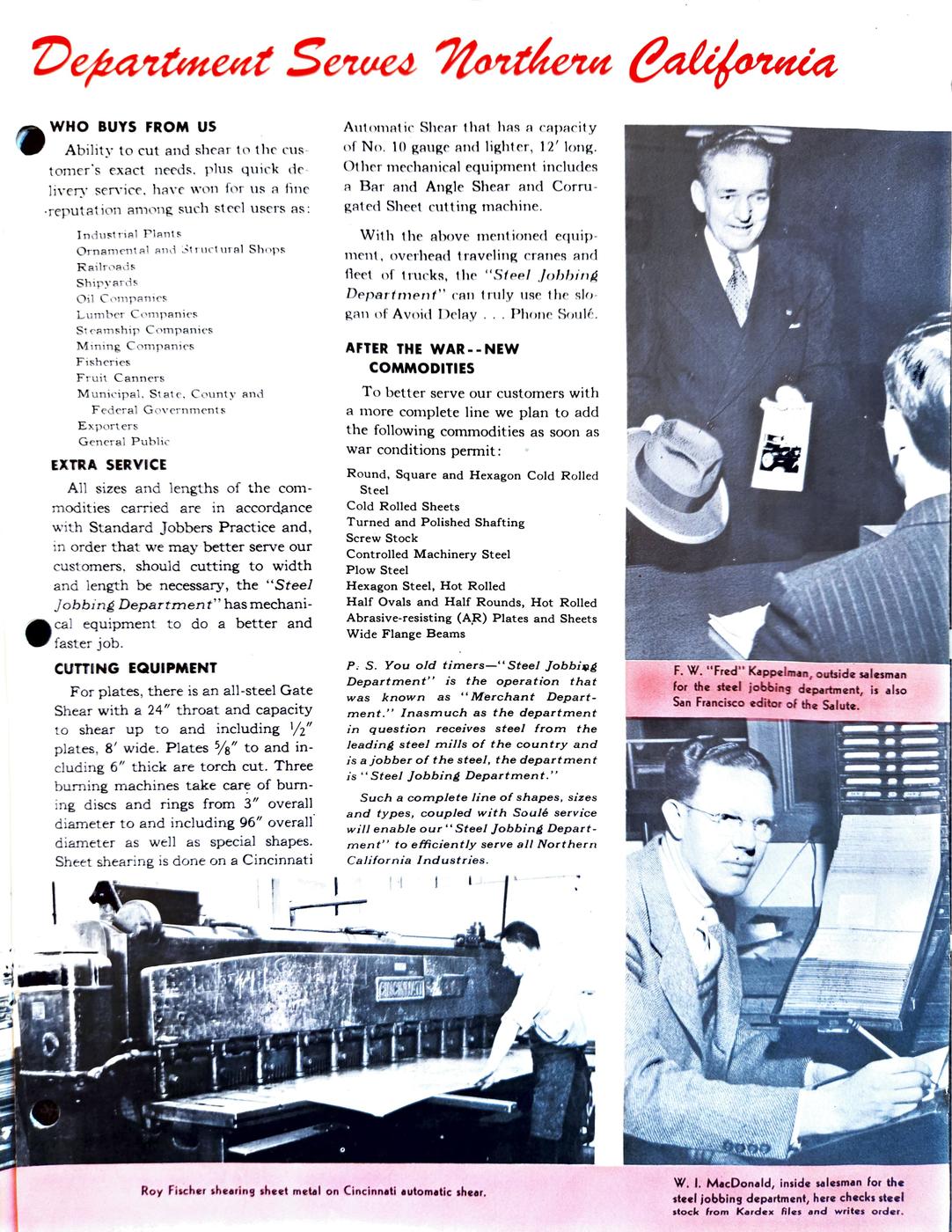
*Photo: W. W. Fleming, manager steel jobbing department, on the receiving end of an "Avoid delay, phone Soulé" call.*
One of the departments of this company, a veteran of World War I and aiding in World War II efforts is that department known as "*Steel Jobbing Department.*"
WHAT WE STOCK
Jobbing steel literally has 1001 uses and is almost always wanted right now—or quicker. That is why Soulé carries in stock for immediate delivery the following steel commodities:
Hot Rolled Carbon Steel Hot Rolled Strip Steel Small Shapes under 3" Structurals 3" and larger J & L Stair Channels 10" and 12" Bar and Structural size TEES Sheared Plates, A.S.T.M. A-10-42 Universal Mill Plates Fire Box Steel, A.S.T.M. A-70-42 A.W. Super-Diamond Floor Plates and Sheets Hot Rolled Sheets Flat and Corrugated Galvanized Sheets No. 11 Ridge Roll and Cap Roof Fastenings Light Industrial Rails 8-12-16-20 lb. with fixtures
*Photo: Part of jobbing steel stock with (left to right) Andy Fabbri and Charles Reuser filling an order.*
Page 5
Department Serves Northern California
WHO BUYS FROM US
Ability to cut and shear to the customer's exact needs, plus quick delivery service, have won for us a fine reputation among such steel users as:
Industrial Plants Ornamental and Structural Shops Railroads Shipyards Oil Companies Lumber Companies Steamship Companies Mining Companies Fisherries Fruit Canners Municipal, State, County and Federal Governments Exporters General Public
EXTRA SERVICE
All sizes and lengths of the commodities carried are in accordance with Standard Jobbers Practice and, in order that we may better serve our customers, should cutting to width and length be necessary, the "*Steel Jobbing Department*" has mechanical equipment to do a better and faster job.
CUTTING EQUIPMENT
For plates, there is an all-steel Gate Shear with a 24" throat and capacity to shear up to and including 1/2" plates, 8' wide. Plates 5/8" to and including 6" thick are torch cut. Three burning machines take care of burning discs and rings from 3" overall diameter to and including 96" overall diameter as well as special shapes. Sheet shearing is done on a Cincinnati Automatic Shear that has a capacity of No. 10 gauge and lighter, 12' long. Other mechanical equipment includes a Bar and Angle Shear and Corrugated Sheet cutting machine.
With the above mentioned equipment, overhead traveling cranes and fleet of trucks, the "*Steel Jobbing Department*" can truly use the slogan of Avoid Delay . . . Phone Soulé.
AFTER THE WAR--NEW COMMODITIES
To better serve our customers with a more complete line we plan to add the following commodities as soon as war conditions permit:
Round, Square and Hexagon Cold Rolled Steel Cold Rolled Sheets Turned and Polished Shafting Screw Stock Controlled Machinery Steel Plow Steel Hexagon Steel, Hot Rolled Half Ovals and Half Rounds, Hot Rolled Abrasive-resisting (AR) Plates and Sheets Wide Flange Beams
*P. S. You old timers—"*Steel Jobbing Department*" is the operation that was known as "*Merchant Department*." Inasmuch as the department in question receives steel from the leading steel mills of the country and is a jobber of the steel, the department is "*Steel Jobbing Department*."*
*Such a complete line of shapes, sizes and types, coupled with Soulé service will enable our "*Steel Jobbing Department*" to efficiently serve all Northern California Industries.*
Photo: F. W. "Fred" Kappelman, outside salesman for the steel jobbing department, is also San Francisco editor of the Salute.
Photo: Roy Fischer shearing sheet metal on Cincinnati automatic shear.
Photo: W. I. MacDonald, inside salesman for the steel jobbing department, here checks steel stock from Kardex files and writes order.
Page 6
DID YOU KNOW?
?
*By Joe Romero*
WRONG SARDINES
That Gordon Strain, of the reinforcing department, had a rare sandwich the other day. It seems his wife made up his lunch and by mistake used some of the sardines he uses for bait when he goes fishing. "Phoo-ee."
FURLOUGH SMILE
That the BIG smile Rena, the Queen of the shipping office, has been wearing lately is because Freddie Scagliola will be home on a furlough real soon. That's her big baby brother you know. Sergeant no less. "How about some 'tur-ta,' Ma?"
IT'S A BOY AT VIZCARRA'S
That Manuel Vizcarr became the proud father of a three pound, four ounce baby boy. We understand this baby has been 15 years getting here. Just goes to prove that there is always hope. Congratulations to Mr. and Mrs. Vizcarr.
ROBERTS ROUGH ON RATS
That this plant was running wild with rats until Mr. Roberts, personnel manager, suggested a compound that looked like cheese to spread on crackers. This, visualized with a tall glass of beer, would look appetizing, even to a human. But the rats got it first, which accounted for the terrific death rate of rats, "Old Killer Bill, he was known as in them days."
HOLD THE SCRAP
That if we did not throw lunch scraps and other tempting things around the plant, the above mentioned rats would soon give us the "go-by."
FIGHTING ROMERO RECEIVES MEDAL
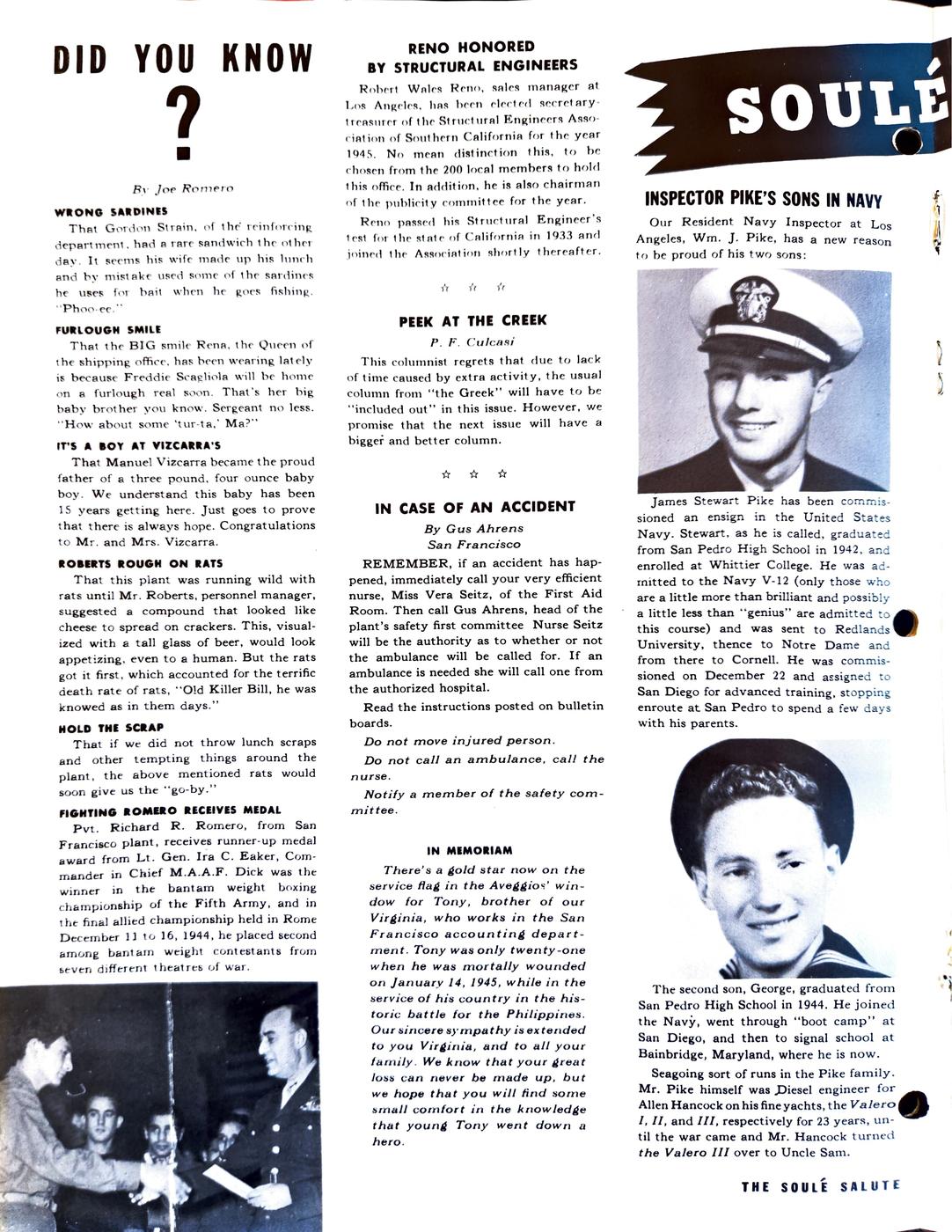
Pvt. Richard R. Romero, from San Francisco plant, receives runner-up medal award from Lt. Gen. Ira C. Eaker, Commander in Chief M.A.A.F. Dick was the winner in the bantam weight boxing championship of the Fifth Army, and in the final allied championship held in Rome December 11 to 16, 1944, he placed second among bantam weight contestants from seven different theatres of war.
*Photo: A uniformed officer presents a medal and certificate to a seated soldier, with other men in uniform looking on.*
RENO HONORED BY STRUCTURAL ENGINEERS
Robert Wales Reno, sales manager at Los Angeles, has been elected secretary-treasurer of the Structural Engineers Association of Southern California for the year 1945. No mean distinction this, to be chosen from the 200 local members to hold this office. In addition, he is also chairman of the publicity committee for the year.
Reno passed his Structural Engineer's test for the state of California in 1933 and joined the Association shortly thereafter.
PEEK AT THE CREEK
*P. F. Culcasi*
This columnist regrets that due to lack of time caused by extra activity, the usual column from "the Greek" will have to be "included out" in this issue. However, we promise that the next issue will have a bigger and better column.
IN CASE OF AN ACCIDENT
*By Gus Ahrens* *San Francisco*
REMEMBER, if an accident has happened, immediately call your very efficient nurse, Miss Vera Seitz, of the First Aid Room. Then call Gus Ahrens, head of the plant's safety first committee. Nurse Seitz will be the authority as to whether or not the ambulance will be called for. If an ambulance is needed she will call one from the authorized hospital.
Read the instructions posted on bulletin boards.
*Do not move injured person.*
*Do not call an ambulance, call the nurse.*
*Notify a member of the safety committee.*
IN MEMORIAM
*There's a gold star now on the service flag in the Aveggios' window for Tony, brother of our Virginia, who works in the San Francisco accounting department. Tony was only twenty-one when he was mortally wounded on January 14, 1945, while in the service of his country in the historic battle for the Philippines. Our sincere sympathy is extended to you Virginia, and to all your family. We know that your great loss can never be made up, but we hope that you will find some small comfort in the knowledge that young Tony went down a hero.*
SOULÉ
INSPECTOR PIKE'S SONS IN NAVY
Our Resident Navy Inspector at Los Angeles, Wm. J. Pike, has a new reason to be proud of his two sons:
*Photo: Portrait of a smiling young man in a U.S. Navy officer's uniform and white cap.*
James Stewart Pike has been commissioned an ensign in the United States Navy. Stewart, as he is called, graduated from San Pedro High School in 1942, and enrolled at Whittier College. He was admitted to the Navy V-12 (only those who are a little more than brilliant and possibly a little less than "genius" are admitted to this course) and was sent to Redlands University, thence to Notre Dame and from there to Cornell. He was commissioned on December 22 and assigned to San Diego for advanced training, stopping enroute at San Pedro to spend a few days with his parents.
*Photo: Portrait of a smiling young man in a U.S. Navy sailor's uniform.*
The second son, George, graduated from San Pedro High School in 1944. He joined the Navy, went through "boot camp" at San Diego, and then to signal school at Bainbridge, Maryland, where he is now.
Seagoing sort of runs in the Pike family. Mr. Pike himself was Diesel engineer for Allen Hancock on his fine yachts, the *Valero I, II,* and *III,* respectively for 23 years, until the war came and Mr. Hancock turned the *Valero III* over to Uncle Sam.
THE SOULÉ SALUTE
Page 7
NEWS
AROUND THE SAN FRANCISCO OFFICE
*By Emma Kochart*
TRAPPED BY A WINDOW
Rose Fabbri of the accounting department really started 1945 off with a bang. After painting the window frames in the office one night, the painters left the tops of all of them open. Not wanting to freeze, Rose decided to close them. She stood on the mail desk to close the back ones and as she was climbing down from the desk got her foot caught in the adjusting cord for the blinds. Suddenly hearing a very loud crash we looked toward the back of the office and saw Rose lying on the floor with one foot stuck up in the air caught in the cord. Luckily she was only slightly bruised.
MUSTACHE MISSED
Has everyone seen what at first appears to be a new employee in the payroll department? Well, take another look. It is really Kenny Riddle, who, after having a mustache for 23 years had it removed. We are hoping we will get used to his new face in a few weeks.
ANOTHER BARE FACE
Bob Raitch's face is also bare of handle bars for the last few weeks.
WATCHES PORTLAND STEEL INSTALLED
Monica Wenzel, of the accounting department, announced after seeing the picture of Oregon's State Capitol in the February *Salute* that she developed a stiff neck while "sidewalk superintending" its erection. Her home is only five blocks from the capitol.
SON GETS COMMISSION
Don Short, chief engineer of the reinforcing department, and his family are very proud these days and they have a good right to be. The Shorts have just received word that their son, Don Harmon Short, Jr., has been commissioned a second lieutenant in the photographic section of the Army Air Force. Our congratulations to the family.
BILUND BACK
Back again after a five weeks illness is Al Bilund, that genial member of the engineering department. He was missed very much while away but he did not get a chance to forget the "gang" or feel he was forgotten as Art Driver and Arlo Israelson sent him sketches and vignettes of the happenings at the office.
MARCH 1945
BILLER LIMPS
Florence Nickerson, billing expert, was limping around due to a badly wrenched ankle. However, she again is "tripping the light fantastic" so we will not have to take her out and shoot her.
ROUSE, OSCLEROSIS VICTIM
Also back off the sick list is Cecil Rouse, that "personality guy" of the expanded metal and lath department. The doctor said he had been suffering from "osclerosis." We don't know what that is, but it sure sounds like tough luck.
BILL BJORKQUIST WRITES
Bill Bjorkquist, a member of Frank Kullmer's staff of engineers at the San Francisco plant before he "shoved off" to become one of Uncle Sam's Navy flying aces, wrote recently of the heavy program he goes through from 0530 to 1900, which to landlubbers is five-thirty in the morning to seven o'clock in the evening. We bet that physical drill he referred to is giving Bill a trim figure.
Lots of luck, Bill, send us a photo for these columns.
Av. Cad. G. W. Bjorkquist Batt. 1A, E2—Room 206 Hillcrest U.S.N. Pre-Flight Iowa City, Iowa
BARNES IN FLORIDA
Private Noble C. Barnes, formerly one of the Los Angeles plant's best welders, writes us from Camp Gordon Johnston, Florida, that he misses the gang and wishes to be remembered to all. For those who wish to write him, his address is:
Private N. C. Barnes (39730429) School Dec. BKS 1105 Camp Gordon Johnston, Fla.
MATERNITY
*Photo: When he saw the quadruplets, he just hollered "Wow" and started refiguring his income tax.*
LIKE TO BE A REPORTER?
This is how to satisfy that creative urge which has been lying dormant in your subconscious. The *Salute* is your paper, and if you like to write, draw or take pictures, see your city editor, Mr. Fred Kappelman, if you work in San Francisco; Mr. R. W. Reno, in Los Angeles; Mr. A. M. Dowell, at Torrance; or Mr. Les Poole, in Portland. He will give you helpful hints that will show you just how to do it. It's a lot of fun, we're sure you'll enjoy it, and our talent scouts always welcome a good news story or picture.
TORRANCE "SUPER" AND "SECOND"
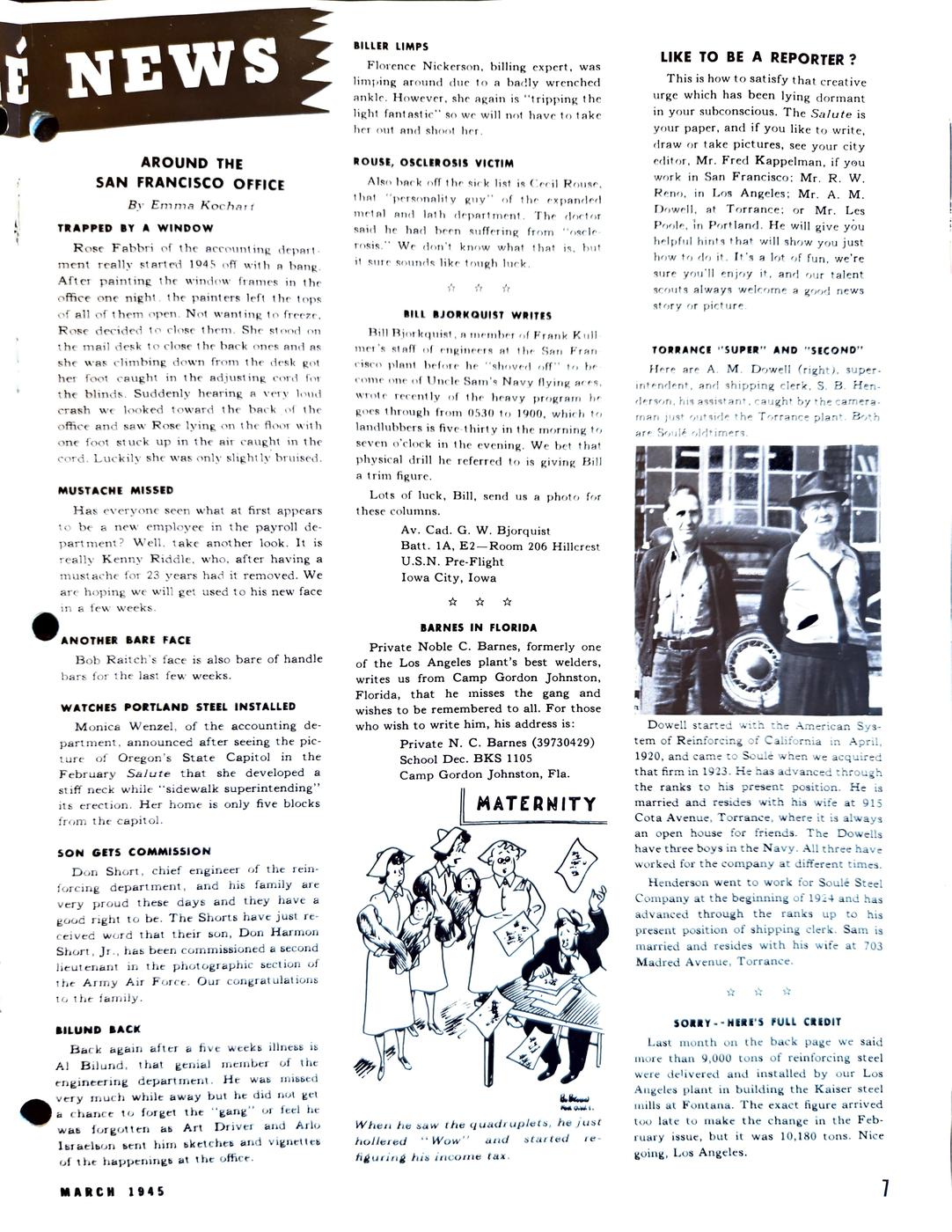
Here are A. M. Dowell (right), superintendent, and shipping clerk, S. B. Henderson, his assistant, caught by the cameraman just outside the Torrance plant. Both are Soule oldtimers.
*Photo: Dowell started with the American System of Reinforcing of California in April, 1920, and came to Soule when we acquired that firm in 1923. He has advanced through the ranks to his present position. He is married and resides with his wife at 915 Cota Avenue, Torrance, where it is always an open house for friends. The Dowells have three boys in the Navy. All three have worked for the company at different times.*
Henderson went to work for Soule Steel Company at the beginning of 1924 and has advanced through the ranks up to his present position of shipping clerk. Sam is married and resides with his wife at 703 Madred Avenue, Torrance.
SORRY--HERE'S FULL CREDIT
Last month on the back page we said more than 9,000 tons of reinforcing steel were delivered and installed by our Los Angeles plant in building the Kaiser steel mills at Fontana. The exact figure arrived too late to make the change in the February issue, but it was 10,180 tons. Nice going, Los Angeles.
7
Page 8
Los Angeles Office Enlarged
By R. W. Reno
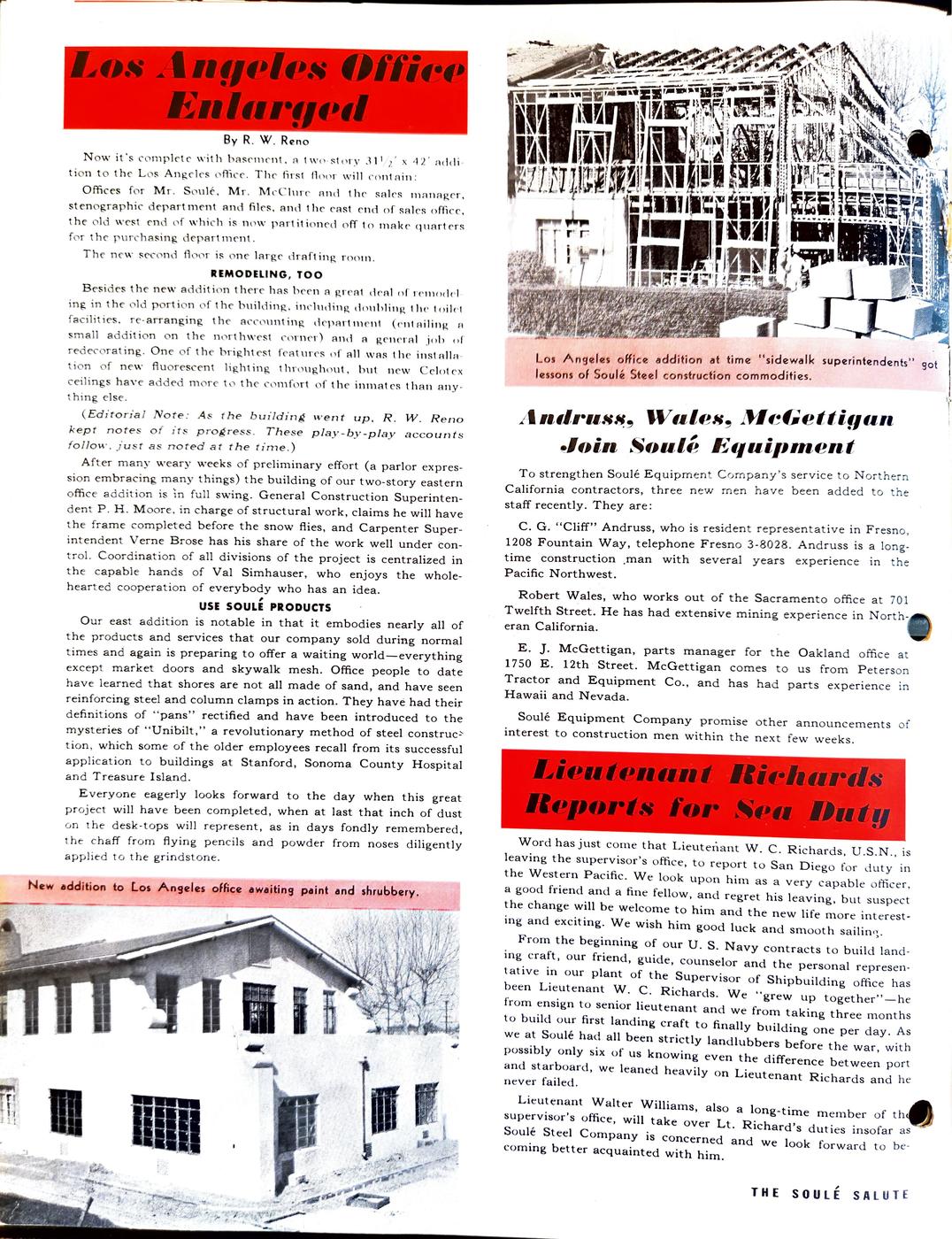
Now it's complete with basement, a two-story 31½' x 42' addition to the Los Angeles office. The first floor will contain:
Offices for Mr. Soulé, Mr. McClure and the sales manager, stenographic department and files, and the east end of sales office, the old west end of which is now partitioned off to make quarters for the purchasing department.
The new second floor is one large drafting room.
REMODELING, TOO
Besides the new addition there has been a great deal of remodeling in the old portion of the building, including doubling the toilet facilities, re-arranging the accounting department (entailing a small addition on the northwest corner) and a general job of redecorating. One of the brightest features of all was the installation of new fluorescent lighting throughout, but new Celotex ceilings have added more to the comfort of the inmates than anything else.
*(Editorial Note: As the building went up, R. W. Reno kept notes of its progress. These play-by-play accounts follow, just as noted at the time.)*
After many weary weeks of preliminary effort (a parlor expression embracing many things) the building of our two-story eastern office addition is in full swing. General Construction Superintendent P. H. Moore, in charge of structural work, claims he will have the frame completed before the snow flies, and Carpenter Superintendent Verne Brose has his share of the work well under control. Coordination of all divisions of the project is centralized in the capable hands of Val Simhauser, who enjoys the whole-hearted cooperation of everybody who has an idea.
USE SOULÉ PRODUCTS
Our east addition is notable in that it embodies nearly all of the products and services that our company sold during normal times and again is preparing to offer a waiting world—everything except market doors and skywalk mesh. Office people to date have learned that shores are not all made of sand, and have seen reinforcing steel and column clamps in action. They have had their definitions of "pans" rectified and have been introduced to the mysteries of "Unibilt," a revolutionary method of steel construction, which some of the older employees recall from its successful application to buildings at Stanford, Sonoma County Hospital and Treasure Island.
Everyone eagerly looks forward to the day when this great project will have been completed, when at last that inch of dust on the desk-tops will represent, as in days fondly remembered, the chaff from flying pencils and powder from noses diligently applied to the grindstone.
*Photo: New addition to Los Angeles office awaiting paint and shrubbery.*
*Photo: Los Angeles office addition at time "sidewalk superintendents" got lessons of Soulé Steel construction commodities.*
Andruss, Wales, McGettigan Join Soulé Equipment
To strengthen Soulé Equipment Company's service to Northern California contractors, three new men have been added to the staff recently. They are:
C. G. "Cliff" Andruss, who is resident representative in Fresno, 1208 Fountain Way, telephone Fresno 3-8028. Andruss is a long-time construction man with several years experience in the Pacific Northwest.
Robert Wales, who works out of the Sacramento office at 701 Twelfth Street. He has had extensive mining experience in Northern California.
E. J. McGettigan, parts manager for the Oakland office at 1750 E. 12th Street. McGettigan comes to us from Peterson Tractor and Equipment Co., and has had parts experience in Hawaii and Nevada.
Soulé Equipment Company promise other announcements of interest to construction men within the next few weeks.
Lieutenant Richards Reports for Sea Duty
Word has just come that Lieutenant W. C. Richards, U.S.N., is leaving the supervisor's office, to report to San Diego for duty in the Western Pacific. We look upon him as a very capable officer, a good friend and a fine fellow, and regret his leaving, but suspect the change will be welcome to him and the new life more interesting and exciting. We wish him good luck and smooth sailing.
From the beginning of our U. S. Navy contracts to build landing craft, our friend, guide, counselor and the personal representative in our plant of the Supervisor of Shipbuilding office has been Lieutenant W. C. Richards. We "grew up together"—he from ensign to senior lieutenant and we from taking three months to build our first landing craft to finally building one per day. As we at Soulé had all been strictly landlubbers before the war, with possibly only six of us knowing even the difference between port and starboard, we leaned heavily on Lieutenant Richards and he never failed.
Lieutenant Walter Williams, also a long-time member of the supervisor's office, will take over Lt. Richard's duties insofar as Soulé Steel Company is concerned and we look forward to becoming better acquainted with him.
THE SOULÉ SALUTE
Page 9
SOULÉ EQUIPMENT APPOINTS STILLEY GENERAL MANAGER
Howard L. Stilley has been appointed general manager of Soulé Equipment Company and will make his headquarters at 1750 East 12th Street, Oakland. He comes here from R. G. LeTourneau, Inc., Peoria, Illinois, where he has been central sales manager. He joined LeTourneau in 1936 as a field engineer and was promoted successively to district representative, assistant western sales manager and chief field engineer. His experience will be particularly helpful because Soulé Equipment Company is LeTourneau's distributor for Northern California.
Mr. Stilley is well known in Northern California, having made his headquarters at the Stockton office of R. G. LeTourneau, Inc., for several years. In his new post, he will have charge of all Soulé Equipment Company offices and representatives in Northern California.
Diamond Iron Works Selects Soulé Equipment
As we go to press word comes that Soulé Equipment Company has been appointed Northern California distributors for the Diamond Iron Works, makers of jaw and roll crushers, screening equipment, bucket elevators, conveying equipment, bins and hoppers, portable crushing and screening plants, and washing and screening rigs.
THINGS YOU CAN FORGET
*Photo: Comic panel. A worker on the left says, "LISTEN, BUD—SOULÉ STEEL WINDOWS WON'T SWELL—THEY OPEN EASILY IN ANY KIND OF WEATHER!!" A worker on the right, slipping on a cracked window, exclaims "@#%!" with a "CRACK!" sound effect.*
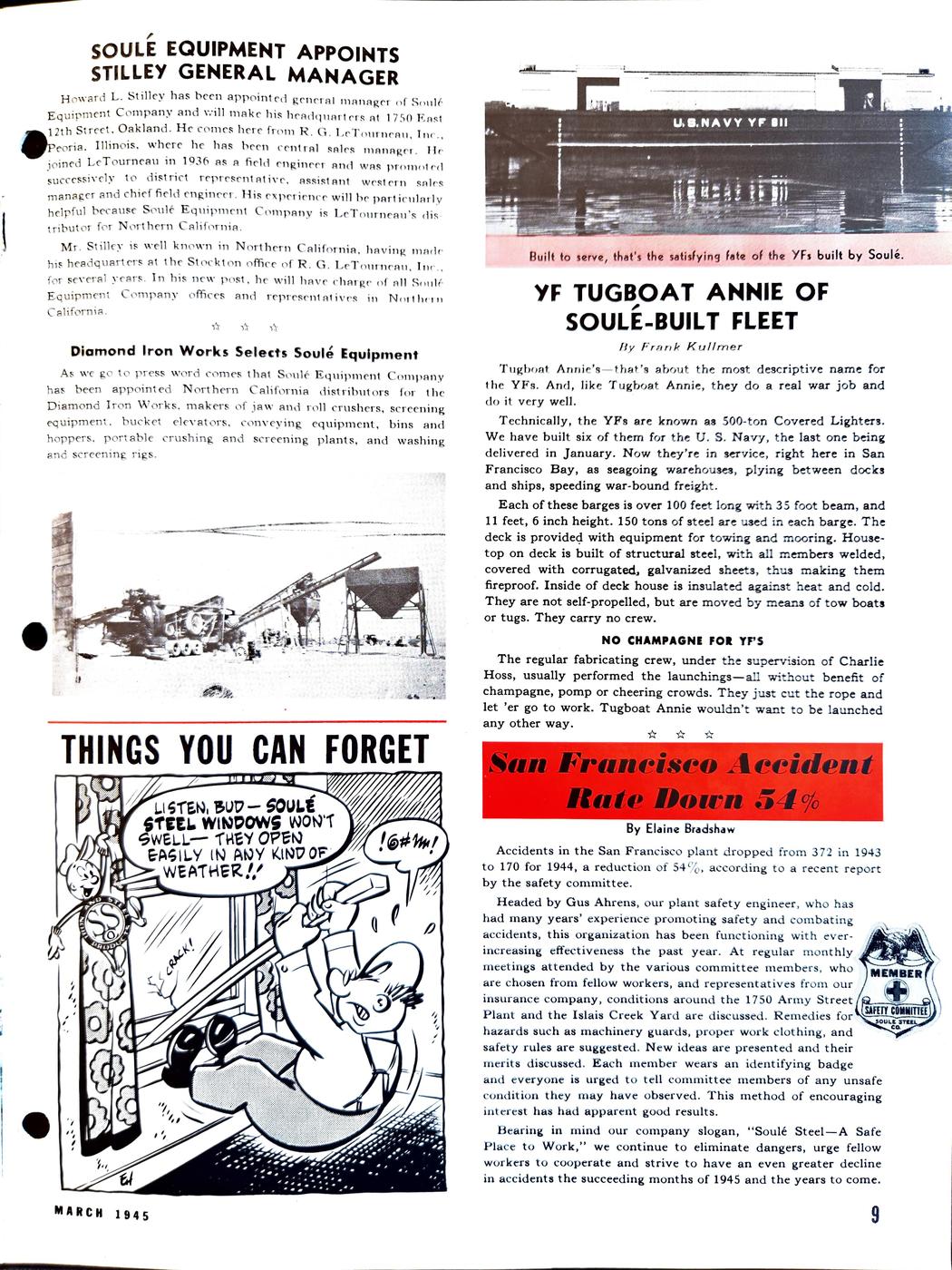
*Photo: A barge marked "U.S. NAVY YF 811" on the water.*
*Built to serve, that's the satisfying fate of the YFs built by Soulé.*
YF TUGBOAT ANNIE OF SOULÉ-BUILT FLEET
*By Frank Kullmer*
Tugboat Annie's—that's about the most descriptive name for the YFs. And, like Tugboat Annie, they do a real war job and do it very well.
Technically, the YFs are known as 500-ton Covered Lighters. We have built six of them for the U. S. Navy, the last one being delivered in January. Now they're in service, right here in San Francisco Bay, as seagoing warehouses, plying between docks and ships, speeding war-bound freight.
Each of these barges is over 100 feet long with 35 foot beam, and 11 feet, 6 inch height. 150 tons of steel are used in each barge. The deck is provided with equipment for towing and mooring. House-top on deck is built of structural steel, with all members welded, covered with corrugated, galvanized sheets, thus making them fireproof. Inside of deck house is insulated against heat and cold. They are not self-propelled, but are moved by means of tow boats or tugs. They carry no crew.
NO CHAMPAGNE FOR YF'S
The regular fabricating crew, under the supervision of Charlie Hoss, usually performed the launchings—all without benefit of champagne, pomp or cheering crowds. They just cut the rope and let 'er go to work. Tugboat Annie wouldn't want to be launched any other way.
San Francisco Accident Rate Down 54%
*By Elaine Bradshaw*
Accidents in the San Francisco plant dropped from 372 in 1943 to 170 for 1944, a reduction of 54%, according to a recent report by the safety committee.
Headed by Gus Ahrens, our plant safety engineer, who has had many years' experience promoting safety and combating accidents, this organization has been functioning with ever-increasing effectiveness the past year. At regular monthly meetings attended by the various committee members, who are chosen from fellow workers, and representatives from our insurance company, conditions around the 1750 Army Street Plant and the Islais Creek Yard are discussed. Remedies for hazards such as machinery guards, proper work clothing, and safety rules are suggested. New ideas are presented and their merits discussed. Each member wears an identifying badge and everyone is urged to tell committee members of any unsafe condition they may have observed. This method of encouraging interest has had apparent good results.
Bearing in mind our company slogan, "Soulé Steel—A Safe Place to Work," we continue to eliminate dangers, urge fellow workers to cooperate and strive to have an even greater decline in accidents the succeeding months of 1945 and the years to come.
MARCH 1945
9
Page 10
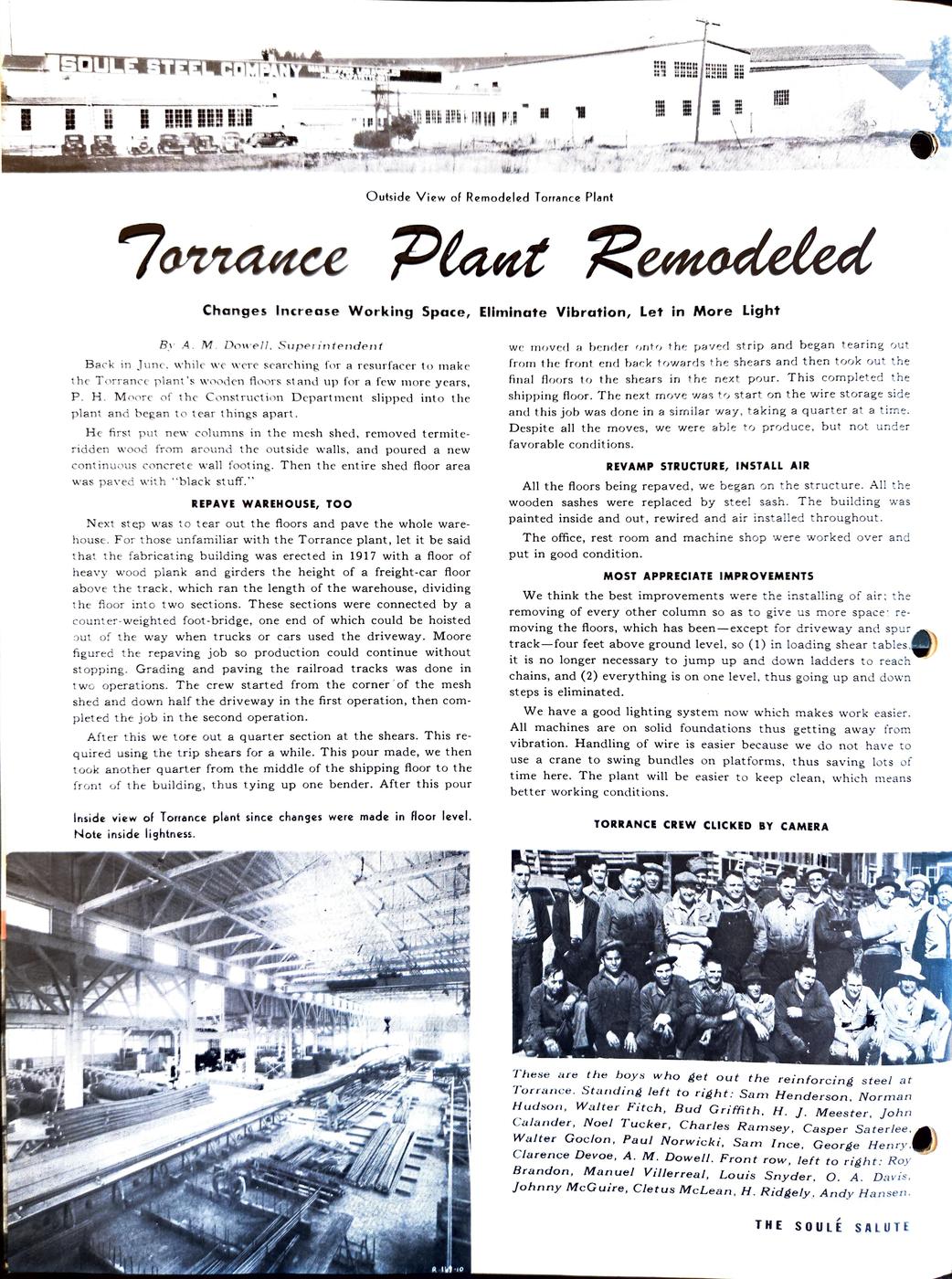
*Photo: Outside View of Remodeled Torrance Plant*
Torrance Plant Remodeled
Changes Increase Working Space, Eliminate Vibration, Let in More Light
*By A. M. Dowell, Superintendent*
Back in June, while we were searching for a resurfacer to make the Torrance plant's wooden floors stand up for a few more years, P. H. Moore of the Construction Department slipped into the plant and began to tear things apart.
He first put new columns in the mesh shed, removed termite-ridden wood from around the outside walls, and poured a new continuous concrete wall footing. Then the entire shed floor area was paved with "black stuff."
REPAVE WAREHOUSE, TOO
Next step was to tear out the floors and pave the whole warehouse. For those unfamiliar with the Torrance plant, let it be said that the fabricating building was erected in 1917 with a floor of heavy wood plank and girders the height of a freight-car floor above the track, which ran the length of the warehouse, dividing the floor into two sections. These sections were connected by a counter-weighted foot-bridge, one end of which could be hoisted out of the way when trucks or cars used the driveway. Moore figured the repaving job so production could continue without stopping. Grading and paving the railroad tracks was done in two operations. The crew started from the corner of the mesh shed and down half the driveway in the first operation, then completed the job in the second operation.
After this we tore out a quarter section at the shears. This required using the trip shears for a while. This pour made, we then took another quarter from the middle of the shipping floor to the front of the building, thus tying up one bender. After this pour we moved a bender onto the paved strip and began tearing out from the front end back towards the shears and then took out the final floors to the shears in the next pour. This completed the shipping floor. The next move was to start on the wire storage side and this job was done in a similar way, taking a quarter at a time. Despite all the moves, we were able to produce, but not under favorable conditions.
REVAMP STRUCTURE, INSTALL AIR
All the floors being repaved, we began on the structure. All the wooden sashes were replaced by steel sash. The building was painted inside and out, rewired and air installed throughout.
The office, rest room and machine shop were worked over and put in good condition.
MOST APPRECIATE IMPROVEMENTS
We think the best improvements were the installing of air; the removing of every other column so as to give us more space; removing the floors, which has been—except for driveway and spur track—four feet above ground level, so (1) in loading shear tables, it is no longer necessary to jump up and down ladders to reach chains, and (2) everything is on one level, thus going up and down steps is eliminated.
We have a good lighting system now which makes work easier. All machines are on solid foundations thus getting away from vibration. Handling of wire is easier because we do not have to use a crane to swing bundles on platforms, thus saving lots of time here. The plant will be easier to keep clean, which means better working conditions.
*Photo: Inside view of Torrance plant since changes were made in floor level. Note inside lightness.*
*Photo: TORRANCE CREW CLICKED BY CAMERA*
*These are the boys who get out the reinforcing steel at Torrance. Standing left to right: Sam Henderson, Norman Hudson, Walter Fitch, Bud Griffith, H. J. Meister, John Calander, Noel Tucker, Charles Ramsey, Casper Saterlee, Walter Goclon, Paul Norwicky, Sam Ince, George Henry, Clarence Devoe, A. M. Dowell. Front row, left to right: Roy Brandon, Manuel Villerreal, Louis Snyder, O. A. Davis, Johnny McGuire, Cletus McLean, H. Ridgely, Andy Hansen.*
THE SOULÉ SALUTE
Page 11
HOW FIRST AID SAFEGUARDS LOS ANGELES PLANT'S HEALTH
*By N. E. Dawson*
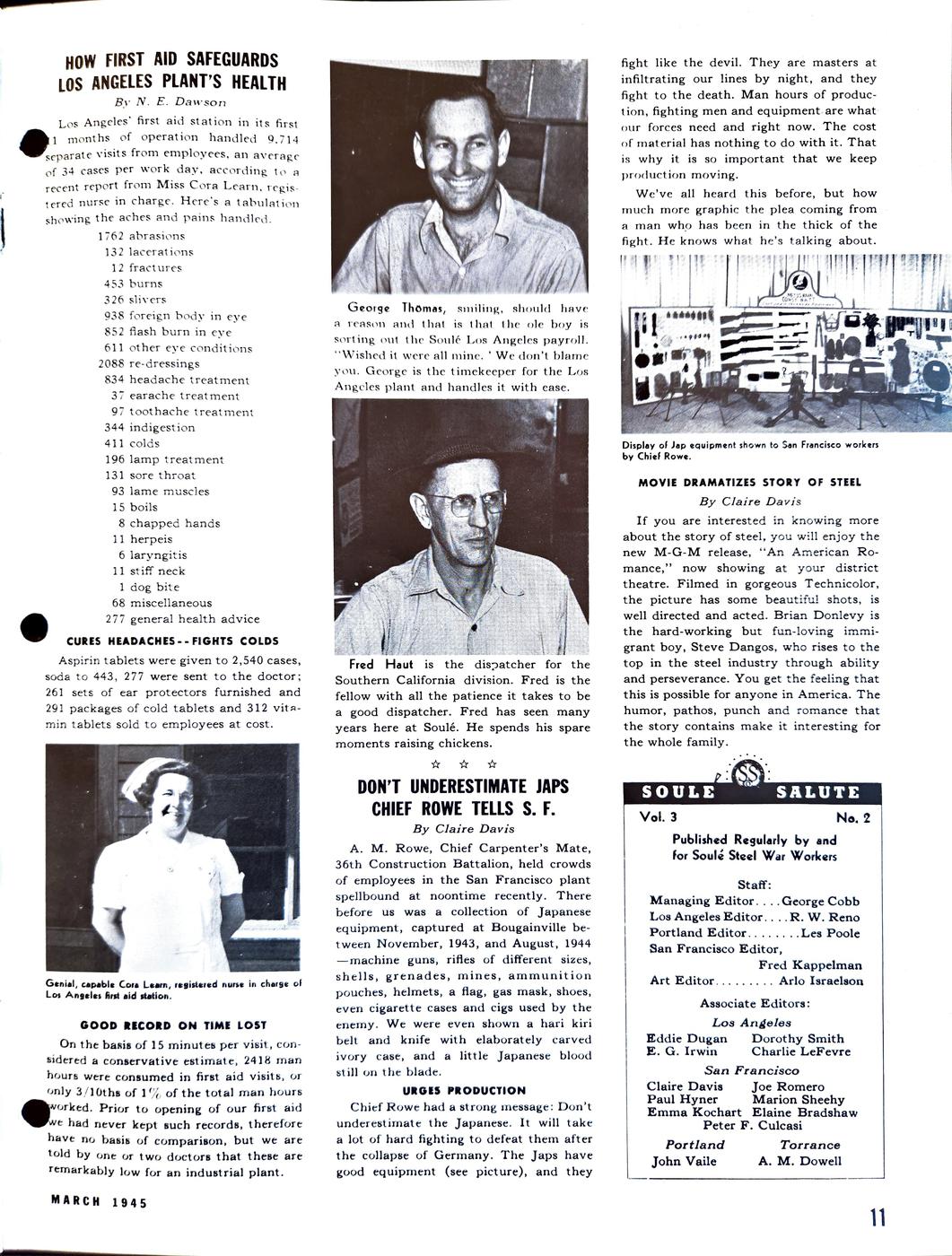
Los Angeles' first aid station in its first 1 months of operation handled 9,714 separate visits from employees, an average of 34 cases per work day, according to a recent report from Miss Cora Learn, registered nurse in charge. Here's a tabulation showing the aches and pains handled.
1762 abrasions 132 lacerations 12 fractures 453 burns 326 slivers 938 foreign body in eye 852 flash burn in eye 611 other eye conditions 2088 re-dressings 834 headache treatment 37 earache treatment 97 toothache treatment 344 indigestion 411 colds 196 lamp treatment 131 sore throat 93 lame muscles 15 boils 8 chapped hands 11 herpeis 6 laryngitis 11 stiff neck 1 dog bite 68 miscellaneous 277 general health advice
CURES HEADACHES--FIGHTS COLDS
Aspirin tablets were given to 2,540 cases, soda to 443, 277 were sent to the doctor; 261 sets of ear protectors furnished and 291 packages of cold tablets and 312 vitamin tablets sold to employees at cost.
*Photo: Genial, capable Cora Learn, registered nurse in charge of Los Angeles first aid station.*
GOOD RECORD ON TIME LOST
On the basis of 15 minutes per visit, considered a conservative estimate, 2418 man hours were consumed in first aid visits, or only 3/10ths of 1% of the total man hours worked. Prior to opening of our first aid we had never kept such records, therefore have no basis of comparison, but we are told by one or two doctors that these are remarkably low for an industrial plant.
MARCH 1945
*Photo: George Thomas, smiling, should have a reason and that is that the ole boy is sorting out the Soulé Los Angeles payroll. "Wished it were all mine." We don't blame you. George is the timekeeper for the Los Angeles plant and handles it with ease.*
*Photo: Fred Haut is the dispatcher for the Southern California division. Fred is the fellow with all the patience it takes to be a good dispatcher. Fred has seen many years here at Soulé. He spends his spare moments raising chickens.*
DON'T UNDERESTIMATE JAPS CHIEF ROWE TELLS S. F.
*By Claire Davis*
A. M. Rowe, Chief Carpenter's Mate, 36th Construction Battalion, held crowds of employees in the San Francisco plant spellbound at noontime recently. There before us was a collection of Japanese equipment, captured at Bougainville between November, 1943, and August, 1944—machine guns, rifles of different sizes, shells, grenades, mines, ammunition pouches, helmets, a flag, gas mask, shoes, even cigarette cases and cigs used by the enemy. We were even shown a hari kiri belt and knife with elaborately carved ivory case, and a little Japanese blood still on the blade.
URGES PRODUCTION
Chief Rowe had a strong message: Don't underestimate the Japanese. It will take a lot of hard fighting to defeat them after the collapse of Germany. The Japs have good equipment (see picture), and they fight like the devil. They are masters at infiltrating our lines by night, and they fight to the death. Man hours of production, fighting men and equipment are what our forces need and right now. The cost of material has nothing to do with it. That is why it is so important that we keep production moving.
We've all heard this before, but how much more graphic the plea coming from a man who has been in the thick of the fight. He knows what he's talking about.
*Photo: Display of Jap equipment shown to San Francisco workers by Chief Rowe.*
MOVIE DRAMATIZES STORY OF STEEL
*By Claire Davis*
If you are interested in knowing more about the story of steel, you will enjoy the new M-G-M release, "An American Romance," now showing at your district theatre. Filmed in gorgeous Technicolor, the picture has some beautiful shots, is well directed and acted. Brian Donlevy is the hard-working but fun-loving immigrant boy, Steve Dangs, who rises to the top in the steel industry through ability and perseverance. You get the feeling that this is possible for anyone in America. The humor, pathos, punch and romance that the story contains make it interesting for the whole family.
SOULE SALUTE
Vol. 3 No. 2
Published Regularly by and for Soulé Steel War Workers
**Staff:**
Managing Editor....George Cobb Los Angeles Editor....R. W. Reno Portland Editor.........Les Poole San Francisco Editor, Fred Kappelman Art Editor........... Arlo Israelson
**Associate Editors:**
**Los Angeles** Eddie Dugan Dorothy Smith E. G. Irwin Charlie LeFevre
**San Francisco** Claire Davis Joe Romero Paul Hyner Marion Sheehy Emma Kochart Elaine Bradshaw Peter F. Culcasi
**Portland** **Torrance** John Vaile A. M. Dowell
11
Page 12
Steel You Fabricated Carried Yank Fighters
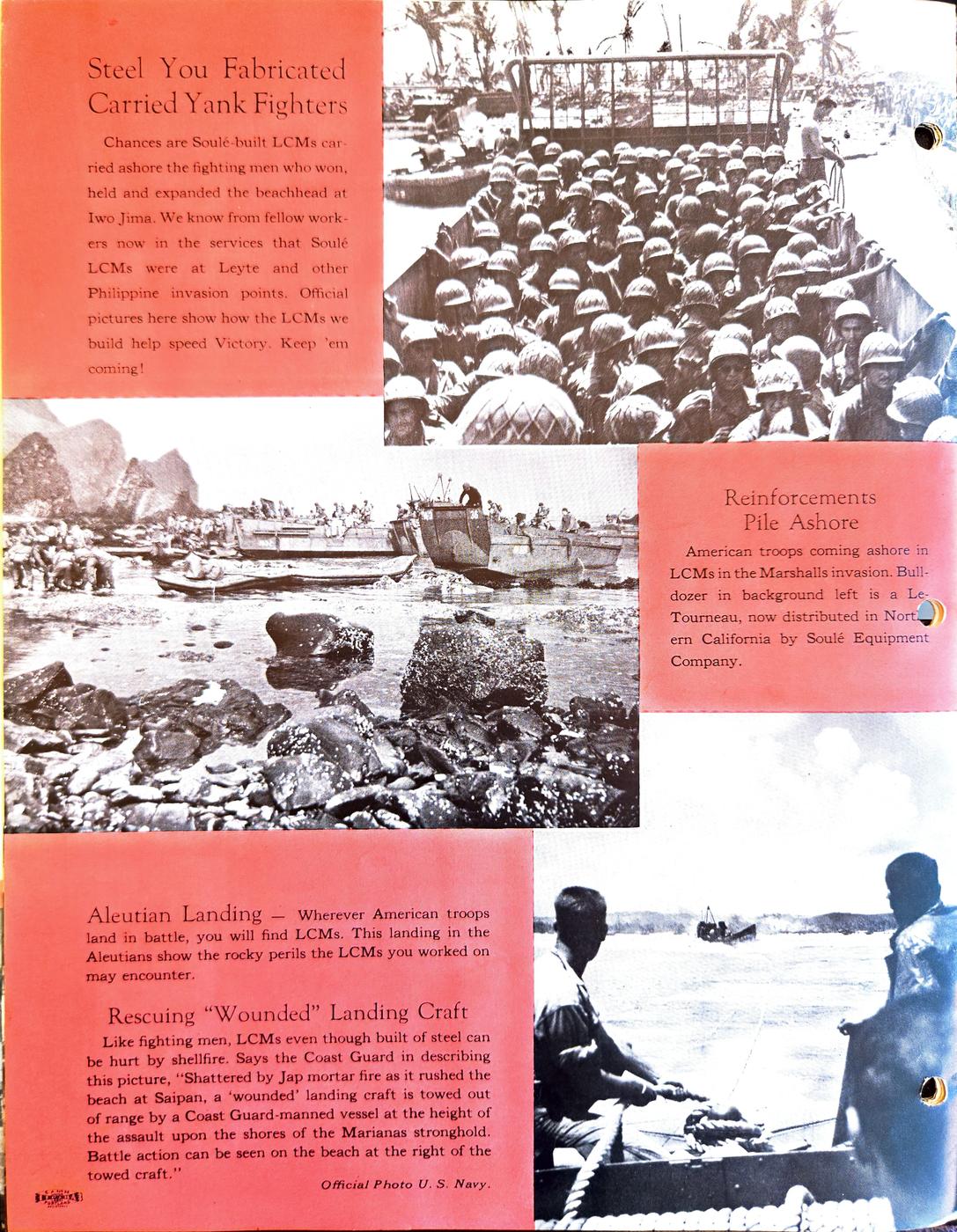
Chances are Soulé-built LCMs carried ashore the fighting men who won, held and expanded the beachhead at Iwo Jima. We know from fellow workers now in the services that Soulé LCMs were at Leyte and other Philippine invasion points. Official pictures here show how the LCMs we build help speed Victory. Keep 'em coming!
Reinforcements Pile Ashore
American troops coming ashore in LCMs in the Marshalls invasion. Bulldozer in background left is a Le-Tourneau, now distributed in Northern California by Soulé Equipment Company.
Aleutian Landing —
Wherever American troops land in battle, you will find LCMs. This landing in the Aleutians show the rocky perils the LCMs you worked on may encounter.
Rescuing "Wounded" Landing Craft
Like fighting men, LCMs even though built of steel can be hurt by shellfire. Says the Coast Guard in describing this picture, "Shattered by Jap mortar fire as it rushed the beach at Saipan, a 'wounded' landing craft is towed out of range by a Coast Guard-manned vessel at the height of the assault upon the shores of the Marianas stronghold. Battle action can be seen on the beach at the right of the towed craft."
*Photo: Official Photo U. S. Navy.*