Page 1
Soulé News
VOLUME 1 NUMBER 1 APRIL 1963
A Company-Wide Soulé Publication
Here is the first issue of the new SOULÉ NEWS. It will be published every month by and for the employees of the Soulé Steel Company. Many things will be discussed in the SOULÉ NEWS which will seriously concern every employee. Therefore, as you receive each issue, you may note that its content is different from that found in many employee publications. It will not be by accident.
We will talk about where the company and its employees are today, where we hope to go and what we must do to get there.
When we do well, we will report it. At times we will discuss set-backs. We will talk about people and what they do, for it takes more than machines to make a company grow.
In short, we will, through the SOULÉ NEWS, dig deeper into many of the factors that make Soulé Steel Company what it is. The following story about Niles O. Millar is a case in point. Mr. Millar retired at the end of March. For more than 40 years he has had a lot to do with the way Soulé Steel has "ticked." What does he think about it all?
*Photo: N. O. Millar, 43 years with Soulé (an officer since 1923).*
N. O. Millar Looks Back on 43 Years With Soulé Steel
*Photo: 1944—Mr. Millar hands the key to the new Soulé cafeteria to Henry Scheiler, its manager. Mr. Millar was nearing his 25th year with the company.*
Q. Mr. Millar, in 43 years you have seen the Soulé Steel Company grow from less than 100 employees to 15 times that size. You have seen it progress from the manufacture of one basic product to a diversified line of steel products. What is the secret of Soulé success?
A. Quality products and sound management, the same reasons for most companies that have long histories, that have survived depressions, wars, changes in technology.
Q. You say quality products and sound management are the reasons for the company's success. A good reporter would ask you to support that statement with evidence. What is your reply?
A. Ask our customers about our product quality. As for the other part, we have grown and are still growing in the face of tough competent competition. That's my proof. The basic change in doing business today, as opposed to when I started with the company, is that it is more complex. However, the principles are the same.
Q. When did you start? What was the name of the company? What was your title?
A. I joined the company on March 20, 1920. It was known as the Edw. L. Soulé Company. Our main products were rebar and merchant bar and I was the credit manager.
Q. When did you receive your first promotion?
A. I never got a promotion. My job just got bigger as the company grew. (While this is technically correct, it should be pointed out that Mr. Millar has been an officer and a member of the board of directors of the company since January 30, 1923.)
(Continued on Page 3)
*Photo: A faded photo but for good reason—it was 1924 and the office staff had just moved into its new quarters at 1700 Army St. Mr. Millar is seated at right.*
Page 2
Try This For Fun
Want to do something interesting and unusual? If your town has a wholesale produce market you are in for a treat. All you have to do is get up at 4:30 a.m. (which is unusual enough for most of us) and ramble down to the place where the men who grow your fruits and vegetables sell their wares.
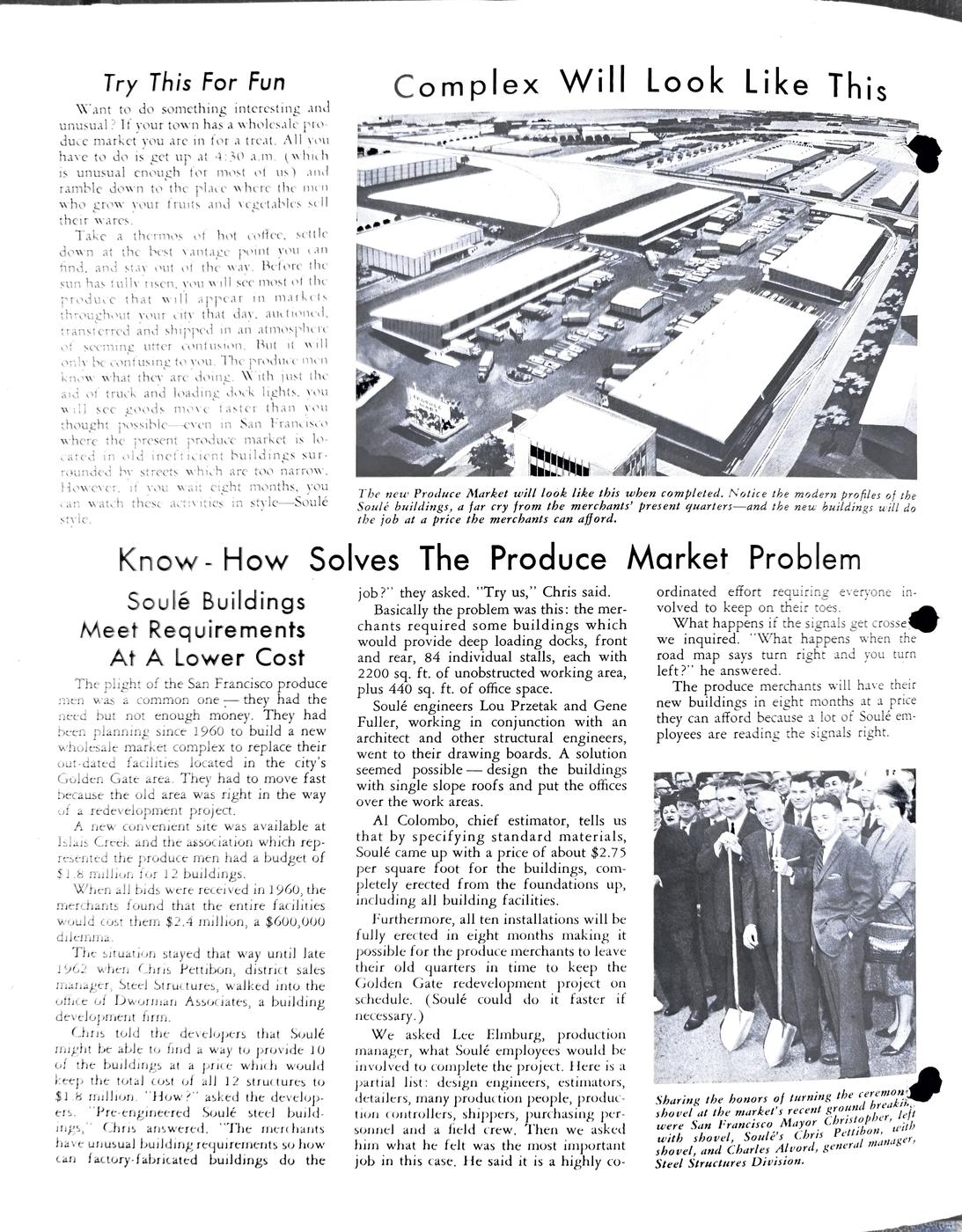
Take a thermos of hot coffee, settle down at the best vantage point you can find, and stay out of the way. Before the sun has fully risen, you will see most of the produce that will appear in markets throughout your city that day, auctioned, transferred and shipped in an atmosphere of seeming utter confusion. But it will only be confusing to you. The produce men know what they are doing. With just the aid of truck and loading dock lights, you will see goods move faster than you thought possible—even in San Francisco where the present produce market is located in old inefficient buildings surrounded by streets which are too narrow. However, if you wait eight months, you can watch these activities in style—Soulé style.
Complex Will Look Like This
*Photo: The new Produce Market will look like this when completed. Notice the modern profiles of the Soulé buildings, a far cry from the merchants' present quarters—and the new buildings will do the job at a price the merchants can afford.*
Know-How Solves The Produce Market Problem
Soulé Buildings Meet Requirements At A Lower Cost
The plight of the San Francisco produce men was a common one—they had the need but not enough money. They had been planning since 1960 to build a new wholesale market complex to replace their out-dated facilities located in the city's Golden Gate area. They had to move fast because the old area was right in the way of a redevelopment project.
A new convenient site was available at Islais Creek and the association which represented the produce men had a budget of $1.8 million for 12 buildings.
When all bids were received in 1960, the merchants found that the entire facilities would cost them $2.4 million, a $600,000 dilemma.
The situation stayed that way until late 1962 when Chris Pettibon, district sales manager, Steel Structures, walked into the office of Dworman Associates, a building development firm.
Chris told the developers that Soulé might be able to find a way to provide 10 of the buildings at a price which would keep the total cost of all 12 structures to $1.8 million. "How?" asked the developers. "Pre-engineered Soulé steel buildings," Chris answered. "The merchants have unusual building requirements so how can factory-fabricated buildings do the job?" they asked. "Try us," Chris said.
Basically the problem was this: the merchants required some buildings which would provide deep loading docks, front and rear, 84 individual stalls, each with 2200 sq. ft. of unobstructed working area, plus 440 sq. ft. of office space.
Soulé engineers Lou Przetak and Gene Fuller, working in conjunction with an architect and other structural engineers, went to their drawing boards. A solution seemed possible—design the buildings with single slope roofs and put the offices over the work areas.
Al Colombo, chief estimator, tells us that by specifying standard materials, Soulé came up with a price of about $2.75 per square foot for the buildings, completely erected from the foundations up, including all building facilities.
Furthermore, all ten installations will be fully erected in eight months making it possible for the produce merchants to leave their old quarters in time to keep the Golden Gate redevelopment project on schedule. (Soulé could do it faster if necessary.)
We asked Lee Elmburg, production manager, what Soulé employees would be involved to complete the project. Here is a partial list: design engineers, estimators, detailers, many production people, production controllers, shippers, purchasing personnel and a field crew. When we asked him what he felt was the most important job in this case. He said it is a highly co-ordinated effort requiring everyone involved to keep on their toes.
What happens if the signals get crossed we inquired. "What happens when the road map says turn right and you turn left?" he answered.
The produce merchants will have their new buildings in eight months at a price they can afford because a lot of Soulé employees are reading the signals right.
*Photo: Sharing the honors of turning the ceremonial shovel at the market's recent ground breaking, were San Francisco Mayor Christopher, left with shovel, Soulé's Chris Pettibon, with shovel, and Charles Alvard, general manager, Steel Structures Division.*
Page 3
Publicity Helps Tell The Soulé Story
A politician once remarked, "I don't care what they say about me as long as they spell my name right." Soulé Steel certainly does care *what* is said about the company, but would agree with the underlying philosophy of the above statement—publicity is important.
Present and potential customers are constantly on the lookout for something new which will improve their operations. Publicity is one of the ways in which Soulé Steel sells its ideas and products to them.
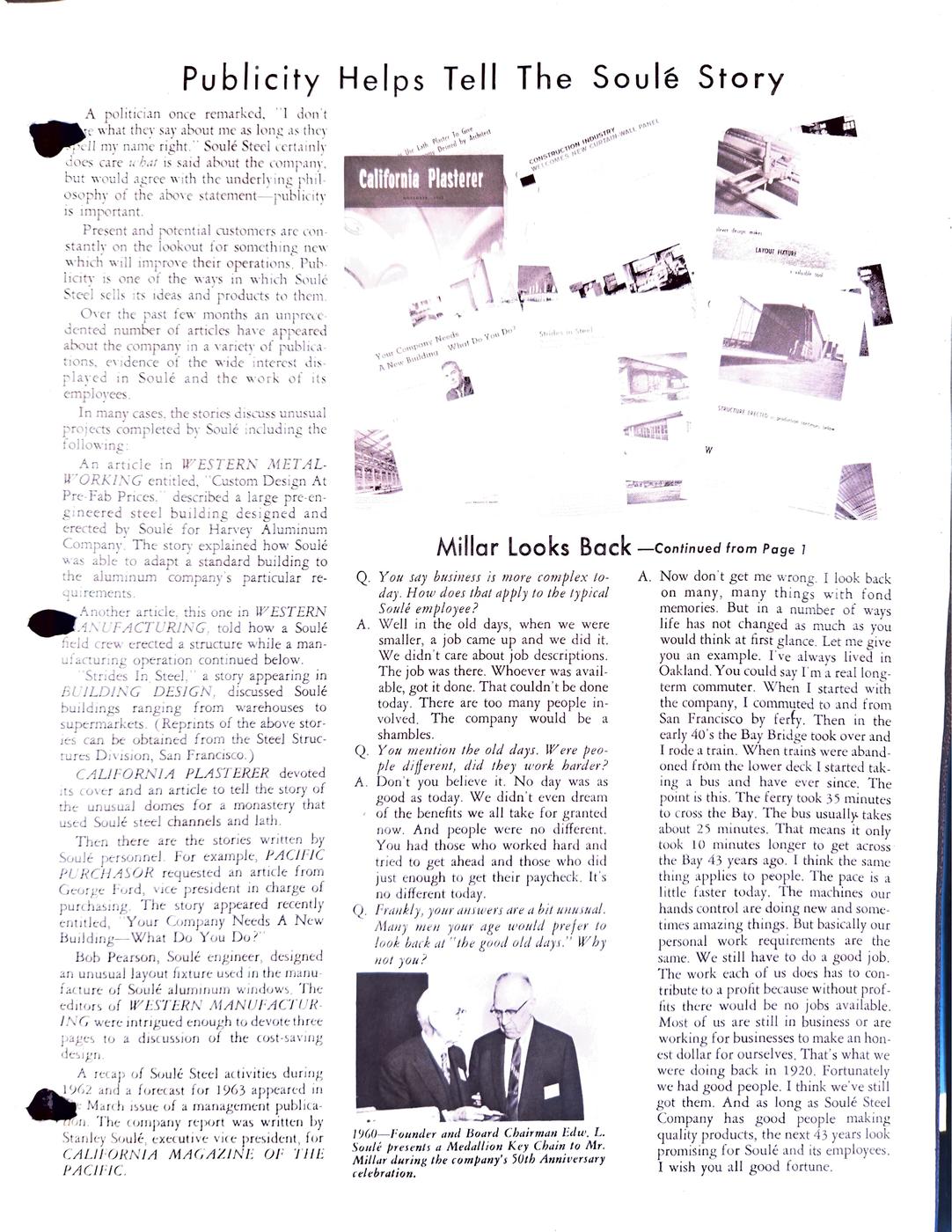
Over the past few months an unprecedented number of articles have appeared about the company in a variety of publications, evidence of the wide interest displayed in Soulé and the work of its employees.
In many cases, the stories discuss unusual projects completed by Soulé including the following:
An article in *WESTERN METAL-WORKING* entitled, "Custom Design At Pre-Fab Prices," described a large pre-engineered steel building designed and erected by Soulé for Harvey Aluminum Company. The story explained how Soulé was able to adapt a standard building to the aluminum company's particular requirements.
Another article, this one in *WESTERN MANUFACTURING*, told how a Soulé field crew erected a structure while a manufacturing operation continued below.
"Strides In Steel," a story appearing in *BUILDING DESIGN*, discussed Soulé buildings ranging from warehouses to supermarkets. (Reprints of the above stories can be obtained from the Steel Structures Division, San Francisco.)
*CALIFORNIA PLASTERER* devoted its cover and an article to tell the story of the unusual domes for a monastery that used Soulé steel channels and lath.
Then there are the stories written by Soulé personnel. For example, *PACIFIC PURCHASOR* requested an article from George Ford, vice president in charge of purchasing. The story appeared recently entitled, "Your Company Needs A New Building—What Do You Do?"
Bob Pearson, Soulé engineer, designed an unusual layout fixture used in the manufacture of Soulé aluminum windows. The editors of *WESTERN MANUFACTURING* were intrigued enough to devote three pages to a discussion of the cost-saving design.
A recap of Soulé Steel activities during 1962 and a forecast for 1963 appeared in the March issue of a management publication. The company report was written by Stanley Soulé, executive vice president, for *CALIFORNIA MAGAZINE OF THE PACIFIC*.
Millar Looks Back—*Continued from Page 1*
**Q. *You say business is more complex today. How does that apply to the typical Soulé employee?***
**A.** Well in the old days, when we were smaller, a job came up and we did it. We didn't care about job descriptions. The job was there. Whoever was available, got it done. That couldn't be done today. There are too many people involved. The company would be a shambles.
**Q. *You mention the old days. Were people different, did they work harder?***
**A.** Don't you believe it. No day was as good as today. We didn't even dream of the benefits we all take for granted now. And people were no different. You had those who worked hard and tried to get ahead and those who did just enough to get their paycheck. It's no different today.
**Q. *Frankly, your answers are a bit unusual. Many men your age would prefer to look back at "the good old days." Why not you?***
**A.** Now don't get me wrong. I look back on many, many things with fond memories. But in a number of ways life has not changed as much as you would think at first glance. Let me give you an example. I've always lived in Oakland. You could say I'm a real long-term commuter. When I started with the company, I commuted to and from San Francisco by ferry. Then in the early 40's the Bay Bridge took over and I rode a train. When trains were abandoned from the lower deck I started taking a bus and have ever since. The point is this. The ferry took 35 minutes to cross the Bay. The bus usually takes about 25 minutes. That means it only took 10 minutes longer to get across the Bay 43 years ago. I think the same thing applies to people. The pace is a little faster today. The machines our hands control are doing new and sometimes amazing things. But basically our personal work requirements are the same. We still have to do a good job. The work each of us does has to contribute to a profit because without profits there would be no jobs available. Most of us are still in business or are working for businesses to make an honest dollar for ourselves. That's what we were doing back in 1920. Fortunately we had good people. I think we've still got them. And as long as Soulé Steel Company has good people making quality products, the next 43 years look promising for Soulé and its employees. I wish you all good fortune.
*Photo: 1960—Founder and Board Chairman Edw. L. Soulé presents a Medallion Key Chain to Mr. Millar during the company's 50th Anniversary celebration.*
Page 4
IDEA PAYS OFF FOR FRED NILSEN
*Photo: Fred Nilsen, right, discusses his award winning insulating idea with Bruce Tuck, supervisor, detailing and estimating, Architectural Products.*
A Soulé employee is $100 richer and the company has a new patent as a result of imagination.
Fred Nilsen, a draftsman in the Architectural Products Div., San Francisco, designs Soulé curtain walls. When a job came up in Fairbanks, Alaska, Fred demonstrated one of the big factors responsible for Soulé Steel success—ideas. Since temperatures get extremely low in the North country, the curtain wall used in a new building had to be insulated. Fred thought there could be a better way of insulating the framing and he set about proving it.
As a result of his efforts Soulé did the job better by providing more effective insulation in less time.
Since Fred's idea was patentable, he was awarded $100 by Soulé Steel Company.
We like to point out employees like Fred Nilsen—not because he is so unusual but because he is a good example of a lot of people who are working to make their lot, as well as the company's, a little better.
Who Is He? →
With baseball leagues preparing for the 1963 battle, sports columnists are busy grinding out their traditional bits of wisdom, blarney, statistics and most anything else that makes good "copy."
You probably have your favorite columnist, but we hope you can find time for one more, because Soulé Steel is starting a couple of leagues itself. While the competition will be over safety instead of baseball, we expect it is going to be interesting. Reason? We have a columnist too, only there is a catch. The man's name is Sad Sam the Safety Man. The trouble is Sam seems to be the opposite of most columnists—Sam is usually wrong, (or is he a lot like most columnists?)
Anyway, our poor lad is accident prone and he wants company. He is going to keep a record of Soulé Safety League standings. We have a feeling the records are going to make Sam unhappy.
We're not going to throw a lot of useless statistics at you, or a long list of "do's and don'ts." We're just going to show you how your team—that is, your plant crew or field
PLANT LEAGUE February, 1963
| | Batting Average | |---|---| | Los Angeles | 1.000 | | L. A. Rebar | 1.000 | | Phoenix | 1.000 | | Portland | 1.000 | | Seattle | 1.000 | | San Francisco | .984 |
FIELD LEAGUE February, 1963
| | Batting Average | |---|---| | Mill | 1.000 | | Phoenix | 1.000 | | No. California | .991 | | So. California | .990 | | Portland | .990 | | Seattle | .933 |
SAD SAM
crew—stacks up against other people doing the same thing. (The boys at Dominguez should have a real battle, because we've put the Mill in the "Field League" and the Rebar group in the "Plant League.")
How are we going to score? Not by counting accidents, but by counting safe workers—just as in baseball where the hits count, not the outs. Your team's batting average is the number of men who worked without a lost-time accident compared to the total number of men on your team. Simple as that.
As much as he will dislike the idea, Sad Sam is going to have to award some pennants. At the end of 1963, the winners of each league will receive a championship flag to fly at their location all during 1964.
So, cut Sad Sam off your roster and let's see who is leading.
SEASON STANDINGS
#### Plant League
| | Average | |---|---| | Los Angeles | 1.000 | | L. A. Rebar | 1.000 | | Phoenix | 1.000 | | Seattle | 1.000 | | San Francisco | .992 | | Portland | .979 |
#### Field League
| | Average | |---|---| | Phoenix | 1.000 | | Portland | .995 | | So. California | .994 | | Mill | .992 | | No. California | .990 | | Seattle | .974 |
Soulé News
Published monthly by and for the employees of Soulé Steel Co. Editor—Douglas Gordon Associate Editors
Los Angeles—Frank Kleman Mill—Dianne Sheridan Phoenix—Furman Davis Portland—Dolores Bedgood San Diego—Esther Longnecker Seattle—Dee Henderson
Bulk Rate U. S. Postage PAID San Francisco, Calif. Permit No. 8185