Page 1
Soulé News
VOLUME 1 NUMBER 3 JUNE 1963
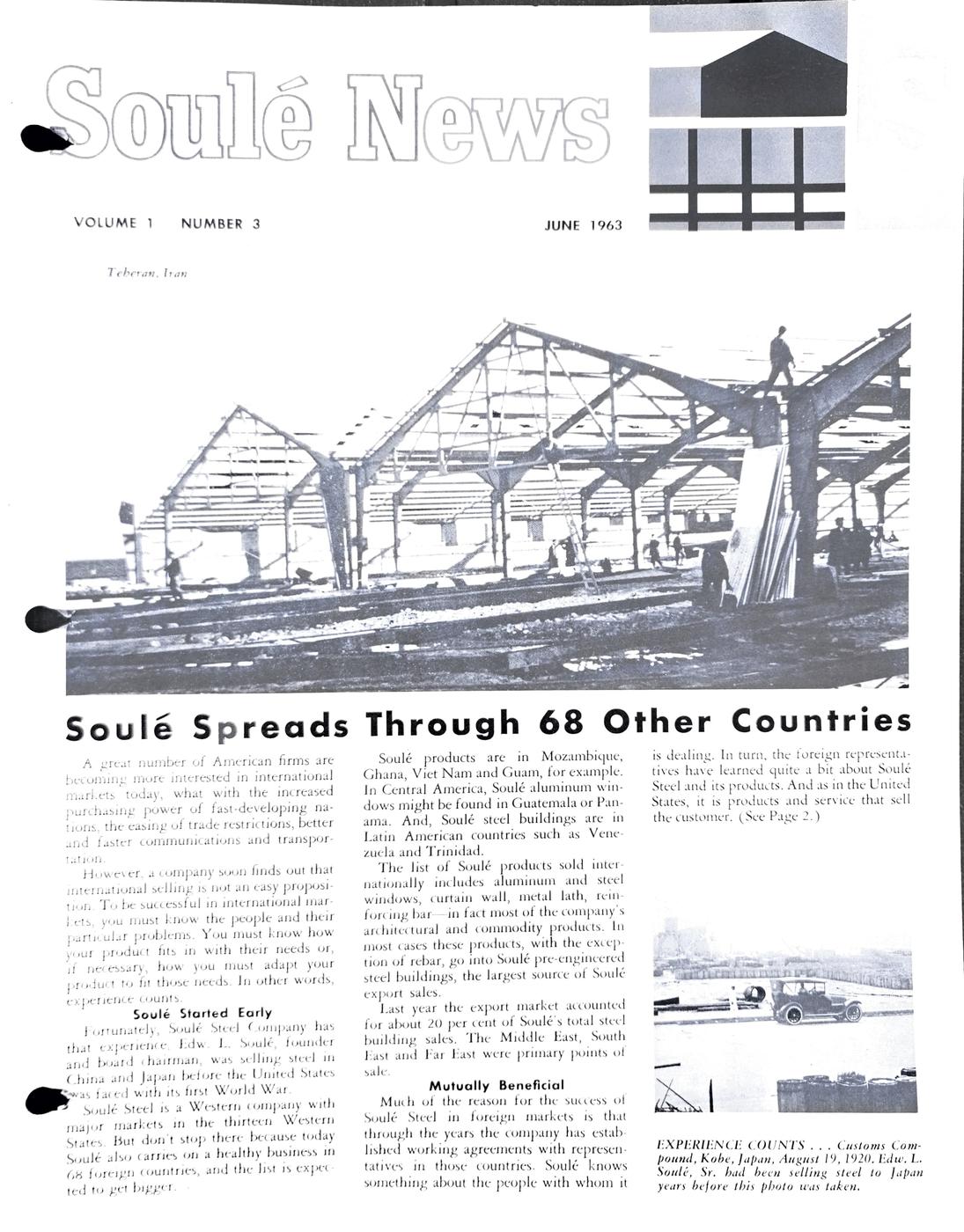
*Teheran, Iran*
Soulé Spreads Through 68 Other Countries
A great number of American firms are becoming more interested in international markets today, what with the increased purchasing power of fast-developing nations, the easing of trade restrictions, better and faster communications and transportation.
However, a company soon finds out that international selling is not an easy proposition. To be successful in international markets, you must know the people and their particular problems. You must know how your product fits in with their needs or, if necessary, how you must adapt your product to fit those needs. In other words, experience counts.
Soulé Started Early
Fortunately, Soulé Steel Company has that experience. Edw. L. Soulé, founder and board chairman, was selling steel in China and Japan before the United States was faced with its first World War.
Soulé Steel is a Western company with major markets in the thirteen Western States. But don't stop there because today Soulé also carries on a healthy business in 68 foreign countries, and the list is expected to get bigger.
Soulé products are in Mozambique, Ghana, Viet Nam and Guam, for example. In Central America, Soulé aluminum windows might be found in Guatemala or Panama. And, Soulé steel buildings are in Latin American countries such as Venezuela and Trinidad.
The list of Soulé products sold internationally includes aluminum and steel windows, curtain wall, metal lath, reinforcing bar—in fact most of the company's architectural and commodity products. In most cases these products, with the exception of rebar, go into Soulé pre-engineered steel buildings, the largest source of Soulé export sales.
Last year the export market accounted for about 20 per cent of Soulé's total steel building sales. The Middle East, South East and Far East were primary points of sale.
Mutually Beneficial
Much of the reason for the success of Soulé Steel in foreign markets is that through the years the company has established working agreements with representatives in those countries. Soulé knows something about the people with whom it is dealing. In turn, the foreign representatives have learned quite a bit about Soulé Steel and its products. And as in the United States, it is products and service that sell the customer. (See Page 2.)
*Photo: EXPERIENCE COUNTS . . . Customs Compound, Kobe, Japan, August 19, 1920. Edw. L. Soulé, Sr. had been selling steel to Japan years before this photo was taken.*
Page 2
Soulé Spreads, Cont'd from Page 1
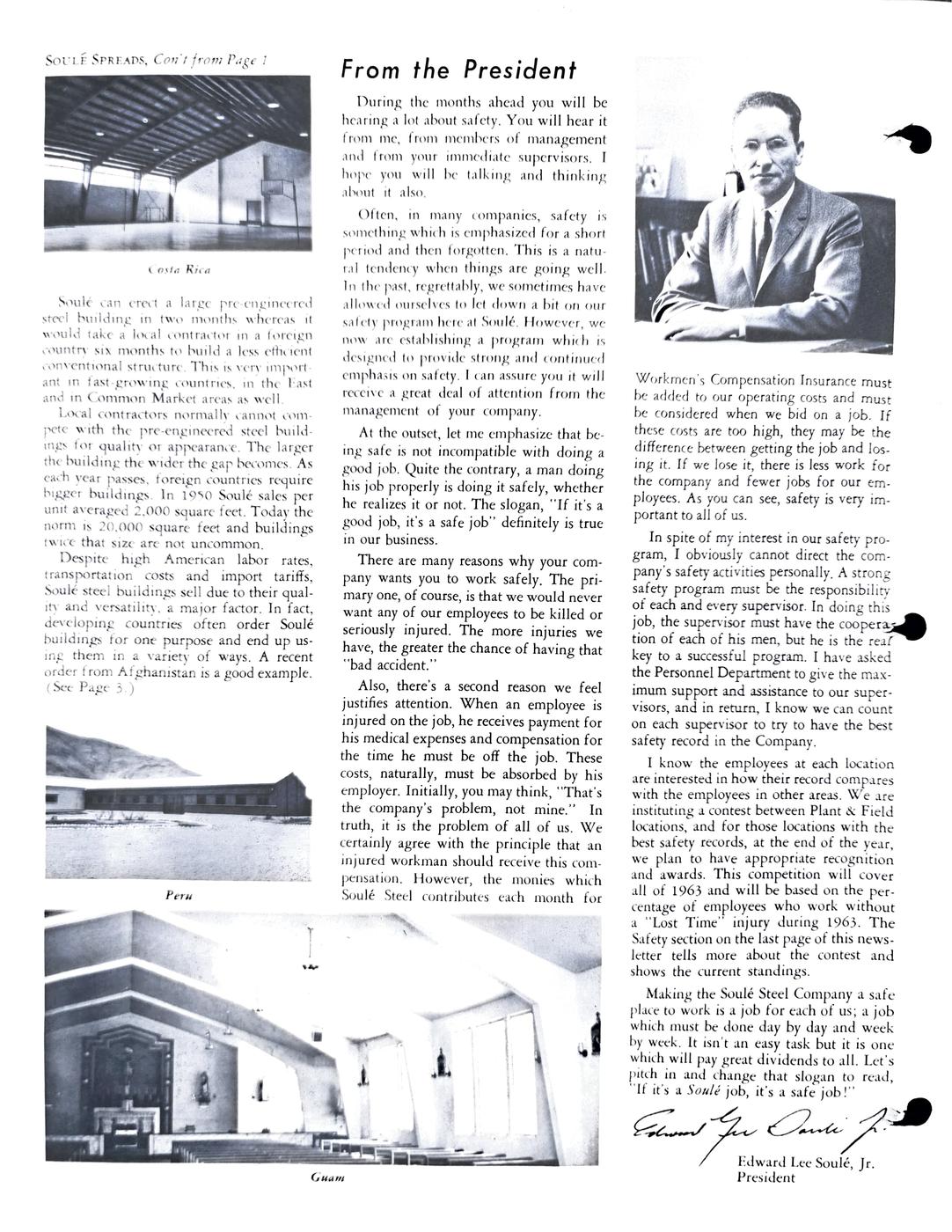
*Photo: Costa Rica*
Soulé can erect a large pre-engineered steel building in two months whereas it would take a local contractor in a foreign country six months to build a less efficient conventional structure. This is very important in fast-growing countries, in the East and in Common Market areas as well.
Local contractors normally cannot compete with the pre-engineered steel buildings for quality or appearance. The larger the building the wider the gap becomes. As each year passes, foreign countries require bigger buildings. In 1950 Soulé sales per unit averaged 2,000 square feet. Today the norm is 20,000 square feet and buildings twice that size are not uncommon.
Despite high American labor rates, transportation costs and import tariffs, Soulé steel buildings sell due to their quality and versatility, a major factor. In fact, developing countries often order Soulé buildings for one purpose and end up using them in a variety of ways. A recent order from Afghanistan is a good example. (See Page 3.)
*Photo: Peru*
*Photo: Guam*
From the President
During the months ahead you will be hearing a lot about safety. You will hear it from me, from members of management and from your immediate supervisors. I hope you will be talking and thinking about it also.
Often, in many companies, safety is something which is emphasized for a short period and then forgotten. This is a natural tendency when things are going well. In the past, regrettably, we sometimes have allowed ourselves to let down a bit on our safety program here at Soulé. However, we now are establishing a program which is designed to provide strong and continued emphasis on safety. I can assure you it will receive a great deal of attention from the management of your company.
At the outset, let me emphasize that being safe is not incompatible with doing a good job. Quite the contrary, a man doing his job properly is doing it safely, whether he realizes it or not. The slogan, "If it's a good job, it's a safe job" definitely is true in our business.
There are many reasons why your company wants you to work safely. The primary one, of course, is that we would never want any of our employees to be killed or seriously injured. The more injuries we have, the greater the chance of having that "bad accident."
Also, there's a second reason we feel justifies attention. When an employee is injured on the job, he receives payment for his medical expenses and compensation for the time he must be off the job. These costs, naturally, must be absorbed by his employer. Initially, you may think, "That's the company's problem, not mine." In truth, it is the problem of all of us. We certainly agree with the principle that an injured workman should receive this compensation. However, the monies which Soulé Steel contributes each month for
Workmen's Compensation Insurance must be added to our operating costs and must be considered when we bid on a job. If these costs are too high, they may be the difference between getting the job and losing it. If we lose it, there is less work for the company and fewer jobs for our employees. As you can see, safety is very important to all of us.
In spite of my interest in our safety program, I obviously cannot direct the company's safety activities personally. A strong safety program must be the responsibility of each and every supervisor. In doing this job, the supervisor must have the cooperation of each of his men, but he is the *real* key to a successful program. I have asked the Personnel Department to give the maximum support and assistance to our supervisors, and in return, I know we can count on each supervisor to try to have the best safety record in the Company.
I know the employees at each location are interested in how their record compares with the employees in other areas. We are instituting a contest between Plant & Field locations, and for those locations with the best safety records, at the end of the year, we plan to have appropriate recognition and awards. This competition will cover all of 1963 and will be based on the percentage of employees who work without a "Lost Time" injury during 1963. The Safety section on the last page of this newsletter tells more about the contest and shows the current standings.
Making the Soulé Steel Company a safe place to work is a job for each of us; a job which must be done day by day and week by week. It isn't an easy task but it is one which will pay great dividends to all. Let's pitch in and change that slogan to read, "If it's a *Soulé* job, it's a safe job!"
Edward Lee Soulé, Jr. President
Page 3
Who's Who In The International Division
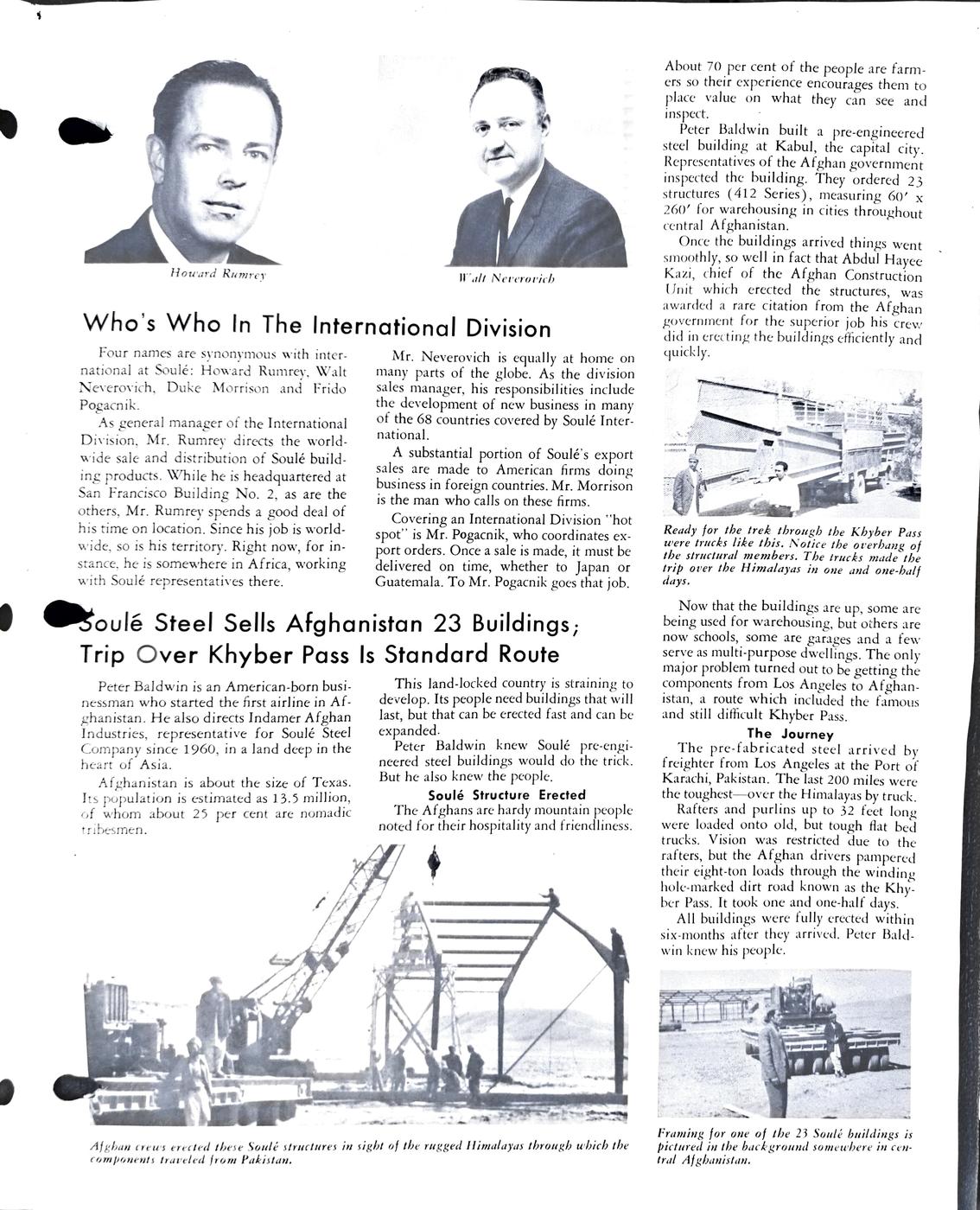
*Howard Rumrey*
*Walt Neverovich*
Four names are synonymous with international at Soulé: Howard Rumrey, Walt Neverovich, Duke Morrison and Frido Pogacnik.
As general manager of the International Division, Mr. Rumrey directs the world-wide sale and distribution of Soulé building products. While he is headquartered at San Francisco Building No. 2, as are the others, Mr. Rumrey spends a good deal of his time on location. Since his job is world-wide, so is his territory. Right now, for instance, he is somewhere in Africa, working with Soulé representatives there.
Mr. Neverovich is equally at home on many parts of the globe. As the division sales manager, his responsibilities include the development of new business in many of the 68 countries covered by Soulé International.
A substantial portion of Soulé's export sales are made to American firms doing business in foreign countries. Mr. Morrison is the man who calls on these firms.
Covering an International Division "hot spot" is Mr. Pogacnik, who coordinates export orders. Once a sale is made, it must be delivered on time, whether to Japan or Guatemala. To Mr. Pogacnik goes that job.
Soulé Steel Sells Afghanistan 23 Buildings; Trip Over Khyber Pass Is Standard Route
Peter Baldwin is an American-born businessman who started the first airline in Afghanistan. He also directs Indamer Afghan Industries, representative for Soulé Steel Company since 1960, in a land deep in the heart of Asia.
Afghanistan is about the size of Texas. Its population is estimated as 13.5 million, of whom about 25 per cent are nomadic tribesmen.
This land-locked country is straining to develop. Its people need buildings that will last, but that can be erected fast and can be expanded.
Peter Baldwin knew Soulé pre-engineered steel buildings would do the trick. But he also knew the people.
Soulé Structure Erected
The Afghans are hardy mountain people noted for their hospitality and friendliness.
About 70 per cent of the people are farmers so their experience encourages them to place value on what they can see and inspect.
Peter Baldwin built a pre-engineered steel building at Kabul, the capital city. Representatives of the Afghan government inspected the building. They ordered 23 structures (412 Series), measuring 60' x 260' for warehousing in cities throughout central Afghanistan.
Once the buildings arrived things went smoothly, so well in fact that Abdul Hayee Kazi, chief of the Afghan Construction Unit which erected the structures, was awarded a rare citation from the Afghan government for the superior job his crew did in erecting the buildings efficiently and quickly.
*Photo: Ready for the trek through the Khyber Pass were trucks like this. Notice the overhang of the structural members. The trucks made the trip over the Himalayas in one and one-half days.*
Now that the buildings are up, some are being used for warehousing, but others are now schools, some are garages and a few serve as multi-purpose dwellings. The only major problem turned out to be getting the components from Los Angeles to Afghanistan, a route which included the famous and still difficult Khyber Pass.
The Journey
The pre-fabricated steel arrived by freighter from Los Angeles at the Port of Karachi, Pakistan. The last 200 miles were the toughest—over the Himalayas by truck.
Rafters and purlins up to 32 feet long were loaded onto old, but tough flat bed trucks. Vision was restricted due to the rafters, but the Afghan drivers pampered their eight-ton loads through the winding hole-marked dirt road known as the Khyber Pass. It took one and one-half days.
All buildings were fully erected within six-months after they arrived. Peter Baldwin knew his people.
*Photo: Afghan crews erected these Soulé structures in sight of the rugged Himalayas through which the components traveled from Pakistan.*
*Photo: Framing for one of the 23 Soulé buildings is pictured in the background somewhere in central Afghanistan.*
Page 4
Zim's Work Is Done; Now For California
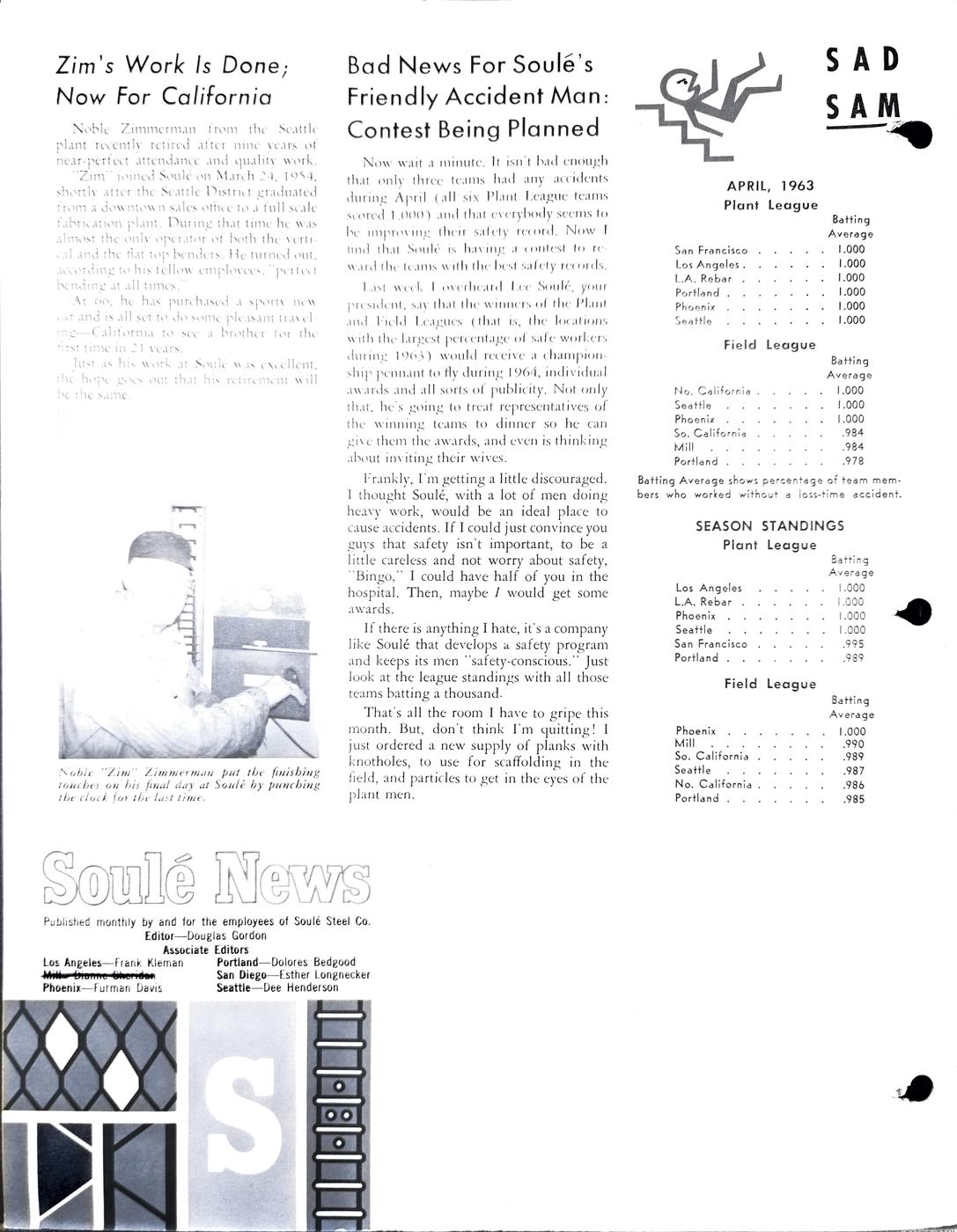
Noble Zimmerman from the Seattle plant recently retired after nine years of near-perfect attendance and quality work.
"Zim" joined Soulé on March 24, 1954, shortly after the Seattle District graduated from a downtown sales office to a full scale fabrication plant. During that time he was almost the only operator of both the vertical and the flat top benders. He turned out, according to his fellow employees, "perfect bending at all times."
At 66, he has purchased a sporty new car and is all set to do some pleasant traveling—California to see a brother for the first time in 21 years.
Just as his work at Soulé was excellent, the hope goes out that his retirement will be the same.
*Photo: Noble "Zim" Zimmerman put the finishing touches on his final day at Soulé by punching the clock for the last time.*
Bad News For Soulé's Friendly Accident Man: Contest Being Planned
Now wait a minute. It isn't bad enough that only three teams had any accidents during April (all six Plant League teams scored 1.000) and that everybody seems to be improving their safety record. Now I find that Soulé is having a contest to reward the teams with the best safety records.
Last week I overheard Lee Soulé, your president, say that the winners of the Plant and Field Leagues (that is, the locations with the largest percentage of safe workers during 1963) would receive a championship pennant to fly during 1964, individual awards and all sorts of publicity. Not only that, he's going to treat representatives of the winning teams to dinner so he can give them the awards, and even is thinking about inviting their wives.
Frankly, I'm getting a little discouraged. I thought Soulé, with a lot of men doing heavy work, would be an ideal place to cause accidents. If I could just convince you guys that safety isn't important, to be a little careless and not worry about safety, "Bingo," I could have half of you in the hospital. Then, maybe *I* would get some awards.
If there is anything I hate, it's a company like Soulé that develops a safety program and keeps its men "safety-conscious." Just look at the league standings with all those teams batting a thousand.
That's all the room I have to gripe this month. But, don't think I'm quitting! I just ordered a new supply of planks with knotholes, to use for scaffolding in the field, and particles to get in the eyes of the plant men.
SAD SAM
APRIL, 1963 Plant League
| | Batting Average | |---|---| | San Francisco | 1.000 | | Los Angeles | 1.000 | | L.A. Rebar | 1.000 | | Portland | 1.000 | | Phoenix | 1.000 | | Seattle | 1.000 |
Field League
| | Batting Average | |---|---| | No. California | 1.000 | | Seattle | 1.000 | | Phoenix | 1.000 | | So. California | .984 | | Mill | .984 | | Portland | .978 |
Batting Average shows percentage of team members who worked without a loss-time accident.
SEASON STANDINGS Plant League
| | Batting Average | |---|---| | Los Angeles | 1.000 | | L.A. Rebar | 1.000 | | Phoenix | 1.000 | | Seattle | 1.000 | | San Francisco | .995 | | Portland | .989 |
Field League
| | Batting Average | |---|---| | Phoenix | 1.000 | | Mill | .990 | | So. California | .989 | | Seattle | .987 | | No. California | .986 | | Portland | .985 |
Soulé News
Published monthly by and for the employees of Soulé Steel Co. Editor—Douglas Gordon Associate Editors Los Angeles—Frank Kleman Mill—[illegible] Phoenix—Furman Davis Portland—Dolores Bedgood San Diego—Esther Longnecker Seattle—Dee Henderson