Page 1
Soule News
VOLUME 1 NUMBER 8 NOVEMBER, 1963
GROWTH IN SEATTLE: SOULÉ IN THE NORTHWEST
By DEE HENDERSON Associate Editor, Seattle
After many successful years in the steel fabricating business in California and Oregon, Edw. L. Soule decided to extend his activities further north. In 1950, a sales office was opened in the downtown business district of Seattle, with materials and placing being furnished out of the Portland plant. In 1953, land was purchased in the south end industrial area and the present plant and office were erected. Since that time Soule has moved up to the front line in the steel building, window, and metal lath market as well as reinforcing steel.
Our Seattle employees are never away although they only spend 8 hours a day at the office or plant. Soule enters into their daily living no matter where they go or what they do. For instance, the freeways, viaducts and overpasses they drive to and from work on are Soule projects. Children of the employees attend Soule constructed schools. The salesmen call on contractors and architects in Soule constructed office buildings. Saturday shopping at the supermarket is done under the roof of a Soule steel building in many Seattle districts. Some of the Seattle employees live in apartments built by Soule. Those living on the east side of Lake Washington cross either the old Lake Washington Floating Bridge or the new Evergreen Point Floating Bridge, both of which are Soule projects. Vacation trips may find Seattle employees crossing the Hoods Canal Floating Bridge to reach the Olympic National Forest. The pontoons for the bridge were built by Soule.
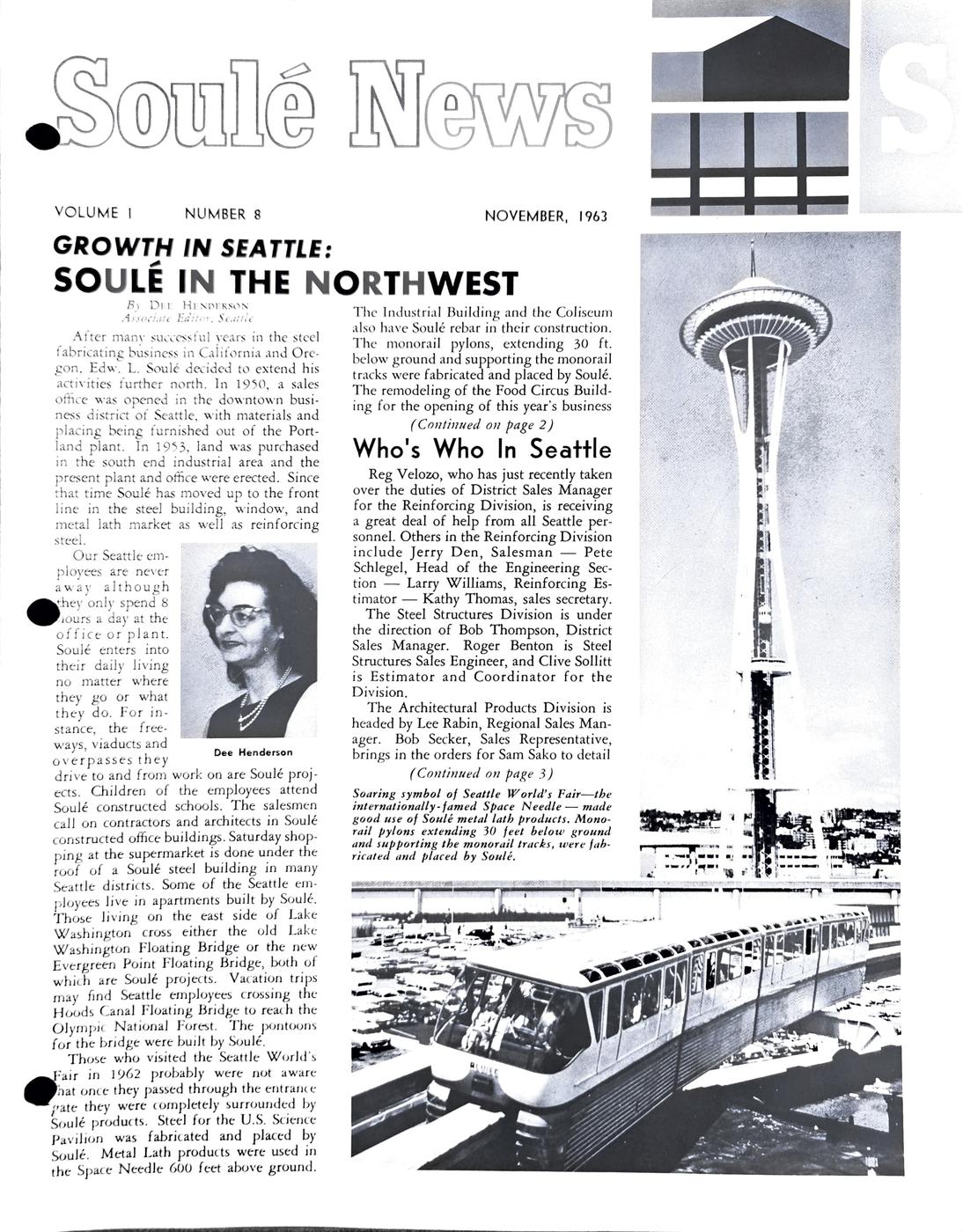
Those who visited the Seattle World's Fair in 1962 probably were not aware that once they passed through the entrance gate they were completely surrounded by Soule products. Steel for the U.S. Science Pavilion was fabricated and placed by Soule. Metal Lath products were used in the Space Needle 600 feet above ground.
Photo: Dee Henderson
The Industrial Building and the Coliseum also have Soule rebar in their construction. The monorail pylons, extending 30 ft. below ground and supporting the monorail tracks were fabricated and placed by Soule. The remodeling of the Food Circus Building for the opening of this year's business (Continued on page 2)
Who's Who In Seattle
Reg Velozo, who has just recently taken over the duties of District Sales Manager for the Reinforcing Division, is receiving a great deal of help from all Seattle personnel. Others in the Reinforcing Division include Jerry Den, Salesman — Pete Schlegel, Head of the Engineering Section — Larry Williams, Reinforcing Estimator — Kathy Thomas, sales secretary.
The Steel Structures Division is under the direction of Bob Thompson, District Sales Manager. Roger Benton is Steel Structures Sales Engineer, and Clive Sollitt is Estimator and Coordinator for the Division.
The Architectural Products Division is headed by Lee Rabin, Regional Sales Manager. Bob Secker, Sales Representative, brings in the orders for Sam Sako to detail (Continued on page 3)
Soaring symbol of Seattle World's Fair—the internationally-famed Space Needle — made good use of Soule metal lath products. Monorail pylons extending 30 feet below ground and supporting the monorail tracks, were fabricated and placed by Soule.
Page 2
From the President
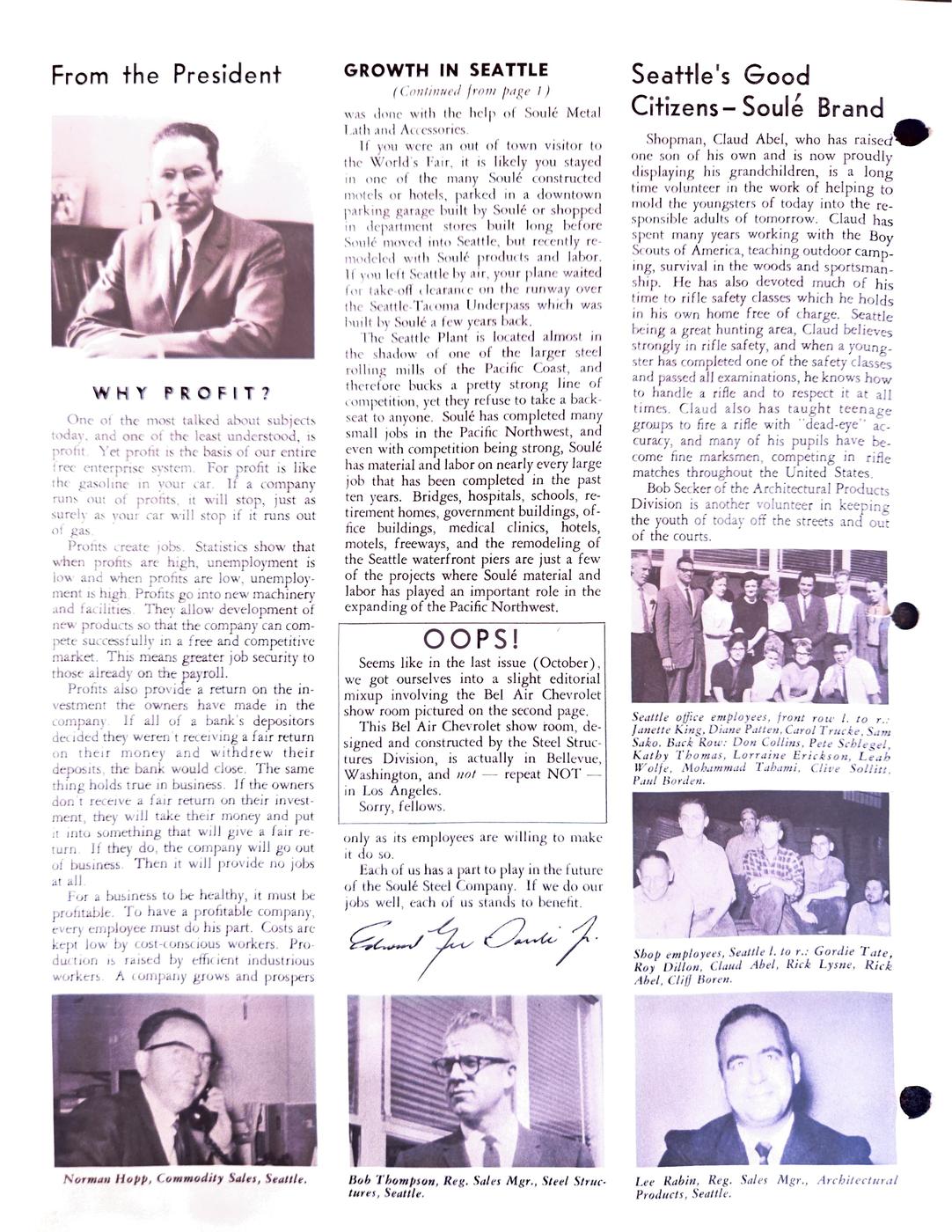
WHY PROFIT?
One of the most talked about subjects today, and one of the least understood, is profit. Yet profit is the basis of our entire free enterprise system. For profit is like the gasoline in your car. If a company runs out of profits, it will stop, just as surely as your car will stop if it runs out of gas.
Profits create jobs. Statistics show that when profits are high, unemployment is low and when profits are low, unemployment is high. Profits go into new machinery and facilities. They allow development of new products so that the company can compete successfully in a free and competitive market. This means greater job security to those already on the payroll.
Profits also provide a return on the investment the owners have made in the company. If all of a bank's depositors decided they weren't receiving a fair return on their money and withdrew their deposits, the bank would close. The same thing holds true in business. If the owners don't receive a fair return on their investment, they will take their money and put it into something that will give a fair return. If they do, the company will go out of business. Then it will provide no jobs at all.
For a business to be healthy, it must be profitable. To have a profitable company, every employee must do his part. Costs are kept low by cost-conscious workers. Production is raised by efficient industrious workers. A company grows and prospers
*Photo: Norman Hopp, Commodity Sales, Seattle.*
GROWTH IN SEATTLE (Continued from page 1)
was done with the help of Soule Metal Lath and Accessories.
If you were an out of town visitor to the World's Fair, it is likely you stayed in one of the many Soule constructed motels or hotels, parked in a downtown parking garage built by Soule or shopped in department stores built long before Soule moved into Seattle, but recently re-modeled with Soule products and labor. If you left Seattle by air, your plane waited for take-off clearance on the runway over the Seattle-Tacoma Underpass which was built by Soule a few years back.
The Seattle Plant is located almost in the shadow of one of the larger steel rolling mills of the Pacific Coast, and therefore bucks a pretty strong line of competition, yet they refuse to take a back-seat to anyone. Soule has completed many small jobs in the Pacific Northwest, and even with competition being strong, Soule has material and labor on nearly every large job that has been completed in the past ten years. Bridges, hospitals, schools, retirement homes, government buildings, office buildings, medical clinics, hotels, motels, freeways, and the remodeling of the Seattle waterfront piers are just a few of the projects where Soule material and labor has played an important role in the expanding of the Pacific Northwest.
OOPS!
Seems like in the last issue (October), we got ourselves into a slight editorial mixup involving the Bel Air Chevrolet show room pictured on the second page.
This Bel Air Chevrolet show room, designed and constructed by the Steel Structures Division, is actually in Bellevue, Washington, and not — repeat NOT — in Los Angeles.
Sorry, fellows.
only as its employees are willing to make it do so.
Each of us has a part to play in the future of the Soule Steel Company. If we do our jobs well, each of us stands to benefit.
Edward J Soule Jr.
*Photo: Bob Thompson, Reg. Sales Mgr., Steel Structures, Seattle.*
Seattle's Good Citizens - Soule Brand
Shopman, Claud Abel, who has raised one son of his own and is now proudly displaying his grandchildren, is a long time volunteer in the work of helping to mold the youngsters of today into the responsible adults of tomorrow. Claud has spent many years working with the Boy Scouts of America, teaching outdoor camping, survival in the woods and sportsmanship. He has also devoted much of his time to rifle safety classes which he holds in his own home free of charge. Seattle being a great hunting area, Claud believes strongly in rifle safety, and when a youngster has completed one of the safety classes and passed all examinations, he knows how to handle a rifle and to respect it at all times. Claud also has taught teenage groups to fire a rifle with "dead-eye" accuracy, and many of his pupils have become fine marksmen, competing in rifle matches throughout the United States.
Bob Secker of the Architectural Products Division is another volunteer in keeping the youth of today off the streets and out of the courts.
*Photo: Seattle office employees, front row l. to r.: Janette King, Diane Patten, Carol Trucke, Sam Sako. Back Row: Don Collins, Pete Schlegel, Kathy Thomas, Lorraine Erickson, Leah Wolfe, Mohammad Tabami, Clive Sollitt, Paul Borden.*
*Photo: Shop employees, Seattle l. to r.: Gordie Tate, Roy Dillon, Claud Abel, Rick Lysne, Rick Abel, Cliff Boren.*
*Photo: Lee Rabin, Reg. Sales Mgr., Architectural Products, Seattle.*
Page 3
Soulé Citizen ## Of the Month
How do you define good citizenship? Often you measure it by the kind of contribution a man or woman makes to his community, above and beyond the job he holds as a wage-earner.
This month, SOULÉ NEWS salutes Ken Gilpin, Detailer with the Steel Structures Division, Los Angeles, for the continuing contribution he is making to his home community of Pico Rivera. Ken recently was reappointed to a three-year term as a member of the Parks and Recreation Commission of that city.
In his letter announcing Ken's appointment, Mayor John William Davis stated: "On behalf of the City Council of Pico Rivera, I would like to express our deep appreciation for the conscientious and dedicated services you have given to our community during your past term of office. We believe your ideas and activities have greatly benefited this community. We appreciate the fact that you have stood up for and worked for all the things in which you believe."
A pretty good definition of a pretty fine citizen.
(Note: Send in your nominations for Soulé Citizen of the Month, and give us your reasons why you feel your candidate — man or woman — should be selected.)
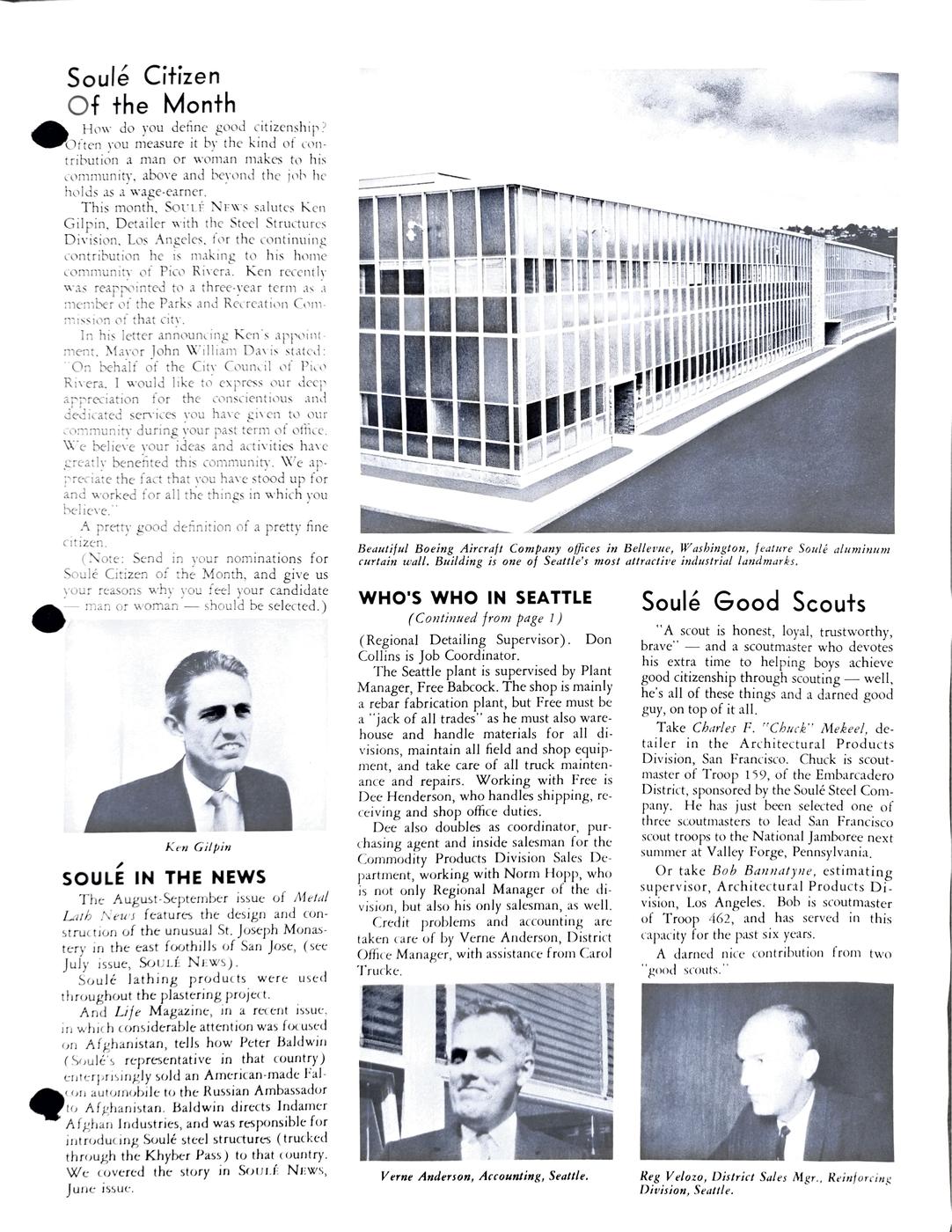
Photo: Beautiful Boeing Aircraft Company offices in Bellevue, Washington, feature Soulé aluminum curtain wall. Building is one of Seattle's most attractive industrial landmarks.
WHO'S WHO IN SEATTLE (Continued from page 1)
(Regional Detailing Supervisor). Don Collins is Job Coordinator.
The Seattle plant is supervised by Plant Manager, Free Babcock. The shop is mainly a rebar fabrication plant, but Free must be a "jack of all trades" as he must also warehouse and handle materials for all divisions, maintain all field and shop equipment, and take care of all truck maintenance and repairs. Working with Free is Dee Henderson, who handles shipping, receiving and shop office duties.
Dee also doubles as coordinator, purchasing agent and inside salesman for the Commodity Products Division Sales Department, working with Norm Hopp, who is not only Regional Manager of the division, but also his only salesman, as well.
Credit problems and accounting are taken care of by Verne Anderson, District Office Manager, with assistance from Carol Trucker.
Soulé Good Scouts
"A scout is honest, loyal, trustworthy, brave" — and a scoutmaster who devotes his extra time to helping boys achieve good citizenship through scouting — well, he's all of these things and a darned good guy, on top of it all.
Take Charles F. "Chuck" Mekeel, detailer in the Architectural Products Division, San Francisco. Chuck is scoutmaster of Troop 159, of the Embarcadero District, sponsored by the Soulé Steel Company. He has just been selected one of three scoutmasters to lead San Francisco scout troops to the National Jamboree next summer at Valley Forge, Pennsylvania.
Or take Bob Bannatyne, estimating supervisor, Architectural Products Division, Los Angeles. Bob is scoutmaster of Troop 462, and has served in this capacity for the past six years.
A darned nice contribution from two "good scouts."
Photo: Ken Gilpin
SOULÉ IN THE NEWS
The August-September issue of Metal Lath News features the design and construction of the unusual St. Joseph Monastery in the east foothills of San Jose, (see July issue, SOULÉ NEWS).
Soulé lathing products were used throughout the plastering project.
And Life Magazine, in a recent issue, in which considerable attention was focused on Afghanistan, tells how Peter Baldwin (Soulé's representative in that country) enterprisingly sold an American-made Falcon automobile to the Russian Ambassador to Afghanistan. Baldwin directs Indamer Afghan Industries, and was responsible for introducing Soulé steel structures (trucked through the Khyber Pass) to that country. We covered the story in SOULÉ NEWS, June issue.
Photo: Verne Anderson, Accounting, Seattle.
Photo: Reg Velozo, District Sales Mgr., Reinforcing Division, Seattle.
Page 4
LA's Fred Trankle - Forty Years on the Job
The date October 20, 1963, marked the 40th year of service with Soulé Steel Company for Fred Trankle, maintenance supervisor at the Los Angeles plant.
Fred began his Soulé career back in 1923 —when Clara Bow and Rudolph Valentino were wowing them down in Hollywood and when a Stutz Bearcat was the hottest thing on the road. In that year Fred went to work at the Torrance Plant, and was transferred to his present base at Los Angeles in 1934.
This is what Fred's associates in Los Angeles have to say about him: "While Fred's present position is not directly connected with the Production Department, his loyalty in the performance of duty and the maintenance of the company's equipment, has helped establish records of production which have boosted Soulé to the top.
Photo: Fred Trankle
"Even though Fred is on the threshold of retirement age, the amount and quality of his work continues to be outstanding. And when the day of retirement does come, Fred will be sorely missed."
SAD SAM
SAD SAM'S SAFETY STANDINGS SEPTEMBER, 1963
**PLANT LEAGUE** Batting Average San Francisco . . . . . 1.000 Los Angeles . . . . . 1.000 L. A. Rebar . . . . . 1.000 Portland . . . . . 1.000 Phoenix . . . . . 1.000 Seattle . . . . . 1.000
**FIELD LEAGUE** No. Calif. . . . . . 1.000 Mill . . . . . 1.000 Seattle . . . . . 1.000 So. Calif. . . . . . .989 Portland . . . . . .981 Phoenix . . . . . .957
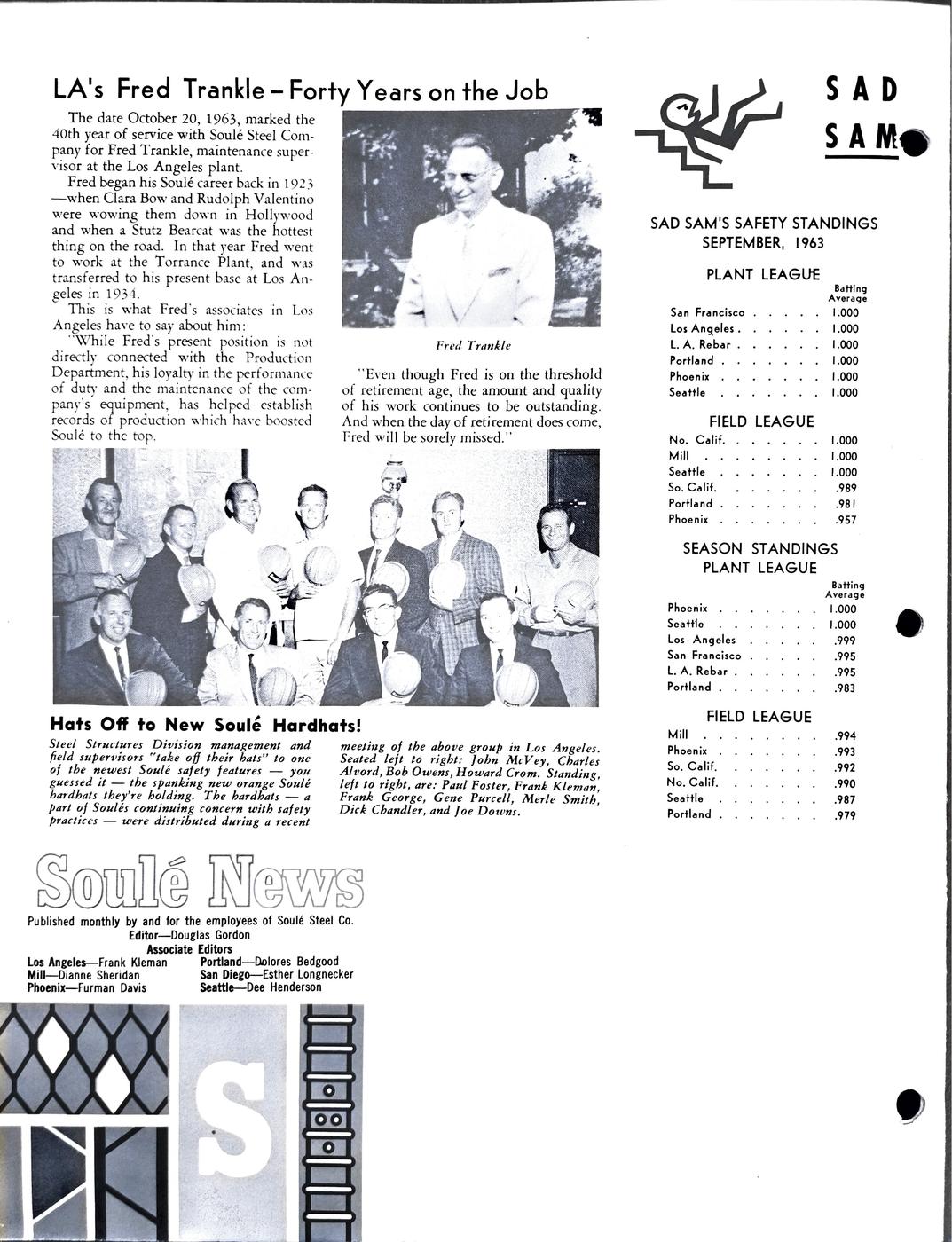
Hats Off to New Soulé Hardhats!
Steel Structures Division management and field supervisors "take off their hats" to one of the newest Soulé safety features — you guessed it — the spanking new orange Soulé hardhats they're holding. The hardhats — a part of Soulé's continuing concern with safety practices — were distributed during a recent meeting of the above group in Los Angeles. Seated left to right: John McVey, Charles Alvord, Bob Owens, Howard Crom. Standing, left to right, are: Paul Foster, Frank Kleman, Frank George, Gene Purcell, Merle Smith, Dick Chandler, and Joe Downs.
**SEASON STANDINGS** **PLANT LEAGUE** Batting Average Phoenix . . . . . 1.000 Seattle . . . . . 1.000 Los Angeles . . . . . .999 San Francisco . . . . . .995 L. A. Rebar . . . . . .995 Portland . . . . . .983
**FIELD LEAGUE** Mill . . . . . .994 Phoenix . . . . . .993 So. Calif. . . . . . .992 No. Calif. . . . . . .990 Seattle . . . . . .987 Portland . . . . . .979
Soule News
Published monthly by and for the employees of Soulé Steel Co. Editor—Douglas Gordon Associate Editors Los Angeles—Frank Kleman Mill—Dianne Sheridan Phoenix—Furman Davis Portland—Dolores Bedgood San Diego—Esther Longnecker Seattle—Dee Henderson