Page 1
SOULÉ STEEL NEWS
"WE ARE AN EQUAL OPPORTUNITY EMPLOYER"
Volume VIII — Fall 1984 — Number 19
LAYING STEEL TO THE STARS
San Francisco is the only remaining city in the world where "little cable cars climb halfway to the stars." In terms of tourist appeal, the cable cars are certainly one of the stars of the city. Soulé Steel, Union City, was proud to have been part of the recent restoration of the cable cars — the only mobile national historic landmark in the country.
Designed by Andrew S. Hallidie, the first cable car went into operation on August 1, 1873. The system ran for 109 years in virtually its original form. On October 1, 1982, a major renovation began that was scheduled to take 24 months and cost approximately $61.5 million.
Because of the complexities of the project — not the least of which was trying as much as possible to avoid tying up traffic — it was decided that the work would be done in segments of only two blocks at a time. This meant that several general contractors were necessary so that work could be going on simultaneously in several different parts of the city.
Soulé was fortunate to have won five of the six jobs the company estimated in conjunction with Underground / Railco of San Leandro, Stacey Whitbeck of San Francisco and Homer Olsen of Union City. This was due in large part to the hard and excellent work of Harold Knox, one of Soulé's estimators, who has been with the company for 37 years.
From December of 1982 through February of 1984, Soulé worked on a total of 52 picturesque (and some not so picturesque) San Francisco city streets. In all, more than 1,500 tons of rebar were laid (representing about 5½ miles of steel up and down the often steep streets in the City by the Bay.
*Photo: Rebar cages ready to be put in place*
Soulé's total contract involvement was approximately $1.3 million.
Due to the heavy work load and critical timing involved, the Soulé employees in the shop had to keep three to four weeks ahead of the field crews. Because the winter of '82 was a particularly wet one, the contractors encountered many problems, such as the difficulty in getting the soil compacted. In spite of these problems, Soulé met or exceeded all of its obligations for the project.
A great deal of the credit must go to Detailers Lou Pagan and Rene Grenados, employees for 39 and 16 years, respectively, for taking on this challenging task and seeing it through to completion. Field Foreman Henry (Rico) Molinari, a Soulé veteran of 36 years, was in charge of seeing that the
*Photo: Harold Knox, Estimator*
(continued on next page)
Page 2
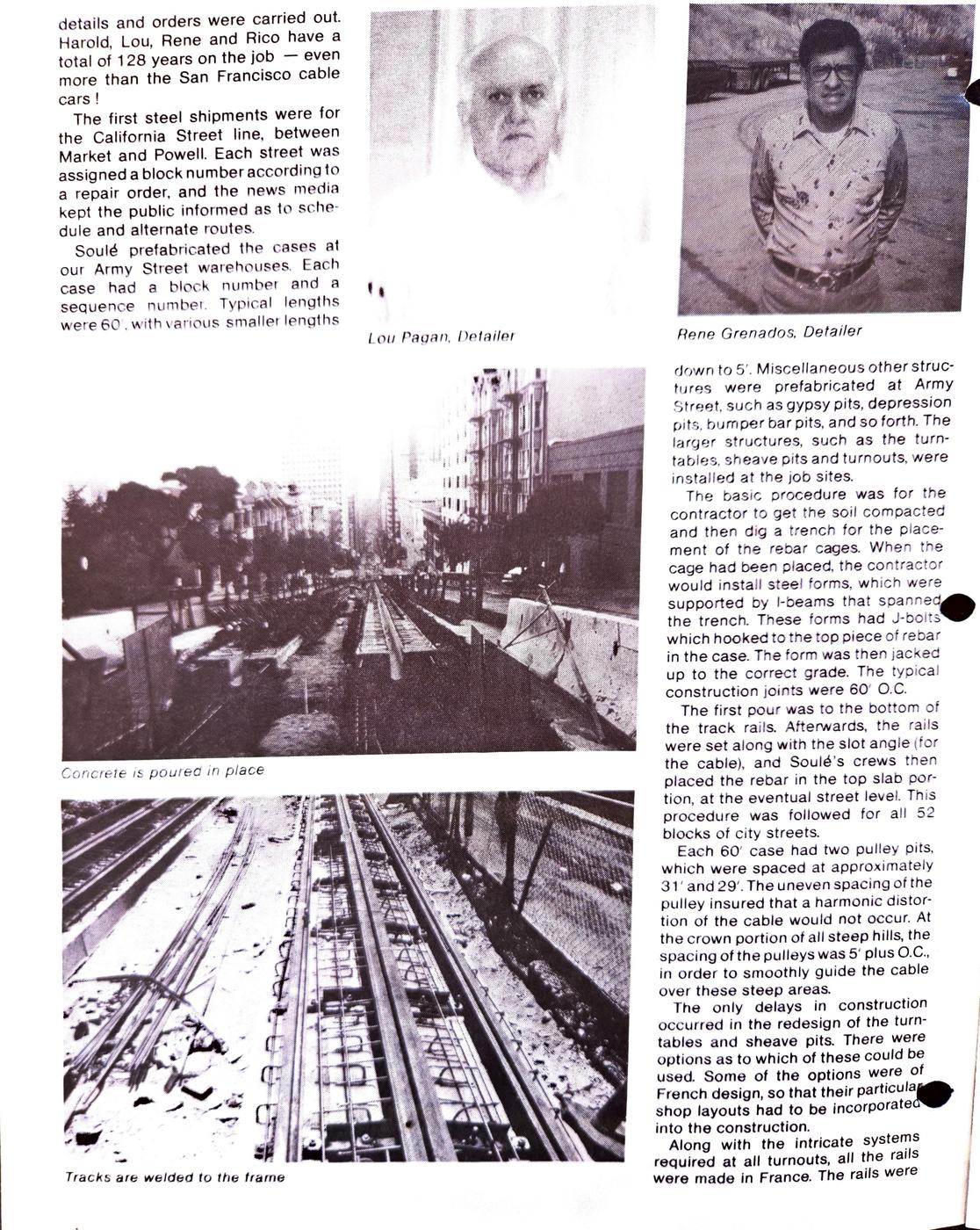
details and orders were carried out. Harold, Lou, Rene and Rico have a total of 128 years on the job — even more than the San Francisco cable cars!
The first steel shipments were for the California Street line, between Market and Powell. Each street was assigned a block number according to a repair order, and the news media kept the public informed as to schedule and alternate routes.
Soulé prefabricated the cages at our Army Street warehouses. Each case had a block number and a sequence number. Typical lengths were 60', with various smaller lengths
*Photo: Lou Pagan, Detailer*
*Photo: Rene Grenados, Detailer*
down to 5'. Miscellaneous other structures were prefabricated at Army Street, such as gypsy pits, depression pits, bumper bar pits, and so forth. The larger structures, such as the turntables, sheave pits and turnouts, were installed at the job sites.
The basic procedure was for the contractor to get the soil compacted and then dig a trench for the placement of the rebar cages. When the cage had been placed, the contractor would install steel forms, which were supported by I-beams that spanned the trench. These forms had J-bolts which hooked to the top piece of rebar in the case. The form was then jacked up to the correct grade. The typical construction joints were 60' O.C.
The first pour was to the bottom of the track rails. Afterwards, the rails were set along with the slot angle (for the cable), and Soulé's crews then placed the rebar in the top slab portion, at the eventual street level. This procedure was followed for all 52 blocks of city streets.
Each 60' case had two pulley pits, which were spaced at approximately 31' and 29'. The uneven spacing of the pulleys insured that a harmonic distortion of the cable would not occur. At the crown portion of all steep hills, the spacing of the pulleys was 5' plus O.C., in order to smoothly guide the cable over these steep areas.
The only delays in construction occurred in the redesign of the turntables and sheave pits. There were options as to which of these could be used. Some of the options were of French design, so that their particular shop layouts had to be incorporated into the construction.
Along with the intricate systems required at all turnouts, all the rails were made in France. The rails were
*Photo: Concrete is poured in place*
*Photo: Tracks are welded to the frame*
Page 3
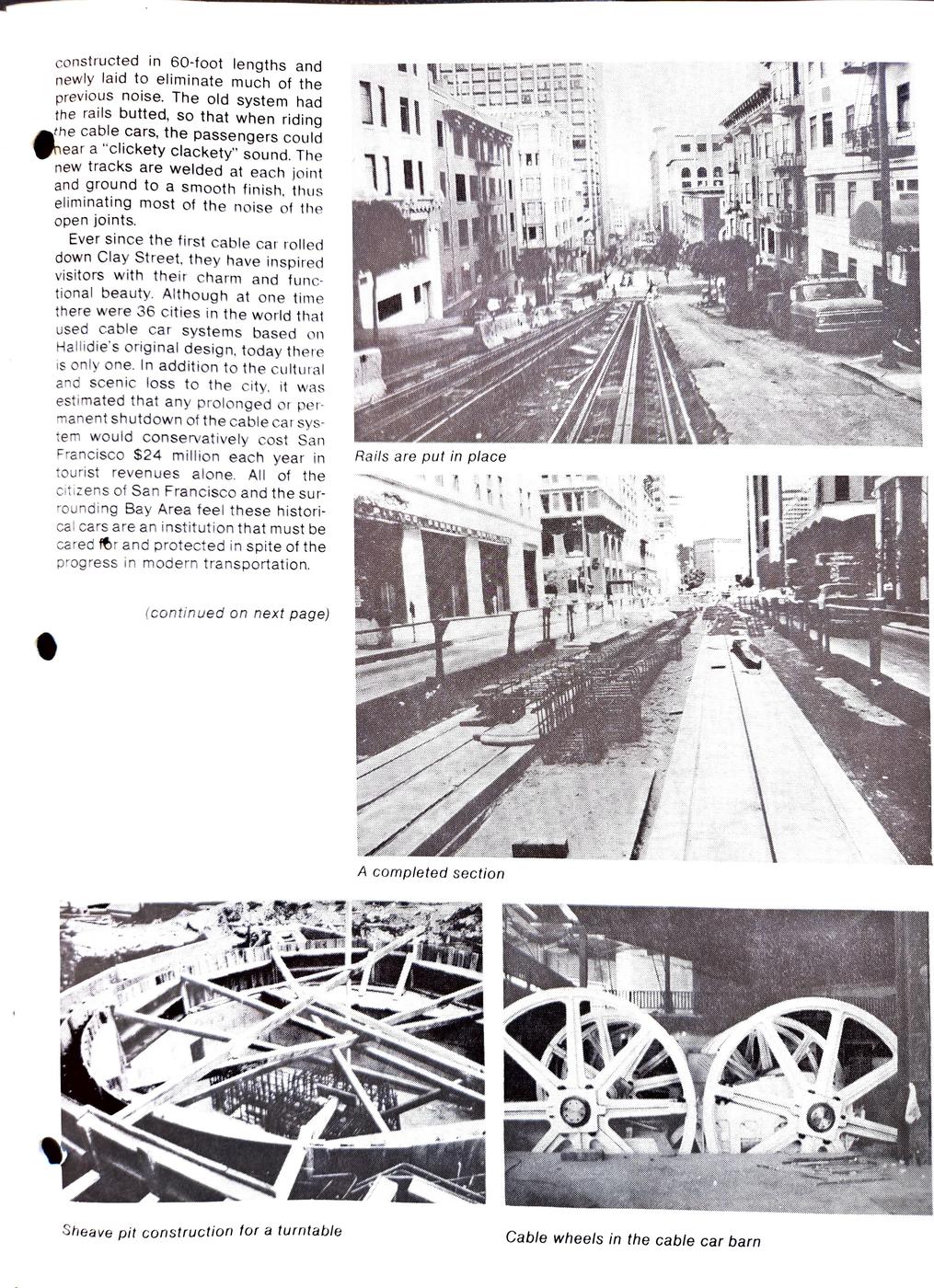
constructed in 60-foot lengths and newly laid to eliminate much of the previous noise. The old system had the rails butted, so that when riding the cable cars, the passengers could hear a "clickety clackety" sound. The new tracks are welded at each joint and ground to a smooth finish, thus eliminating most of the noise of the open joints.
Ever since the first cable car rolled down Clay Street, they have inspired visitors with their charm and functional beauty. Although at one time there were 36 cities in the world that used cable car systems based on Hallidie's original design, today there is only one. In addition to the cultural and scenic loss to the city, it was estimated that any prolonged or permanent shutdown of the cable car system would conservatively cost San Francisco $24 million each year in tourist revenues alone. All of the citizens of San Francisco and the surrounding Bay Area feel these historical cars are an institution that must be cared for and protected in spite of the progress in modern transportation.
(continued on next page)
*Photo: Rails are put in place*
*Photo: A completed section*
*Photo: Sheave pit construction for a turntable*
*Photo: Cable wheels in the cable car barn*
Page 4
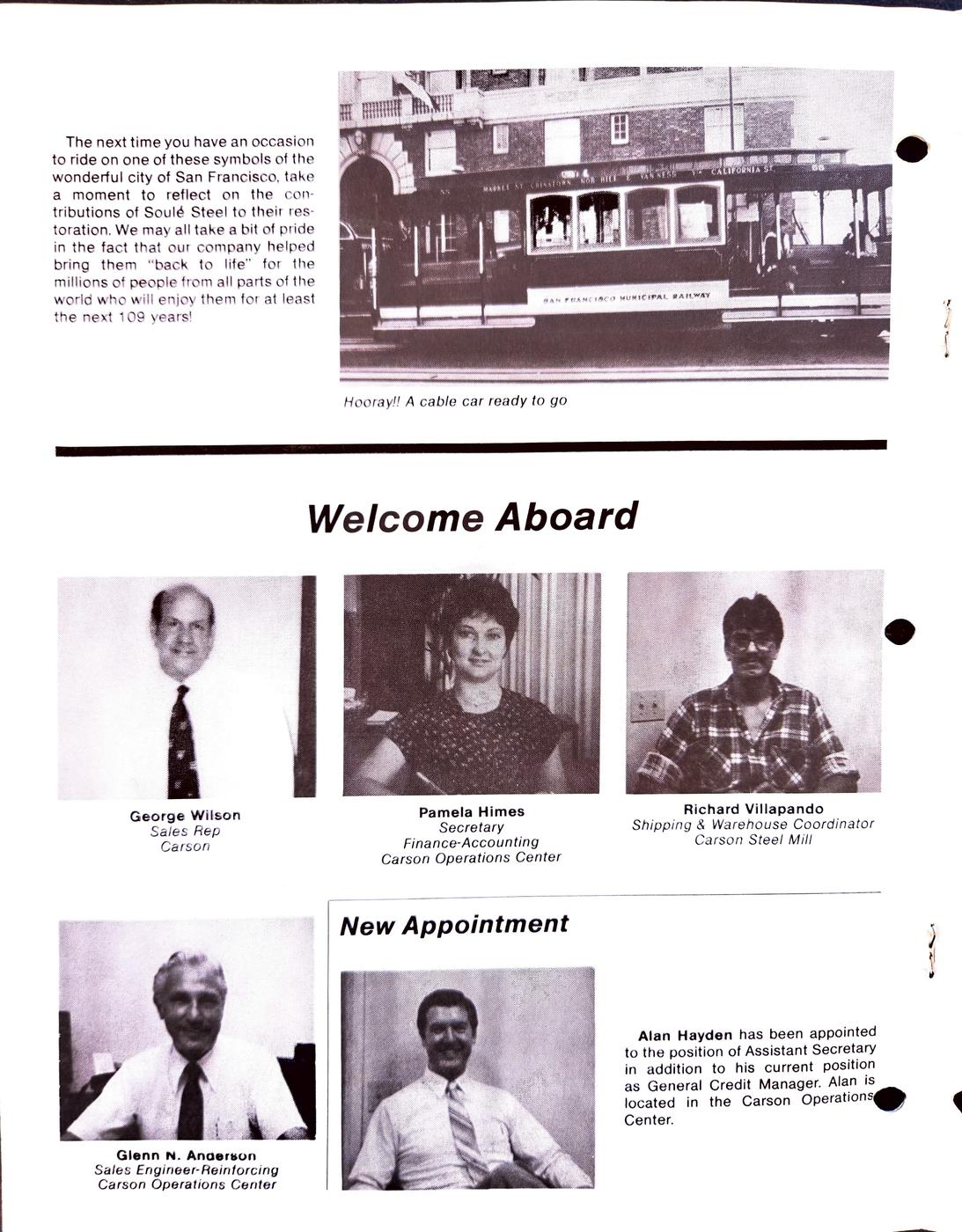
The next time you have an occasion to ride on one of these symbols of the wonderful city of San Francisco, take a moment to reflect on the contributions of Soulé Steel to their restoration. We may all take a bit of pride in the fact that our company helped bring them "back to life" for the millions of people from all parts of the world who will enjoy them for at least the next 109 years!
*Photo: Hooray!! A cable car ready to go*
Welcome Aboard
George Wilson Sales Rep Carson
Pamela Himes Secretary Finance-Accounting Carson Operations Center
Richard Villapando Shipping & Warehouse Coordinator Carson Steel Mill
Glenn N. Anderson Sales Engineer-Reinforcing Carson Operations Center
New Appointment
**Alan Hayden** has been appointed to the position of Assistant Secretary in addition to his current position as General Credit Manager. Alan is located in the Carson Operations Center.
Page 5
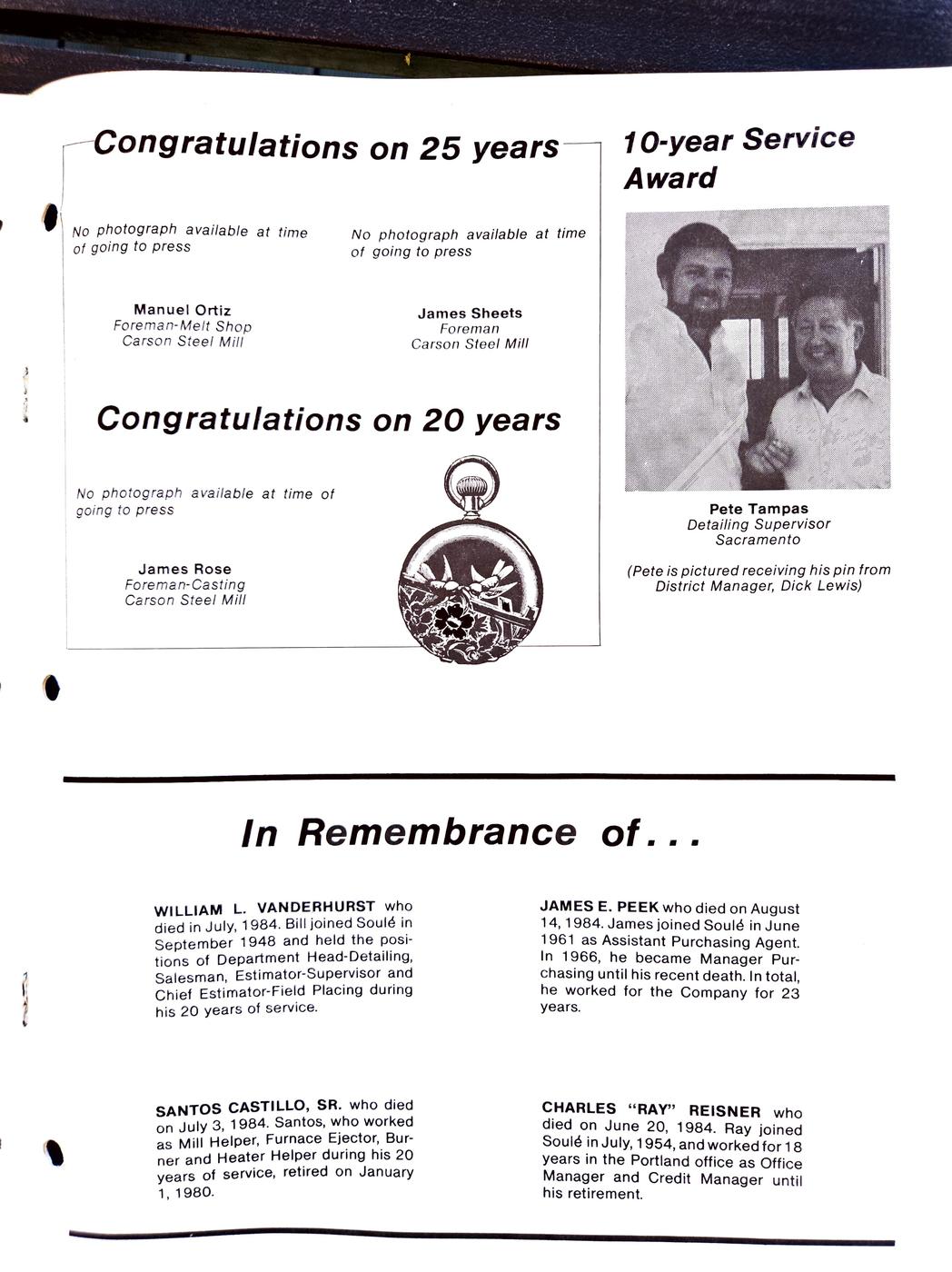
Congratulations on 25 years
*No photograph available at time of going to press*
Manuel Ortiz Foreman-Melt Shop Carson Steel Mill
*No photograph available at time of going to press*
James Sheets Foreman Carson Steel Mill
Congratulations on 20 years
*No photograph available at time of going to press*
James Rose Foreman-Casting Carson Steel Mill
10-year Service Award
Pete Tampas Detailing Supervisor Sacramento
*(Pete is pictured receiving his pin from District Manager, Dick Lewis)*
In Remembrance of...
**WILLIAM L. VANDERHURST** who died in July, 1984. Bill joined Soulé in September 1948 and held the positions of Department Head-Detailing, Salesman, Estimator-Supervisor and Chief Estimator-Field Placing during his 20 years of service.
**JAMES E. PEEK** who died on August 14, 1984. James joined Soulé in June 1961 as Assistant Purchasing Agent. In 1966, he became Manager Purchasing until his recent death. In total, he worked for the Company for 23 years.
**SANTOS CASTILLO, SR.** who died on July 3, 1984. Santos, who worked as Mill Helper, Furnace Ejector, Burner and Heater Helper during his 20 years of service, retired on January 1, 1980.
**CHARLES "RAY" REISNER** who died on June 20, 1984. Ray joined Soulé in July, 1954, and worked for 18 years in the Portland office as Office Manager and Credit Manager until his retirement.
Page 6
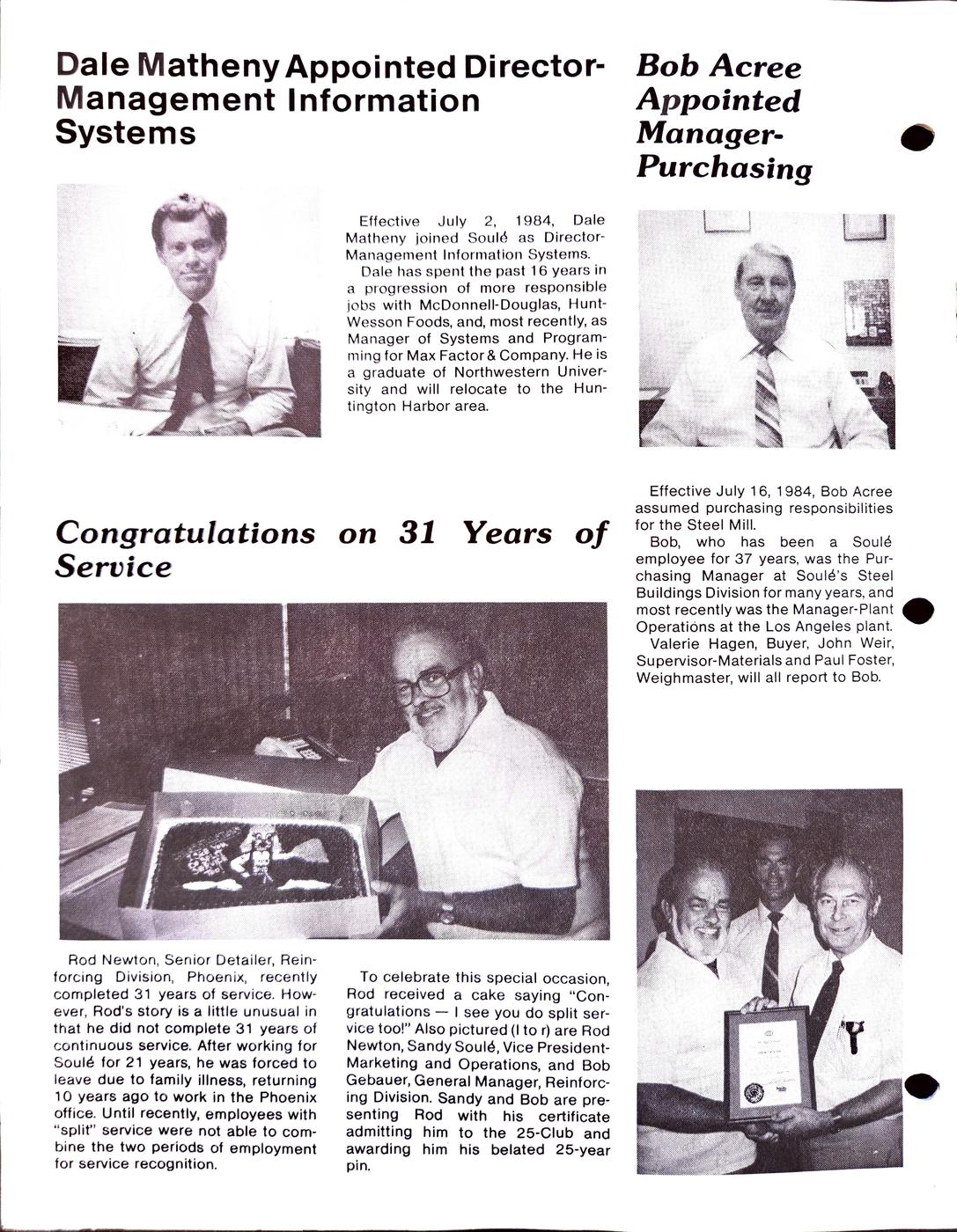
Dale Matheny Appointed Director-Management Information Systems
Effective July 2, 1984, Dale Matheny joined Soulé as Director-Management Information Systems.
Dale has spent the past 16 years in a progression of more responsible jobs with McDonnell-Douglas, Hunt-Wesson Foods, and, most recently, as Manager of Systems and Programming for Max Factor & Company. He is a graduate of Northwestern University and will relocate to the Huntington Harbor area.
Bob Acree Appointed Manager-Purchasing
Effective July 16, 1984, Bob Acree assumed purchasing responsibilities for the Steel Mill.
Bob, who has been a Soulé employee for 37 years, was the Purchasing Manager at Soulé's Steel Buildings Division for many years, and most recently was the Manager-Plant Operations at the Los Angeles plant.
Valerie Hagen, Buyer, John Weir, Supervisor-Materials and Paul Foster, Weighmaster, will all report to Bob.
Congratulations on 31 Years of Service
Rod Newton, Senior Detailer, Reinforcing Division, Phoenix, recently completed 31 years of service. However, Rod's story is a little unusual in that he did not complete 31 years of continuous service. After working for Soulé for 21 years, he was forced to leave due to family illness, returning 10 years ago to work in the Phoenix office. Until recently, employees with "split" service were not able to combine the two periods of employment for service recognition.
To celebrate this special occasion, Rod received a cake saying "Congratulations — I see you do split service too!" Also pictured (l to r) are Rod Newton, Sandy Soulé, Vice President-Marketing and Operations, and Bob Gebauer, General Manager, Reinforcing Division. Sandy and Bob are presenting Rod with his certificate admitting him to the 25-Club and awarding him his belated 25-year pin.
Page 7
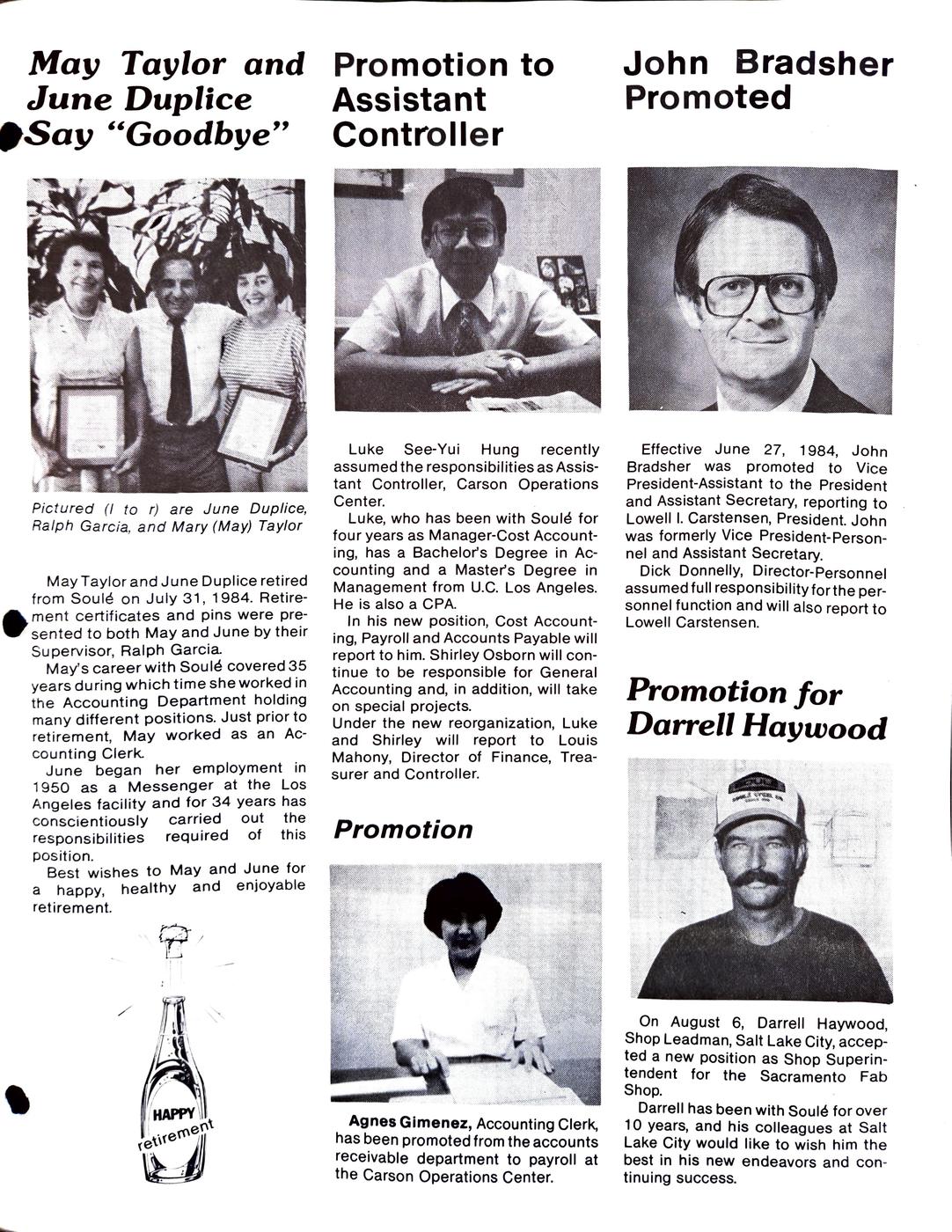
May Taylor and June Duplice Say "Goodbye"
*Photo: Pictured (l to r) are June Duplice, Ralph Garcia, and Mary (May) Taylor*
May Taylor and June Duplice retired from Soulé on July 31, 1984. Retirement certificates and pins were presented to both May and June by their Supervisor, Ralph Garcia.
May's career with Soulé covered 35 years during which time she worked in the Accounting Department holding many different positions. Just prior to retirement, May worked as an Accounting Clerk.
June began her employment in 1950 as a Messenger at the Los Angeles facility and for 34 years has conscientiously carried out the responsibilities required of this position.
Best wishes to May and June for a happy, healthy and enjoyable retirement.
Promotion to Assistant Controller
Luke See-Yui Hung recently assumed the responsibilities as Assistant Controller, Carson Operations Center.
Luke, who has been with Soulé for four years as Manager-Cost Accounting, has a Bachelor's Degree in Accounting and a Master's Degree in Management from U.C. Los Angeles. He is also a CPA.
In his new position, Cost Accounting, Payroll and Accounts Payable will report to him. Shirley Osborn will continue to be responsible for General Accounting and, in addition, will take on special projects.
Under the new reorganization, Luke and Shirley will report to Louis Mahony, Director of Finance, Treasurer and Controller.
Promotion
*Photo: Agnes Gimenez, Accounting Clerk, has been promoted from the accounts receivable department to payroll at the Carson Operations Center.*
John Bradsher Promoted
Effective June 27, 1984, John Bradsher was promoted to Vice President-Assistant to the President and Assistant Secretary, reporting to Lowell I. Carstensen, President. John was formerly Vice President-Personnel and Assistant Secretary.
Dick Donnelly, Director-Personnel assumed full responsibility for the personnel function and will also report to Lowell Carstensen.
Promotion for Darrell Haywood
On August 6, Darrell Haywood, Shop Leadman, Salt Lake City, accepted a new position as Shop Superintendent for the Sacramento Fab Shop.
Darrell has been with Soulé for over 10 years, and his colleagues at Salt Lake City would like to wish him the best in his new endeavors and continuing success.
Page 8
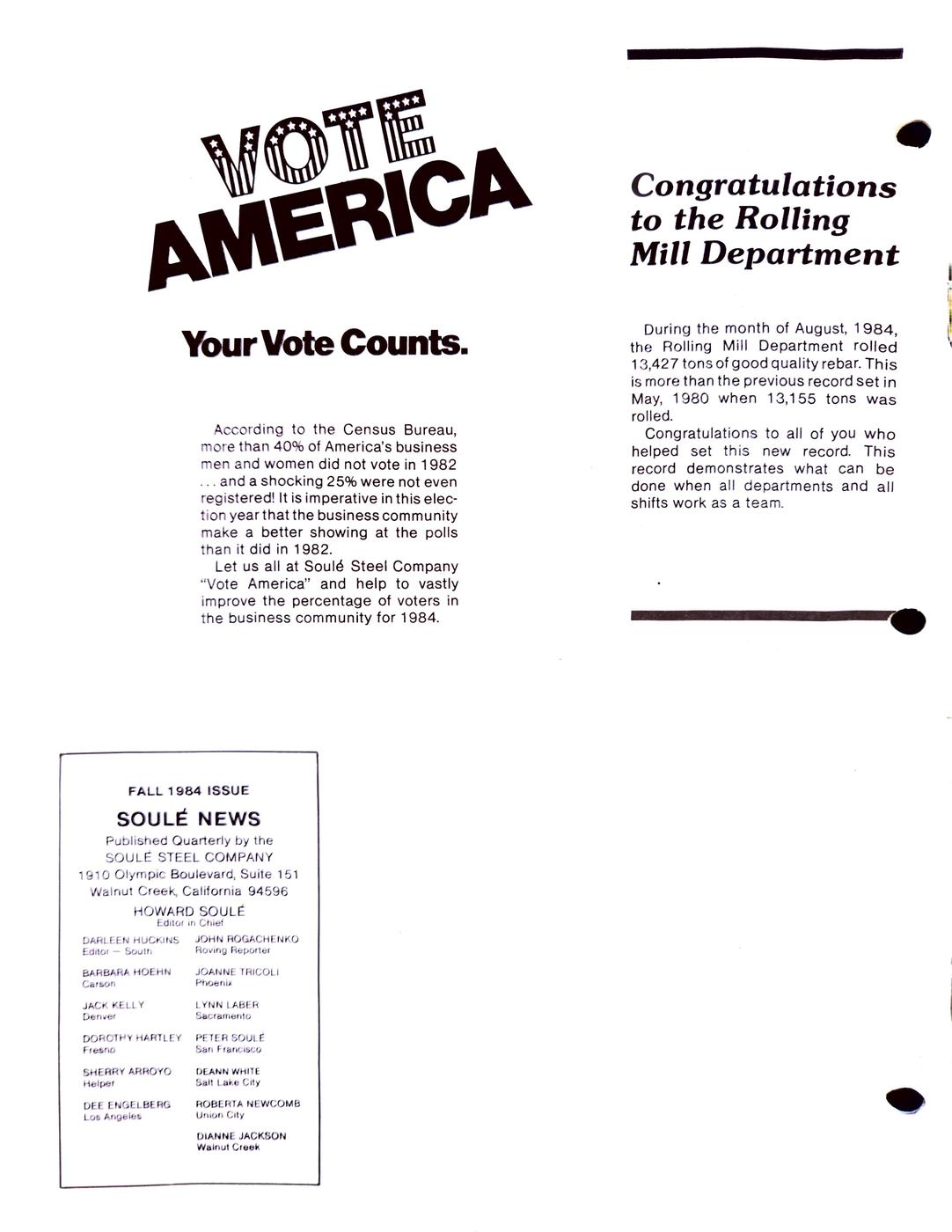
VOTE AMERICA
Your Vote Counts.
According to the Census Bureau, more than 40% of America's business men and women did not vote in 1982 ... and a shocking 25% were not even registered! It is imperative in this election year that the business community make a better showing at the polls than it did in 1982.
Let us all at Soulé Steel Company "Vote America" and help to vastly improve the percentage of voters in the business community for 1984.
Congratulations to the Rolling Mill Department
During the month of August, 1984, the Rolling Mill Department rolled 13,427 tons of good quality rebar. This is more than the previous record set in May, 1980 when 13,155 tons was rolled.
Congratulations to all of you who helped set this new record. This record demonstrates what can be done when all departments and all shifts work as a team.
FALL 1984 ISSUE
**SOULÉ NEWS**
Published Quarterly by the SOULÉ STEEL COMPANY 1910 Olympic Boulevard, Suite 151 Walnut Creek, California 94596
HOWARD SOULÉ — Editor in Chief
DARLEEN HUCKINS — Editor — South JOHN ROGACHENKO — Roving Reporter BARBARA HOERN — Carson JOANNE TRICOLI — Phoenix JACK KELLY — Denver LYNN LABER — Sacramento DOROTHY HARTLEY — Fresno PETER SOULÉ — San Francisco SHERRY ARROYO — Helper DEANN WHITE — Salt Lake City DEE ENGELBERG — Los Angeles ROBERTA NEWCOMB — Union City DIANNE JACKSON — Walnut Creek